Page 189 of 344

Rocking Your Vehicle To Get It Out
First, turn your steering wheel left and right. That will
clear the area around your front wheels. If your vehicle
has traction control, you should turn the system off.
SeeFull-Range Traction Control System on page 4-9or
Traction Control System (TCS) on page 4-10. Then
shift back and forth between REVERSE (R) and
a forward gear, spinning the wheels as little as possible.
Release the accelerator pedal while you shift, and
press lightly on the accelerator pedal when the transaxle
is in gear. By slowly spinning your wheels in the
forward and reverse directions, you will cause a rocking
motion that may free your vehicle. If that doesn’t get
you out after a few tries, you may need to be towed out.
If you do need to be towed out, see“Towing Your
Vehicle”following.
Towing
Towing Your Vehicle
Consult your dealer or a professional towing service if
you need to have your disabled vehicle towed. See
Roadside Assistance Program on page 7-6.
If you want to tow your vehicle behind another vehicle
for recreational purposes (such as behind a motorhome),
see“Recreational Vehicle Towing”following.
Recreational Vehicle Towing
Recreational vehicle towing means towing your vehicle
behind another vehicle–such as behind a motorhome.
The two most common types of recreational vehicle
towing are known as“dinghy towing”(towing your
vehicle with all four wheels on the ground) and“dolly
towing”(towing your vehicle with two wheels on
the ground and two wheels up on a device known as a
“dolly”).
With the proper preparation and equipment, many
vehicles can be towed in these ways. See“Dinghy
Towing”and“Dolly Towing,”following.
4-31
2003 - Regal OM
Page 190 of 344

Here are some important things to consider before you
do recreational vehicle towing:
What’s the towing capacity of the towing vehicle?
Be sure you read the tow vehicle manufacturer’s
recommendations.
How far will you tow? Some vehicles have
restrictions on how far and how long they can tow.
Do you have the proper towing equipment?
See your dealer or trailering professional for
additional advice and equipment recommendations.
Is your vehicle ready to be towed? Just as you
would prepare your vehicle for a long trip, you’ll
want to make sure your vehicle is prepared to be
towed. SeeBefore Leaving on a Long Trip on
page 4-23.
Dinghy Towing
Notice:Towing your vehicle with all four wheels on
the ground will damage drivetrain components.
Your vehicle was not designed to be towed with all four
wheels on the ground. If your vehicle must be towed,
you should use a dolly. See“Dolly Towing”that follows
for more information.
Dolly Towing
Your vehicle can be towed using a dolly. To tow your
vehicle using a dolly, follow these steps:
1. Put the front wheels on a dolly.
2. Put the vehicle in PARK (P).
3. Set the parking brake and then remove the key.
4. Clamp the steering wheel in a straight-ahead
position.
5. Releases the parking brake.
4-32
2003 - Regal OM
Page 197 of 344

Driving with a Trailer
Towing a trailer requires a certain amount of experience.
Before setting out for the open road, you’ll want to get
to know your rig. Acquaint yourself with the feel of
handling and braking with the added weight of the trailer.
And always keep in mind that the vehicle you are
driving is now a good deal longer and not nearly as
responsive as your vehicle is by itself.
Before you start, check the trailer hitch and platform
(and attachments), safety chains, electrical connector,
lamps, tires and mirror adjustment. If the trailer has
electric brakes, start your vehicle and trailer moving and
then apply the trailer brake controller by hand to be
sure the brakes are working. This lets you check your
electrical connection at the same time.
During your trip, check occasionally to be sure that the
load is secure, and that the lamps and any trailer
brakes are still working.
Following Distance
Stay at least twice as far behind the vehicle ahead as
you would when driving your vehicle without a trailer.
This can help you avoid situations that require
heavy braking and sudden turns.
Passing
You’ll need more passing distance up ahead when
you’re towing a trailer. And, because you’re a good deal
longer, you’ll need to go much farther beyond the
passed vehicle before you can return to your lane.
Backing Up
Hold the bottom of the steering wheel with one hand.
Then, to move the trailer to the left, just move that hand
to the left. To move the trailer to the right, move your
hand to the right. Always back up slowly and, if possible,
have someone guide you.
Making Turns
Notice:Making very sharp turns while trailering
could cause the trailer to come in contact with the
vehicle. Your vehicle could be damaged. Avoid
making very sharp turns while trailering.
When you’re turning with a trailer, make wider turns
than normal. Do this so your trailer won’t strike
soft shoulders, curbs, road signs, trees or other objects.
Avoid jerky or sudden maneuvers. Signal well in
advance.
4-39
2003 - Regal OM
Page 201 of 344

Service............................................................5-3
Doing Your Own Service Work.........................5-3
Adding Equipment to the Outside of
Your Vehicle..............................................5-4
Fuel................................................................5-4
Gasoline Octane............................................5-4
Gasoline Specifications....................................5-5
California Fuel...............................................5-5
Additives.......................................................5-5
Fuels in Foreign Countries...............................5-6
Filling Your Tank............................................5-6
Filling a Portable Fuel Container.......................5-8
Checking Things Under the Hood.....................5-8
Hood Release................................................5-9
Engine Compartment Overview.......................5-10
Engine Oil...................................................5-13
Supercharger Oil..........................................5-18
Engine Air Cleaner/Filter................................5-18
Automatic Transaxle Fluid..............................5-20
Engine Coolant.............................................5-22
Radiator Pressure Cap..................................5-25
Engine Overheating.......................................5-25
Cooling System............................................5-28Power Steering Fluid.....................................5-36
Windshield Washer Fluid................................5-38
Brakes........................................................5-39
Battery........................................................5-42
Jump Starting...............................................5-43
Headlamp Aiming...........................................5-48
Bulb Replacement..........................................5-50
Halogen Bulbs..............................................5-50
Headlamps..................................................5-51
Front Turn Signal and Parking Lamps..............5-52
Center High-Mounted
Stoplamp (CHMSL)....................................5-52
Taillamps, Turn Signal, and Stoplamps............5-53
Back-Up Lamps............................................5-54
Replacement Bulbs.......................................5-55
Windshield Wiper Blade Replacement..............5-55
Tires..............................................................5-56
Inflation — Tire Pressure...............................5-57
Tire Pressure Monitor System.........................5-58
Tire Inspection and Rotation...........................5-59
When It Is Time for New Tires.......................5-60
Buying New Tires.........................................5-61
Section 5 Service and Appearance Care
5-1
2003 - Regal OM
Page 209 of 344
{CAUTION:
Things that burn can get on hot engine parts
and start are. These include liquids like fuel,
oil, coolant, brakeuid, windshield washer and
otheruids, and plastic or rubber. You or
others could be burned. Be careful not to drop
or spill things that will burn onto a hot engine.
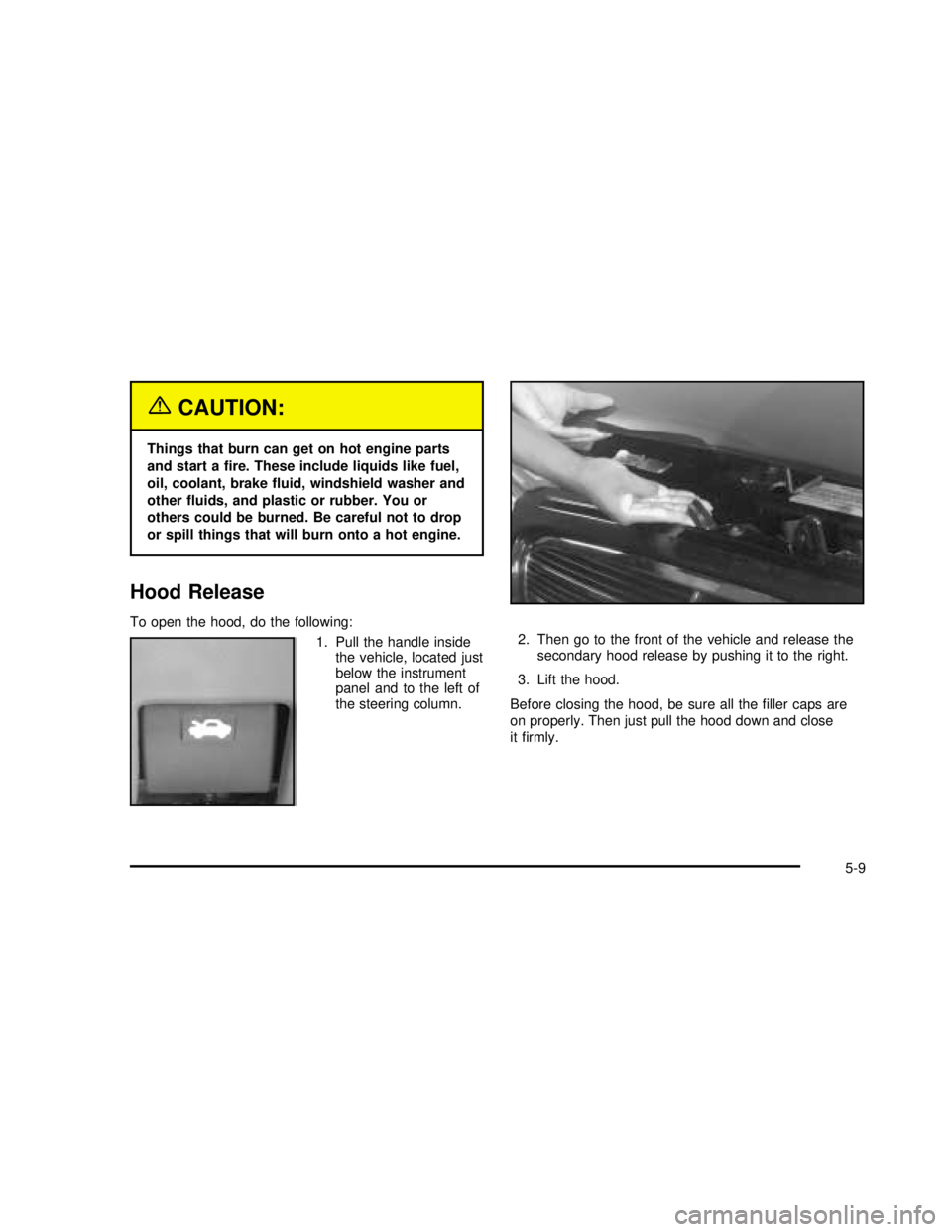
Hood Release
To open the hood, do the following:
1. Pull the handle inside
the vehicle, located just
below the instrument
panel and to the left of
the steering column.2. Then go to the front of the vehicle and release the
secondary hood release by pushing it to the right.
3. Lift the hood.
Before closing the hood, be sure all thefiller caps are
on properly. Then just pull the hood down and close
itfirmly.
5-9
2003 - Regal OM
Page 211 of 344
A. Windshield Washer Fluid Reservoir
B. Battery
C. Remote Positive (+) Battery Terminal
D. Underhood Fuse Block
E. Radiator Pressure Cap
F. Engine Coolant Recovery Tank
G. Power Steering Fluid Reservoir (Below Generator)H. Electric Cooling Fan
I. Engine Oil Dipstick
J. Engine Oil Fill Cap
K. Automatic Transaxle Fluid Dipstick
L. Brake Fluid Reservoir
M. Engine Air Cleaner/Filter
5-11
2003 - Regal OM
Page 213 of 344
A. Windshield Washer Fluid Reservoir
B. Battery
C. Remote Positive (+) Battery Terminal
D. Underhood Electrical Center
E. Radiator Pressure Cap
F. Engine Coolant Recovery Tank
G. Power Steering Fluid Reservoir (Below Generator)
H. Electric Cooling Fan
I. Engine Oil Dipstick
J. Engine Oil Fill Cap
K. Automatic Transaxle Fluid Dipstick
L. Brake Fluid Reservoir
M. Engine Air Cleaner/FilterEngine Oil
Checking Engine Oil
It’s a good idea to check your engine oil every time you
get fuel. In order to get an accurate reading, the oil
must be warm and the vehicle must be on level ground.
The engine oil dipstick handle is the yellow loop located
near the front of the engine compartment. SeeEngine
Compartment Overview on page 5-10for more
information on location.
5-13
2003 - Regal OM
Page 236 of 344
12. Then replace the pressure cap. At any time during
this procedure if coolant begins toflow out of the
filler neck, reinstall the pressure cap. Be sure
the arrow on the pressure cap lines up like this.
13. Check the coolant in the recovery tank. The level in
the coolant recovery tank should be at the HOT
mark when the engine is hot or at the COLD mark
when the engine is cold.
Power Steering Fluid
The power steeringfluid reservoir is located on the
passenger’s side of the vehicle at the back of the engine
compartment, and can be identified by the above
graphic on the cap.
5-36
2003 - Regal OM