Page 74 of 344

Trunk
{CAUTION:
It can be dangerous to drive with the trunk lid
open because carbon monoxide (CO) gas can
come into your vehicle. You can’t see or smell
CO. It can cause unconsciousness and even
death. If you must drive with the trunk lid open
or if electrical wiring or other cable
connections must pass through the seal
between the body and the trunk lid:
Make sure all other windows are shut.
Turn the fan on your heating or cooling
system to its highest speed and select the
control setting that will force outside air
into your vehicle. See“Climate Controls”
in the Index.
If you have air outlets on or under the
instrument panel, open them all the way.
See“Engine Exhaust”in the Index.
Trunk Lock
To unlock the trunk from the outside, insert the door key
and turn it. You can also press the trunk symbol on
your remote keyless entry transmitter.
Remote Trunk Release
Press the button located
inside of the glove box
door to release the trunk
from inside the vehicle.
The shift lever must be in
PARK (P) for the remote
trunk release button
to work.
2-12
2003 - Regal OM
Page 75 of 344
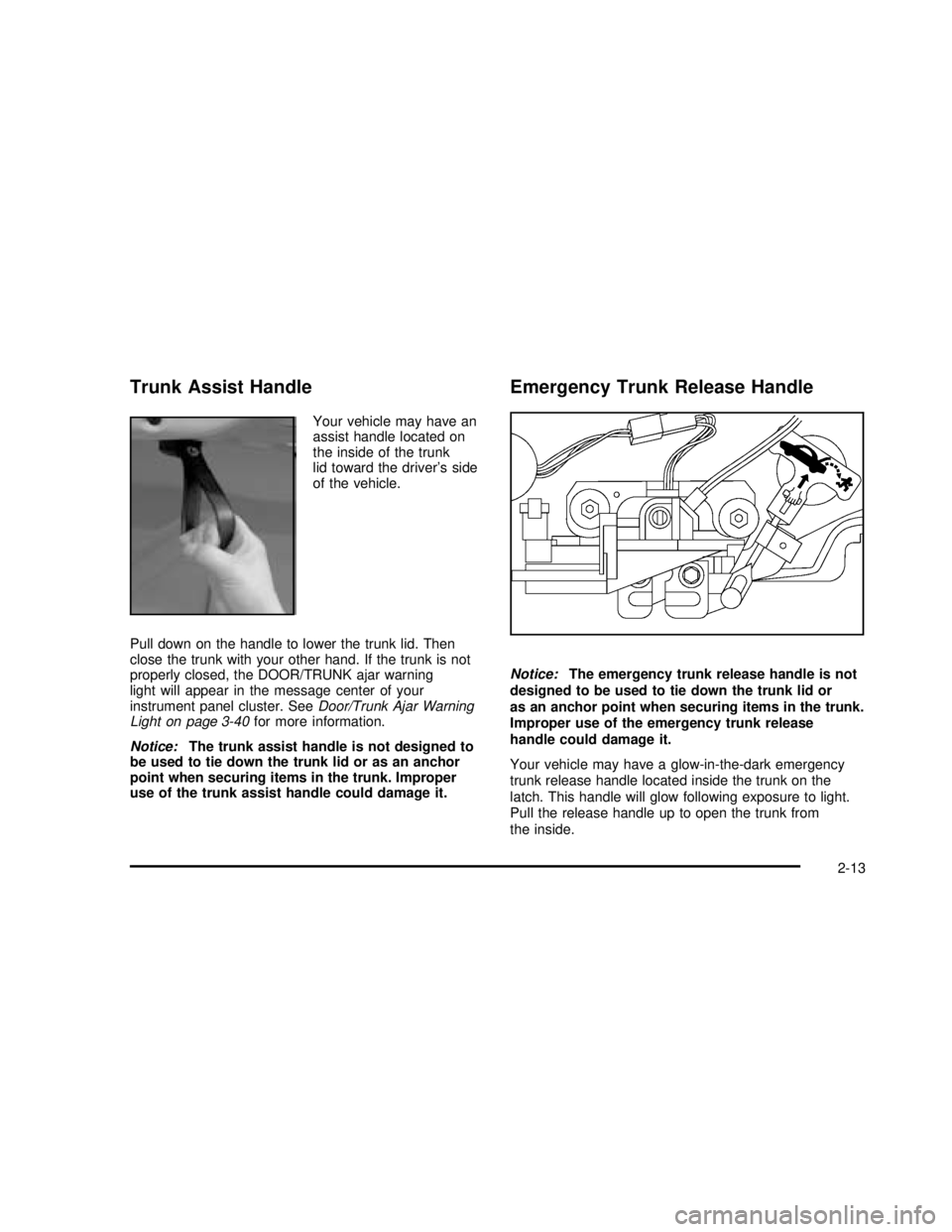
Trunk Assist Handle
Your vehicle may have an
assist handle located on
the inside of the trunk
lid toward the driver’s side
of the vehicle.
Pull down on the handle to lower the trunk lid. Then
close the trunk with your other hand. If the trunk is not
properly closed, the DOOR/TRUNK ajar warning
light will appear in the message center of your
instrument panel cluster. SeeDoor/Trunk Ajar Warning
Light on page 3-40for more information.
Notice:The trunk assist handle is not designed to
be used to tie down the trunk lid or as an anchor
point when securing items in the trunk. Improper
use of the trunk assist handle could damage it.
Emergency Trunk Release Handle
Notice:The emergency trunk release handle is not
designed to be used to tie down the trunk lid or
as an anchor point when securing items in the trunk.
Improper use of the emergency trunk release
handle could damage it.
Your vehicle may have a glow-in-the-dark emergency
trunk release handle located inside the trunk on the
latch. This handle will glow following exposure to light.
Pull the release handle up to open the trunk from
the inside.
2-13
2003 - Regal OM
Page 78 of 344

Theft-Deterrent Systems
Vehicle theft is big business, especially in some cities.
Although your vehicle has a number of theft-deterrent
features, we know that nothing we put on it can make it
impossible to steal. However, there are ways you
can help.
PASS-Key®II
Your vehicle is equipped
with the PASS-Key®II
(Personalized Automotive
Security System)
theft-deterrent system.
PASS-Key
®II is a passive
theft-deterrent system.
It works when you insert or
remove the key from the
ignition.
PASS-Key
®II uses a resistor pellet in the ignition key
that matches a decoder in your vehicle.When the PASS-Key
®II system senses that someone is
using the wrong key, it shuts down the vehicle’s
starter and fuel systems. For about three minutes, the
starter won’t work and fuel won’t go to the engine.
If someone tries to start your vehicle again or uses
another key during this time, the vehicle will not start.
This discourages someone from randomly trying different
keys with different resistor pellets in an attempt to
make a match.
The ignition key must be clean and dry before it’s
inserted in the ignition or the engine may not start. If the
engine does not start and the SECURITY warning
light on the instrument panel isflashing, the key may be
dirty or wet. Turn the ignition off.
Clean and dry the key. Wait about three minutes and try
again. If the starter still won’t work, and the key
appears to be clean and dry, wait about three minutes
and try another ignition key. At this time, you may
also want to check the fuse. SeeFuses and Circuit
Breakers on page 5-87. If the starter won’t work with the
other key, your vehicle needs service. If your vehicle
does start, thefirst ignition key may be faulty. See your
dealer or a locksmith who can service the PASS-Key
®II.
2-16
2003 - Regal OM
Page 79 of 344

If you accidentally use a key that has a damaged or
missing resistor pellet, the starter won’t work. The
SECURITY warning light on the instrument panel will
then come on. But you don’t have to wait three minutes
before trying another ignition key.
See your dealer or a locksmith who can service the
PASS-Key
®II to have a new key made.
If you’re ever driving and the SECURITY warning light
comes on, you will be able to restart your engine if
you turn it off. Your PASS-Key
®II system, however, is
not working properly and must be serviced by your
dealer. Your vehicle is not protected by the
PASS-Key
®II system.
If you lose or damage a PASS-Key
®II ignition key, see
your dealer or a locksmith who can service
PASS-Key
®II to have a new key made. Also, see
Roadside Assistance Program on page 7-6for more
information.
Starting and Operating Your
Vehicle
New Vehicle Break-In
Notice:Your vehicle doesn’t need an elaborate
“break-in.”But it will perform better in the long run
if you follow these guidelines:
Don’t drive at any one speed—fast or
slow—for the first 500 miles (805 km). Don’t
make full-throttle starts.
•Avoid making hard stops for the first 200 miles
(322 km) or so. During this time your new
brake linings aren’t yet broken in. Hard stops
with new linings can mean premature wear and
earlier replacement. Follow this breaking-in
guideline every time you get new brake linings.
•Don’t tow a trailer during break-in. See “Towing
a Trailer” in the Index for more information.
2-17
2003 - Regal OM
Page 83 of 344
How long should you keep the coolant heater plugged
in? The answer depends on the outside temperature, the
kind of oil you have, and some other things. Instead
of trying to list everything here, we ask that you contact
your dealer in the area where you’ll be parking your
vehicle. The dealer can give you the best advice for that
particular area.
Automatic Transaxle Operation
Your automatic transaxle
will have a shift lever on
the console between
the seats.The graphic shown above is displayed on your
instrument panel cluster and will indicate the gear your
vehicle is in when you move.
Maximum engine speed is limited on automatic transaxle
vehicles when you’re in PARK (P) or NEUTRAL (N) to
protect driveline components from improper operation.
2-21
2003 - Regal OM
Page 99 of 344

Instrument Panel Overview...............................3-2
Hazard Warning Flashers................................3-4
Other Warning Devices...................................3-4
Horn .............................................................3-5
Tilt Wheel.....................................................3-5
Turn Signal/Multifunction Lever.........................3-5
Exterior Lamps.............................................3-10
Interior Lamps..............................................3-13
Accessory Power Outlets...............................3-15
Auxiliary Power Connection (Power Drop).........3-16
Ashtrays and Cigarette Lighter........................3-17
Climate Controls............................................3-17
Dual Climate Control System..........................3-17
Dual Automatic Climate Control System...........3-20
Outlet Adjutment...........................................3-24
Passenger Compartment Air Filter...................3-24
Warning Lights, Gages and Indicators.............3-26
Instrument Panel Cluster................................3-27
Speedometer and Odometer...........................3-28
Tachometer.................................................3-29
Safety Belt Reminder Light.............................3-29
Air Bag Readiness Light................................3-30
Charging System Light..................................3-31
Brake System Warning Light..........................3-31
Anti-Lock Brake System Warning Light.............3-32
Traction Control System (TCS) Warning Light . . .3-33
Low Traction Light
........................................3-33Engine Coolant Temperature Warning Light......3-34
Engine Coolant Temperature Gage..................3-34
Tire Pressure Light.......................................3-35
Malfunction Indicator Lamp.............................3-35
Oil Pressure Light.........................................3-38
Low Oil Level Light.......................................3-39
Change Engine Oil Light................................3-39
Security Light...............................................3-40
Cruise Control Light......................................3-40
Low Washer Fluid Warning Light.....................3-40
Door/Trunk Ajar Warning Light........................3-40
Service Vehicle Soon Light............................3-41
Fuel Gage...................................................3-41
Low Fuel Warning Light.................................3-42
Driver Information Center (DIC).......................3-42
Audio System(s).............................................3-44
Setting the Time...........................................3-45
Radio with Cassette......................................3-45
Radio with Cassette and CD..........................3-49
Theft-Deterrent Feature..................................3-55
Audio Steering Wheel Controls.......................3-57
Understanding Radio Reception......................3-57
Care of Your Cassette Tape Player.................3-58
Care of Your CDs.........................................3-59
Care of Your CD Player................................3-59
Backglass Antenna.......................................3-59
Section 3 Instrument Panel
3-1
2003 - Regal OM
Page 100 of 344
Instrument Panel Overview
3-2
2003 - Regal OM
Page 101 of 344
The main components of the instrument panel are the following:
A. Exterior Lamps Control
B. Turn Signal/Multifunction Lever
C. Instrument Panel Cluster
D. Audio Steering Wheel Controls
E. Air Outlets
F. Side Window Defogger Outlet
G. Hood ReleaseH. Tilt Wheel Lever
I. Horn
J. Audio System
K. Ashtray
L. Climate Control
M. Glove Box
N. Instrument Panel Fuse Block
3-3
2003 - Regal OM