Page 44 of 380
Once you have the top strap anchored, you'll be ready
to secure the child restraint itself. Tighten the top
strap when and as the child restraint manufacturer's
instructions say.
Top Strap Anchor Location
Your vehicle has top strap anchors already installed for
the rear seating positions. You'll ®nd them behind
the rear seat on the ®ller panel.
In order to get to a bracket, you'll have to open the
trim cover.
Lower Anchorages and Top Tethers
for Children (LATCH System)
Your vehicle has the LATCH system. You'll ®nd
anchors (A) in all three rear seat positions.
To assist you in locating
the lower anchors for this
child restraint system,
each seating position with
the LATCH system will
have a label sewn into the
seatback at each anchor
point.
1-38
Page 45 of 380
In order to use the system, you need either a
forward-facing child restraint that has attaching
points (B) at its base and a top tether anchor (C), or a
rear-facing child restraint that has attaching points (B),
as shown here.
1-39
Page 46 of 380

With this system, use the LATCH system instead of the
vehicle's safety belts to secure a child restraint.
{CAUTION:
If a LATCH-type child restraint isn't attached to
its anchorage points, the restraint won't be
able to protect the child correctly. In a crash,
the child could be seriously injured or killed.
Make sure that a LATCH-type child restraint is
properly installed using the anchorage points,
or use the vehicle's safety belts to secure the
restraint. See ªSecuring a Child Restraint
Designed for the LATCH Systemº or ªSecuring
a Child Restraint in a Rear Seat Positionº in
the Index for information on how to secure a
child restraint in your vehicle.
Securing a Child Restraint Designed
for the LATCH System
1. Find the anchors for the seating position you want
to use, where the bottom of the seatback meets the
back of the seat cushion.
2. Put the child restraint on the seat.
3. Attach the anchor points on the child restraint to the
anchors in the vehicle. The child restraint
instructions will show you how.
4. If the child restraint is forward-facing, attach the top
strap to the top strap anchor. See
Top Strap on
page 1-37. Tighten the top strap according to
the child restraint instructions.
5. Push and pull the child restraint in different
directions to be sure it is secure.
To remove the child restraint, simply unhook the top
strap from the top tether anchor and then disconnect the
anchor points.
1-40
Page 47 of 380

Securing a Child Restraint in a Rear
Seat Position
If your child restraint is equipped with the LATCH
system, seeLower Anchorages and Top Tethers for
Children (LATCH System) on page 1-38.
{CAUTION:
A child in a child restraint in the center front
seat can be badly injured or killed by the right
front passenger's air bag if it in¯ates. Never
secure a child restraint in the center front seat.
It is always better to secure a child restraint in
the rear seat.
CAUTION: (Continued)
CAUTION: (Continued)
If you secure a forward-facing child restraint in
the right front passenger seat, move the front
passenger seat as far back as it will go. It is
better to secure the child restraint in a rear seat.
You'll be using the lap-shoulder belt. See the earlier
part about the top strap if the child restraint has one. Be
sure to follow the instructions that came with the child
restraint. Secure the child in the child restraint when and
as the instructions say.
1. Put the restraint on the seat.
2. Pick up the latch plate, and run the lap and shoulder
portions of the vehicle's safety belt through or
around the restraint. The child restraint instructions
will show you how.
1-41
Page 49 of 380

4. To tighten the belt, pull up on the shoulder belt
while you push down on the child restraint. If
you're using a forward-facing child restraint, you
may ®nd it helpful to use your knee to push down on
the child restraint as you tighten the belt.
5. Push and pull the child restraint in different
directions to be sure it is secure.
To remove the child restraint, just unbuckle the vehicle's
safety belt and let it go back all the way. The safety
belt will move freely again and be ready to work for an
adult or larger child passenger.
Securing a Child Restraint in the
Right Front Seat Position
Your vehicle has a right front passenger air bag.Neverput a rear facing child restraint in this seat. Here's why:
{CAUTION:
A child in a rear-facing child restraint can be
seriously injured or killed if the right front
passenger's air bag in¯ates. This is because
the back of the rear-facing child restraint
would be very close to the in¯ating air bag.
Always secure a rear-facing child restraint in a
rear seat.
1-43
Page 50 of 380
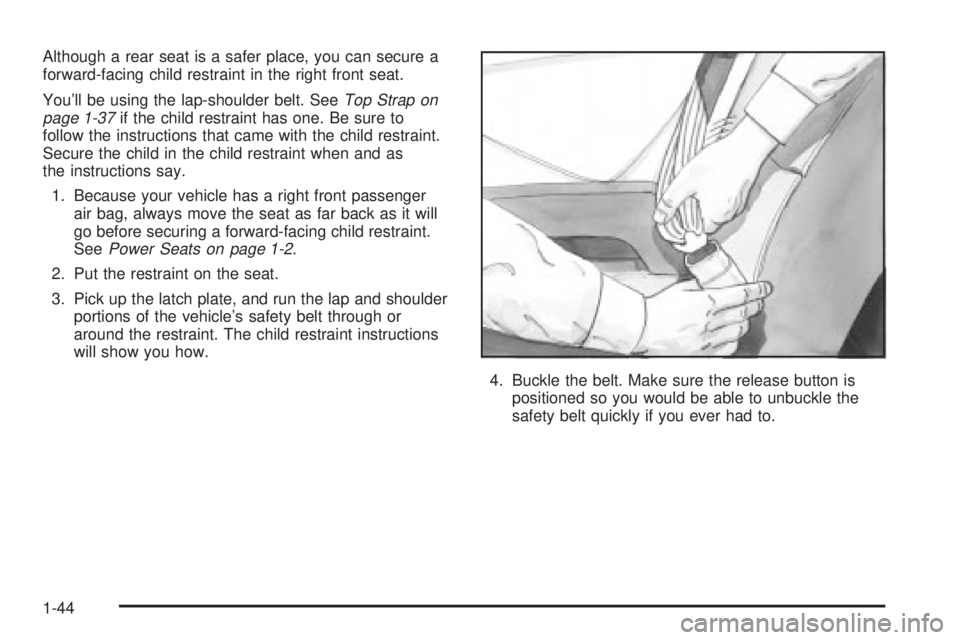
Although a rear seat is a safer place, you can secure a
forward-facing child restraint in the right front seat.
You'll be using the lap-shoulder belt. See
Top Strap on
page 1-37if the child restraint has one. Be sure to
follow the instructions that came with the child restraint.
Secure the child in the child restraint when and as
the instructions say.
1. Because your vehicle has a right front passenger
air bag, always move the seat as far back as it will
go before securing a forward-facing child restraint.
See
Power Seats on page 1-2.
2. Put the restraint on the seat.
3. Pick up the latch plate, and run the lap and shoulder
portions of the vehicle's safety belt through or
around the restraint. The child restraint instructions
will show you how.
4. Buckle the belt. Make sure the release button is
positioned so you would be able to unbuckle the
safety belt quickly if you ever had to.
1-44
Page 51 of 380
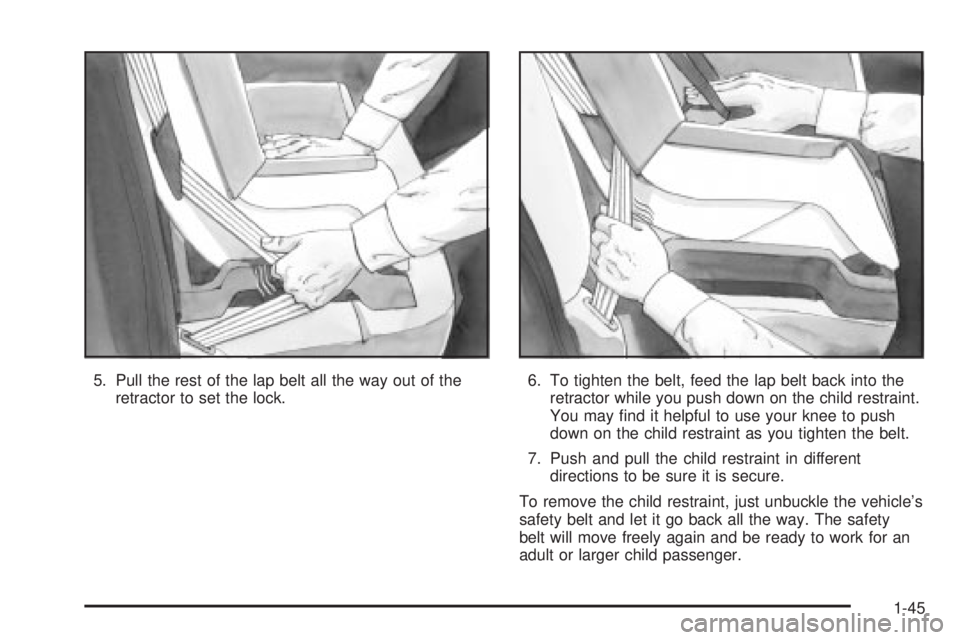
5. Pull the rest of the lap belt all the way out of the
retractor to set the lock.6. To tighten the belt, feed the lap belt back into the
retractor while you push down on the child restraint.
You may ®nd it helpful to use your knee to push
down on the child restraint as you tighten the belt.
7. Push and pull the child restraint in different
directions to be sure it is secure.
To remove the child restraint, just unbuckle the vehicle's
safety belt and let it go back all the way. The safety
belt will move freely again and be ready to work for an
adult or larger child passenger.
1-45
Page 54 of 380
{CAUTION:
Anyone who is up against, or very close to,
any air bag when it in¯ates can be seriously
injured or killed. Air bags plus lap-shoulder
belts offer the best protection for adults, but
not for young children and infants. Neither the
vehicle's safety belt system nor its air bag
system is designed for them. Young children
and infants need the protection that a child
restraint system can provide. Always secure
children properly in your vehicle. To read how,
see the part of this manual called ªOlder
Childrenº or ªInfants and Young Children.ºThere is an air bag
readiness light on the
instrument panel, which
shows AIR BAG.
The system checks the air bag electrical system for
malfunctions. The light tells you if there is an electrical
problem. See
Air Bag Readiness Light on page 3-36.
1-48