Page 35 of 48
35
M54engMS43/ST036/6/20000
The dual VANOS in conjunction with the variable intake manifold provides an additional
emission control feature.
Because of the improved combustion, the camshaft timing is adjusted for more overlap.
The increased overlap supports internal exhaust gas recirculation (EGR) which reduces
tailpipe emissions and lowers fuel consumption.
During the part load engine range, the intake camshaft overlap opens the intake valve. This
allows limited exhaust gas reflow the intake manifold.
The “internal” EGR reduces the cylinder temperature thus lowering NOx. This feature pro-
vides EGR without the external hardware as seen on previous systems.
INLET
TURBULENCE
IDLE AIR
CONTROL VALVEMDK
INT. EGR
CATALYST
CLOSE TO
ENGINESECONDARY
AIR
INJECTION
(AIR FILTER)OUTLET-VANOS
(228/80-105)INLET-VANOS
(228/80-120)
Page 40 of 48
40
M54engMS43/ST036/6/2000
RZV IGNITION SYSTEM
The Siemens MS43.0 system uses a multiple spark ignition function. The purpose of mul-
tiple ignition is:
• Provide clean burning during engine start up and while idling (reducing emissions).
• This function helps to keep the spark plugs clean for longer service life (new BMW
longlife plugs).
Multiple ignition is active up to an engine speed of approximately 1350 RPM (varied with
engine temperature) and up to 20 degrees after TDC.
Multiple ignition is dependent on battery voltage. When the voltage is low, the primary cur-
rent is also lower and a longer period of time is required to build up the magnetic field in the
coil(s).
• Low battery voltage = less multiple ignitions
• High battery voltage = more multiple ignitions
The 240 ohm shunt resistor is still used on the MS43.0 system for detecting secondary igni-
tion faults and diagnostic purposes.
MS 43.0
Page 46 of 48
46
M54engMS43/ST036/6/2000
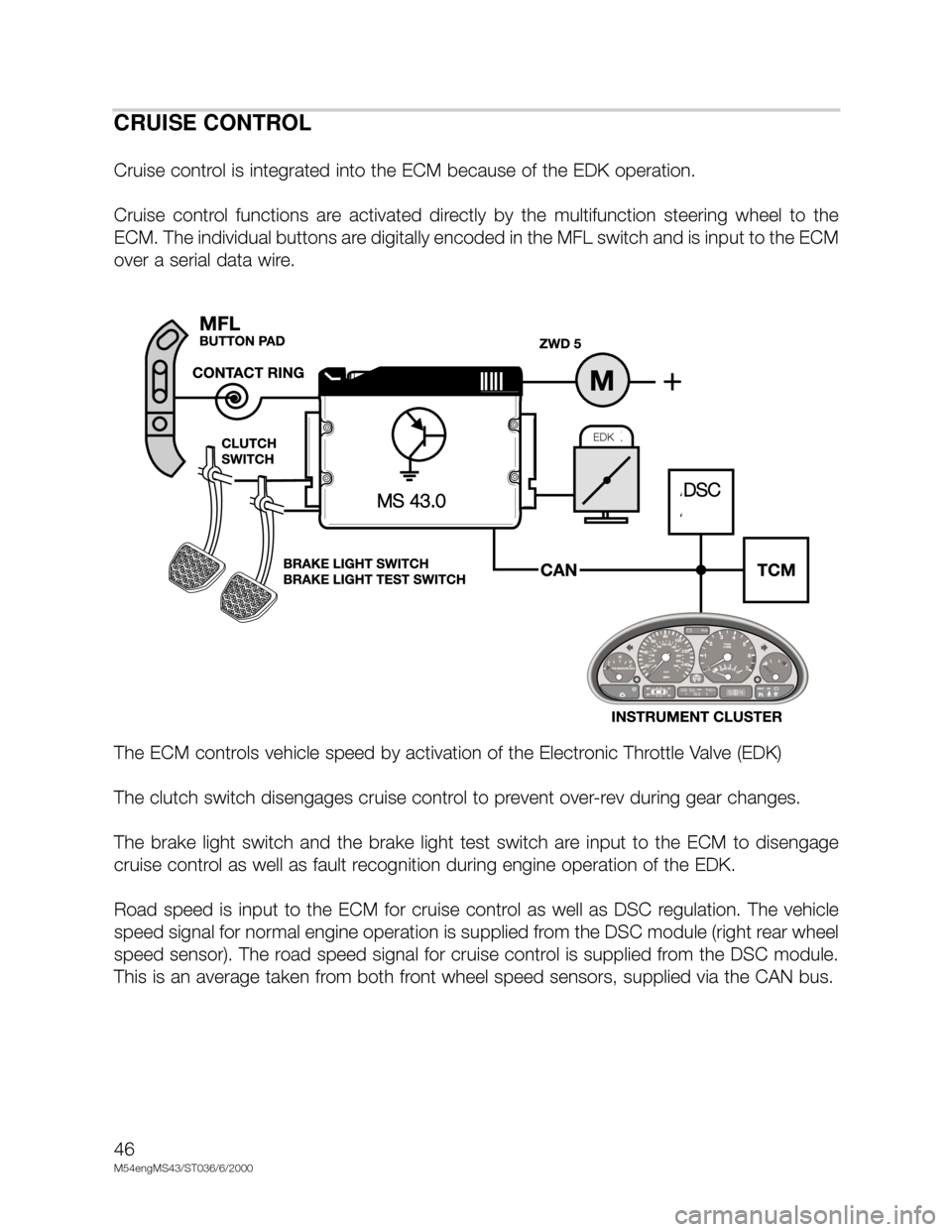
CRUISE CONTROL
Cruise control is integrated into the ECM because of the EDK operation.
Cruise control functions are activated directly by the multifunction steering wheel to the
ECM. The individual buttons are digitally encoded in the MFL switch and is input to the ECM
over a serial data wire.
The ECM controls vehicle speed by activation of the Electronic Throttle Valve (EDK)
The clutch switch disengages cruise control to prevent over-rev during gear changes.
The brake light switch and the brake light test switch are input to the ECM to disengage
cruise control as well as fault recognition during engine operation of the EDK.
Road speed is input to the ECM for cruise control as well as DSC regulation. The vehicle
speed signal for normal engine operation is supplied from the DSC module (right rear wheel
speed sensor). The road speed signal for cruise control is supplied from the DSC module.
This is an average taken from both front wheel speed sensors, supplied via the CAN bus.
DSCMS 43.0
EDK

