2003 BMW X5 4.4I tow
[x] Cancel search: towPage 113 of 183

113n
OverviewControlsMaintenanceRepairsDataIndex
BMW Universal TransmitterChecking for the conversion code To determine whether the original
hand-held transmitter is provided with
a conversion-code system, you may
either read the instructions for the orig-
inal hand-held transmitter or program a
channel key as described on the next
page Ð left-hand column under
Programming.
Then press and hold the programmed
channel key of the BMW Universal
Transmitter. If the indicator lamp of the
BMW Universal Transmitter flashes for
two seconds and then comes on
steadily, the original hand-held trans-
mitter is provided with a conversion-
code system. With a conversion-code
system, program the channel keys as
described on the next page Ð right-hand
column under Programming a hand-
held transmitter with conversion code.
If you have additional questions,
please consult your BMW Sports
Activity Vehicle center or call
1-800-355-3515.
You can also visit this website:
www.bmwusa.com.<
Programming 1 Channel keys
2 Indicator lamp
3 Receiver for programming
Read and comply with the safety
precautions on the previous
page.<
1. Turn the ignition key to position 2
2. For initial use:
Press and hold both outside keys 1
until the indicator lamp 2 flashes, and
then release them. The three channel
keys are cleared 530us136
3. Hold the original hand-held trans-
mitter toward the receiver 3 a
maximum of 2 in/5 cm away
4. Press the transmission key of the
original hand-held transmitter, refer
to arrow 2, and the desired channel
key of the Integrated BMW Universal
Transmitter, refer to arrow 1, simulta-
neously. Release both keys as soon
as the indicator lamp flashes rapidly
5. To program other original hand-held
transmitters, repeat steps 3 and 4.
The corresponding channel key is now
programmed with the signal of the orig-
inal hand-held transmitter. 530us137
Page 122 of 183
122n
Cargo area Partition net
*
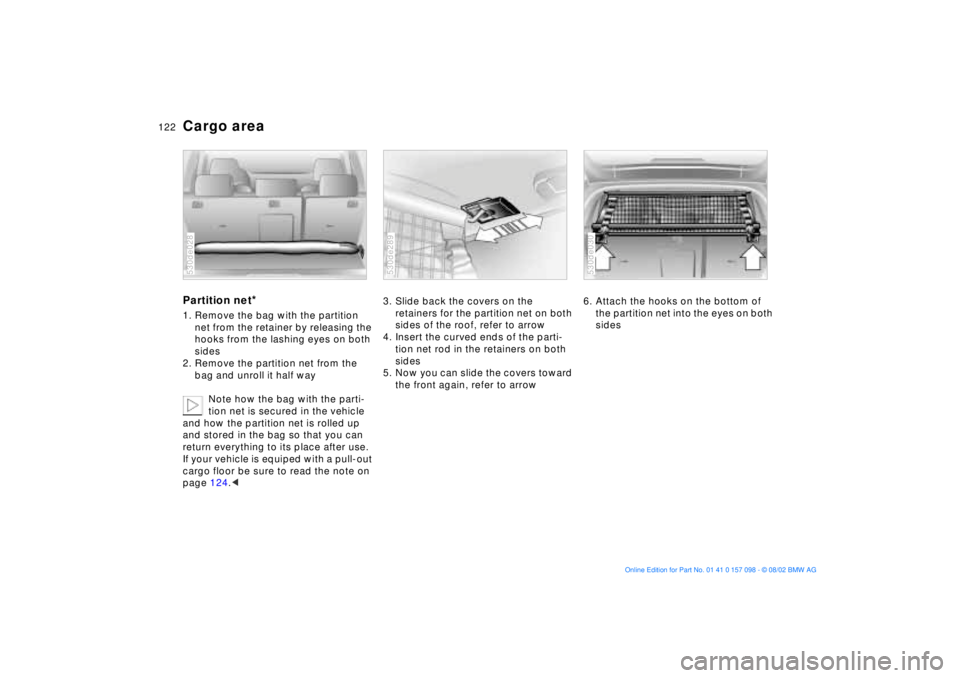
1. Remove the bag with the partition
net from the retainer by releasing the
hooks from the lashing eyes on both
sides
2. Remove the partition net from the
bag and unroll it half way
Note how the bag with the parti-
tion net is secured in the vehicle
and how the partition net is rolled up
and stored in the bag so that you can
return everything to its place after use.
If your vehicle is equiped with a pull-out
cargo floor be sure to read the note on
page 124.< 530de028
3. Slide back the covers on the
retainers for the partition net on both
sides of the roof, refer to arrow
4. Insert the curved ends of the parti-
tion net rod in the retainers on both
sides
5. Now you can slide the covers toward
the front again, refer to arrow 530de289
6. Attach the hooks on the bottom of
the partition net into the eyes on both
sides 530de030
Page 126 of 183
126n
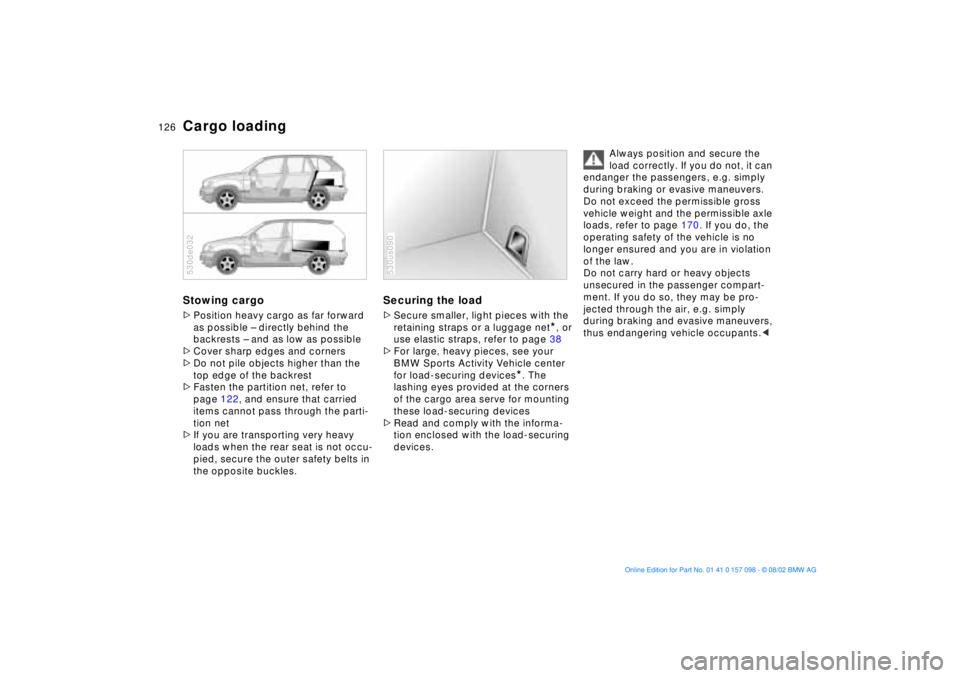
Cargo loadingStowing cargo >Position heavy cargo as far forward
as possible Ð directly behind the
backrests Ð and as low as possible
>Cover sharp edges and corners
>Do not pile objects higher than the
top edge of the backrest
>Fasten the partition net, refer to
page 122, and ensure that carried
items cannot pass through the parti-
tion net
>If you are transporting very heavy
loads when the rear seat is not occu-
pied, secure the outer safety belts in
the opposite buckles. 530de032
Securing the load >Secure smaller, light pieces with the
retaining straps or a luggage net
*, or
use elastic straps, refer to page 38
>For large, heavy pieces, see your
BMW Sports Activity Vehicle center
for load-securing devices
*. The
lashing eyes provided at the corners
of the cargo area serve for mounting
these load-securing devices
>Read and comply with the informa-
tion enclosed with the load-securing
devices.
530us090
Always position and secure the
load correctly. If you do not, it can
endanger the passengers, e.g. simply
during braking or evasive maneuvers.
Do not exceed the permissible gross
vehicle weight and the permissible axle
loads, refer to page 170. If you do, the
operating safety of the vehicle is no
longer ensured and you are in violation
of the law.
Do not carry hard or heavy objects
unsecured in the passenger compart-
ment. If you do so, they may be pro-
jected through the air, e.g. simply
during braking and evasive maneuvers,
thus endangering vehicle occupants.<
Page 130 of 183

130n
Break-in proceduresTo ensure that your vehicle provides
maximum economy throughout a long
service life, we request that you
observe the following instructions: Engine and differential Up to 1,200 miles/2,000 km:
Drive at varying engine speeds and
road speeds, but do not exceed
4,500 rpm and the following road
speeds during this initial period:
6-cylinder engines: 100 mph/160 km/h
8-cylinder engines: 106 mph/170 km/h
Obey your local and state maximum
speed limits.
Refrain from using full throttle and avoid
pressing the accelerator beyond the
kickdown point.
Once you have driven 1,200 miles/
2,000 km, engine and vehicle speeds
can gradually be increased.
You should also comply with these
break-in procedures should the engine
or one of the differentials be replaced
later in the course of the vehicle's ser-
vice life.
TiresDue to technical factors associated
with their manufacture, tires do not
achieve their full traction potential until
an initial break-in period has elapsed.
For this reason, drive with extra care
during the initial 200 miles/300 km.
Obey your local and state maximum
speed limits.
When the vehicle is operated on
wet or slushy roads, a wedge of
water may form between the tire and
the road surface. This phenomenon is
referred to as aquaplaning, or hydro-
planing, and can lead to partial or com-
plete loss of traction, vehicle control
and braking effectiveness. Reduce your
speed on wet roads.<
Brake systemApprox. 300 miles/500 km must elapse
before the brake pads and rotors
achieve the optimal pad-surface and
wear patterns required for trouble-free
operation and long service life later on.
To break in the separate parking brake
drums, apply the parking brake lightly
when coasting to a standstill at a traffic
signal, for instance, provided that traffic
conditions allow you to do so.
To avoid corrosion, repeat this proce-
dure from time to time.
The brake lamps do not light up
when the parking brake is applied.
Vacuum for the brake system servo unit
on your BMW is available only when the
engine is running. When you move the
vehicle with the engine switched off Ð
when towing, for instance Ð substan-
tially higher levels of pedal force will be
required to brake the vehicle.<
Page 135 of 183

135n
OverviewControlsMaintenanceRepairsDataIndex
Tire condition Tire replacement Proceed carefully to the nearest
BMW Sports Activity Vehicle center or
professional tire center, or have the
vehicle towed in to have it, its wheels
and tires inspected.
Tire damage up to and including blow-
outs can endanger the lives of both the
vehicle occupants and other road
users.<
DOT Quality GradesTread wear
Traction AA A B C
Temperature A B C
All passenger car tires must con-
form to Federal Safety Require-
ments in addition to these grades.< Tread wearThe tread wear grade is a comparative
rating based on the wear rate of the tire
when tested under controlled condi-
tions on a specified government test
course.
For example, a tire graded 150 would
wear one and one-half Ð 1g Ð times as
well on the government course as a tire
graded 100. The relative performance
of tires depends upon the actual condi-
tions of their use, however, and may
depart significantly from the norm due
to variations in driving habits, service
practices and differences in road char-
acteristics and climate.
TractionThe traction grades, from highest to
lowest, are AA, A, B, and C.
Those grades represent the tire's ability
to stop on wet pavement as measured
under controlled conditions on speci-
fied government test surfaces of
asphalt and concrete. A tire marked C
may have poor traction performance.
The traction grade assigned to
this tire is based on straight-
ahead braking traction tests, and does
not include acceleration, cornering,
hydroplaning, or peak traction charac-
teristics.<
Page 141 of 183

141n
OverviewControlsMaintenanceRepairsDataIndex
Washer fluid Engine oil Windshield and headlamp washer
system Approximate capacity is 8.2 US quarts/
7.8 liters.
Fill with water and Ñ if required Ñ with a
washer antifreeze, according to manu-
facturer's recommendations.
It is more convenient to mix the
washer fluid before adding it to
the reservoir.<
Antifreeze agent for the washer
systems is inflammable. For this
reason, keep it away from sources of
flame and store it only in its original
containers. Store it so that it is inacces-
sible to children. Comply with the
instructions on the containers.< 530de298
Checking oil level 1. Park the vehicle on a level surface
2. Switch the engine off after it has
reached normal operating tempera-
ture
3. After approx. 5 minutes, pull the
dipstick out and wipe it off with a
clean lint-free cloth, paper towel, or
similar material
4. Push the dipstick carefully all the way
into the guide tube and pull it out
again
5. The oil level should be in between
the two marks on the dipstick.
As with fuel economy, oil consumption
is directly influenced by your driving
style and vehicle operating conditions. 530us100
The oil volume between the two marks
on the dipstick corresponds to approx.
1.1 US quarts/1 liter. Do not fill beyond
the upper mark on the dipstick. Excess
oil will damage the engine
BMW X5 4.6is:
If the vehicle's performance reserves
are used extensively Ð high-perfor-
mance driving Ð the oil level should be
maintained at the upper mark on the
dipstick.530us205
Page 150 of 183

150n
Under the cargo area floor in a pocket.
530us106
Front 1. Move the wiper to a fold-out posi-
tion, refer to page 68
2. Lift the wiper arm and press the
securing spring, refer to arrow
3. Pull the wiper blade off toward the
wiper arm
4. Insert the new blade and snap it into
place.
Fold the wipers back down onto
the windshield before you turn the
ignition key to position 1 or 2 again. If
you do not, they could be damaged.< 530de300
Rear
1. Hold the wiper blade on the window
and remove/unclip the wiper arm at
the articulated joint, refer to arrow
2. Insert a new wiper blade and press it
on/clip it into the wiper arm.
Use only wiper blades approved
by BMW.< 530de301
Onboard tool kit Windshield wiper blades
Page 164 of 183

164n
Towing the vehicle Tow fittingThe screw-in tow fitting is stored
beneath the cargo area floor. Carry it
with you at all times. This fitting is
designed for installation in the tow
sockets located at the front and rear of
the vehicle, and is intended for towing
on paved road surfaces only.
It should not be used to pull a vehicle
out of deep snow, mud, sand, etc.
Always observe all applicable towing
laws and regulations. Access to tow sockets Front:
Use a screwdriver to press the right or
left cover out, refer to arrows.530us128
Rear:
Pull the cover off.
Screw the tow fitting in until it is
tight. If you do not, the threads
could be damaged.
Do not tow the vehicle by any compo-
nents of the running gear, or lash them
down in any way. If you do so, the com-
ponents could be damaged, leading to
possible accidents.<
Use only a nylon towing strap to tow
the vehicle, since the inherent resil-
ience of this material helps protect both
vehicles from sudden jerking move-
ments. 530de318
Avoid off-center towing. Be sure
that the tow rope is pulled tightly
when the towing vehicle begins to
move.<
Do not tow a vehicle heavier than
your own. If you do, it is no longer
possible to control vehicle response.<
Tow-startingIt is not possible to start the engine of a
vehicle equipped with an automatic
transmission by towing or pushing.
For instructions on Jump starting refer
to page 162.
Never attempt to use your vehicle to
push another vehicle. If you do so,
damage to the energy-absorbing
bumpers could result.