2003 BMW 540I SEDAN wheel
[x] Cancel search: wheelPage 73 of 187
73n
OverviewControlsMaintenanceRepairsDataIndex
Automatic transmission
*
Before leaving the vehicle when
the engine is running, move the
selector lever to the "Park" or "Neutral"
position and apply the parking brake to
prevent the vehicle from rolling.
Never leave the vehicle unattended
with the engine running. An unattended
vehicle with a running engine repre-
sents a potential safety hazard.
If you should accidentally select
"Neutral" while traveling at high speed,
remove your foot from the accelerator
pedal immediately. Allow the engine
speed to drop to idle before selecting
the desired drive position. Damage
could otherwise occur due to excessive
engine speed.<
P ParkSelect only when the vehicle is com-
pletely stopped. The transmission locks
to prevent the rear wheels from turning.R ReverseSelect only when the vehicle is com-
pletely stopped.
N Neutral (idle)Select only if your journey is interrupted
for a longer period.D Drive
(automatic shift program)This position is designed for driving
under all normal operating conditions.
All forward gears are available.
Under normal operating conditions, fuel
consumption is lowest when driving in
position D.4 Ð Sport ProgramThe Sport Program is designed for per-
formance-oriented driving.
3 and 2 Ð shift limiterSelect this range when you wish to limit
gear changes (on steep uphill or down-
hill slopes, for instance). The transmis-
sion shifts up only as far as the selected
gear limit."Kickdown" In the "kickdown" mode, you achieve
maximum performance.
Depress the accelerator pedal past the
resistance point at the full-throttle posi-
tion.
Page 76 of 187
76n
Automatic transmission with Steptronic
*
To prevent the vehicle from
starting off on its own, always
move the selector lever to position P or
N and engage the parking brake before
leaving your vehicle with the engine
running. Do not leave the vehicle unat-
tended with the engine running. An
unattended vehicle with a running
engine represents a potential safety
hazard.<
P ParkSelect "Park" only when the vehicle is
completely stopped. The transmission
locks to prevent the rear wheels from
turning.R ReverseSelect "Reverse" only when the vehicle
is completely stopped.N Neutral (idle)Select "Neutral" only if your journey is
interrupted for a longer period.
D Drive
(automatic shift program)This position is designed for driving
under all normal operating conditions.
All forward gears are available."Kickdown"In the "kickdown" mode, you achieve
maximum acceleration and top speed
in position D.
Depress the accelerator pedal past the
resistance point at the full-throttle posi-
tion.
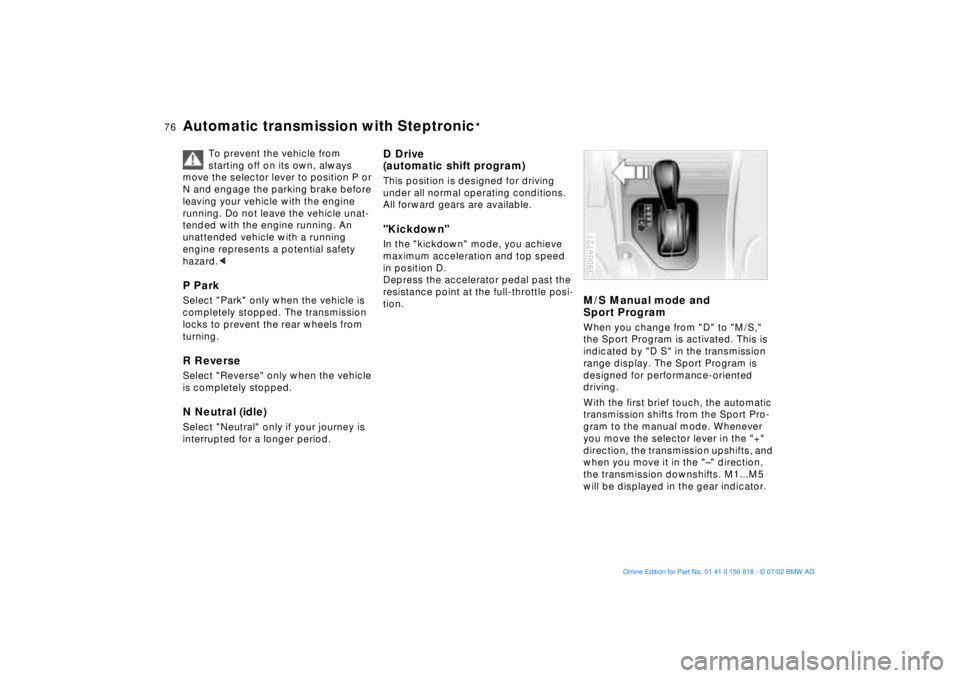
M/S Manual mode and
Sport ProgramWhen you change from "D" to "M/S,"
the Sport Program is activated. This is
indicated by "D S" in the transmission
range display. The Sport Program is
designed for performance-oriented
driving.
With the first brief touch, the automatic
transmission shifts from the Sport Pro-
gram to the manual mode. Whenever
you move the selector lever in the "+"
direction, the transmission upshifts, and
when you move it in the "Ð" direction,
the transmission downshifts. M1...M5
will be displayed in the gear indicator.390de721
Page 101 of 187
101n
OverviewControlsMaintenanceRepairsDataIndex
Self-leveling suspension
*
Tire Pressure Monitor (RDC)
*
The warning lamp for the self-
leveling suspension comes on,
or the message "SELFLEVEL
SUSP.INACT" appears in the Check
Control: there is a malfunction in the
self-leveling suspension.
Stop and inspect the vehicle. If it is
riding significantly lower in the rear than
in the front, or if it is sitting at an incline
(left rear compared to right rear), con-
sult the nearest BMW center. Drive with
appropriate caution in the meantime.
The vehicle has reduced ground clear-
ance or driving comfort is noticeably
reduced.
Even if the attitude of the vehicle is
normal, you should consult the nearest
BMW center if the warning lamp indi-
cates a system fault.
The conceptRDC monitors the tire pressures at all
four wheels, even when the vehicle is
moving. The system provides an alert
whenever the inflation pressure drops
significantly below the specified pres-
sure in one or more tires.
In order for the system to "learn" the
correct tire inflation pressure, check the
inflation pressure in all tires. Refer to
the table of "Tire inflation pressures"
beginning on page 27 and make any
necessary corrections. Then activate
the system.
This indicator lamp in the instru-
ment cluster or the Check Con-
trol will inform you if the tire
pressure is not correct.
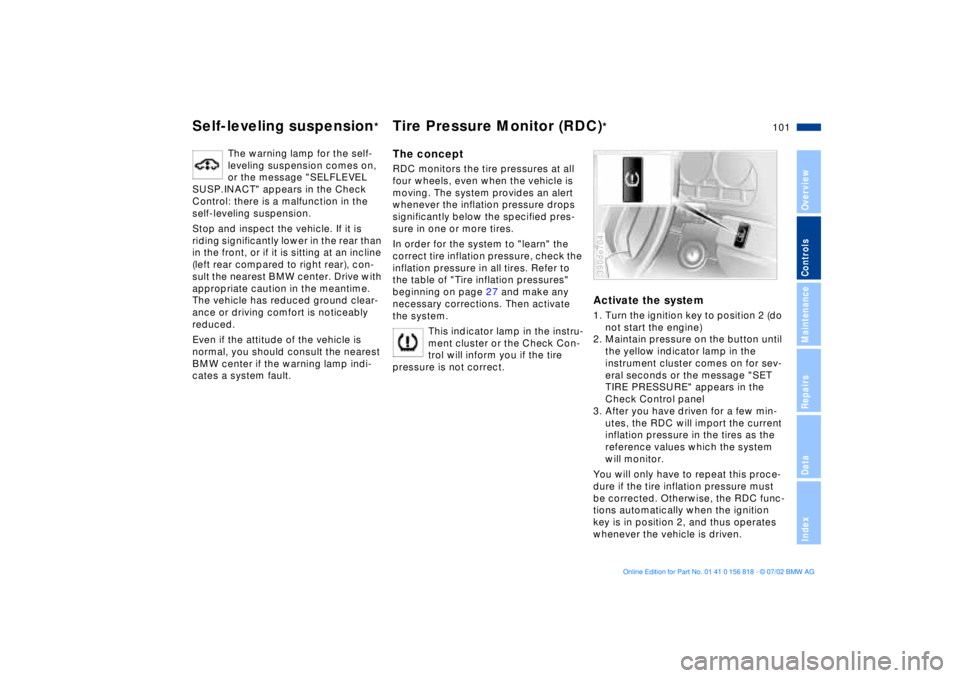
Activate the system1. Turn the ignition key to position 2 (do
not start the engine)
2. Maintain pressure on the button until
the yellow indicator lamp in the
instrument cluster comes on for sev-
eral seconds or the message "SET
TIRE PRESSURE" appears in the
Check Control panel
3. After you have driven for a few min-
utes, the RDC will import the current
inflation pressure in the tires as the
reference values which the system
will monitor.
You will only have to repeat this proce-
dure if the tire inflation pressure must
be corrected. Otherwise, the RDC func-
tions automatically when the ignition
key is in position 2, and thus operates
whenever the vehicle is driven.390de704
Page 102 of 187
102n
Tire Pressure Monitor (RDC)*Loss of tire pressureIf, after a certain period of time, the
inflation pressure has gone down sig-
nificantly (which is normal for any tire),
the yellow indicator lamp comes on or
the message "CHECK TIRE PRES-
SURE" appears in the Check Control.
This alerts you that you should have the
tires inflated to the specified pressures
as soon as possible.
If you are prompted to check the
tire pressure shortly after a cor-
rection has been made, this indicates
that the corrected values were not
accurate. Please check the inflation
pressure again and make corrections
according to the inflation pressure
table.<
Flat tireIf there is a tire failure with a loss of
inflation pressure, the red indicator
lamp comes on or the message "TIRE
DEFECT" appears in the Check Control.
In addition, a gong sounds.
If this occurs, reduce vehicle speed
immediately and stop the vehicle in a
safe location. Avoid hard brake applica-
tions. Do not oversteer. Replace the flat
tire.
The spare tire which is available in
your vehicle as standard equip-
ment is equipped with the electronics
required for RDC and, following activa-
tion of the system, is also monitored
after it is mounted.<
The RDC cannot alert you to
severe and sudden tire damage
caused by external factors.<
Have the tires changed at your
BMW center.
Your BMW center has the information
needed for working with RDC and is
equipped with the necessary special
tools.<
System interferenceDuring the period of the malfunction,
the yellow indicator lamp comes on
or the message "TIRECONTROL INAC-
TIVE" appears in the Check Control.
You will also see the same message
>in the event of a system fault
>if a wheel is mounted without the
RDC electronics
>if, in addition to the spare tire, addi-
tional wheels with RDC electronics
are on board.
Please contact your BMW center for
additional information.
Page 107 of 187
107n
OverviewControlsMaintenanceRepairsDataIndex
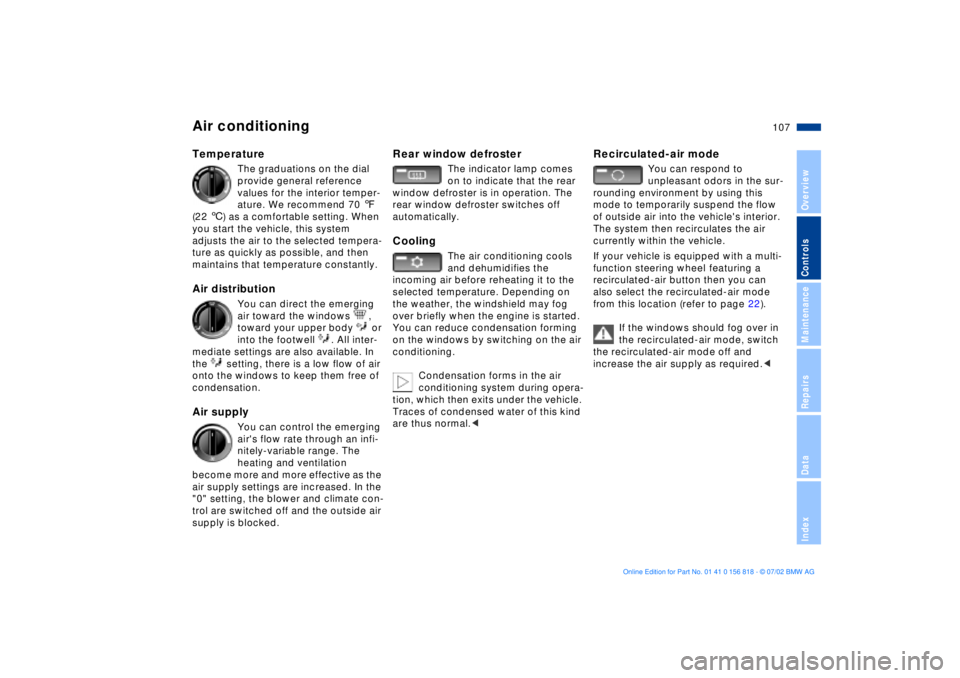
Air conditioningTemperature
The graduations on the dial
provide general reference
values for the interior temper-
ature. We recommend 70 7
(22 6) as a comfortable setting. When
you start the vehicle, this system
adjusts the air to the selected tempera-
ture as quickly as possible, and then
maintains that temperature constantly.
Air distribution
You can direct the emerging
air toward the windows ,
toward your upper body or
into the footwell . All inter-
mediate settings are also available. In
the setting, there is a low flow of air
onto the windows to keep them free of
condensation.
Air supply
You can control the emerging
air's flow rate through an infi-
nitely-variable range. The
heating and ventilation
become more and more effective as the
air supply settings are increased. In the
"0" setting, the blower and climate con-
trol are switched off and the outside air
supply is blocked.
Rear window defroster
The indicator lamp comes
on to indicate that the rear
window defroster is in operation. The
rear window defroster switches off
automatically.
Cooling
The air conditioning cools
and dehumidifies the
incoming air before reheating it to the
selected temperature. Depending on
the weather, the windshield may fog
over briefly when the engine is started.
You can reduce condensation forming
on the windows by switching on the air
conditioning.
Condensation forms in the air
conditioning system during opera-
tion, which then exits under the vehicle.
Traces of condensed water of this kind
are thus normal.<
Recirculated-air mode
You can respond to
unpleasant odors in the sur-
rounding environment by using this
mode to temporarily suspend the flow
of outside air into the vehicle's interior.
The system then recirculates the air
currently within the vehicle.
If your vehicle is equipped with a multi-
function steering wheel
featuring a
recirculated-air button then you can
also select the recirculated-air mode
from this location (refer to page 22).
If the windows should fog over in
the recirculated-air mode, switch
the recirculated-air mode off and
increase the air supply as required.<
Page 112 of 187
112n
Automatic climate control
*
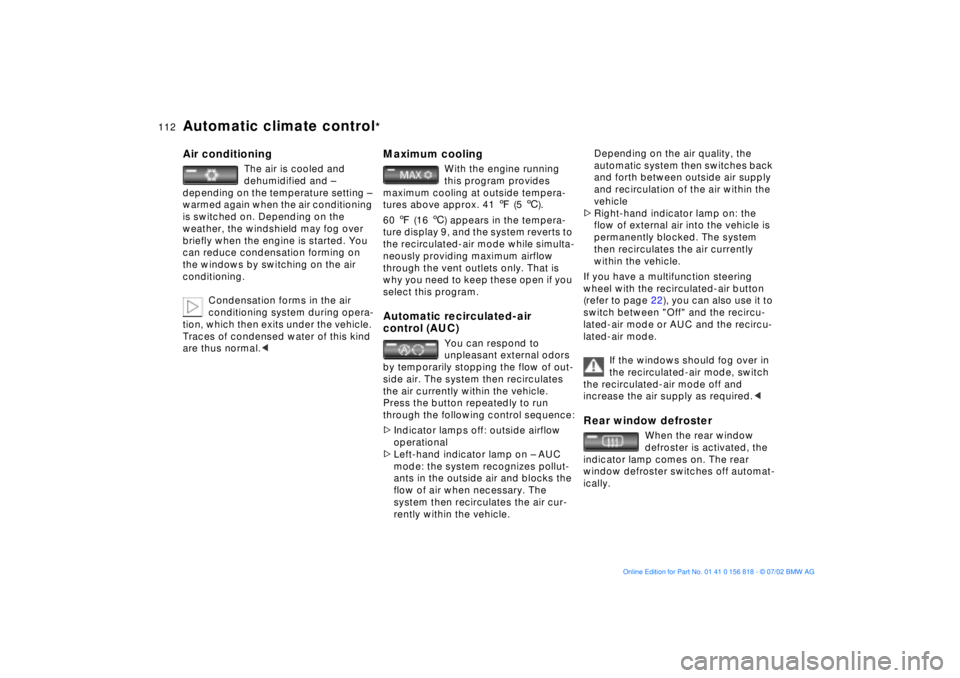
Air conditioning
The air is cooled and
dehumidified and Ð
depending on the temperature setting Ð
warmed again when the air conditioning
is switched on. Depending on the
weather, the windshield may fog over
briefly when the engine is started. You
can reduce condensation forming on
the windows by switching on the air
conditioning.
Condensation forms in the air
conditioning system during opera-
tion, which then exits under the vehicle.
Traces of condensed water of this kind
are thus normal.<
Maximum cooling
With the engine running
this program provides
maximum cooling at outside tempera-
tures above approx. 41 7 (5 6).
60 7 (16 6) appears in the tempera-
ture display 9, and the system reverts to
the recirculated-air mode while simulta-
neously providing maximum airflow
through the vent outlets only. That is
why you need to keep these open if you
select this program.
Automatic recirculated-air
control (AUC)
You can respond to
unpleasant external odors
by temporarily stopping the flow of out-
side air. The system then recirculates
the air currently within the vehicle.
Press the button repeatedly to run
through the following control sequence:
>Indicator lamps off: outside airflow
operational
>Left-hand indicator lamp on Ð AUC
mode: the system recognizes pollut-
ants in the outside air and blocks the
flow of air when necessary. The
system then recirculates the air cur-
rently within the vehicle.
Depending on the air quality, the
automatic system then switches back
and forth between outside air supply
and recirculation of the air within the
vehicle
>Right-hand indicator lamp on: the
flow of external air into the vehicle is
permanently blocked. The system
then recirculates the air currently
within the vehicle.
If you have a multifunction steering
wheel with the recirculated-air button
(refer to page 22), you can also use it to
switch between "Off" and the recircu-
lated-air mode or AUC and the recircu-
lated-air mode.
If the windows should fog over in
the recirculated-air mode, switch
the recirculated-air mode off and
increase the air supply as required.< Rear window defroster
When the rear window
defroster is activated, the
indicator lamp comes on. The rear
window defroster switches off automat-
ically.
Page 133 of 187
133n
OverviewControlsMaintenanceRepairsDataIndex
Driving notes Antilock Brake System
Brakes:
Do not drive with your foot resting
on the brake pedal. Even light but con-
sistent pedal pressure can lead to high
temperatures, brake wear and possibly
even brake failure.
Hydroplaning:
When driving on wet or slushy roads,
reduce vehicle speed. If you do not, a
wedge of water may form between the
tires and the road surface. This phe-
nomenon is referred to as aquaplaning
or hydroplaning. It is characterized by a
partial or complete loss of contact
between the tires and the road surface.
The ultimate results are loss of steering
and braking control.
Driving through water:
When there is water on the roads, do
not drive in it if it is deeper than
1 ft (30 cm), and even then, only at
walking speed, otherwise the vehicle
can sustain damage to the engine, the
electrical systems and the transmission.
Rear parcel tray:
Do not place heavy or hard objects on
the rear parcel tray. These objects
could endanger vehicle occupants
during heavy brake applications or eva-
sive maneuvers.
Clothes hooks:
Hang items of clothing from the hooks
so that they will not obstruct the driver's
vision. Do not hang heavy objects on
the hooks. If you do so, they could
cause personal injury during braking or
evasive maneuvers.<
The conceptThe Antilock Brake System (ABS) keeps
the wheels from locking during braking,
thereby enhancing active driving safety.
With ABS, the shortest possible braking
distances are achieved under most
conditions (on straight-aways and in
curves, on asphalt, ice, wet road sur-
faces, etc.).Braking with ABSIf you are in a situation that requires full
braking, you will exploit the full benefits
of the ABS system if you apply max-
imum pedal pressure ("panic stop").
Pulsation at the brake pedal combined
with sounds from the hydraulic circuits
indicates to the driver that ABS is in its
active mode.
Page 135 of 187
135n
OverviewControlsMaintenanceRepairsDataIndex
Information for your safetyThe factory-approved radial tires are
matched to the vehicle and have been
selected to provide optimum safety and
driving comfort.
It is not merely the tire's service life, but
also driving comfort and Ð above all else
Ð driving safety which depend on the
condition of the tires and the mainte-
nance of the specified tire inflation
pressure.
Incorrect inflation pressures are a
frequent cause of tire problems
and flat tires. Tire pressure also has a
major effect on your BMW's handling
response. We recommend that you
check the tire pressure Ð remember to
check the spare tire as well Ð before
every extended trip, as well as at least
every two weeks in normal use (refer to
page 26). Failure to observe these pre-
cautions can result in incorrect tire
pressures, which cause instable han-
dling response as well as tire damage,
and can ultimately lead to an acci-
dent.<
Tire tread Ð Tire damageInspect your tires frequently for tread
wear, signs of damage and for foreign
objects lodged in the tread. Check the
tread depth.
The tread depth should not drop
below 0.12 in (3 mm), even though, for
example the legally specified minimum
tread depth in Europe is only 0.063 in
(1.6 mm). Below a tread depth of
0.12 in (3 mm) there is an increased risk
of hydroplaning, even at relatively mod-
erate speeds and with only small
amounts of water on the road.
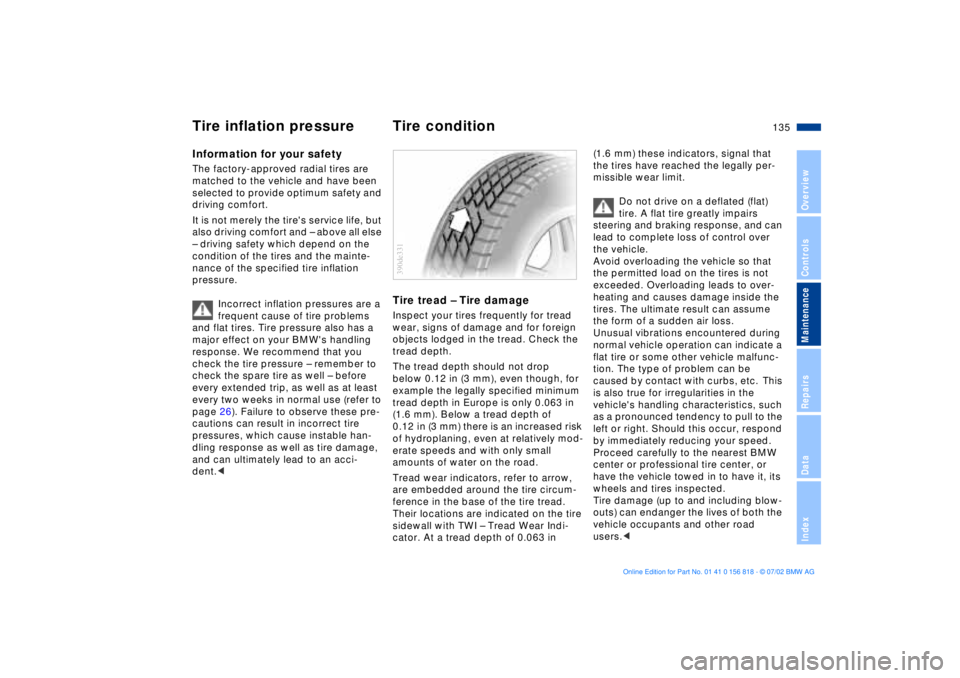
Tread wear indicators, refer to arrow,
are embedded around the tire circum-
ference in the base of the tire tread.
Their locations are indicated on the tire
sidewall with TWI Ð Tread Wear Indi-
cator. At a tread depth of 0.063 in 390de331
(1.6 mm) these indicators, signal that
the tires have reached the legally per-
missible wear limit.
Do not drive on a deflated (flat)
tire. A flat tire greatly impairs
steering and braking response, and can
lead to complete loss of control over
the vehicle.
Avoid overloading the vehicle so that
the permitted load on the tires is not
exceeded. Overloading leads to over-
heating and causes damage inside the
tires. The ultimate result can assume
the form of a sudden air loss.
Unusual vibrations encountered during
normal vehicle operation can indicate a
flat tire or some other vehicle malfunc-
tion. The type of problem can be
caused by contact with curbs, etc. This
is also true for irregularities in the
vehicle's handling characteristics, such
as a pronounced tendency to pull to the
left or right. Should this occur, respond
by immediately reducing your speed.
Proceed carefully to the nearest BMW
center or professional tire center, or
have the vehicle towed in to have it, its
wheels and tires inspected.
Tire damage (up to and including blow-
outs) can endanger the lives of both the
vehicle occupants and other road
users.<
Tire inflation pressure Tire condition