2003 BMW 325XI rear
[x] Cancel search: rearPage 51 of 166
51
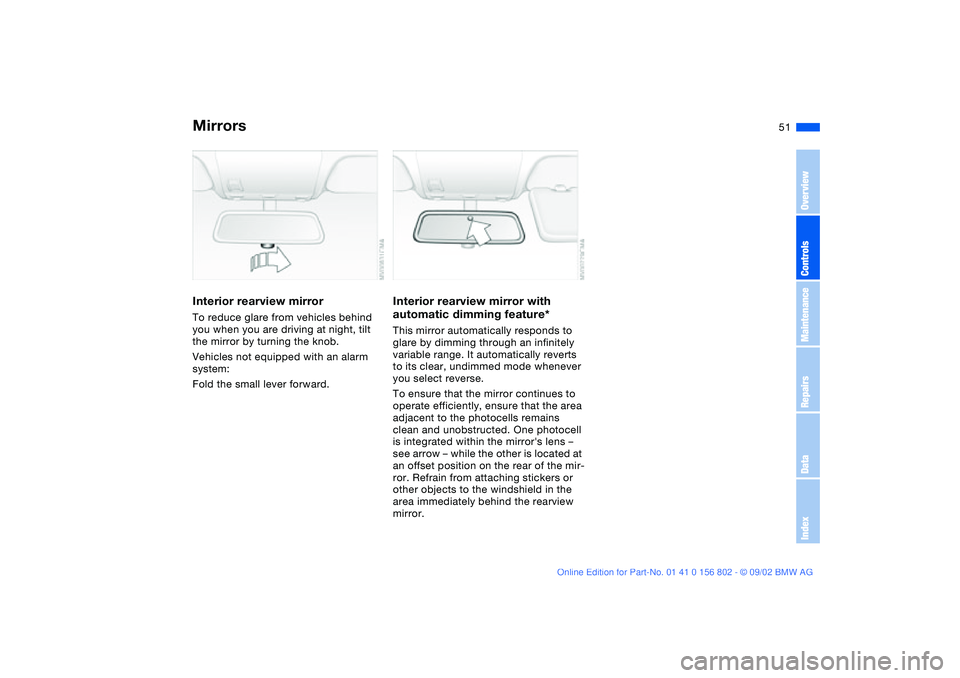
Interior rearview mirrorTo reduce glare from vehicles behind
you when you are driving at night, tilt
the mirror by turning the knob.
Vehicles not equipped with an alarm
system:
Fold the small lever forward.
Interior rearview mirror with
automatic dimming feature*This mirror automatically responds to
glare by dimming through an infinitely
variable range. It automatically reverts
to its clear, undimmed mode whenever
you select reverse.
To ensure that the mirror continues to
operate efficiently, ensure that the area
adjacent to the photocells remains
clean and unobstructed. One photocell
is integrated within the mirror's lens –
see arrow – while the other is located at
an offset position on the rear of the mir-
ror. Refrain from attaching stickers or
other objects to the windshield in the
area immediately behind the rearview
mirror.
Mirrors
OverviewControlsMaintenanceRepairsDataIndex
handbook.book Page 51 Saturday, July 27, 2002 1:36 PM
Page 52 of 166
52Passenger safety systems
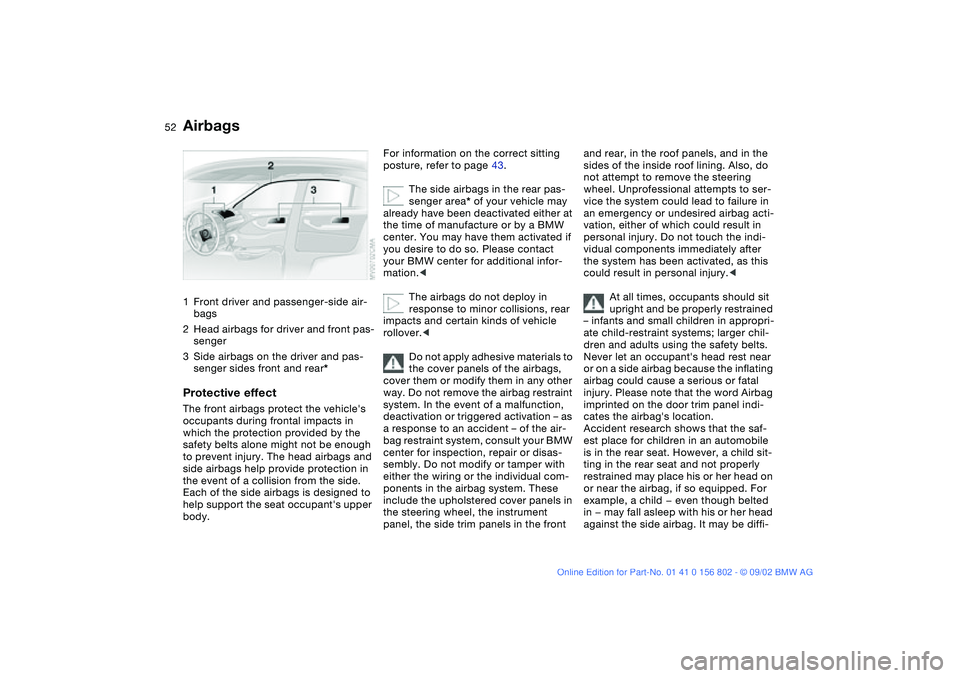
Airbags1Front driver and passenger-side air-
bags
2Head airbags for driver and front pas-
senger
3Side airbags on the driver and pas-
senger sides front and rear*Protective effectThe front airbags protect the vehicle's
occupants during frontal impacts in
which the protection provided by the
safety belts alone might not be enough
to prevent injury. The head airbags and
side airbags help provide protection in
the event of a collision from the side.
Each of the side airbags is designed to
help support the seat occupant's upper
body.
For information on the correct sitting
posture, refer to page 43.
The side airbags in the rear pas-
senger area* of your vehicle may
already have been deactivated either at
the time of manufacture or by a BMW
center. You may have them activated if
you desire to do so. Please contact
your BMW center for additional infor-
mation.<
The airbags do not deploy in
response to minor collisions, rear
impacts and certain kinds of vehicle
rollover.<
Do not apply adhesive materials to
the cover panels of the airbags,
cover them or modify them in any other
way. Do not remove the airbag restraint
system. In the event of a malfunction,
deactivation or triggered activation – as
a response to an accident – of the air-
bag restraint system, consult your BMW
center for inspection, repair or disas-
sembly. Do not modify or tamper with
either the wiring or the individual com-
ponents in the airbag system. These
include the upholstered cover panels in
the steering wheel, the instrument
panel, the side trim panels in the front
and rear, in the roof panels, and in the
sides of the inside roof lining. Also, do
not attempt to remove the steering
wheel. Unprofessional attempts to ser-
vice the system could lead to failure in
an emergency or undesired airbag acti-
vation, either of which could result in
personal injury. Do not touch the indi-
vidual components immediately after
the system has been activated, as this
could result in personal injury.<
At all times, occupants should sit
upright and be properly restrained
– infants and small children in appropri-
ate child-restraint systems; larger chil-
dren and adults using the safety belts.
Never let an occupant's head rest near
or on a side airbag because the inflating
airbag could cause a serious or fatal
injury. Please note that the word Airbag
imprinted on the door trim panel indi-
cates the airbag's location.
Accident research shows that the saf-
est place for children in an automobile
is in the rear seat. However, a child sit-
ting in the rear seat and not properly
restrained may place his or her head on
or near the airbag, if so equipped. For
example, a child — even though belted
in — may fall asleep with his or her head
against the side airbag. It may be diffi-
handbook.book Page 52 Saturday, July 27, 2002 1:36 PM
Page 53 of 166
53
cult for a driver to ensure that children
in the rear seat will remain properly
positioned at all times and not place
their heads on or near the side airbag.
Therefore, we recommend that the
rear-seat side airbags, if installed in the
vehicle, be deactivated if children will
travel in the rear seat.
The rear side airbags may already have
been deactivated, either at the time of
manufacture or by a BMW center.
Labels in the door opening should indi-
cate the status of your rear side air-
bags. If you are uncertain of their sta-
tus, or wish to have the airbags
activated or deactivated, please con-
tact your BMW center.<
Even when all these guidelines are fol-
lowed, there is still a small residual risk
of injuries to the face, hands and arms
occurring from airbag deployment in
isolated instances.
The ignition and inflation noise may
induce a mild temporary hearing loss in
sensitive individuals.
Corresponding airbag warning labels
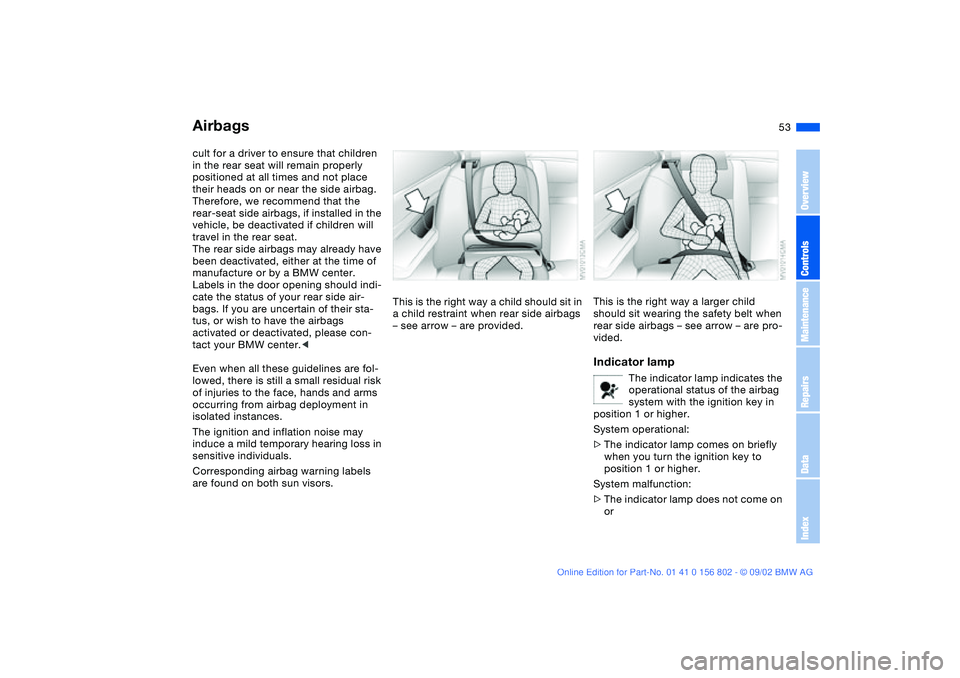
are found on both sun visors.This is the right way a child should sit in
a child restraint when rear side airbags
– see arrow – are provided.
This is the right way a larger child
should sit wearing the safety belt when
rear side airbags – see arrow – are pro-
vided.Indicator lamp
The indicator lamp indicates the
operational status of the airbag
system with the ignition key in
position 1 or higher.
System operational:
>The indicator lamp comes on briefly
when you turn the ignition key to
position 1 or higher.
System malfunction:
>The indicator lamp does not come on
or
Airbags
OverviewControlsMaintenanceRepairsDataIndex
handbook.book Page 53 Saturday, July 27, 2002 1:36 PM
Page 55 of 166
55
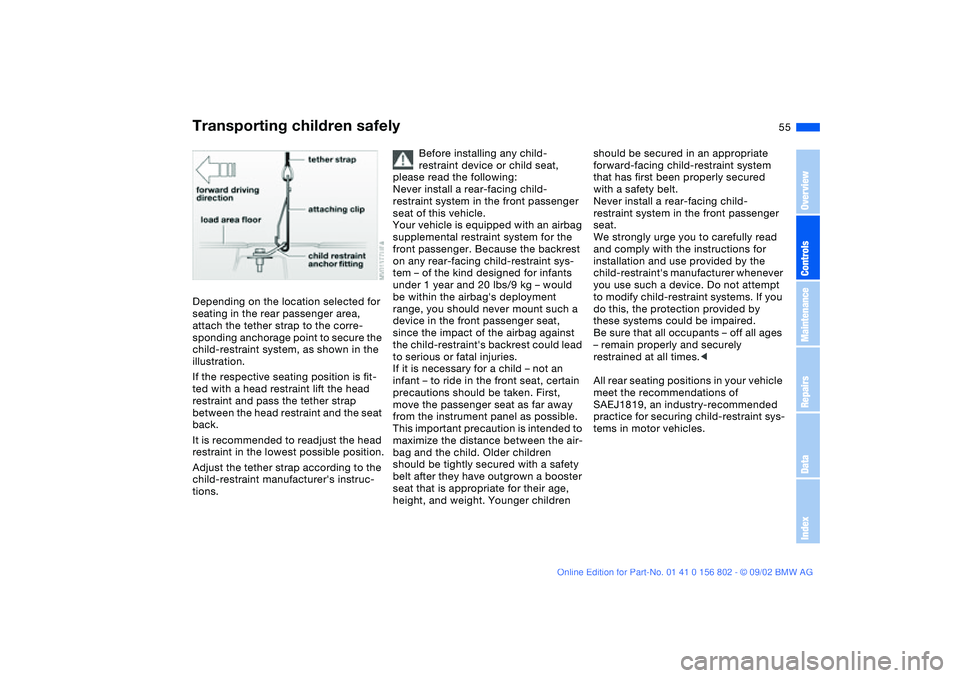
Depending on the location selected for
seating in the rear passenger area,
attach the tether strap to the corre-
sponding anchorage point to secure the
child-restraint system, as shown in the
illustration.
If the respective seating position is fit-
ted with a head restraint lift the head
restraint and pass the tether strap
between the head restraint and the seat
back.
It is recommended to readjust the head
restraint in the lowest possible position.
Adjust the tether strap according to the
child-restraint manufacturer's instruc-
tions.
Before installing any child-
restraint device or child seat,
please read the following:
Never install a rear-facing child-
restraint system in the front passenger
seat of this vehicle.
Your vehicle is equipped with an airbag
supplemental restraint system for the
front passenger. Because the backrest
on any rear-facing child-restraint sys-
tem – of the kind designed for infants
under 1 year and 20 lbs/9 kg – would
be within the airbag's deployment
range, you should never mount such a
device in the front passenger seat,
since the impact of the airbag against
the child-restraint's backrest could lead
to serious or fatal injuries.
If it is necessary for a child – not an
infant – to ride in the front seat, certain
precautions should be taken. First,
move the passenger seat as far away
from the instrument panel as possible.
This important precaution is intended to
maximize the distance between the air-
bag and the child. Older children
should be tightly secured with a safety
belt after they have outgrown a booster
seat that is appropriate for their age,
height, and weight. Younger children
should be secured in an appropriate
forward-facing child-restraint system
that has first been properly secured
with a safety belt.
Never install a rear-facing child-
restraint system in the front passenger
seat.
We strongly urge you to carefully read
and comply with the instructions for
installation and use provided by the
child-restraint's manufacturer whenever
you use such a device. Do not attempt
to modify child-restraint systems. If you
do this, the protection provided by
these systems could be impaired.
Be sure that all occupants – off all ages
– remain properly and securely
restrained at all times.<
All rear seating positions in your vehicle
meet the recommendations of
SAEJ1819, an industry-recommended
practice for securing child-restraint sys-
tems in motor vehicles.
Transporting children safely
OverviewControlsMaintenanceRepairsDataIndex
handbook.book Page 55 Saturday, July 27, 2002 1:36 PM
Page 56 of 166
56
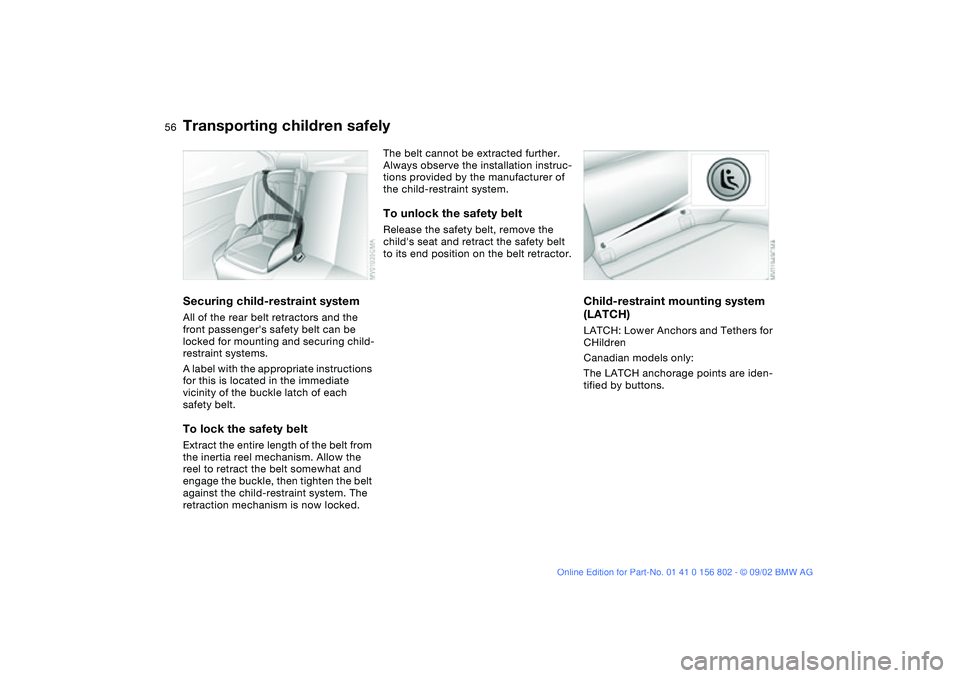
Securing child-restraint systemAll of the rear belt retractors and the
front passenger's safety belt can be
locked for mounting and securing child-
restraint systems.
A label with the appropriate instructions
for this is located in the immediate
vicinity of the buckle latch of each
safety belt.To lock the safety beltExtract the entire length of the belt from
the inertia reel mechanism. Allow the
reel to retract the belt somewhat and
engage the buckle, then tighten the belt
against the child-restraint system. The
retraction mechanism is now locked.
The belt cannot be extracted further.
Always observe the installation instruc-
tions provided by the manufacturer of
the child-restraint system.To unlock the safety beltRelease the safety belt, remove the
child's seat and retract the safety belt
to its end position on the belt retractor.
Child-restraint mounting system
(LATCH)LATCH: Lower Anchors and Tethers for
CHildren
Canadian models only:
The LATCH anchorage points are iden-
tified by buttons.
Transporting children safely
handbook.book Page 56 Saturday, July 27, 2002 1:36 PM
Page 57 of 166
57
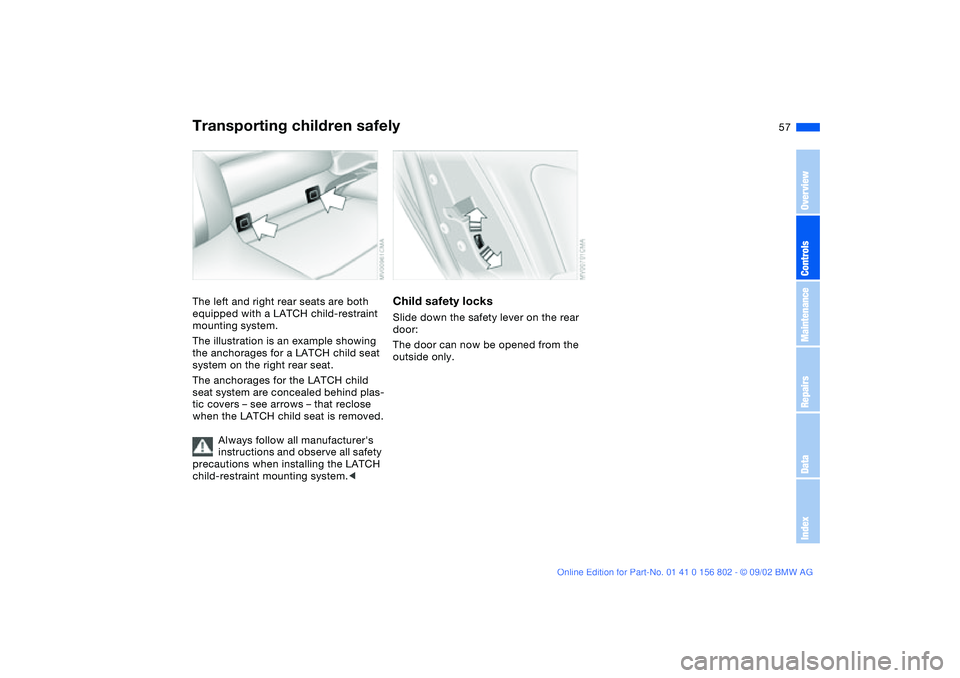
The left and right rear seats are both
equipped with a LATCH child-restraint
mounting system.
The illustration is an example showing
the anchorages for a LATCH child seat
system on the right rear seat.
The anchorages for the LATCH child
seat system are concealed behind plas-
tic covers – see arrows – that reclose
when the LATCH child seat is removed.
Always follow all manufacturer's
instructions and observe all safety
precautions when installing the LATCH
child-restraint mounting system.<
Child safety locksSlide down the safety lever on the rear
door:
The door can now be opened from the
outside only.
Transporting children safely
OverviewControlsMaintenanceRepairsDataIndex
handbook.book Page 57 Saturday, July 27, 2002 1:36 PM
Page 58 of 166

58
Vehicle Memory, Key MemoryHow the system functionsNo doubt you have often reflected on
how great it would be if you could per-
manently configure your vehicle's vari-
ous features and adjustments to mirror
your own personal preferences. In engi-
neering your vehicle, BMW has
included a number of options for stor-
ing personal adjustment data. These
can be programmed at your BMW cen-
ter.
The available configuration data fall into
two categories, according to whether
their primary orientation is the vehicle –
Vehicle Memory – or the individual –
Key Memory. Provided that each per-
son has a separate remote-control key,
you can have your BMW center enter
basic adjustment data for up to four
individuals in the system.
The system relies on a bilateral data
exchange to identify the individual user
and executes the selected settings
whenever the remote control unit is
used to disengage the locks.
Color-coded decals have been pro-
vided to help you distinguish the differ-
ent keys with their individual settings.What the system can doYou can learn about the entire array of
features this system offers at your BMW
center. Here are just a few examples:
Examples for Vehicle Memory:
>Various signals as acknowledgment
when locking or unlocking your vehi-
cle, refer to pages 31, 33
>Activates/deactivates the "Follow me
home" function, refer to page 89
>Activates/deactivates daytime driv-
ing lamps, refer to page 89
>Sets the units of measure for display-
ing time, outside temperature, dis-
tance traveled and fuel consumption
in the instrument cluster>Indicates via an acoustic tone that
PDC has been activated, refer to
page 77
>Switches on rear window defroster
automatically, refer to pages 94, 99
>After giving an ice warning, the dis-
play returns to the previous setting,
refer to page 75.
Examples for Key Memory:
>Locks the vehicle automatically after
starting off, refer to page 34
>Unlocks the driver's door first, then
the vehicle's remaining locks, refer to
page 34
>Opens the tailgate instead of the rear
window with the remote control, refer
to page 32
>Automatically adjusts the driver's
seat to the personal programmed
settings when the vehicle is
unlocked, refer to page 48
>Determines how far the passenger
mirror will tilt, refer to page 49.
You will see this symbol through-
out the Owner's Manual. It is to
remind you at appropriate places of the
settings that are available to you.<
handbook.book Page 58 Saturday, July 27, 2002 1:36 PM
Page 61 of 166
61
Switching off the engineTurn the ignition key to position 1 or 0.
You should never remove the igni-
tion key when the vehicle is in
motion, as the steering lock could
engage.
When you leave the vehicle, always
remove the ignition key and engage the
steering lock.
Vehicles with manual transmission:
Always engage the parking brake when
parking on slopes and inclined sur-
faces. Placing the lever in gear may not
provide adequate resistance to rolling.
Vehicles with automatic transmission:
Place the selector lever in Park.<
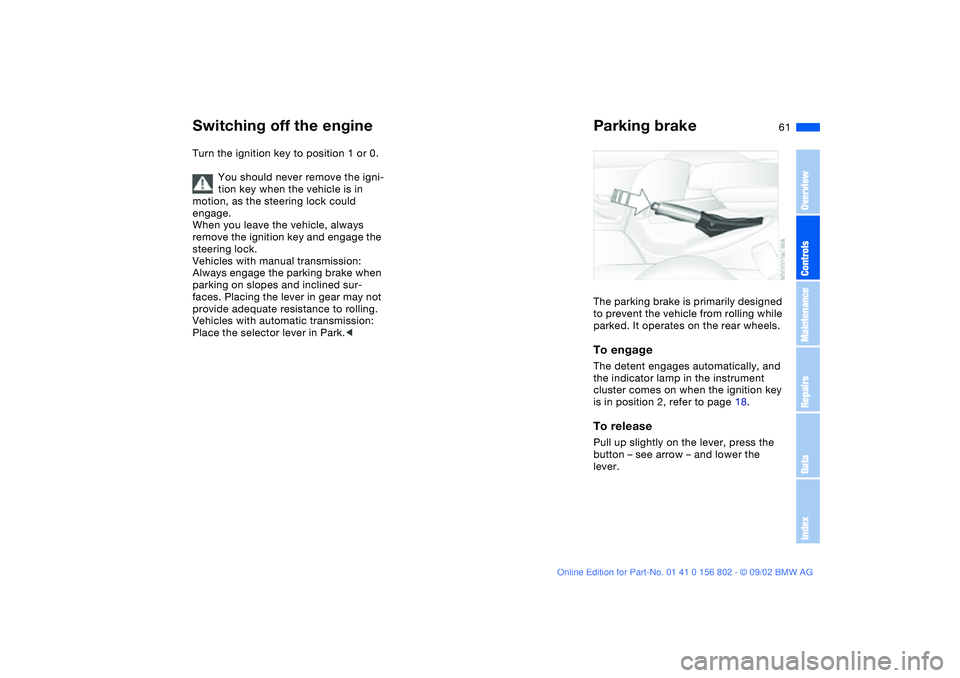
Parking brakeThe parking brake is primarily designed
to prevent the vehicle from rolling while
parked. It operates on the rear wheels.To engageThe detent engages automatically, and
the indicator lamp in the instrument
cluster comes on when the ignition key
is in position 2, refer to page 18.To releasePull up slightly on the lever, press the
button – see arrow – and lower the
lever.
OverviewControlsMaintenanceRepairsDataIndex
handbook.book Page 61 Saturday, July 27, 2002 1:36 PM