Page 290 of 347

This section covers the more-
common problems that motorists
experience with their vehicles. It
gives you inf ormation about how to
safely evaluate the problem and what
to do to correct it. If the problem has
stranded you on the side of the road,
you may be able to get going again.
If not, you will also f ind instructions
on getting your car towed.......................
Compact Spare Tire .288
....................
Changing a Flat Tire .289
..........
If Your Engine Won’t Start . 295
Nothing Happens or the Starter Motor Operates ............................
Very Slowly .295
The Starter Operates ................................
Normally .296
................................
Jump Starting .296
............
If Your Engine Overheats . 300
.........
Low Oil Pressure Indicator . 301
..........
Charging System Indicator . 302
.......
Malf unction Indicator Lamp . 303
.......................
Readiness Codes .304
...............
Brake System Indicator . 305
..................
Closing the Moonroof . 306
..............................................
Fuses .307
..........
Checking and Replacing . 308
......................
Emergency Towing .312
Taking Care of the Unexpected
T aking Care of t he Unexpect ed287
Page 292 of 347

If you have a f lat tire while driving,
stop in a saf e place to change it.
Stopping in traf f ic or on the shoulder
of a busy road is dangerous. Drive
slowly along the shoulder until you
gettoanexitoranareatostopthat
is far away from the traffic lanes.Open the trunk. Raise the trunk
f loor by lif ting up on the back edge.
To keep the trunk f loor out of the
way, attach the hook into the slot
in the trunk lid.
The tools are in the tool box on
the right side of the trunk. Take
the tools out of the tool box. Unscrew the wing bolt and take
the spare tire out of its well.
Park the car on f irm, level, and
non-slippery ground away f rom
traffic. Put the transmission in
Park. Apply the parking brake.
If you are towing a trailer, unhitch
the trailer.
Turn on the hazard warning lights
and turn the ignition switch to
LOCK (0). Have all the
passengers get out of the car while
you change the tire. 5. 4. 3.
2. 1.
CONT INUED
Changing a Flat T ire
T aking Care of t he Unexpect ed289
T T
O
OO OLL B
BOOX X
H
H
O
OO OKK T
T
R
RU UN NKK F
FLLOOO ORR
S
SP PA
A R
REE T
TI
IRRE E J
JA
A C
CKK
The car can easily roll off the
jack, seriously injuring anyone
underneath.
Follow the directions for
changing a tire exactly, and
never get under the car when it
is supported only by the jack.
Page 300 of 347

�µ
�´ �´
CONT INUED
Connect the second jumper cable
to the negative ( ) terminal on
the booster battery. Connect the
other end to the grounding strap
as shown. Do not connect this
jumper cable to any other part of
the engine.
Remove the battery cover.
To jump start your car, f ollow these
directions closely:
Open the hood and check the
physical condition of the battery
(see page ). In very cold
weather, check the condition of
the electrolyte. If it seems slushy
or like ice, do not try jump starting
until it thaws.
Turn of f all the electrical acces-
sories: climate control, stereo
system, lights, etc.
Put the transmission in Neutral or
Park, and set the parking brake. Connect one jumper cable to the
positive ( ) terminal on your
Acura’s battery. Connect the other
end to the positive ( ) terminal
on the booster battery.
4.
5.
3.
1.
2. 253
Jump Starting
T aking Care of t he Unexpect ed297
P P
r
reem m i
iuu m
m m
mo
od
de
ell
If a battery sits in extreme cold, the
electrolyte inside can f reeze.
Attempting to jump start with a f rozen
battery can cause it to rupture.
Page 302 of 347

CONT INUED
The pointer of your car’s tempera-
ture gauge should stay in the mid-
range under most conditions. It may
go higher if you are driving up a long
steep hill on a very hot day. If it
climbs to the red mark, you should
determine the reason.Your car can overheat f or several
reasons, such as lack of coolant or a
mechanical problem. The only
indication may be the temperature
gauge climbing to or above the red
mark. Or you may see steam or
spray coming f rom under the car or
engine cover. In either case, you
should take immediate action. Saf ely pull to the side of the road.
Put the transmission in Neutral or
Park and set the parking brake.
Turn of f the climate control and all
otheraccessories.Turnonthe
hazard warning indicators.
If you see steam and/or spray
coming f rom under the hood, turn
of f the engine.
If you do not see steam or spray,
leave the engine running and
watch the temperature gauge. If
the high heat is due to overloading
(climbing a long, steep hill on a
hot day with the A/C running, for
example), the engine should start
to cool down almost immediately.
If it does, wait until the tempera-
ture gauge comes down to the mid-
point then continue driving.
1.
2.
3.
If Your Engine Overheats
T aking Care of t he Unexpect ed299
Steam and spray from an
overheated engine can
seriously scald you.
Do not open the hood if steam
is coming out.
Driving with the temperature gauge
pointer at the red mark can cause
serious damage to your engine.
Page 308 of 347
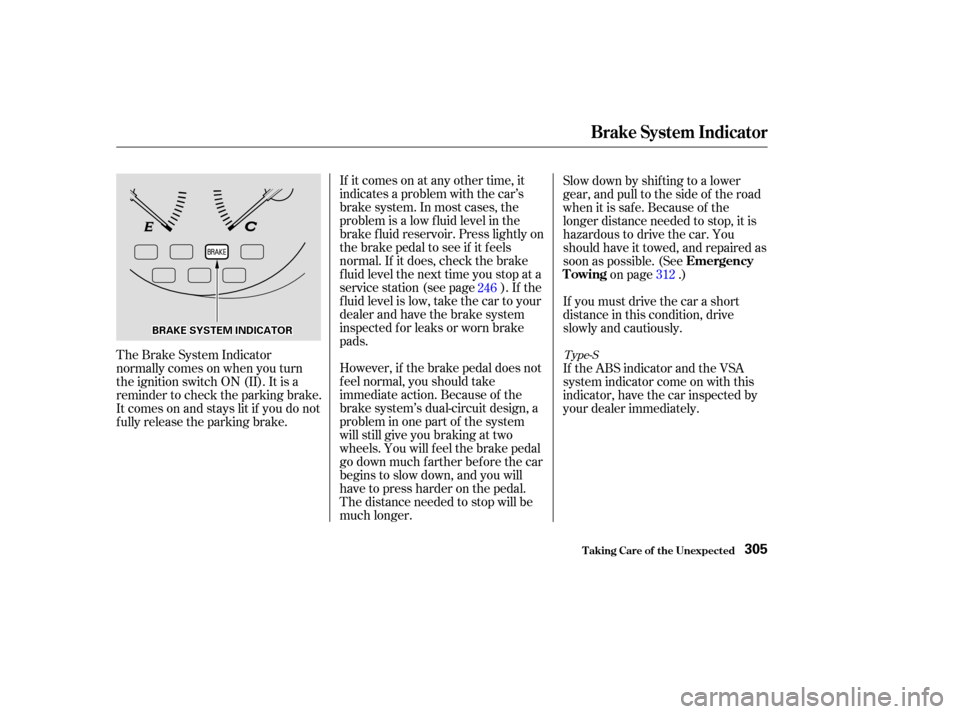
If it comes on at any other time, it
indicates a problem with the car’s
brake system. In most cases, the
problem is a low f luid level in the
brake f luid reservoir. Press lightly on
the brake pedal to see if it f eels
normal. If it does, check the brake
f luid level the next time you stop at a
service station (see page ). If the
fluid level is low, take the car to your
dealer and have the brake system
inspected f or leaks or worn brake
pads.
However, if the brake pedal does not
f eel normal, you should take
immediate action. Because of the
brake system’s dual-circuit design, a
problem in one part of the system
will still give you braking at two
wheels. You will f eel the brake pedal
go down much f arther bef ore the car
begins to slow down, and you will
have to press harder on the pedal.
The distance needed to stop will be
much longer.Slow down by shif ting to a lower
gear, and pull to the side of the road
when it is saf e. Because of the
longer distance needed to stop, it is
hazardous to drive the car. You
should have it towed, and repaired as
soon as possible. (See
on page .)
If you must drive the car a short
distance in this condition, drive
slowly and cautiously.
The Brake System Indicator
normallycomesonwhenyouturn
the ignition switch ON (II). It is a
reminder to check the parking brake.
It comes on and stays lit if you do not
f ully release the parking brake. If the ABS indicator and the VSA
system indicator come on with this
indicator, have the car inspected by
your dealer immediately.
246
312
Type-S
Emergency
Towing
Brake System Indicator
T aking Care of t he Unexpect ed305
B BR RAA K
KEE S
SYYSSTTE
EM
M I
INND DI
ICCA A T
TO
OR R
Page 315 of 347

�µ�µ
�µ
If your car needs to be towed, call a
prof essional towing service or, if you
belong to one, an organization that
provides roadside assistance. Never
tow your car behind another vehicle
with just a rope or chain. It is very
dangerous.
There are three popular types of
prof essional towing equipment.
The operator
loads your car on the back of a truck. The tow
truck uses metal cables with hooks
on the ends. These hooks go around
parts of the f rame or suspension and
the cables lif t that end of the car of f
the ground. Your car’s suspension
and body can be seriously damaged.
If your Acura cannot be transported
by f lat-bed, it should be towed by
wheel-lif t equipment with the f ront
wheels of f the ground. If , due to
damage, your car must be towed
with the f ront wheels on the ground,
do the f ollowing.
Release the parking brake.
Start the engine.
ShifttoD ,thentoN.
Turn of f the engine.
The tow
truck uses two pivoting arms that go
under the tires (f ront or rear) and lif t
them of f the ground. The other two
tires remain on the ground. With the f ront wheels on the ground,
it is best to tow the car no farther
than 50 miles (80 km), and keep the
speedbelow35mph(55km/h).
5
Flat -bed EquipmentSling-t ype Equipment
Wheel-lif t Equipment
This is the best way to transport
your A cura. T his method of towing is
unacceptable.
T his is
an acceptable way to tow your
Acura.
Emergency T owing
T aking Care of t he Unexpect ed312
Improper towing preparation will
damage the transmission. Follow the
above procedure exactly. If you cannot
shif t the transmission or start the
engine, your car must be transported
with the f ront wheels of f the ground.
Page 322 of 347

�Î
�Î �Î
�Î
�Î
�Î
�µ
�µ
�µ
�µ
�µ
�µ
�µ
�µ
�µ
�µ
�µ
�µ
�µ
�µ
�µ
�Î
�Î �Î
�Î
Specif ications
T echnical Inf ormation319
Fuses Battery Lights
Engine
Alignment
Tires3.50 x 3.39 in (89.0 x 86.0 mm)
12 V 60 W (HB3)
12 V 24/2.2 CP
195.8 cu-in (3,210 cm
)
9.8 : 1
Water cooled 4-stroke
SOHC VTEC 6-cylinder (V6), gasoline engine
Interior
Under-hood Capacity 12 V 65 AH/20 HR
Headlights
Front turn signal/Side marker/
Parking lights
Fog Lights
Rear turn signal lights
Stop/Taillights
High-mount brake light
Back-up lights
License plate light
Ceiling light
Trunk light
Door courtesy lights
Vanity mirror lights
Spotlights
12 V 12 V
12 V
12 V
12 V
12 V
12 V
12 V
12 V
12 V
4CP
1.1 W
2CP
5W
7W
3CP
18 W
21 W
21/5 W
21 W Type
BorexStroke
Displacement
Compression ratio
Spark plugs
10.5 : 1
12 V 51 W (HB4)
Toe-in
Camber
Caster
Size
Pressure 3°00’
0°30’0°
0.08 in (2.0 mm) 0.00 in (0.0 mm)
60 psi (420 kPa , 4.2 kgf/cm
)
32 psi (220 kPa , 2.2 kgf/cm)
T135/80R16 101M P215/50R17 93V
P205/60R16 91V
See page 310or the fuse box
cover. See spark plug maintenance
section page
252.
See page 311or the fuse label
attached to the inside of the fuse
box door on each side of the
dashboard. Front
Rear
Front
Rear
Front
(High beam)
Low beam headlight bulbs are a type of high voltage discharge tube. Front/Rear
Spare
Front/Rear
Spare
1 : Premium model
1 : Premium model 2 : Type-S
2 : Type-S
2
1
2
1
Page 331 of 347
Select a nearby lightly traveled
major highway where you can
maintain a speed of 50 to 60 mph
(80to97km/h)foratleast20
minutes. Drive on the highway in
D .Donotusethecruisecontrol.
When traffic allows, drive for 90
seconds without moving the
accelerator pedal. (Vehicle speed
may vary slightly; this is okay.) If
you cannot do this f or a
continuous 90 seconds because of
traf f ic conditions, drive f or at least
30 seconds, then repeat it two
more times (for a total of 90
seconds).If the testing f acility determines the
readiness codes are still not set, see
your Acura dealer.
Then drive in city/suburban
traffic for at least 10 minutes.
When traf f ic conditions allow, let
the vehicle coast f or several
seconds without using the
accelerator pedal or the brake
pedal.
5
St at e Emissions T est ing
T echnical Inf ormation328
