Page 294 of 355

Repair chips and scratches in the
paint as soon as you discover them.
Inspect and clean out the drain
holes in the bottom of the doors
and body.
Check the f loor coverings f or
dampness. Carpeting and f loor
mats may remain damp f or a long
time, especially in winter. This
dampness can eventually cause
the f loor panels to corrode.
Two f actors normally contribute to
causing corrosion in your car:
Many corrosion-preventive measures
are built into your Acura. You can
help keep your car f rom corroding
by perf orming some simple periodic
maintenance: Use a high-pressure spray to clean
the underside of your car. This is
especially important in areas that
useroadsaltinwinter.Itisalsoa
good idea in humid climates and
areas subject to salt air. Be careful
of the ABS wheel sensors and
wiring at each wheel.
Have the corrosion-preventive
coatings on the underside of your
car inspected and repaired
periodically.
Removal of paint and protective
coatings f rom the exterior and
underside of the car. Moisture trapped in body cavities.
Dirtandroadsaltthatcollectsin
hollows on the underside of the
car stays damp, promoting
corrosion in that area.
1.
2.
Corrosion Prot ect ion
Appearance Care291
Page 297 of 355

Thecompactsparetirehasashorter
tread lif e than a regular tire. Replace
it when you can see the tread wear
indicator bars. The replacement
should be the same size and design
tire, mounted on the same wheel.
Thecompactsparetireisnot
designed to be mounted on a regular
wheel, and the compact wheel is not
designed f or mounting a regular tire.
Check the inf lation pressure of the
compact spare tire every time you
check the other tires. It should be
inf lated to: Your car has a compact spare tire
that takes up less space. Use this
sparetireasatemporaryreplace-
ment only. Get your regular tire
repaired or replaced and put it back
on your car as soon as you can.
Follow these precautions whenever
you are using the compact spare tire:
Do not exceed 50 mph (80 km/h)
under any circumstances.
This tire gives a harsher ride and
less traction on some road sur-
f aces than the regular tire. Use
greater caution while driving on
this tire.
Do not mount snow chains on the compact spare.
The wheel of the compact spare
tire is designed especially to f it
your car. Do not use your spare
tire on another vehicle unless it is
thesamemakeandmodel.
Turn off the Traction Control
System (see page ). Driving
withthecompactsparetiremay
activate the TCS.
Turn of f the VSA system (see
page ).
Driving with the compact spare
tiremayactivatetheVSAsystem.
Do not drive with the compact
sparetiremountedonthefront
wheels f or a long period; it will
damage the Limited Slip
Dif f erential.
213
210
Premium model
Type-S with M/T
Type-S with A/T
Compact Spare Tire
T aking Care of t he Unexpect ed294
I IN
ND DI
ICCA A T
TO
OR R L
LOOC CAA T
TI
IOON N M
MA
AR
RKK
T
T R
RE EA
A D
D W
WE EA
A R
R I
INND DI
ICCA A T
TO
OR R B
BAA R
R
60 psi (420 kPa , 4.2 kgf/cm)
Page 299 of 355
Loosen the f ive wheel nuts 1/2
turn with the wheel wrench.
Turn the jack’s end bracket
counterclockwise to loosen it, then
remove the jack.
The jack is behind a cover in the
right f ender. Remove the cover by
turning the handle counterclock-
wise, then pulling on the cover.
6.
7.8.
T aking Care of t he Unexpect ed
Changing a Flat T ire
296
W WHHE
EE
EL
L W
WR REEN
NC CHH
J
JA
A C
CKK
Page 300 of 355
�Ú
CONT INUED
Remove the wheel nuts and f lat
tire. Temporarily place the f lat tire
on the ground with the outside
surf ace of the wheel f acing up.
You could scratch the wheel if you
putitfacedown.
Use the extension and wheel
wrench as shown to raise the
vehicle until the f lat tire is of f the
ground.
Locate the jacking point nearest
thetireyouneedtochange.Itis
pointed to by a mark molded
into the underside of the body.
Place the jack under the jacking
point. Turn the end bracket
clockwise until the top of the jack
contacts the jacking point. Make
sure the jacking point tab is
restinginthejacknotch.
9.
10.
11.
Changing a Flat T ire
T aking Care of t he Unexpect ed297
E EX
X T
TE
EN
NS SIIOON N
J
J A
A C
CKKIINNG G P
PO
OI INNT T W
WH
HE
EE
EL
L
W
WR REEN
NC CHH
Page 301 of 355
Lowerthecartothegroundand
remove the jack.
Put on the spare tire. Put the
wheel nuts back on f inger-tight,
then tighten them in a crisscross
pattern with the wheel wrench
until the wheel is f irmly against
the hub. Do not try to tighten
them f ully.
Bef ore mounting the spare tire,
wipeanydirtoff themounting
surface of the wheel and hub with
a clean cloth. Wipe the hub
carefully,itmaybehotfrom
driving.
12.
13.14.
T aking Care of t he Unexpect ed
Changing a Flat T ire
298
B BRRAA K
KEE H
HU
UB B
Page 302 of 355
CONT INUED
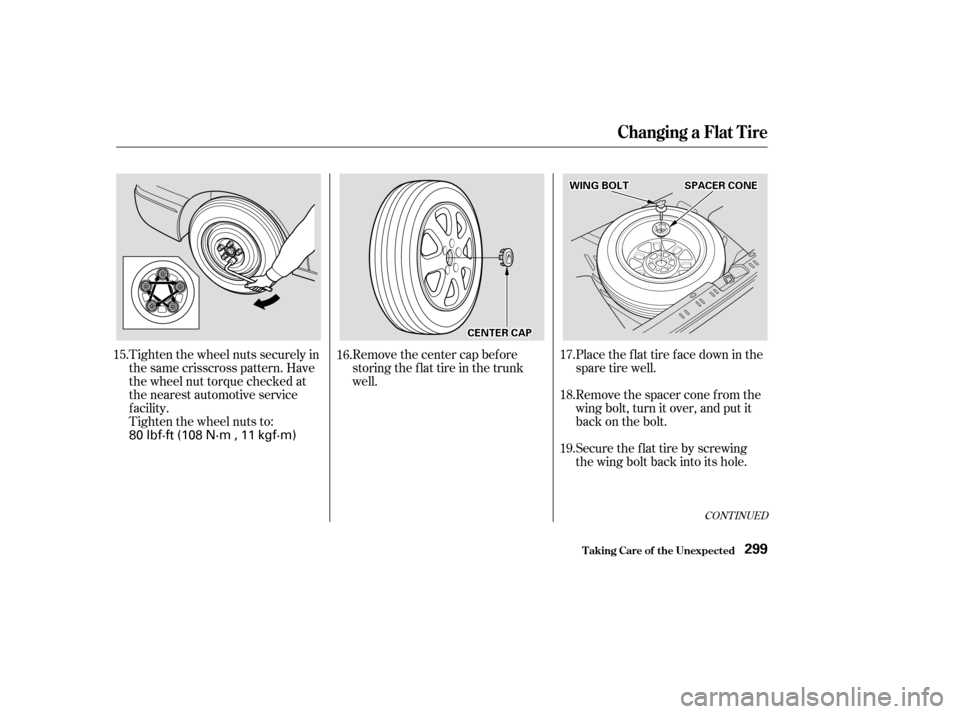
Remove the center cap before
storing the f lat tire in the trunk
well.Place the flat tire face down in the
spare tire well.
Tighten the wheel nuts securely in
the same crisscross pattern. Have
the wheel nut torque checked at
the nearest automotive service
f acility.
Tighten the wheel nuts to: Remove the spacer cone f rom the
wing bolt, turn it over, and put it
back on the bolt.
Secure the f lat tire by screwing
the wing bolt back into its hole.
16.
15.
17.
18.
19.
Changing a Flat T ire
T aking Care of t he Unexpect ed299
C CEEN
NT TE
ER
R C
CAA P
P W
WI
INNG G B
BOOL LT
T S
SPPA
A C
CEER
R C
COON NEE
80 lbf·ft (108 N·m , 11 kgf·m)
Page 303 of 355
Store the jack in its holder. Turn
the jack’s end bracket to lock it in
place. Replace the cover. Store the
tools.Diagnosing why your engine won’t
start f alls into two areas, depending
on what you hear when you turn the
key to START (III):
You hear nothing, or almost
nothing. The engine’s starter
motor does not operate at all, or
operates very slowly.
You can hear the starter motor
operating normally, or the starter
motor sounds like it is spinning
f aster than normal, but the engine
does not start up and run.
Store the center cap in the trunk.
Make sure it does not get scratch-
ed or damaged.
Unhook the handle f rom the trunk
opening and lower the f loor lid.
Close the trunk lid.
20.
21.
22.
23.
Changing a Flat Tire, If Your Engine Won’t Start
T aking Care of t he Unexpect ed
If Your Engine Won’t Start
300
Loose items can fly around the
interior in a crash and could
seriously injure the occupants.
Store the wheel, jack, and tools
securely before driving.
Page 315 of 355

�Î
�Î�Î
�Î
If you must drive the car a short
distance in this condition, drive
slowly and cautiously.
If it comes on at any other time, it
indicates a problem with the car’s
brake system. In most cases, the
problem is a low f luid level in the
brake f luid reservoir. Press lightly on
the brake pedal to see if it f eels
normal. If it does, check the brake
f luid level the next time you stop at a
service station (see page ). If the
fluid level is low, take the car to your
dealer and have the brake system
inspected f or leaks or worn brake
pads. Slow down by shif ting to a lower
gear, and pull to the side of the road
when it is saf e. Because of the
longer distance needed to stop, it is
hazardous to drive the car. You
should have it towed, and repaired as
soon as possible. (See
on page .)
However, if the brake pedal does not
f eel normal, you should take
immediate action. Because of the
brake system’s dual-circuit design, a
problem in one part of the system
will still give you braking at two
wheels. You will f eel the brake pedal
go down much f arther bef ore the car
begins to slow down, and you will
have to press harder on the pedal.
The distance needed to stop will be
much longer. If the ABS indicator and the VSA
system indicator come on with this
indicator, have the car inspected by
your dealer immediately.
The Brake System Indicator
normallycomesonwhenyouturn
the ignition switch ON (II). It is a
reminder to check the parking brake.
It comes on and stays lit if you do not
f ully release the parking brake. 252
320
On Type-S with A/T
Emergency
Towing
Brake System Indicator
T aking Care of t he Unexpect ed312
U U. .SS. .i
inn d
di
icca at too r
r s
shh o
ow
wn n
B
BR
RAA K
KEE S
SYYSSTTE
EM
M I
INND DI
ICCA A T
TO
OR R