Page 20 of 102
INSTRUMENT AND CONTROL FUNCTIONS
3-5
3
EAU00110
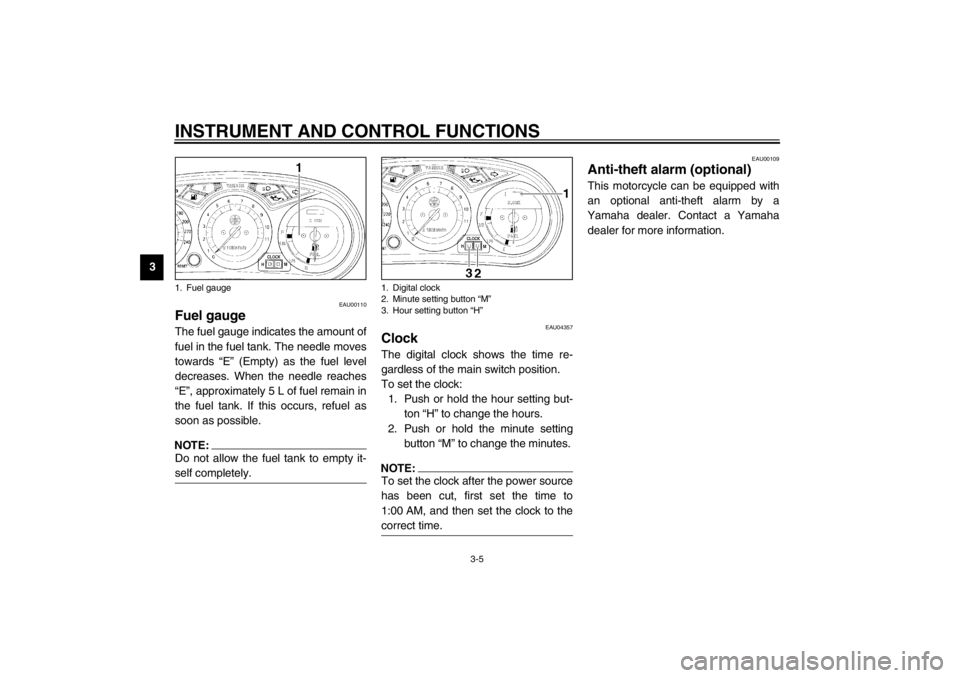
Fuel gauge The fuel gauge indicates the amount of
fuel in the fuel tank. The needle moves
towards “E” (Empty) as the fuel level
decreases. When the needle reaches
“E”, approximately 5 L of fuel remain in
the fuel tank. If this occurs, refuel as
soon as possible.NOTE:@ Do not allow the fuel tank to empty it-
self completely. @
EAU04357
Clock The digital clock shows the time re-
gardless of the main switch position.
To set the clock:
1. Push or hold the hour setting but-
ton “H” to change the hours.
2. Push or hold the minute setting
button “M” to change the minutes.NOTE:_ To set the clock after the power source
has been cut, first set the time to
1:00 AM, and then set the clock to the
correct time. _
EAU00109
Anti-theft alarm (optional) This motorcycle can be equipped with
an optional anti-theft alarm by a
Yamaha dealer. Contact a Yamaha
dealer for more information.
1. Fuel gauge
1. Digital clock
2. Minute setting button “M”
3. Hour setting button “H”
E_4km.book Page 5 Tuesday, August 28, 2001 9:51 AM
Page 22 of 102
INSTRUMENT AND CONTROL FUNCTIONS
3-7
3
EAU03890
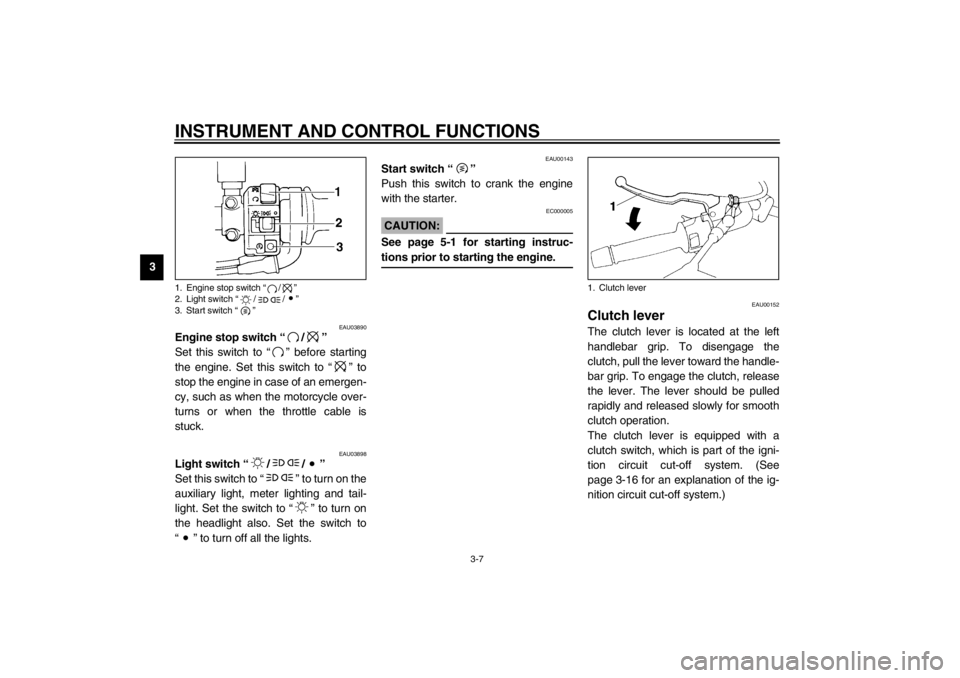
Engine stop switch “/”
Set this switch to “” before starting
the engine. Set this switch to “” to
stop the engine in case of an emergen-
cy, such as when the motorcycle over-
turns or when the throttle cable is
stuck.
EAU03898
Light switch “//”
Set this switch to “” to turn on the
auxiliary light, meter lighting and tail-
light. Set the switch to “” to turn on
the headlight also. Set the switch to
“” to turn off all the lights.
EAU00143
Start switch “”
Push this switch to crank the engine
with the starter.
EC000005
CAUTION:@ See page 5-1 for starting instruc-
tions prior to starting the engine. @
EAU00152
Clutch lever The clutch lever is located at the left
handlebar grip. To disengage the
clutch, pull the lever toward the handle-
bar grip. To engage the clutch, release
the lever. The lever should be pulled
rapidly and released slowly for smooth
clutch operation.
The clutch lever is equipped with a
clutch switch, which is part of the igni-
tion circuit cut-off system. (See
page 3-16 for an explanation of the ig-
nition circuit cut-off system.)
1. Engine stop switch “/”
2. Light switch “//”
3. Start switch “”
1. Clutch lever
E_4km.book Page 7 Tuesday, August 28, 2001 9:51 AM
Page 23 of 102
INSTRUMENT AND CONTROL FUNCTIONS
3-8
3
EAU00157
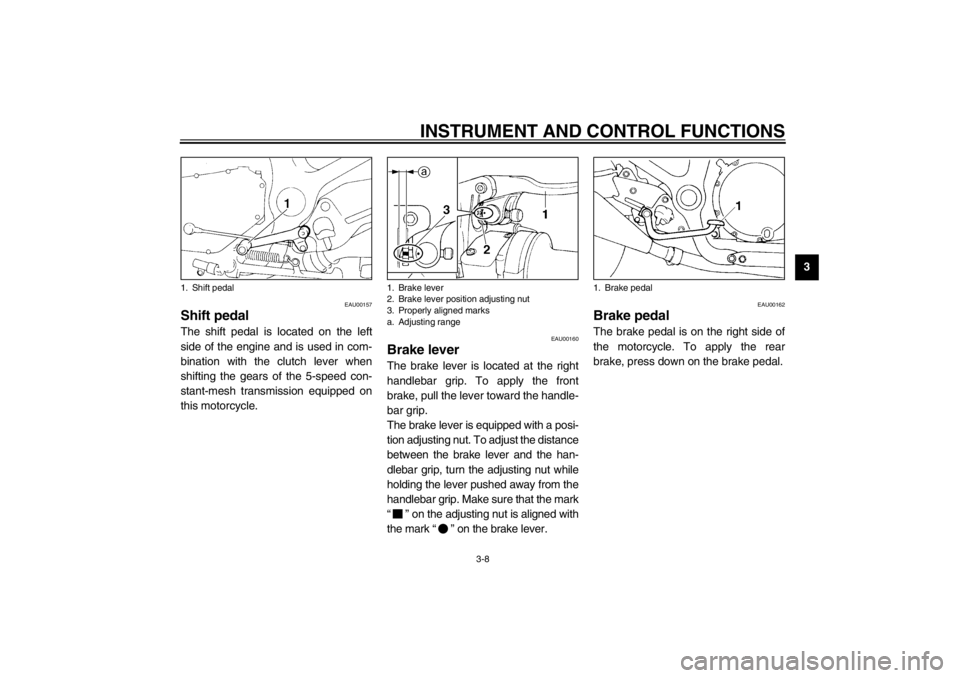
Shift pedal The shift pedal is located on the left
side of the engine and is used in com-
bination with the clutch lever when
shifting the gears of the 5-speed con-
stant-mesh transmission equipped on
this motorcycle.
EAU00160
Brake lever The brake lever is located at the right
handlebar grip. To apply the front
brake, pull the lever toward the handle-
bar grip.
The brake lever is equipped with a posi-
tion adjusting nut. To adjust the distance
between the brake lever and the han-
dlebar grip, turn the adjusting nut while
holding the lever pushed away from the
handlebar grip. Make sure that the mark
“” on the adjusting nut is aligned with
the mark “” on the brake lever.
EAU00162
Brake pedal The brake pedal is on the right side of
the motorcycle. To apply the rear
brake, press down on the brake pedal.
1. Shift pedal
1. Brake lever
2. Brake lever position adjusting nut
3. Properly aligned marks
a. Adjusting range
1. Brake pedal
E_4km.book Page 8 Tuesday, August 28, 2001 9:51 AM
Page 40 of 102
OPERATION AND IMPORTANT RIDING POINTS
5-3
5
EAU01258
Starting a warm engine Follow the same procedure as for start-
ing a cold engine with the exception
that the starter (choke) is not required
when the engine is warm.
EAU00423
Shifting Shifting gears lets you control the
amount of engine power available for
starting off, accelerating, climbing hills,
etc.
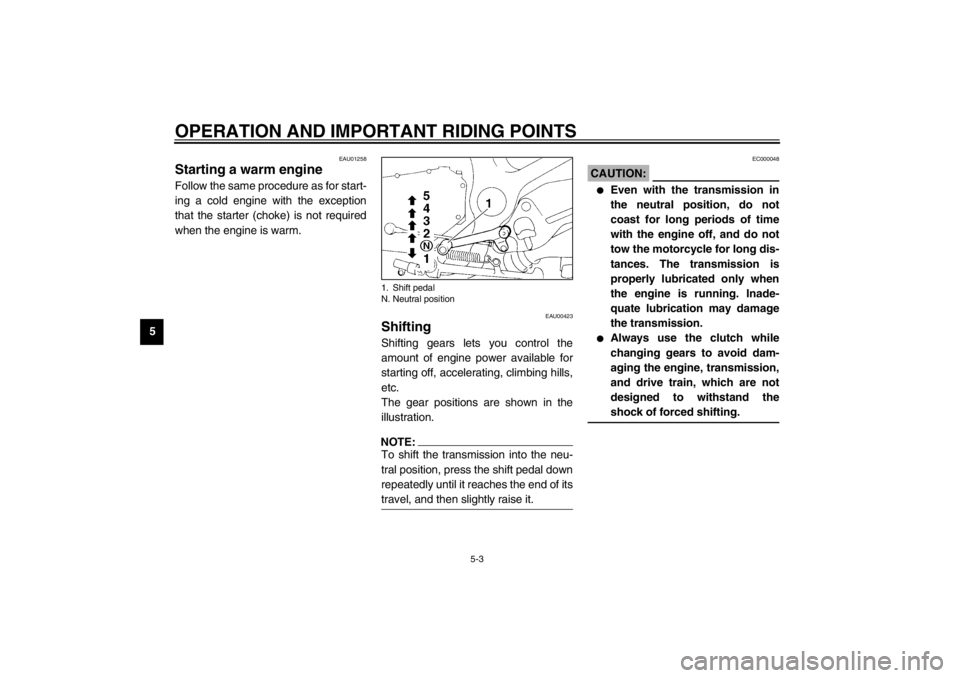
The gear positions are shown in the
illustration.NOTE:@ To shift the transmission into the neu-
tral position, press the shift pedal down
repeatedly until it reaches the end of its
travel, and then slightly raise it. @
EC000048
CAUTION:@ �
Even with the transmission in
the neutral position, do not
coast for long periods of time
with the engine off, and do not
tow the motorcycle for long dis-
tances. The transmission is
properly lubricated only when
the engine is running. Inade-
quate lubrication may damage
the transmission.
�
Always use the clutch while
changing gears to avoid dam-
aging the engine, transmission,
and drive train, which are not
designed to withstand the
shock of forced shifting.
@
1. Shift pedal
N. Neutral position
E_4km.book Page 3 Tuesday, August 28, 2001 9:51 AM