Page 70 of 102
PERIODIC MAINTENANCE AND MINOR REPAIR
6-27
6
EAU02939
Checking the front fork The condition and operation of the front
fork must be checked as follows at the
intervals specified in the periodic main-
tenance and lubrication chart.
To check the condition
EW000115
WARNING
@ Securely support the motorcycle so
that there is no danger of it falling
over. @Check the inner tubes for scratches,
damage and excessive oil leakage.To check the operation
1. Place the motorcycle on a level
surface and hold it in an upright
position.
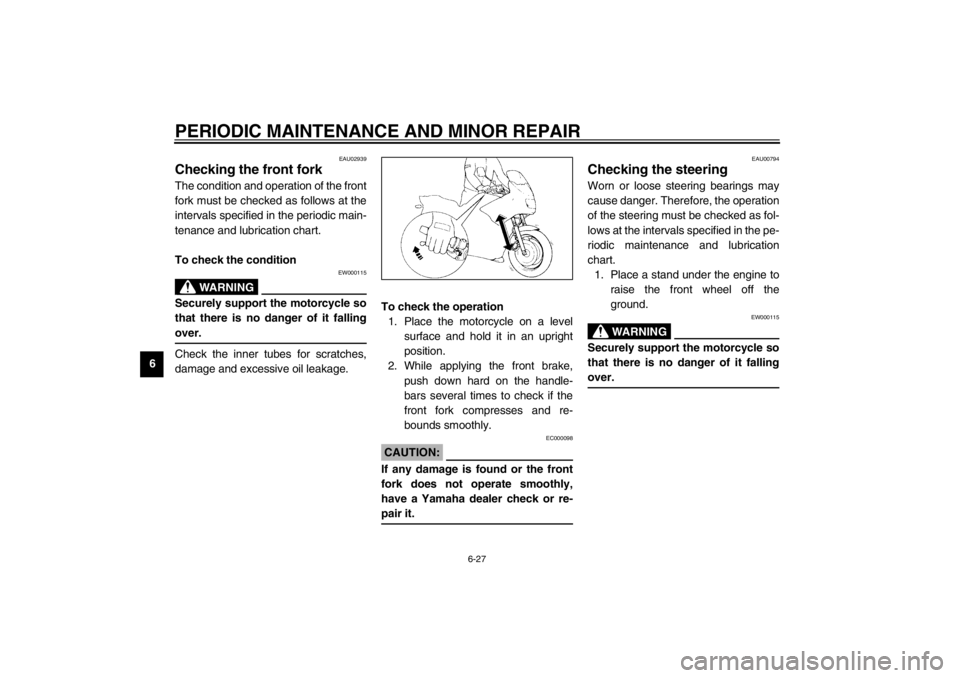
2. While applying the front brake,
push down hard on the handle-
bars several times to check if the
front fork compresses and re-
bounds smoothly.
EC000098
CAUTION:@ If any damage is found or the front
fork does not operate smoothly,
have a Yamaha dealer check or re-
pair it. @
EAU00794
Checking the steering Worn or loose steering bearings may
cause danger. Therefore, the operation
of the steering must be checked as fol-
lows at the intervals specified in the pe-
riodic maintenance and lubrication
chart.
1. Place a stand under the engine to
raise the front wheel off the
ground.
EW000115
WARNING
@ Securely support the motorcycle so
that there is no danger of it falling
over. @
E_4km.book Page 27 Tuesday, August 28, 2001 9:51 AM
Page 72 of 102
PERIODIC MAINTENANCE AND MINOR REPAIR
6-29
6
EAU00800
Battery This motorcycle is equipped with a
sealed-type (MF) battery, which does
not require any maintenance. There is
no need to check the electrolyte or to
add distilled water.
EC000101
CAUTION:@ Never attempt to remove the battery
cell seals, as this would permanent-
ly damage the battery. @
EW000116
WARNING
@ �
Electrolyte is poisonous and
dangerous since it contains sul-
furic acid, which causes severe
burns. Avoid any contact with
skin, eyes or clothing and al-
ways shield your eyes when
working near batteries. In case
of contact, administer the fol-
lowing FIRST AID.
EXTERNAL: Flush with plenty
of water.INTERNAL: Drink large quan-
tities of water or milk and im-
mediately call a physician.
EYES: Flush with water for
15 minutes and seek prompt
medical attention.
�
Batteries produce explosive hy-
drogen gas. Therefore, keep
sparks, flames, cigarettes, etc.,
away from the battery and pro-
vide sufficient ventilation when
charging it in an enclosed
space.
�
KEEP THIS AND ALL BATTER-
IES OUT OF THE REACH OF
CHILDREN.
@To charge the battery
Have a Yamaha dealer charge the bat-
tery as soon as possible if it seems to
have discharged. Keep in mind that the
battery tends to discharge more quickly
if the motorcycle is equipped with op-
tional electrical accessories.To store the battery
1. If the motorcycle will not be used
for more than one month, remove
the battery, fully charge it, and
then place it in a cool, dry place.
2. If the battery will be stored for
more than two months, check it at
least once a month and fully
charge it if necessary.
3. Fully charge the battery before
installation.
4. After installation, make sure that
the battery leads are properly con-
nected to the battery terminals.
E_4km.book Page 29 Tuesday, August 28, 2001 9:51 AM
Page 74 of 102
PERIODIC MAINTENANCE AND MINOR REPAIR
6-31
6
EC000103
CAUTION:_ Do not use a fuse of a higher amper-
age rating than recommended to
avoid causing extensive damage to
the electrical system and possibly a
fire. _3. Turn the key to “ON” and turn on
the electrical circuit in question to
check if the device operates.
4. If the fuse immediately blows
again, have a Yamaha dealer
check the electrical system.
EAU04136
Replacing the headlight bulb This motorcycle is equipped with a
quartz bulb headlight. If the headlight
bulb burns out, replace it as follows.
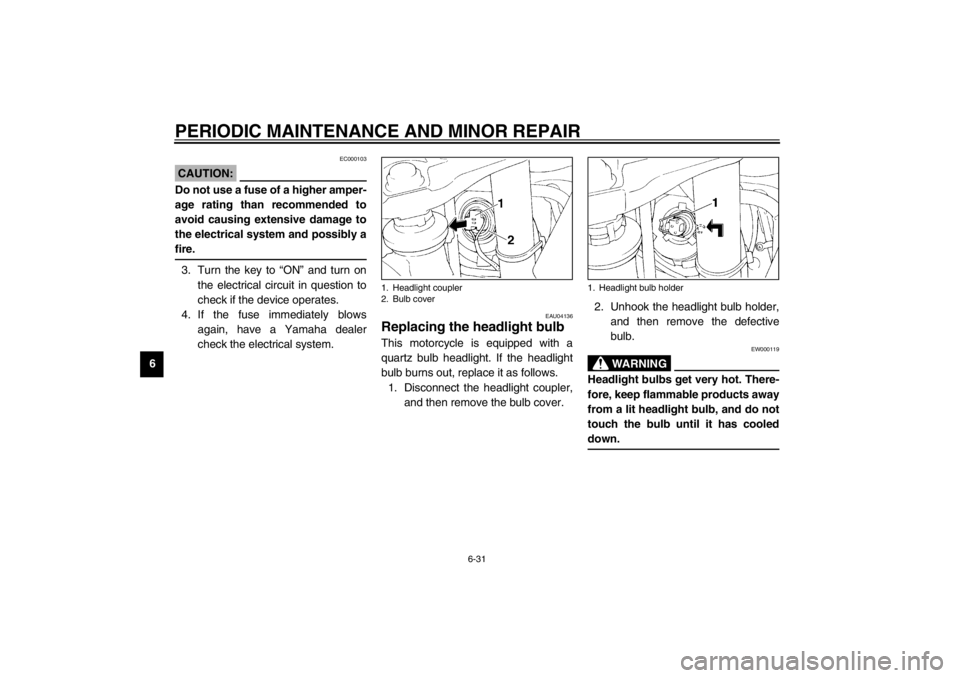
1. Disconnect the headlight coupler,
and then remove the bulb cover.2. Unhook the headlight bulb holder,
and then remove the defective
bulb.
EW000119
WARNING
_ Headlight bulbs get very hot. There-
fore, keep flammable products away
from a lit headlight bulb, and do not
touch the bulb until it has cooled
down. _
1. Headlight coupler
2. Bulb cover
1. Headlight bulb holder
E_4km.book Page 31 Tuesday, August 28, 2001 9:51 AM
Page 76 of 102
PERIODIC MAINTENANCE AND MINOR REPAIR
6-33
6
EAU03598
Front wheel To remove the front wheel
EW000122
WARNING
@ �
It is advisable to have a Yamaha
dealer service the wheel.
�
Securely support the motor-
cycle so that there is no danger
of it falling over.
@1. Place the motorcycle on the
centerstand.
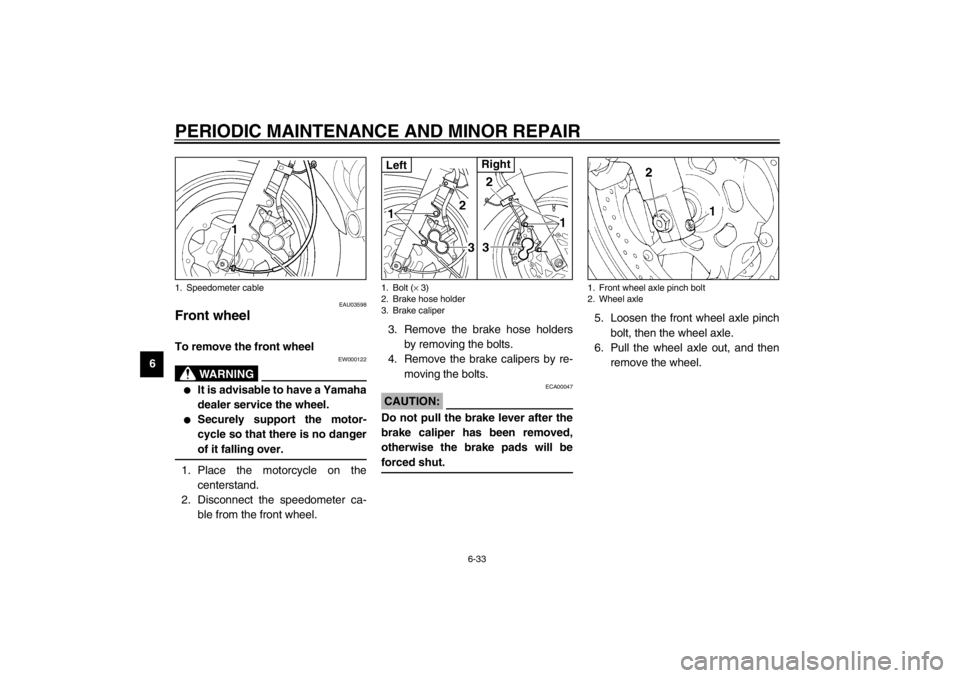
2. Disconnect the speedometer ca-
ble from the front wheel.3. Remove the brake hose holders
by removing the bolts.
4. Remove the brake calipers by re-
moving the bolts.
ECA00047
CAUTION:@ Do not pull the brake lever after the
brake caliper has been removed,
otherwise the brake pads will be
forced shut. @
5. Loosen the front wheel axle pinch
bolt, then the wheel axle.
6. Pull the wheel axle out, and then
remove the wheel.
1. Speedometer cable
1. Bolt (× 3)
2. Brake hose holder
3. Brake caliperLeft
Right
1. Front wheel axle pinch bolt
2. Wheel axle
E_4km.book Page 33 Tuesday, August 28, 2001 9:51 AM
Page 78 of 102
PERIODIC MAINTENANCE AND MINOR REPAIR
6-35
6
EAU04361
Rear wheel To remove the rear wheel
EW000122
WARNING
_ �
It is advisable to have a Yamaha
dealer service the wheel.
�
Securely support the motor-
cycle so that there is no danger
of it falling over.
_
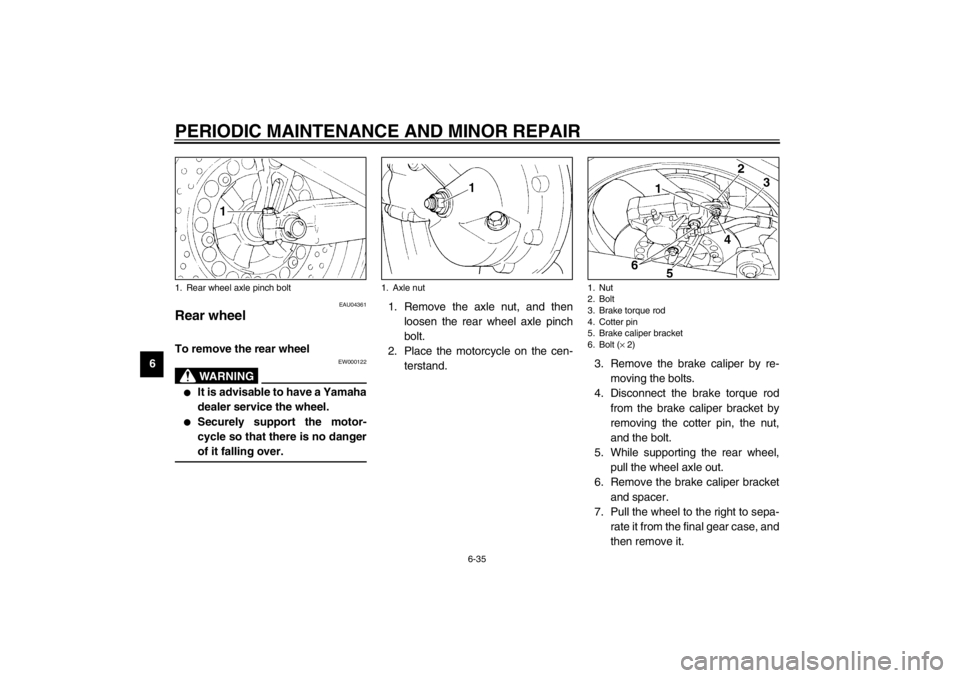
1. Remove the axle nut, and then
loosen the rear wheel axle pinch
bolt.
2. Place the motorcycle on the cen-
terstand.3. Remove the brake caliper by re-
moving the bolts.
4. Disconnect the brake torque rod
from the brake caliper bracket by
removing the cotter pin, the nut,
and the bolt.
5. While supporting the rear wheel,
pull the wheel axle out.
6. Remove the brake caliper bracket
and spacer.
7. Pull the wheel to the right to sepa-
rate it from the final gear case, and
then remove it.
1. Rear wheel axle pinch bolt
1. Axle nut
1. Nut
2. Bolt
3. Brake torque rod
4. Cotter pin
5. Brake caliper bracket
6. Bolt (× 2)
E_4km.book Page 35 Tuesday, August 28, 2001 9:51 AM
Page 80 of 102
PERIODIC MAINTENANCE AND MINOR REPAIR
6-37
68. Install the brake torque rod cotter
pin.
EW000124
WARNING
_ Always use a new cotter pin. _
EAU01008
Troubleshooting Although Yamaha motorcycles receive
a thorough inspection before shipment
from the factory, trouble may occur dur-
ing operation. Any problem in the fuel,
compression, or ignition systems, for
example, can cause poor starting and
loss of power.
The following troubleshooting chart
represents a quick and easy procedure
for checking these vital systems your-
self. However, should your motorcycle
require any repair, take it to a Yamaha
dealer, whose skilled technicians have
the necessary tools, experience, and
know-how to service the motorcycle
properly.
Use only genuine Yamaha replace-
ment parts. Imitation parts may look
like Yamaha parts, but they are often
inferior, have a shorter service life and
can lead to expensive repair bills.
E_4km.book Page 37 Tuesday, August 28, 2001 9:51 AM
Page 81 of 102

PERIODIC MAINTENANCE AND MINOR REPAIR
6-38
6
EAU01297
Troubleshooting chart
EW000125
WARNING
@ Keep away open flames and do not smoke while checking or working on the fuel system. @
Check the fuel level in
the fuel tank.1. Fuel
There is enough fuel.
There is no fuel.
Check the compression.
Supply fuel.
The engine does not start.
Check the compression.
Operate the electric starter.2. Compression
There is compression.
There is no compression.
Check the ignition.
Have a Yamaha dealer
check the vehicle.
Remove the spark plugs
and check the electrodes.3. Ignition
Wipe off with a dry cloth and correct the
spark plug gaps, or replace the spark plugs.
Have a Yamaha dealer check the vehicle.
The engine does not start.
Have a Yamaha dealer
check the vehicle.
The engine does not start.
Check the battery.
Operate the electric starter.4. Battery
The engine turns over
quickly.
The engine turns over
slowly.
The battery is good.Check the battery lead connections,
and charge the battery if necessary.
DryWet
Open the throttle halfway and operate
the electric starter.
E_4km.book Page 38 Tuesday, August 28, 2001 9:51 AM
Page 86 of 102
MOTORCYCLE CARE AND STORAGE
7-3
7After cleaning
1. Dry the motorcycle with a chamois
or an absorbing cloth.
2. Use a chrome polish to shine
chrome, aluminum and stainless-
steel parts, including the exhaust
system. (Even the thermally in-
duced discoloring of stainless-
steel exhaust systems can be re-
moved through polishing.)
3. To prevent corrosion, it is recom-
mended to apply a corrosion pro-
tection spray on all metal,
including chrome- and nickel-plat-
ed, surfaces.
4. Use spray oil as a universal clean-
er to remove any remaining dirt.
5. Touch up minor paint damage
caused by stones, etc.
6. Wax all painted surfaces.
7. Let the motorcycle dry completely
before storing or covering it.
EWA00031
WARNING
@ �
Make sure that there is no oil or
wax on the brakes or tires.
�
If necessary, clean the brake
discs and brake linings with a
regular brake disc cleaner or ac-
etone, and wash the tires with
warm water and a mild deter-
gent. Before riding at higher
speeds, test the motorcycle’s
braking performance and cor-
nering behavior.
@
ECA00013
CAUTION:@ �
Apply spray oil and wax spar-
ingly and make sure to wipe off
any excess.
�
Never apply oil or wax to any
rubber and plastic parts, but
treat them with a suitable care
product.
�
Avoid using abrasive polishing
compounds as they will wear
away the paint.
@NOTE:@ Consult a Yamaha dealer for advice on
what products to use. @
E_4km.book Page 3 Tuesday, August 28, 2001 9:51 AM