Page 75 of 102
PERIODIC MAINTENANCE AND MINOR REPAIR
6-32
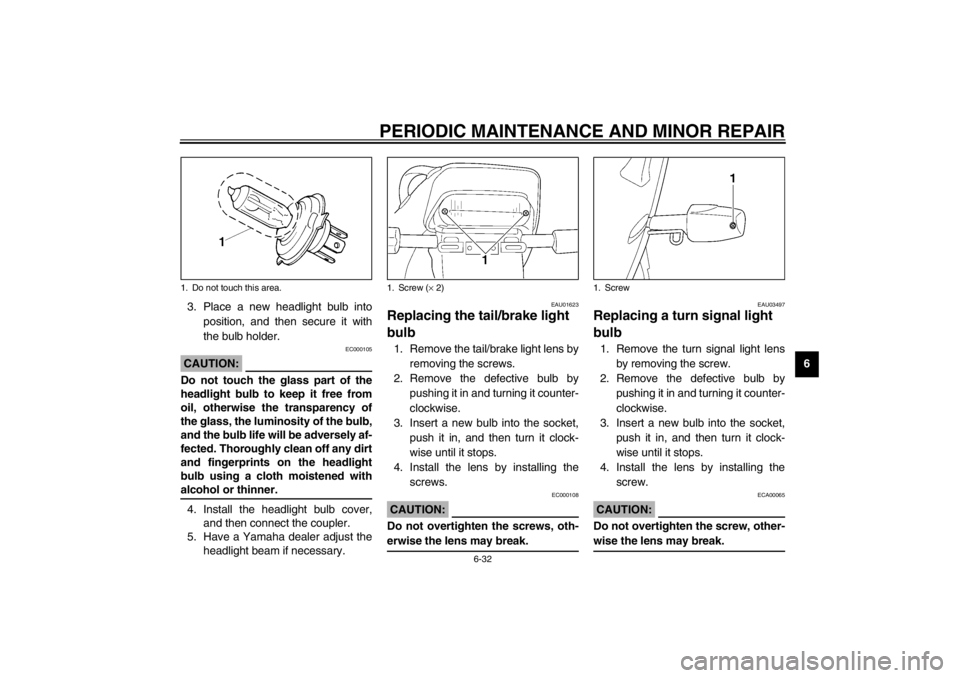
6 3. Place a new headlight bulb into
position, and then secure it with
the bulb holder.
EC000105
CAUTION:_ Do not touch the glass part of the
headlight bulb to keep it free from
oil, otherwise the transparency of
the glass, the luminosity of the bulb,
and the bulb life will be adversely af-
fected. Thoroughly clean off any dirt
and fingerprints on the headlight
bulb using a cloth moistened with
alcohol or thinner. _4. Install the headlight bulb cover,
and then connect the coupler.
5. Have a Yamaha dealer adjust the
headlight beam if necessary.
EAU01623
Replacing the tail/brake light
bulb 1. Remove the tail/brake light lens by
removing the screws.
2. Remove the defective bulb by
pushing it in and turning it counter-
clockwise.
3. Insert a new bulb into the socket,
push it in, and then turn it clock-
wise until it stops.
4. Install the lens by installing the
screws.
EC000108
CAUTION:_ Do not overtighten the screws, oth-
erwise the lens may break. _
EAU03497
Replacing a turn signal light
bulb 1. Remove the turn signal light lens
by removing the screw.
2. Remove the defective bulb by
pushing it in and turning it counter-
clockwise.
3. Insert a new bulb into the socket,
push it in, and then turn it clock-
wise until it stops.
4. Install the lens by installing the
screw.
ECA00065
CAUTION:_ Do not overtighten the screw, other-
wise the lens may break. _
1. Do not touch this area.
1. Screw (× 2)
1. Screw
E_4km.book Page 32 Tuesday, August 28, 2001 9:51 AM
Page 84 of 102
7-1
7
EAU03412
7-MOTORCYCLE CARE AND STORAGECare While the open design of a motorcycle
reveals the attractiveness of the tech-
nology, it also makes it more vulnera-
ble. Rust and corrosion can develop
even if high-quality components are
used. A rusty exhaust pipe may go un-
noticed on a car, however, it detracts
from the overall appearance of a
motorcycle. Frequent and proper care
does not only comply with the terms of
the warranty, but it will also keep your
motorcycle looking good, extend its life
and optimize its performance.Before cleaning
1. Cover the muffler outlets with plas-
tic bags after the engine has
cooled down.
2. Make sure that all caps and covers
as well as all electrical couplers
and connectors, including the
spark plug caps, are tightly in-
stalled.
3. Remove extremely stubborn dirt,
like oil burnt onto the crankcase,
with a degreasing agent and a
brush, but never apply such prod-
ucts onto seals, gaskets and
wheel axles. Always rinse the dirt
and degreaser off with water.Cleaning
ECA00010
CAUTION:@ �
Avoid using strong acidic wheel
cleaners, especially on spoked
wheels. If such products are
used on hard-to-remove dirt, do
not leave the cleaner on the af-
fected area any longer than in-
structed. Also, thoroughly rinse
the area off with water, immedi-
ately dry it, and then apply a
corrosion protection spray.
�
Improper cleaning can damage
windshields, cowlings, panels
and other plastic parts. Use
only a soft, clean cloth or
sponge with mild detergent and
water to clean plastic.
E_4km.book Page 1 Tuesday, August 28, 2001 9:51 AM
Page 86 of 102
MOTORCYCLE CARE AND STORAGE
7-3
7After cleaning
1. Dry the motorcycle with a chamois
or an absorbing cloth.
2. Use a chrome polish to shine
chrome, aluminum and stainless-
steel parts, including the exhaust
system. (Even the thermally in-
duced discoloring of stainless-
steel exhaust systems can be re-
moved through polishing.)
3. To prevent corrosion, it is recom-
mended to apply a corrosion pro-
tection spray on all metal,
including chrome- and nickel-plat-
ed, surfaces.
4. Use spray oil as a universal clean-
er to remove any remaining dirt.
5. Touch up minor paint damage
caused by stones, etc.
6. Wax all painted surfaces.
7. Let the motorcycle dry completely
before storing or covering it.
EWA00031
WARNING
@ �
Make sure that there is no oil or
wax on the brakes or tires.
�
If necessary, clean the brake
discs and brake linings with a
regular brake disc cleaner or ac-
etone, and wash the tires with
warm water and a mild deter-
gent. Before riding at higher
speeds, test the motorcycle’s
braking performance and cor-
nering behavior.
@
ECA00013
CAUTION:@ �
Apply spray oil and wax spar-
ingly and make sure to wipe off
any excess.
�
Never apply oil or wax to any
rubber and plastic parts, but
treat them with a suitable care
product.
�
Avoid using abrasive polishing
compounds as they will wear
away the paint.
@NOTE:@ Consult a Yamaha dealer for advice on
what products to use. @
E_4km.book Page 3 Tuesday, August 28, 2001 9:51 AM
Page 87 of 102
MOTORCYCLE CARE AND STORAGE
7-4
7
Storage Short-term
Always store your motorcycle in a cool,
dry place and, if necessary, protect it
against dust with a porous cover.
ECA00014
CAUTION:@ �
Storing the motorcycle in a
poorly ventilated room or cover-
ing it with a tarp, while it is still
wet, will allow water and humid-
ity to seep in and cause rust.
�
To prevent corrosion, avoid
damp cellars, stables (because
of the presence of ammonia)
and areas where strong chemi-
cals are stored.
@
Long-term
Before storing your motorcycle for
several months:
1. Follow all the instructions in the
“Care” section of this chapter.
2. For motorcycles equipped with a
fuel cock that has an “OFF” posi-
tion: Turn the fuel cock lever to
“OFF”.
3. Drain the carburetor float cham-
bers by loosening the drain bolts;
this will prevent fuel deposits from
building up. Pour the drained fuel
into the fuel tank.
4. Fill up the fuel tank and add fuel
stabilizer (if available) to prevent
the fuel tank from rusting and the
fuel from deteriorating.
5. Perform the following steps to pro-
tect the cylinders, piston rings, etc.
from corrosion.a. Remove the spark plug caps and
spark plugs.
b. Pour a teaspoonful of engine oil
into each spark plug bore.
c. Install the spark plug caps onto the
spark plugs, and then place the
spark plugs on the cylinder head
so that the electrodes are ground-
ed. (This will limit sparking during
the next step.)
d. Turn the engine over several times
with the starter. (This will coat the
cylinder walls with oil.)
e. Remove the spark plug caps from
the spark plugs, and then install
the spark plugs and the spark plug
caps.
EWA00003
WARNING
@ To prevent damage or injury from
sparking, make sure to ground the
spark plug electrodes while turning
the engine over. @
E_4km.book Page 4 Tuesday, August 28, 2001 9:51 AM
Page 90 of 102

8-1
8
EAU01038
8-SPECIFICATIONSSpecifications CS-01E
Model XJ900S
Dimensions
Overall length 2,230 mm
Overall width 750 mm
Overall height 1,300 mm
Seat height 795 mm
Wheelbase 1,505 mm
Ground clearance 130 mm
Minimum turning radius 3,000 mm
Basic weight (with oil and full
fuel tank)
265 kg
Engine
Engine type Air-cooled 4-stroke, DOHC
Cylinder arrangement Forward-inclined parallel
4-cylinder
Displacement 892 cm
3
Bore × Stroke 68.5 × 60.5 mm
Compression ratio 10:1
Starting system Electric starter
Lubrication system Wet sumpEngine oil
Ty p e
Recommended engine oil
classification API Service SE, SF, SG or
higher
Quantity
Without oil filter cartridge
replacement 3.2 L
With oil filter car tridge
replacement 3.4 L
Total amount (dry engine) 4.4 L
-20 -10 0
10 20 30
40
50 ˚C
SAE 10W-30
SAE 15W-40SAE 20W-40SAE 20W-50
SAE 10W-40
CAUTION:Be sure to use motor oils that do not contain anti-friction
modifiers. Passenger car motor oils (often labeled
“ENERGY CONSERVING II”) contain anti-friction additives
which will cause clutch and/or starter clutch slippage, result-
ing in reduced component life and poor engine performance.
E_4km.book Page 1 Tuesday, August 28, 2001 9:51 AM
Page 91 of 102

SPECIFICATIONS
8-2
8
Final gear oil
Type Hypoid gear oil SAE 80 (API GL4)
or multi-grade hypoid gear oil
SAE 80W-90
Quantity 0.2 L
Air filterDry element
Fuel
Type REGULAR UNLEADED
GASOLINE ONLY
Fuel tank capacity 24 L
Fuel reserve amount 5 L
Carburetor
Manufacturer MIKUNI
Model ×
quantity BDSR34 × 4
Spark plug
Manufacturer/model NGK / DPR8EA-9 or
DENSO / X24EPR-U9
Gap 0.8–0.9 mm
Clutch typeWet, multiple-disc
Transmission
Primary reduction system Spur gear
Primary reduction ratio 1.672
Secondary reduction system Shaft drive
Secondary reduction ratio 1.278
Transmission type Constant-mesh, 5-speedOperation Left foot
Gear ratio
1st 2.188
2nd 1.500
3rd 1.154
4th 0.933
5th 0.813
Chassis
Frame type Double cradle
Caster angle 27°
°° °
Trail 121 mm
Tire
Front
Type Tubeless tire
Size 120/70-17 58V
120/70-17 M/C 58V
Manufacturer/
model Dunlop / K505F
Metzeler / ME33
Bridgestone / G601
Rear
Type Tubeless tire
Size 150/70-17 69V
150/70-17 M/C 69V
E_4km.book Page 2 Tuesday, August 28, 2001 9:51 AM
Page 92 of 102

SPECIFICATIONS
8-3
8
Manufacturer/
model Dunlop / K505
Metzeler / ME55A
Bridgestone / G602
Maximum load* 205 kg
Tire air pressure (measured
on cold tires)
up to 90 kg*
Front 225 kPa (2.25 kgf/cm
2, 2.25 bar)
Rear 250 kPa (2.50 kgf/cm2, 2.50 bar)
90 kg–maximum*
Front 250 kPa (2.50 kgf/cm2, 2.50 bar)
Rear 290 kPa (2.90 kgf/cm2, 2.90 bar)
High-speed riding
Front 250 kPa (2.50 kgf/cm2, 2.50 bar)
Rear 290 kPa (2.90 kgf/cm2, 2.90 bar)
* Total weight of rider, passenger, cargo and accessories
Wheels
Front
Type Cast wheel
Size 17 × MT 3.00
17 M/C × MT 3.00
Rear
Type Cast wheel
Size 17 × MT 4.00
17 M/C × MT 4.00Brakes
Fr o n t
Type Dual disc brake
Operation Right hand
Fluid DOT 4
Rear
Type Single disc brake
Operation Right foot
Fluid DOT 4
Suspension
Front Telescopic fork
Rear Swingarm (link suspension)
Spring/shock absorber
Front Coil spring / oil damper
Rear Coil spring / gas-oil damper
Wheel travel
Front 140 mm
Rear 110 mm
Electrical systems
Ignition system T.C.I. (digital)
Charging system
Model A.C. generator
Standard output 13.5 V, 34 A @ 5,000 r/min
Battery
Model YTX14-BS
E_4km.book Page 3 Tuesday, August 28, 2001 9:51 AM
Page 93 of 102
SPECIFICATIONS
8-4
8
Voltage, capacity 12 V, 12 Ah
Headlight typeQuar tz bulb (halogen)
Bulb voltage, wattage × quantity
Headlight 12 V, 60/55 W × 1
Tail/brake light 12 V, 5/21 W × 1
Auxiliary light 12 V, 4 W × 1
Turn signal light 12 V, 21 W × 4
Meter lighting 12 V, 3.4 W × 4
Neutral indicator light 12 V, 3.4 W × 1
High beam indicator light 12 V, 3.4 W × 1
Oil level warning light 12 V, 3.4 W × 1
Turn signal indicator light 12 V, 3.4 W × 2
Fuel level warning light 12 V, 3.4 W × 1
Fuses
Main fuse 30 A
Signaling system fuse 20 A
Headlight fuse 15 A
Hazard fuse 10 A
Ignition fuse 10 A
Clock fuse 10 A
E_4km.book Page 4 Tuesday, August 28, 2001 9:51 AM