Page 66 of 106

3-31
E
EJU01296
Post-operation checks
Always perform the following post-opera-
tion checks after operating the watercraft.
1. Remove the watercraft from the water.
2. Wash down the hull, steering pole, han-
dlebars, and jet unit with fresh water.
3. Remove the hood and check the engine
compartment for water. To drain excess
water, turn the watercraft on its port (left)
side. If necessary, turn the watercraft
upside down to drain water completely.
CAUTION:@ �Place a suitable clean cloth or carpet-
ing underneath the watercraft to pro-
tect it from abrasions and scratches.
�Always turn the watercraft over onto
its port (left) side.
�When turning the watercraft onto its
side or inverting it, support the bow
and secure the steering pole, other-
wise the steering pole and handlebars
could be bent or damaged.
@
NOTE:@ This watercraft is equipped with an auto-
matic bilge-draining system that removes
water from the engine compartment while
you are underway. However, some residual
water will remain.
@
4. Put the watercraft in a horizontal posi-
tion.
5. Flush the cooling system to prevent it
from clogging with salt, sand, or dirt.
(See pages 4-1 to 4-2 for flushing the
cooling system procedures.)
6. Drain residual water from the exhaust
system by alternately squeezing and
releasing the throttle lever for 10 to
15 seconds while the engine is running.
E_F1N-70.book Page 31 Wednesday, July 18, 2001 3:28 PM
Page 68 of 106
3-33
E
EJU01297
Transporting
WARNING@ Always place the fuel cock knob in the
“OFF” position when transporting the
watercraft, otherwise fuel could leak out
into the engine or engine compartment,
which would create a fire hazard.
@
Transport this watercraft using the special
trailer that incorporates a hole into which the
pin 1 can be inserted and locked after
passing it through the rope hole 2.
After securing the bow with the pin,
secure the stern with ropes or tie downs 2
over the gunwale. Use a rubber shock
cord1 to hold the steering pole.
CAUTION:@ �Do not route ropes or tie downs over
the steering pole, as they may damage
it. Also, wrap the ropes or tie downs
with towels or rags where they touch
the body of the watercraft to avoid
scratching or damage.
�Do not transport the watercraft with
steering pole up, or the steering pole
may be damaged during transporta-
tion.
@
E_F1N-70.book Page 33 Wednesday, July 18, 2001 3:28 PM
Page 72 of 106
4-3
E
EJU01299
Lubrication
WARNING@ To reduce the risk of fire or explosion:
Never pour or spray gasoline, or any sub-
stance other than a rust inhibitor through
the hole in the carburetor silencer cover.
@
CAUTION:@ �Make sure to replace the cap securely
after fogging the engine, otherwise
water could enter the engine and
cause damage.
�Do not attempt to run the engine at full
throttle or for more than 15 seconds
while the watercraft is out of the water,
otherwise the engine may overheat
and/or seize.
@
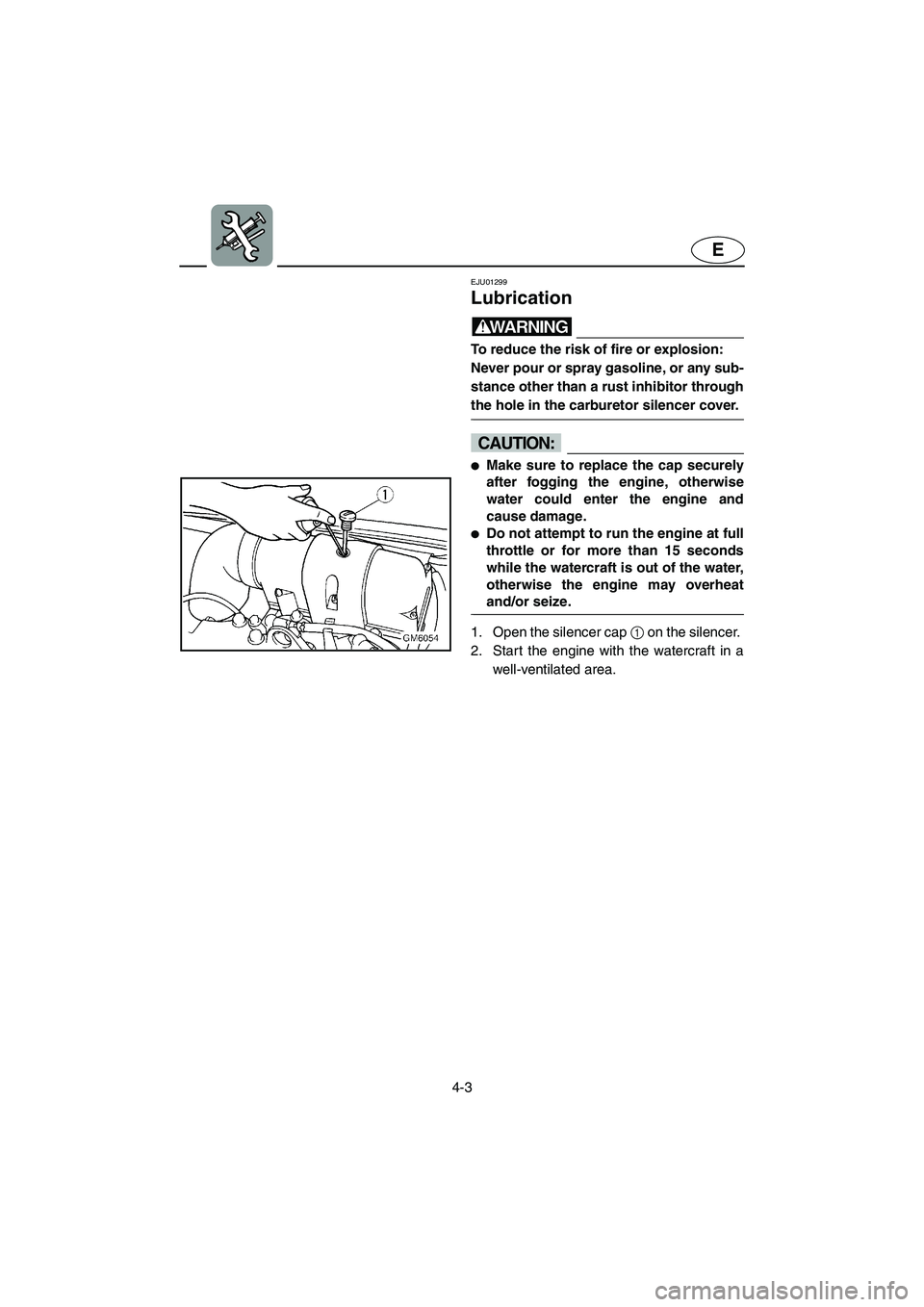
1. Open the silencer cap 1 on the silencer.
2. Start the engine with the watercraft in a
well-ventilated area.
E_F1N-70.book Page 3 Wednesday, July 18, 2001 3:28 PM
Page 73 of 106
4-4
E
3. With the engine running at a fast idle,
quickly spray as much rust inhibitor as
possible through the hole in the silencer
cover. Keep spraying until the engine
stalls (or a maximum of 15 seconds).
4. Install the cap securely.
5. Lubricate all cables such as the throttle,
choke, and steering cables.
NOTE:@ Use a suitable marine grease applicator to
pressure lubricate the cables and purge out
any moisture between the inner and outer
cables.
@
6. Lubricate the areas of the watercraft
specified under Lubrication points on
page 4-14–4-16.
E_F1N-70.book Page 4 Wednesday, July 18, 2001 3:28 PM
Page 83 of 106
4-14
E
NOTE:@ �Wipe off any water on the spark plug or
inside the cap before installing the spark
plug cap. Push the spark plug cap down
until it clicks.
�If a torque wrench is not available when
you are fitting a new spark plug, a good
estimate of the correct torque is 1/4 turn
to 1/2 turn past finger tight. Have the
spark plug adjusted to the correct torque
with a torque wrench as soon as possible.
@
WARNING@ Be careful not to damage the insulator
when removing or installing a spark plug.
A damaged insulator could allow sparks
to escape, which could lead to explosion
or fire.
@
EJU01302
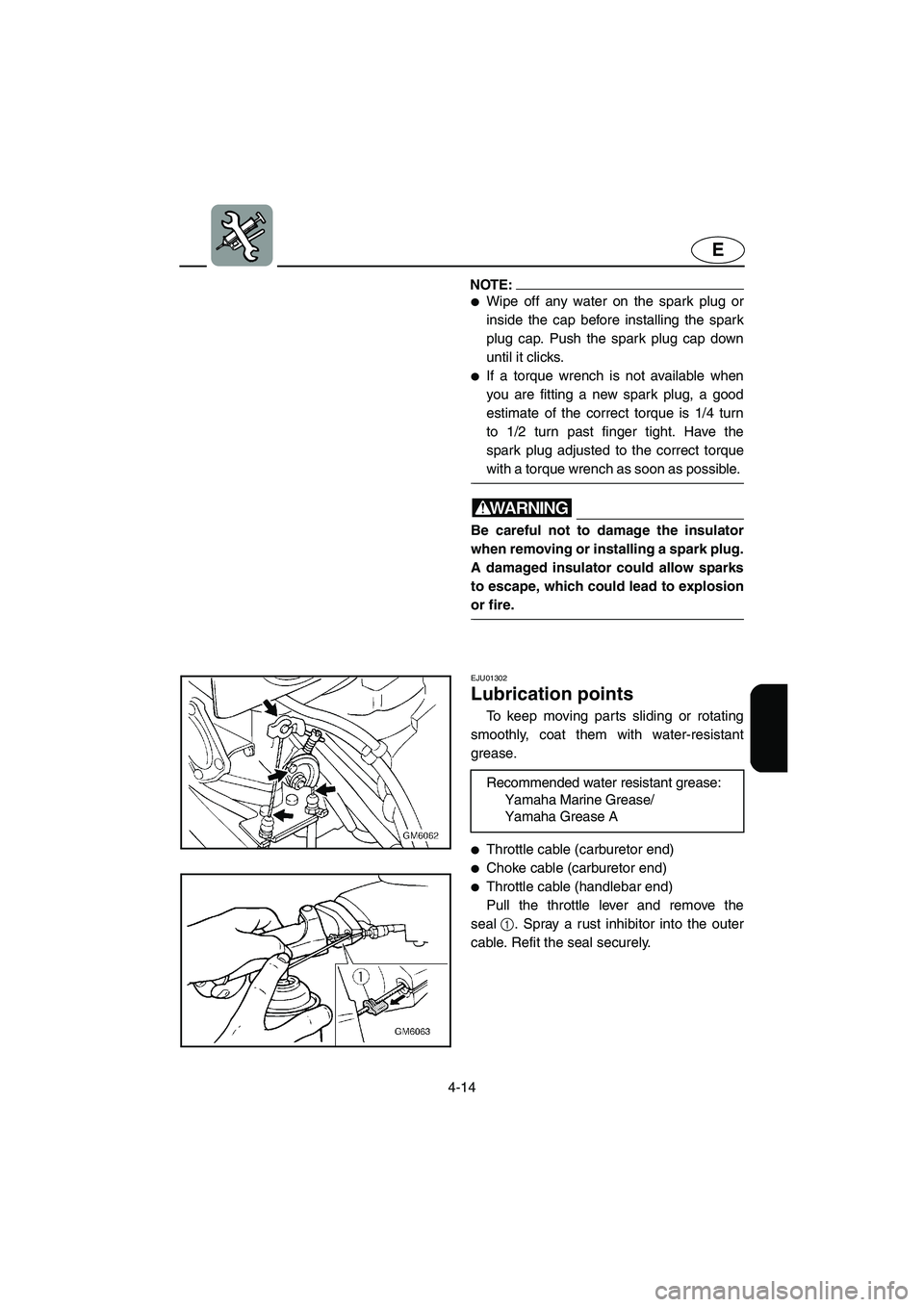
Lubrication points
To keep moving parts sliding or rotating
smoothly, coat them with water-resistant
grease.
�Throttle cable (carburetor end)
�Choke cable (carburetor end)
�Throttle cable (handlebar end)
Pull the throttle lever and remove the
seal1. Spray a rust inhibitor into the outer
cable. Refit the seal securely. Recommended water resistant grease:
Yamaha Marine Grease/
Yamaha Grease A
E_F1N-70.book Page 14 Wednesday, July 18, 2001 3:28 PM
Page 86 of 106
4-17
E
EJU01108
Inspecting the battery
Check the level of the battery electrolyte
and make sure the leads are secure.
WARNING@ Battery electrolyte is poisonous and dan-
gerous, causing severe burns, etc. Elec-
trolyte contains sulfuric acid. Avoid
contact with skin, eyes or clothing.
Antidotes
External: Flush with water.
Internal: Drink large quantities of water
or milk. Follow with milk of magnesia,
beaten egg or vegetable oil. Call physi-
cian immediately.
Eyes: Flush with water for 15 minutes
and get prompt medical attention.
Batteries produce explosive gases. Keep
sparks, flame, cigarettes, etc., well away.
If using or charging the battery in an
enclosed space, make sure that it is well
ventilated. Always shield your eyes when
working near batteries.
KEEP OUT OF THE REACH OF CHIL-
DREN.
@
CAUTION:@ Be careful not to place the battery on its
side.
Make sure to remove the battery from the
battery compartment when adding bat-
tery electrolyte or charging the battery.
When checking the battery, make sure
the breather hose is connected to the
battery and not obstructed.
@
E_F1N-70.book Page 17 Wednesday, July 18, 2001 3:28 PM
Page 87 of 106
4-18
E
To replenish the battery:
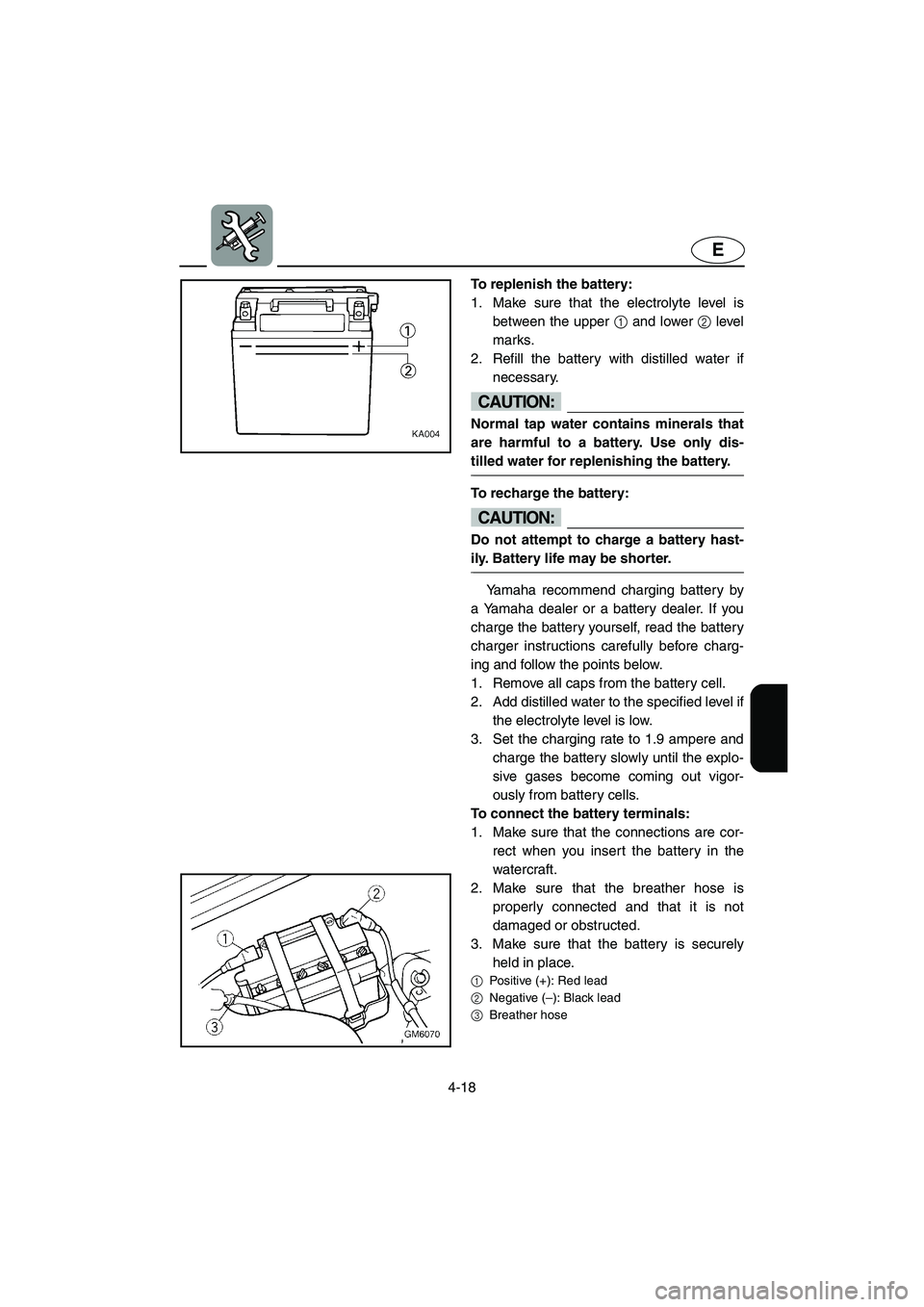
1. Make sure that the electrolyte level is
between the upper 1 and lower 2 level
marks.
2. Refill the battery with distilled water if
necessary.
CAUTION:@ Normal tap water contains minerals that
are harmful to a battery. Use only dis-
tilled water for replenishing the battery.
@
To recharge the battery:
CAUTION:@ Do not attempt to charge a battery hast-
ily. Battery life may be shorter.
@
Yamaha recommend charging battery by
a Yamaha dealer or a battery dealer. If you
charge the battery yourself, read the battery
charger instructions carefully before charg-
ing and follow the points below.
1. Remove all caps from the battery cell.
2. Add distilled water to the specified level if
the electrolyte level is low.
3. Set the charging rate to 1.9 ampere and
charge the battery slowly until the explo-
sive gases become coming out vigor-
ously from battery cells.
To connect the battery terminals:
1. Make sure that the connections are cor-
rect when you insert the battery in the
watercraft.
2. Make sure that the breather hose is
properly connected and that it is not
damaged or obstructed.
3. Make sure that the battery is securely
held in place.
1Positive (+): Red lead
2Negative (–): Black lead
3Breather hose
E_F1N-70.book Page 18 Wednesday, July 18, 2001 3:28 PM
Page 91 of 106
4-22
E
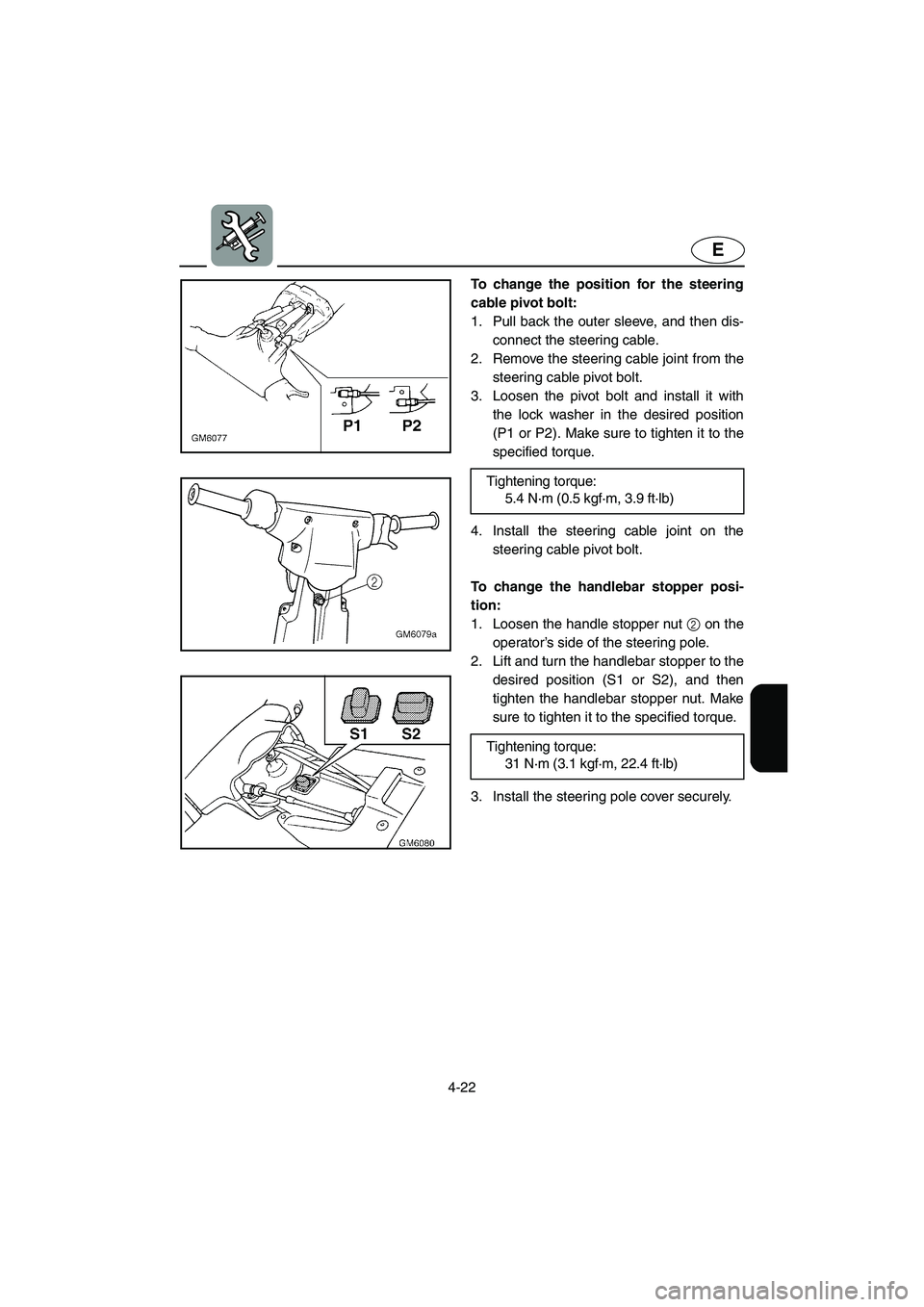
To change the position for the steering
cable pivot bolt:
1. Pull back the outer sleeve, and then dis-
connect the steering cable.
2. Remove the steering cable joint from the
steering cable pivot bolt.
3. Loosen the pivot bolt and install it with
the lock washer in the desired position
(P1 or P2). Make sure to tighten it to the
specified torque.
4. Install the steering cable joint on the
steering cable pivot bolt.
To change the handlebar stopper posi-
tion:
1. Loosen the handle stopper nut 2 on the
operator’s side of the steering pole.
2. Lift and turn the handlebar stopper to the
desired position (S1 or S2), and then
tighten the handlebar stopper nut. Make
sure to tighten it to the specified torque.
3. Install the steering pole cover securely. Tightening torque:
5.4 N·m (0.5 kgf·m, 3.9 ft·lb)
Tightening torque:
31 N·m (3.1 kgf·m, 22.4 ft·lb)
E_F1N-70.book Page 22 Wednesday, July 18, 2001 3:28 PM