Page 53 of 118
3-8
E
EJU01054
Battery
Check the battery condition and the elec-
trolyte level.
Check that the battery leads are tightened
securely and there is no corrosion on the
battery terminals.
WARNING@ The battery must always be fully charged
and in good condition. Loss of battery
power may leave you stranded. Never
operate the watercraft if the battery does
not have sufficient power to start the
engine or if it shows any other signs of
decreased power.
@
Make sure that the breather hose is prop-
erly connected and that it is not damaged or
obstructed.
Make sure that the battery is securely
held in place.
1
Positive (+): Red lead
2
Negative (–): Black lead
3
Breather hose
UF0X72.book Page 8 Friday, August 3, 2001 11:13 AM
Page 55 of 118
3-10
E
EJU01056
Throttle
Squeeze and release the throttle lever
several times to make sure that there is no
hesitation in its travel. It should be smooth
over the complete range, and spring back to
the idle position when released.
WARNING@ Before starting the engine, always check
the operation of the throttle lever. It
should move smoothly through its full
range of operation, and should spring
back to the idle position when released.
@
EJU01057
Steering system
Check for looseness in the handlebars.
Turn them as far as possible to the right
and left to make sure that operation is
smooth and unrestricted throughout the
whole range. Make sure that the jet thrust
nozzle also changes directions as the han-
dlebars are turned, and that there is no free
play between the handlebars and the jet
thrust nozzle.
UF0X72.book Page 10 Friday, August 3, 2001 11:13 AM
Page 56 of 118

3-11
E
EJU01058
Jet unit
Carefully check the jet intake for weeds,
debris, or anything else that might restrict
the intake of water. If the intake is clogged,
cavitation could occur, reducing jet thrust,
and possibly damaging the jet pump.
In some cases, the engine may overheat
because of lack of cooling water, and dam-
age to the engine could result. Engine cool-
ing water is fed to the engine by the jet
pump. (See page 5-4 for jet intake cleaning
procedures.)
WARNING@ �Keep away from intake grate while
engine is on. Items such as long hair,
loose clothing, or PFD straps can
become entangled in moving parts
resulting in severe injury or drowning.
�Stop the engine and remove the clip
from the engine shut-off switch before
removing any debris or weeds, which
may have collected around the jet
intake.
@
EJU01059
Engine shut-off cord (lanyard)
Check that the engine shut-off cord is not
frayed or broken. If the cord is damaged,
replace it; never try to repair it or tie it
together.
UF0X72.book Page 11 Friday, August 3, 2001 11:13 AM
Page 58 of 118

3-13
E
EJU01063
Operation
WARNING@ Before operating your watercraft,
become familiar with all controls. Con-
sult your Yamaha dealer about any con-
trol or function you do not fully
understand. Failure to understand how
controls work could cause an accident or
prevent you from avoiding an accident.
@
CAUTION:@ Make sure that stern drain plugs are
securely tightened before launching the
watercraft.
@
EJU01064
Engine break-in
The engine break-in period is essential to
allow the various components of the engine
to wear and polish themselves to the correct
operating clearances. This ensures proper
performance and promotes longer compo-
nent life.
CAUTION:@ �For the first tankful of operation, pre-
mix a 50:1 mixture of fuel and oil (in
addition to the oil in the oil tank).
�After break-in, use straight gasoline
for normal operation.
@
1. Launch the watercraft and start the
engine. (See pages 3-15 to 3-17 for
engine starting procedures.)
2. Run the engine at the lowest possible
speed for 5 minutes.
UF0X72.book Page 13 Friday, August 3, 2001 11:13 AM
Page 60 of 118
3-15
E
EJU01065
Starting the engine
WARNING@ Never start the engine or let it run for any
length of time in an enclosed area.
Exhaust fumes contain carbon monox-
ide, a colorless, odorless gas that may
cause loss of consciousness and death
within a short time. Always operate the
watercraft in an open area.
@
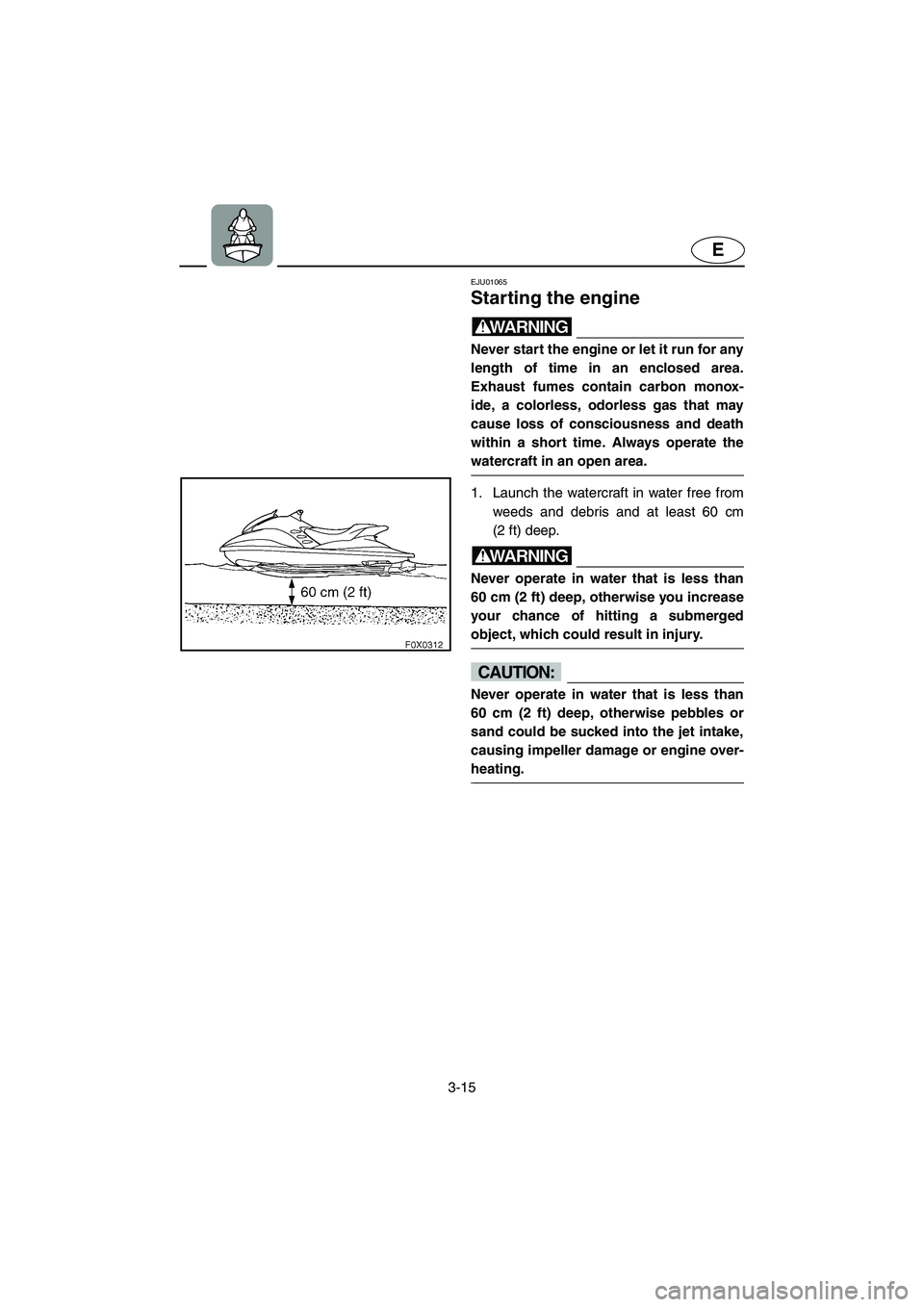
1. Launch the watercraft in water free from
weeds and debris and at least 60 cm
(2 ft) deep.
WARNING@ Never operate in water that is less than
60 cm (2 ft) deep, otherwise you increase
your chance of hitting a submerged
object, which could result in injury.
@
CAUTION:@ Never operate in water that is less than
60 cm (2 ft) deep, otherwise pebbles or
sand could be sucked into the jet intake,
causing impeller damage or engine over-
heating.
@
UF0X72.book Page 15 Friday, August 3, 2001 11:13 AM
Page 61 of 118
3-16
E
2. Turn the fuel cock knob to the “ON” posi-
tion.
NOTE:@ Before starting the watercraft, after it has
been sitting, remove the fuel tank filler cap
to release any built-up pressure in the tank
due to fuel expansion.
@
3. Attach the clip 1 to the engine shut-off
switch 2. Also, attach the engine shut-
off cord 3 to your left wrist.
WARNING@ Check that the engine shut-off cord is not
frayed or broken, and keep it free from
the handlebars so the engine stops if the
operator falls off. The engine shut-off
cord may not pull free if wrapped around
the handlebars when the operator falls
off, allowing the watercraft to continue to
run and cause an accident.
@
NOTE:@ It is not possible to start the engine with the
clip removed from the engine shut-off
switch.
@
4. Move the choke lever all the way in the
direction of the arrow to start a cold
engine.
NOTE:@ The choke should not be used when the
engine is warm.
@
UF0X72.book Page 16 Friday, August 3, 2001 11:13 AM
Page 62 of 118
3-17
E
5. While lightly squeezing the throttle lever,
push the start switch (green button).
WARNING@ On this watercraft, the engine is con-
nected directly to the jet pump. Starting
the engine immediately generates some
thrust. Apply only enough throttle to
keep the engine running.
@
6. Release the start switch as soon as the
engine starts to run.
CAUTION:@ �Never push the start switch while the
engine is running.
�Do not operate the start switch for
more than 5 seconds, otherwise the
battery will be discharged and the
engine will not start. Also, the starter
motor may be damaged. If the engine
does not start in 5 seconds, release
the start switch, wait 15 seconds, and
try again.
@
7. After the engine has warmed up, move
the choke lever back to its original posi-
tion.
NOTE:@ If the choke lever is left turned on, the
engine will stall.
@
UF0X72.book Page 17 Friday, August 3, 2001 11:13 AM
Page 63 of 118
3-18
E
EJU01066
Stopping the engine
To stop the engine, release the throttle
lever, and then push the engine stop switch
(red button).
WARNING@ You need throttle to steer. Shutting off
the engine can cause you to hit an obsta-
cle you are attempting to avoid. A colli-
sion could result in severe injury or
death.
@
EJU01067
Leaving the watercraft
If leaving the watercraft, remove the
engine shut-off cord to reduce the chance of
accidental starting or unauthorized use by
children or others.
UF0X72.book Page 18 Friday, August 3, 2001 11:13 AM