2002 VOLVO S60 tires
[x] Cancel search: tiresPage 71 of 106
resulting in loss of vehicle control without prior warning.
Temporary Spare (certain models)
The spare tire in your car is called a "Temporary Spare". It has the following designation: T125/80 R17.
Recommended tire pressure (see decal on Fuel filler door) should be maintained irrespective of which position on the
car the Temporary Spare tire is used on. In the event of damage to this tire, a new one can be purchased from your
Volvo retailer.
WARNING!
Current legislation prohibits the use of the "Temporary Spare" tire other than as a temporary replacement for a
punctured tire. It must be replaced as soon as possible by a standard tire. Road holding and handling may be affected
with the "Temporary Spare" in use. Do not exceed 50 mph (80 km/h). Do not drive farther than 50 miles (80 km) on
a temporary spare tire.
CAUTION:
The car must not be driven with wheels of different dimensions or with a spare tire other than the one that came with
the car. The use of different size wheels can seriously damage your car's transmission.
NOTE: Certain models may be equipped with a full-size spare tire. When used, it should be inflated to the same
pressure as the tire it is replacing.
pg. 159 Tread wear indicators
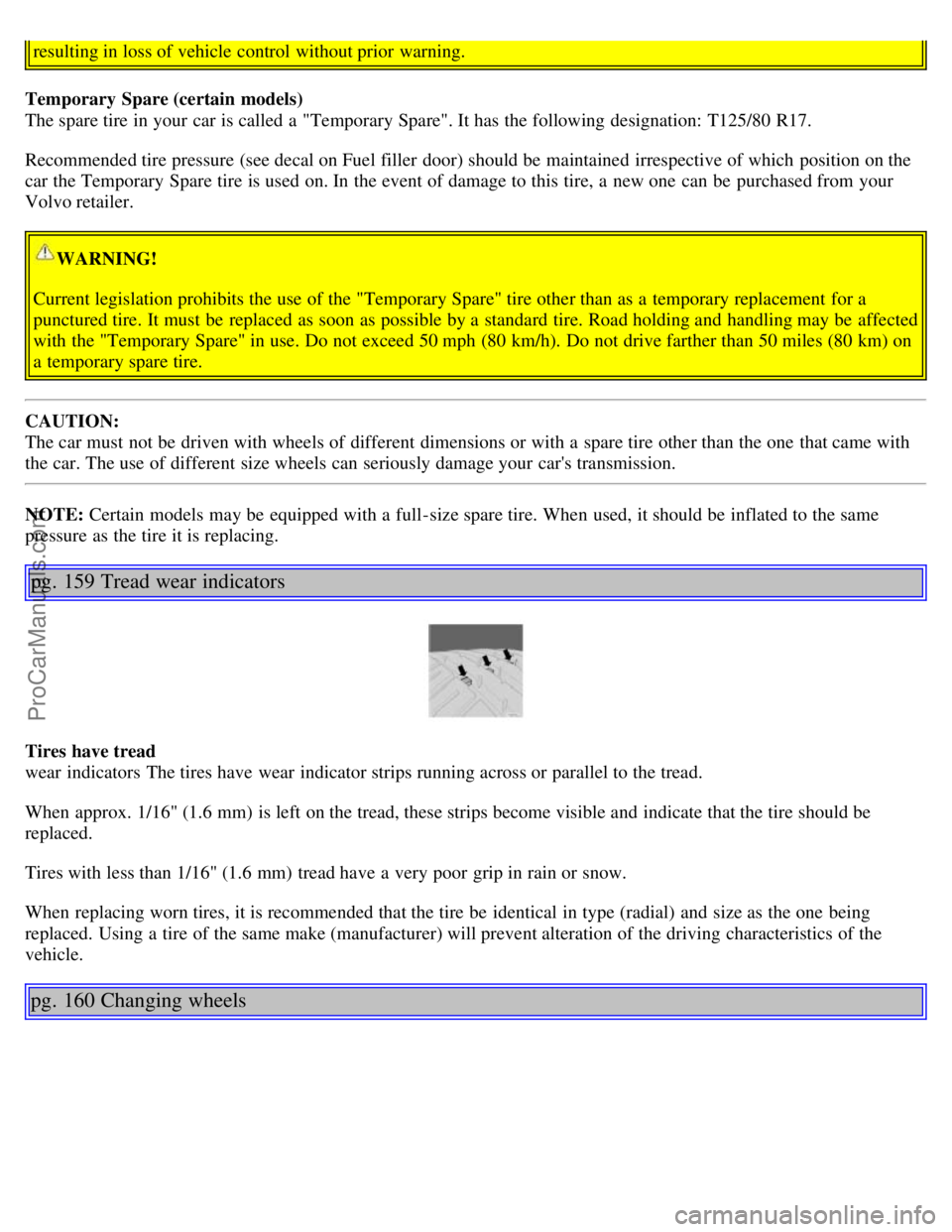
Tires have tread
wear indicators The tires have wear indicator strips running across or parallel to the tread.
When approx. 1/16" (1.6 mm) is left on the tread, these strips become visible and indicate that the tire should be
replaced.
Tires with less than 1/16" (1.6 mm) tread have a very poor grip in rain or snow.
When replacing worn tires, it is recommended that the tire be identical in type (radial) and size as the one being
replaced. Using a tire of the same make (manufacturer) will prevent alteration of the driving characteristics of the
vehicle.
pg. 160 Changing wheels
ProCarManuals.com
Page 73 of 106
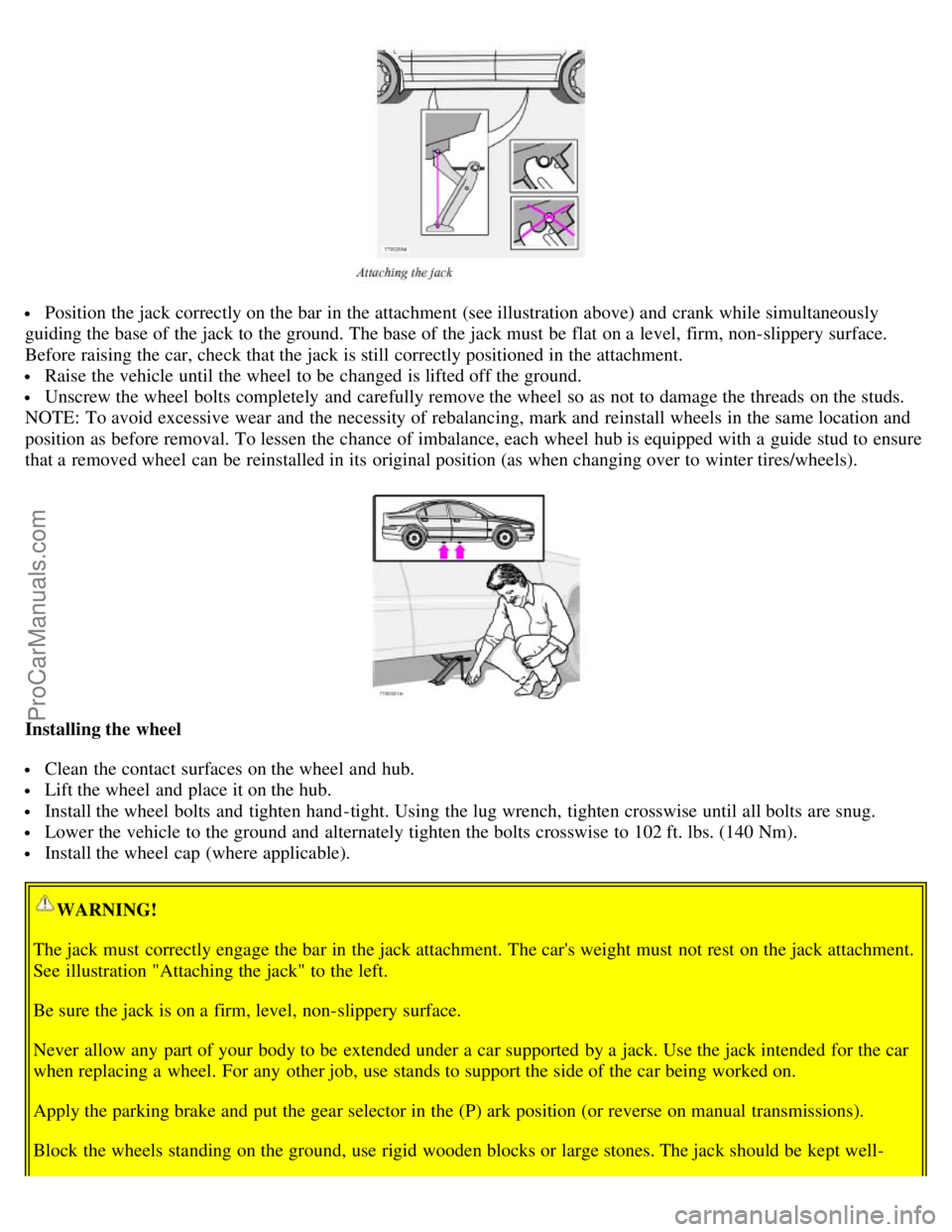
Position the jack correctly on the bar in the attachment (see illustration above) and crank while simultaneously
guiding the base of the jack to the ground. The base of the jack must be flat on a level, firm, non-slippery surface.
Before raising the car, check that the jack is still correctly positioned in the attachment.
Raise the vehicle until the wheel to be changed is lifted off the ground.
Unscrew the wheel bolts completely and carefully remove the wheel so as not to damage the threads on the studs.
NOTE: To avoid excessive wear and the necessity of rebalancing, mark and reinstall wheels in the same location and
position as before removal. To lessen the chance of imbalance, each wheel hub is equipped with a guide stud to ensure
that a removed wheel can be reinstalled in its original position (as when changing over to winter tires/wheels).
Installing the wheel
Clean the contact surfaces on the wheel and hub.
Lift the wheel and place it on the hub.
Install the wheel bolts and tighten hand -tight. Using the lug wrench, tighten crosswise until all bolts are snug.
Lower the vehicle to the ground and alternately tighten the bolts crosswise to 102 ft. lbs. (140 Nm).
Install the wheel cap (where applicable).
WARNING!
The jack must correctly engage the bar in the jack attachment. The car's weight must not rest on the jack attachment.
See illustration "Attaching the jack" to the left.
Be sure the jack is on a firm, level, non-slippery surface.
Never allow any part of your body to be extended under a car supported by a jack. Use the jack intended for the car
when replacing a wheel. For any other job, use stands to support the side of the car being worked on.
Apply the parking brake and put the gear selector in the (P) ark position (or reverse on manual transmissions).
Block the wheels standing on the ground, use rigid wooden blocks or large stones. The jack should be kept well-
ProCarManuals.com
Page 74 of 106

greased.
pg. 162 Uniform Tire Quality Grading
Uniform Tire Quality Grading
ALL PASSENGER CAR TIRES MUST CONFORM TO FEDERAL SAFETY REQUIREMENTS IN
ADDITION TO THESE GRADES
Quality grades can be found, where applicable, on the tire sidewall between the tread shoulder and maximum
section width. For example:
Treadwear 200 Traction AA Temperature A
TREADWEAR
The treadwear grade is a comparative rating based on the wear rate of the tire when tested under controlled conditions
on a specified government test course. For example, a tire graded 150 would wear one and one half (1 1/2) times as
well on the government course as a tire graded 100. The relative performance of tires depends upon the actual
conditions of their use, however, and many depart significantly from the norm due to variation in driving habits,
service practices and differences in road characteristics and climate.
TRACTION
The traction grades, from highest to lowest, are AA, A, B, and C, as measured under controlled conditions on specified
government test surfaces of asphalt and concrete. A tire marked C may have poor traction performance..
WARNING!
The traction grade assigned to this tire is based on braking (straight-ahead) traction tests and is not a measure of
cornering (turning) traction.
TEMPERATURE
The temperature grades are AA (the highest), A, B, and C, representing the tire's resistance to the generation of heat
and its ability to dissipate heat when tested under controlled conditions on a specified indoor laboratory test wheel.
Sustained high temperature can cause the material of the tire to degenerate and reduce tire life, and excessive
temperature can lead to sudden tire failure. The grade C corresponds to a minimum level of performance that all
passenger car tires must meet under the Federal Motor Safety Standard No. 109. Grades B and A represent higher
levels of performance on the laboratory test wheel than the minimum required by law.
WARNING!
The temperature grade for this tire is established for a tire that is properly inflated and not overloaded. Excessive
speed, under-inflation, or excessive loading, either separately or in combination, can cause heat buildup and possible
tire failure.
Contents | Top of Page
ProCarManuals.com
Page 98 of 106

Cup holder110 , 111
Current fuel consumption44
D
Defroster57
Dimension designation (tires)156
Direction indicator, rear - bulb185
Direction indicators41
Dolby Surround Pro Logic79
Door mirror defroster43
Door mirrors37
Driving economically133
DSTC35 , 38
Dual - threshold airbags13
E
ECC56
Economical driving133
Electric socket38 , 46
Electrical system202
Electrically operated windows47
Engine - starting131
Engine compartment172
Engine oil173
Engine oil, capacity197
Engine specifications203
Engine oil - checking174
Environment3
F
Federal Clean Air Act168
FIX NEXT SERVICE36
Floor mats108
Fog lamp33 , 185
Front seat - backrest103
Front seats102
Front seats - heated43
Front seats - manual adjustment102
Front seats - power104
Front seats - power(programming the memory)106
Front suspension201
Fuel2 , 128
Fuel filler cap2 , 130
Fuel filler door - unlocking40
Fuel filler door2 , 130
Fuel gauge30
Fuel tank, capacity197
ProCarManuals.com
Page 101 of 106

PROPOSITION 65 WARNING147
R
Radiator172
Radio67
Reading lamps107
Rear fog lights40
Rear seat113
Rear suspension201
Rear window defroster43 , 61
Rearview mirror/ door mirrors49
Recirculation58 , 62
REDUCE SPEED36
Refrigerant (A/ C system)54
Refueling128 , 130
Remote control - central locking system119
Replacing the battery179
Reporting safety defects28
Reverse gear inhibitor135
Roadholding134
Roof racks (load carriers)152
S
Safety9
Safety defects - reporting28
Seat belt10
Seat belt maintenance28
Seat belt reminder49
Seat belts (keeping child seats in place)27
Service168
Service key118
Service reminder34
SERVICE REQUIRED36
SERVICE URGENT36
Shiftlock2 , 131
Side airbags18
Side marker lamp185
SIPS airbags18
Ski hatch114
Snow chains157
Snow tires157
Spare tires158
Spare wheel115
Spark plugs202
Specifications193
Speedometer30
ProCarManuals.com
Page 102 of 106

Spoiler lamps40
Sport shifter135
SRS12
Stability system143
Start inhibitor (immobilizer)118
Starter switch and steering wheel lock132
Starting the car131
STC35, 37, 143
Steering132
Steering wheel adjustment39
Steering wheel lock132
Stone chips166
STOP ENGINE36
STOP SAFELY ASAP36
Storage compartments110
Storage compartments in the passenger compartment109
Studded tires157
Sun roof (electrically operated)50
Sun visor51
Supplemental Restraint System (SRS)12
Supplemental Restraint System (SRS) - warning light33
Suspension201
Switches in the center console37
T
Tachometer30
Temperature (climate control)57
Temperature gauge30
Temporary spare tire158
Text window - messages36
TIME FOR REGULAR SERVICE
Tires156
Tires - tread wear indicators159
Tools115
Towing145
Towing - cars with All Wheel Drive146
Towing a trailer148
Trailer indicator lamp
Trailer towing148
Transmission - automatic136
Transmission - automatic138
Transmission - automatic135
Transmission - automatic135
Trip computer44
Trip odometer30
ProCarManuals.com
Page 103 of 106
Trunk - opening from the inside122
Trunk - unlocking122
Turn signals - normal turns41
Turn signals - lane change position41
Type designations194
U
Uniform Tire Quality Grading162
, 162
Unlocking121
Unlocking the trunk122
Use of Additives129
V
Valet key118
Vanity mirror108
Vehicle Identification Number (VIN)194
Vehicle loading158
VIN (Vehicle Identification Number)194
Volvo and the environment3
Volvo On Call205
W
W - Winter137
, 139
Warning symbol in center of dashboard31
Warranties168
Washer fluid reservoir172 , 175
Washing the car164
Waxing165
Weight distribution133
Weights195
Wheels156
WHIPS22
Windshield washer42
Windshield washer fluid reservoir175
Windshield wipers42
Winter tires156
Winter/ Wet driving mode153
Wiper blades177
Contents | Top of Page
ProCarManuals.com