Page 56 of 334
02 SIENNA_U (L/O 0107)
522002 MY SIENNA_U (OM45407U)
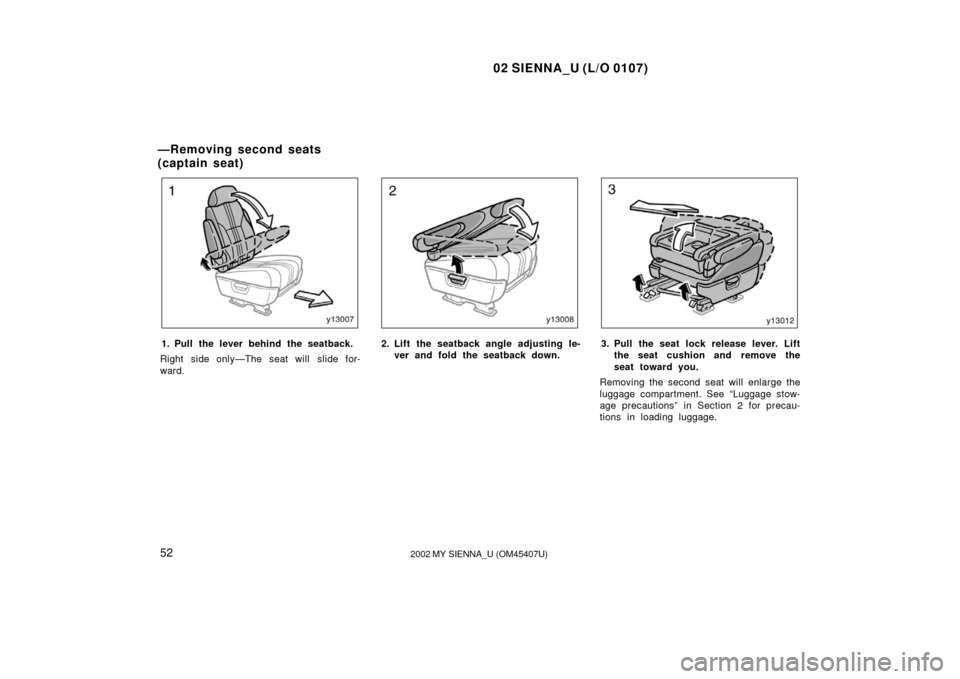
1. Pull the lever behind the seatback.
Right side only—The seat will slide for-
ward.2. Lift the seatback angle adjusting le- ver and fold the seatback down.3. Pull the seat lock release lever. Liftthe seat cushion and remove the
seat toward you.
Removing the second seat will enlarge the
luggage compartment. See “Luggage stow-
age precautions” in Section 2 for precau-
tions in loading luggage.
—Removing second seats
(captain seat)
Page 58 of 334
02 SIENNA_U (L/O 0107)
542002 MY SIENNA_U (OM45407U)
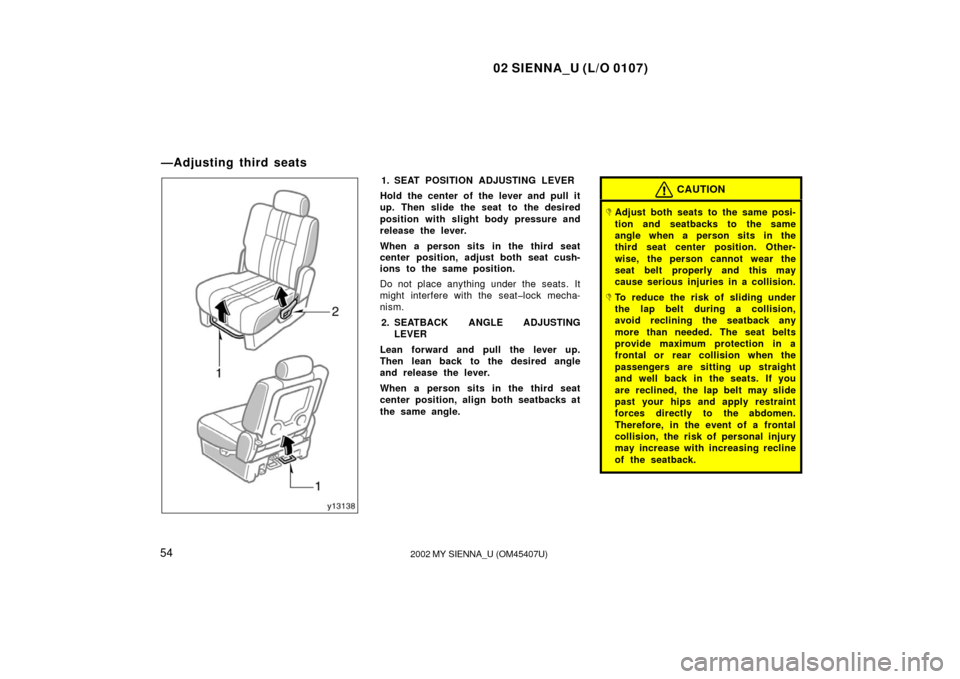
1. SEAT POSITION ADJUSTING LEVER
Hold the center of the lever and pull it
up. Then slide the seat to the desired
position with slight body pressure and
release the lever.
When a person sits in the third seat
center position, adjust both seat cush-
ions to the same position.
Do not place anything under the seats. It
might interfere with the seatlock mecha-
nism.
2. SEATBACK ANGLE ADJUSTING LEVER
Lean forward and pull the lever up.
Then lean back to the desired angle
and release the lever.
When a person sits in the third seat
center position, align both seatbacks at
the same angle.CAUTION
�Adjust both seats to the same posi-
tion and seatbacks to the same
angle when a person sits in the
third seat center position. Other-
wise, the person cannot wear the
seat belt properly and this may
cause serious injuries in a collision.
�To reduce the risk of sliding under
the lap belt during a collision,
avoid reclining the seatback any
more than needed. The seat belts
provide maximum protection in a
frontal or rear collision when the
passengers are sitting up straight
and well back in the seats. If you
are reclined, the lap belt may slide
past your hips and apply restraint
forces directly to the abdomen.
Therefore, in the event of a frontal
collision, the risk of personal injury
may increase with increasing recline
of the seatback.
—Adjusting third seats
Page 59 of 334
02 SIENNA_U (L/O 0107)
552002 MY SIENNA_U (OM45407U)
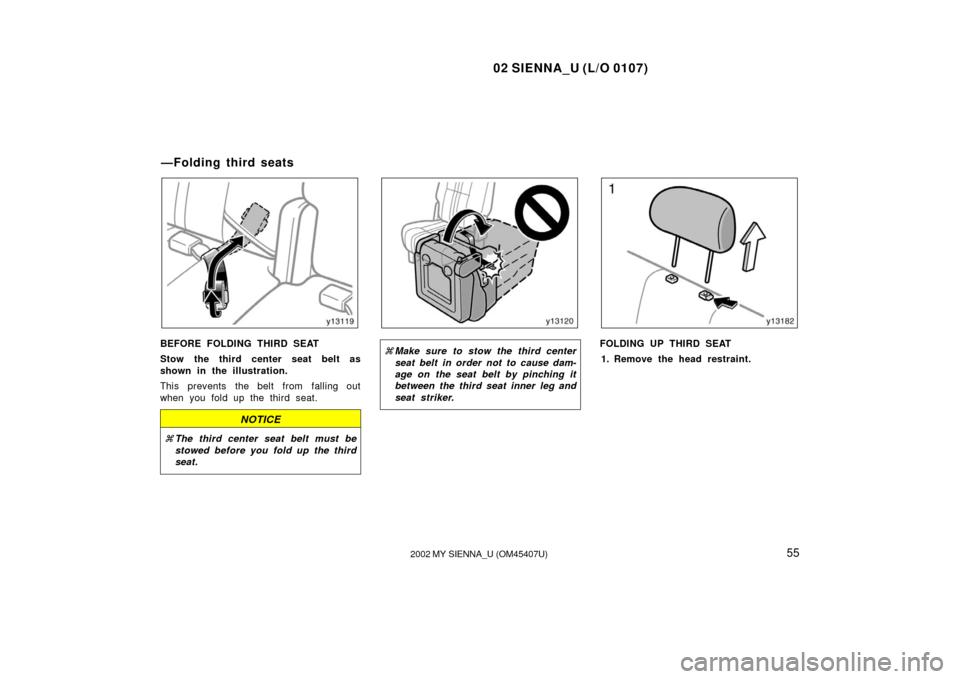
BEFORE FOLDING THIRD SEAT
Stow the third center seat belt as
shown in the illustration.
This prevents the belt from falling out
when you fold up the third seat.
NOTICE
�The third center seat belt must be
stowed before you fold up the third
seat.
�Make sure to stow the third center
seat belt in order not to cause dam-
age on the seat belt by pinching it
between the third seat inner leg and
seat striker.FOLDING UP THIRD SEAT
1. Remove the head restraint.
—Folding third seats
Page 61 of 334
02 SIENNA_U (L/O 0107)
572002 MY SIENNA_U (OM45407U)
NOTICE
To prevent the seat from damaging,
avoid putting heavy loads on the tem-
porary table.
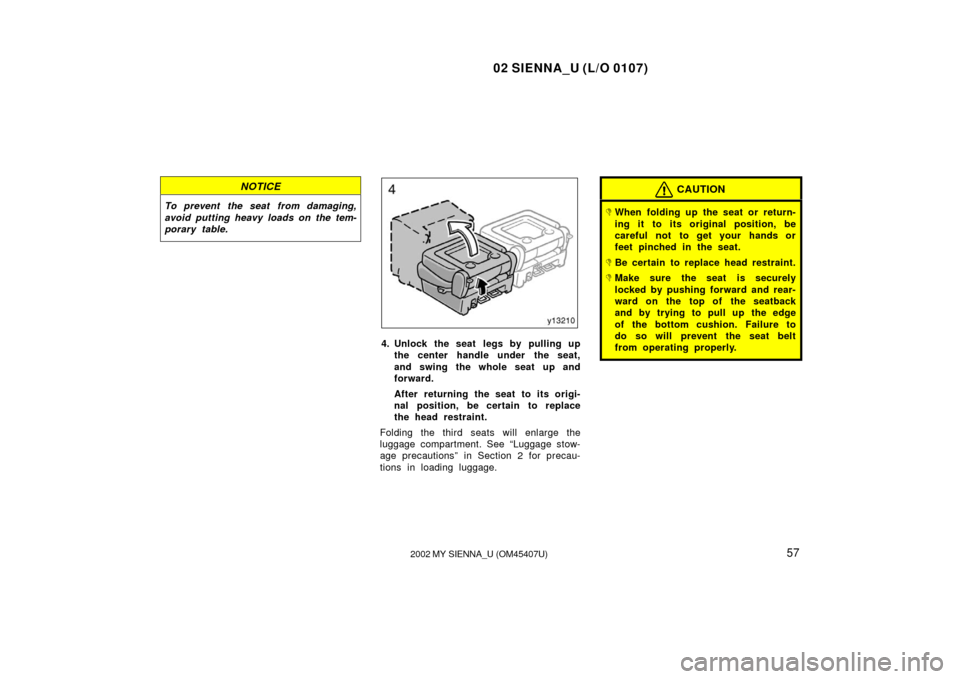
4. Unlock the seat legs by pulling up
the center handle under the seat,
and swing the whole seat up and
forward.
After returning the seat to its origi-
nal position, be certain to replace
the head restraint.
Folding the third seats will enlarge the
luggage compartment. See “Luggage stow-
age precautions” in Section 2 for precau-
tions in loading luggage.
CAUTION
�When folding up the seat or return-
ing it to its original position, be
careful not to get your hands or
feet pinched in the seat.
�Be certain to replace head restraint.
�Make sure the seat is securely
locked by pushing forward and rear-
ward on the top of the seatback
and by trying to pull up the edge
of the bottom cushion. Failure to
do so will prevent the seat belt
from operating properly.
Page 62 of 334
02 SIENNA_U (L/O 0107)
582002 MY SIENNA_U (OM45407U)
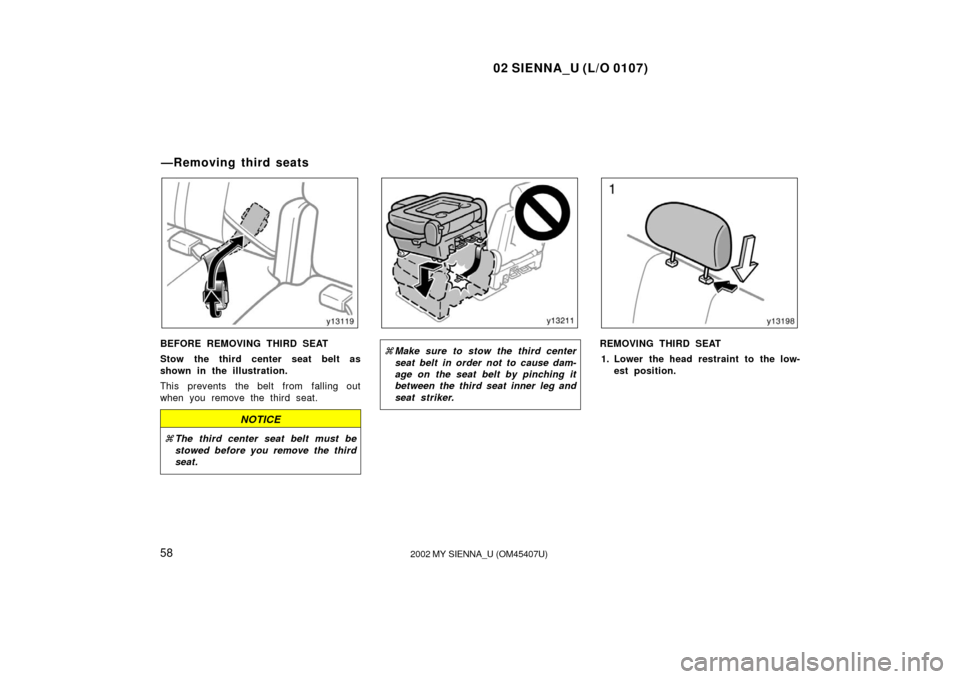
BEFORE REMOVING THIRD SEAT
Stow the third center seat belt as
shown in the illustration.
This prevents the belt from falling out
when you remove the third seat.
NOTICE
�The third center seat belt must be
stowed before you remove the third
seat.
�Make sure to stow the third center
seat belt in order not to cause dam-
age on the seat belt by pinching it
between the third seat inner leg and
seat striker.REMOVING THIRD SEAT
1. Lower the head restraint to the low- est position.
—Removing third seats
Page 67 of 334
02 SIENNA_U (L/O 0107)
632002 MY SIENNA_U (OM45407U)
NOTICE
�Do not put unevenly weighed ob-
jects on the seat and do not stick
sharp objects (needles, nails, etc.)
into the seat.
� When cleaning the seats, do not
use organic substances (paint thin-
ner, benzine, alcohol, gasoline,
etc.). They may damage the heater
and seat surface.
� To prevent the battery from being
discharged, turn the switch on
when the engine is running.
Toyota strongly urges that the driver and
passengers in the vehicle be properly re-
strained at all times with the seat belts
provided. Failure to do so could increase
the chance of injury and/or the severity of
injury in accidents.
Child. Use a child restraint system ap-
propriate for the child until the child be-
comes large enough to properly wear the
vehicle’s seat belts. See “Child restraint”
for details.
If a child is too large for a child restraint
system, the child s hould sit in the rear
seat and must be restrained using the
vehicle’s seat belt. According to accident
statistics, the child is safer when properly
restrained in the rear seat than in the
front seat.
If a child must sit in the front seat, the
seat belts should be worn properly. If an
accident occurs and the seat belts are not
worn properly, the force of the rapid infla-
tion of the airbag may cause death or
serious injury to the child. Do not allow the child to stand up or
kneel on either rear or front seats. An
unrestrained child could suffer serious in-
jury or death during emergency braking or
a collision. Also, do not let the child sit
on your lap. It does not provide sufficient
restraint.
Pregnant woman.
Toyota recommends the
use of a seat belt. Ask your doctor for
specific recommendations. The lap belt
should be worn securely and as low as
possible over the hips and not on the
waist.
Injured person. Toyota recommends the
use of a seat belt. Depending on the inju-
ry, first check with your doctor for specific
recommendations.
Seat belts—
—Seat belt precautions
Page 68 of 334
02 SIENNA_U (L/O 0107)
642002 MY SIENNA_U (OM45407U)
CAUTION
Persons should ride in their seats
properly wearing their seat belts
whenever the vehicle is moving.
Otherwise, they are much more likely
to suffer serious bodily injury or
death in the event of sudden braking
or a collision.
When using the seat belts, observe
the following:
�Use the belt for only one person at
a time. Do not use a single belt for
two or more people—even children.
�Avoid reclining the seatbacks too
much. The seat belts provide maxi-
mum protection when the seatbacks
are in the upright position. (Refer
to the seat adjustment instructions.)
�Be careful not to damage the belt
webbing or hardware. Take care that
they do not get caught or pinched
in the seat or doors.
�Inspect the belt system periodically.
Check for cuts, fraying, and loose
parts. Damaged parts should be re-
placed. Do not disassemble or
modify the system.
�Keep the belts clean and dry. If
they need cleaning, use a mild soap
solution or lukewarm water. Never
use bleach, dye, or abrasive clean-
ers—they may severely weaken the
belts. (See “Cleaning the interior”
in Section 5.)
�Replace the belt assembly (includ-
ing bolts) if it has been used in a
severe impact. The entire assembly
should be replaced even if damage
is not obvious.
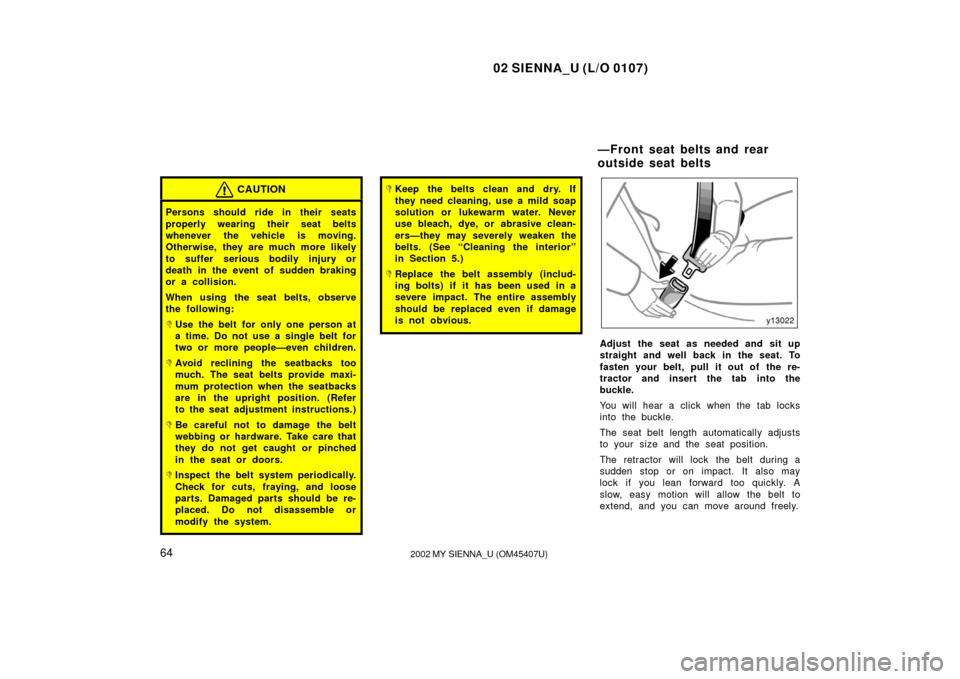
Adjust the seat as needed and sit up
straight and well back in the seat. To
fasten your belt, pull it out of the re-
tractor and insert the tab into the
buckle.
You will hear a click when the tab locks
into the buckle.
The seat belt length automatically adjusts
to your size and the seat position.
The retractor will lock the belt during a
sudden stop or on impact. It also may
lock if you lean forward too quickly. A
slow, easy motion will allow the belt to
extend, and you can move around freely.
—Front seat belts and rear
outside seat belts
Page 87 of 334
02 SIENNA_U (L/O 0107)
832002 MY SIENNA_U (OM45407U)
Collision from the rear
Collision from the front Vehicle rollover
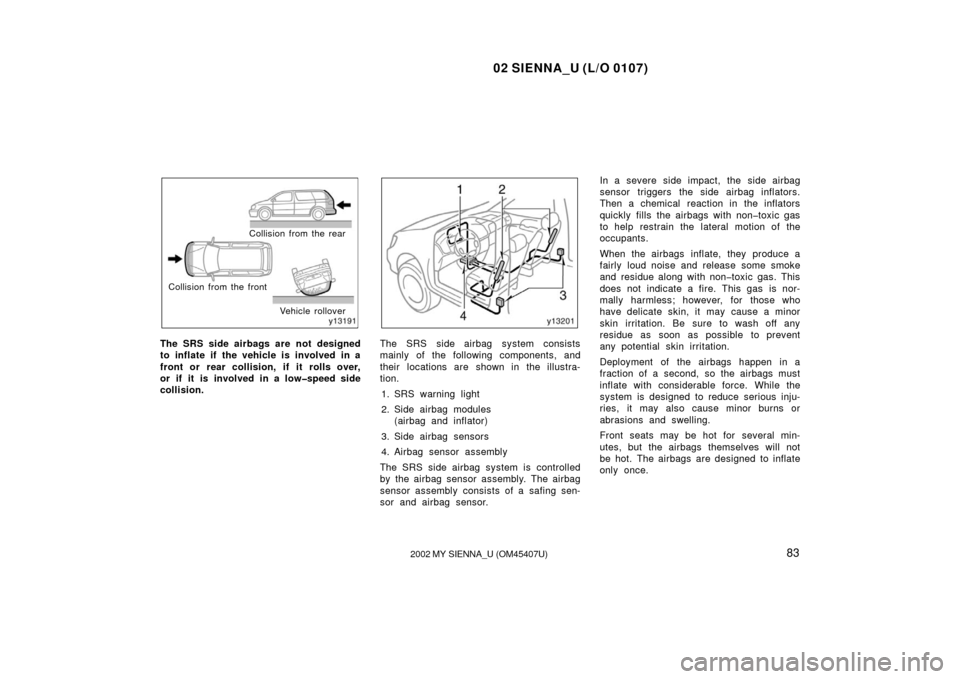
The SRS side airbags are not designed
to inflate if the vehicle is involved in a
front or rear collision, if it rolls over,
or if it is involved in a lowspeed side
collision.The SRS side airbag system consists
mainly of the following components, and
their locations are shown in the illustra-
tion.1. SRS warning light
2. Side airbag modules (airbag and inflator)
3. Side airbag sensors
4. Airbag sensor assembly
The SRS side airbag system is controlled
by the airbag sensor assembly. The airbag
sensor assembly consists of a safing sen-
sor and airbag sensor. In a severe side impact, the side airbag
sensor triggers the side airbag inflators.
Then a chemical reaction in the inflators
quickly fills the air
bags with nontoxic gas
to help restrain the lateral motion of the
occupants.
When the airbags inflate, they produce a
fairly loud noise and release some smoke
and residue along with nontoxic gas. This
does not indicate a fire. This gas is nor-
mally harmless; however, for those who
have delicate skin, it may cause a minor
skin irritation. Be sure to wash off any
residue as soon as possible to prevent
any potential skin irritation.
Deployment of the airbags happen in a
fraction of a second, so the airbags must
inflate with considerable force. While the
system is desi gned to reduce serious inju-
ries, it may also cause minor burns or
abrasions and swelling.
Front seats may be hot for several min-
utes, but the airbags themselves will not
be hot. The airbags are designed to inflate
only once.