216
When a tire is replaced, the wheel
should always be balanced.
An unbalanced wheel may affect vehicle
handling and tire life. Wheels can get out
of balance with regular use and should
therefore be balanced occasionally.
When replacing a tubeless tire, the air
valve should also be replaced with a
new one.
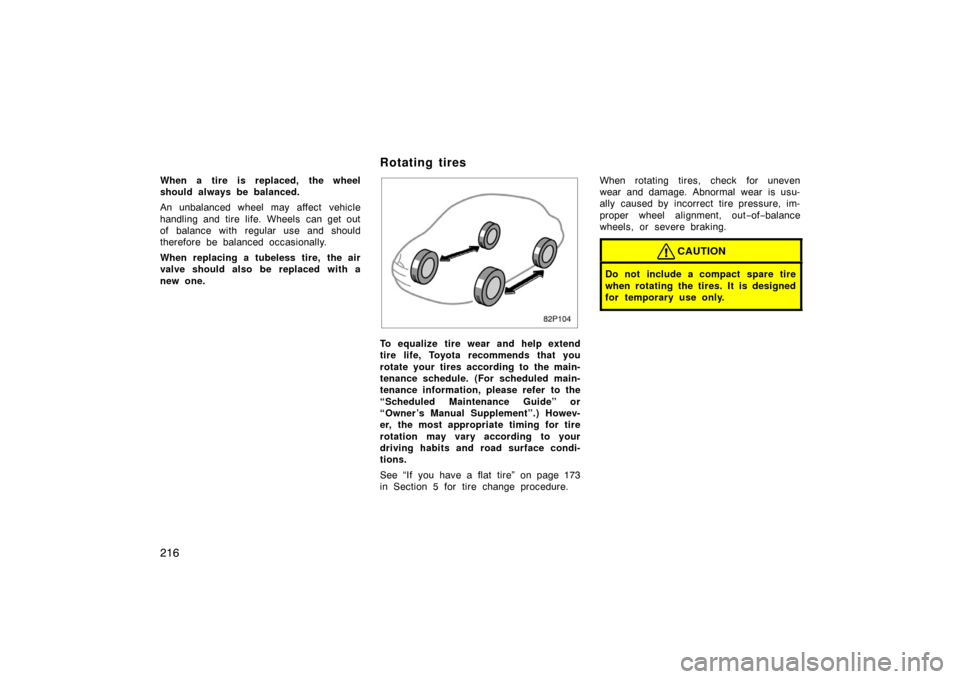
82p104
To equalize tire wear and help extend
tire life, Toyota recommends that you
rotate your tires according to the main-
tenance schedule. (For scheduled main-
tenance information, please refer to the
“Scheduled Maintenance Guide” or
“Owner ’s Manual Supplement”.) Howev-
er, the most appropriate timing for tire
rotation may vary according to your
driving habits and road surface condi-
tions.
See “If you have a flat tire” on page 173
in Section 5 for tire change procedure.When rotating tires, check for uneven
wear and damage. Abnormal wear is usu-
ally caused by incorrect tire pressure, im-
proper wheel alignment, out
−of −balance
wheels, or severe braking.
CAUTION
Do not include a compact spare tire
when rotating the tires. It is designed
for temporary use only.
Rotating tires
219
�
When installing aluminum w
heels,
check that the wheel nuts are tight
after driving your vehicle the first 1600
km (1000 miles).
�If you have rotated, repaired, or
changed your tires, check that the
wheel nuts are still tight after driving
1600 km (1000 miles).
�When using tire chains, be careful not
to damage the aluminum wheels.
�Use only the Toyota wheel nuts and
wrench designed for your aluminum
wheels.
�When balancing your wheels, use only
Toyota balance weights or equivalent
and a plastic or rubber hammer.
�As with any wheel, periodically check
your aluminum wheels for damage. If
damaged, replace immediately.
Aluminum wheel precautions