Page 108 of 258

95
NOTICE
Do not drive the vehicle with the
warning light on—even for one block.
It may ruin the engine.
(i) “ABS” Warning Light
The light comes on when the ignition key
is turned to the “ON” position. If the anti−
lock brake system works properly, the
light turns off after a few seconds. There-
after if the system malfunctions, the light
comes on again.
When the “ABS” warning light is on (and
the brake system warning light is off), the
anti −lock brake system does not operate,
but the brake system still operates con-
ventionally.
When the “ABS” warning light is on (and
the brake system warning light is off), the
anti −lock brake system does not operate
so that the wheels could lock up during
a sudden braking or braking on slippery
road surfaces.
If either of the following conditions
occurs, this indicates a malfunction
somewhere in the parts monitored by
the warning light system. Contact your
Toyota dealer as soon as possible so
service the vehicle.
�The light does not come on when the
ignition key is turned to the “ON” posi-
tion, or remains on.
�The light comes on while you are driv-
ing.
A warning light turning on briefly during
operation does not indicate a problem.
CAUTION
If the “ABS” warning light remains on
together with the brake system warn-
ing light, immediately stop your ve-
hicle at a safe place and contact your
Toyota dealer.
In this case, not only the antilock
brake system will fail but also the
vehicle will become extremely unsta-
ble during braking.
Either of the following conditions may
occur, but does not indicate the mal-
function:
�The light may stay on for about 60
seconds after the ignition key is turned
to the “ON” position. It is normal if it
turns off after a while.
�Depressing the brake pedal repeatedly
may turn on the light. It is normal if
it turns off after a few seconds.
(j) SRS Warning Light
This light will come on when the igni-
tion key is turned to the “ACC” or
“ON” position. After about 6 seconds,
the light will go off. This means the
system of the airbag and front seat belt
pretensioners are operating properly.
The warning light system monitors the air-
bag sensor assembly, front airbag sen-
sors, side airbag sensors, front seat belt
pretensioner assemblies, warning light, in-
terconnecting wiring and power sources.
If either of the following conditions occurs,
this indicates a malfunction somewhere in
the parts monitored by the warning light
system. Contact your Toyota dealer as
soon as possible to service the vehicle.
�The light does not come on when the
ignition key is turn to the “ACC” or
“ON” position or remains on.
�The light comes on or flashes while
driving.
Page 144 of 258
131
OPERATION OF INSTRUMENTS AND
CONTROLS
Air conditioning system
Controls132
. . . . . . . . . . . . . . . . . . . . . . . . . . . . . . . . . . . . .\
. . . . . . . . . . . . . .
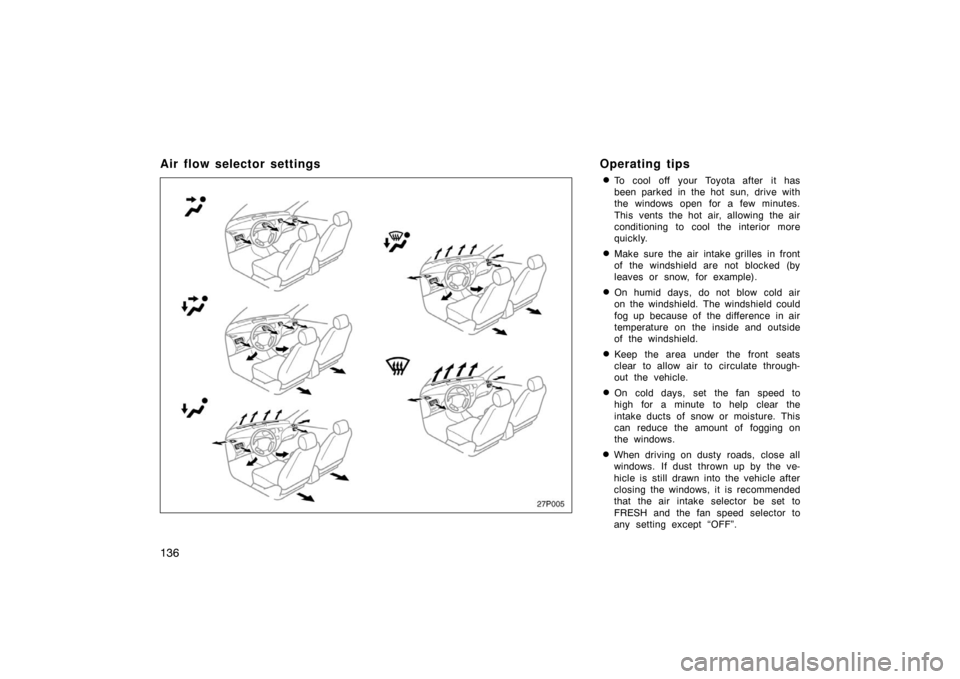
Air flow selector settingss 136
. . . . . . . . . . . . . . . . . . . . . . . . . . . . . . . . . . .
Operating tips 136
. . . . . . . . . . . . . . . . . . . . . . . . . . . . . . . . . . . . \
. . . . . . . . . .
Instrument panel vents 138
. . . . . . . . . . . . . . . . . . . . . . . . . . . . . . . . . . . . \
. .
SECTION 2– 8
Page 145 of 258
132
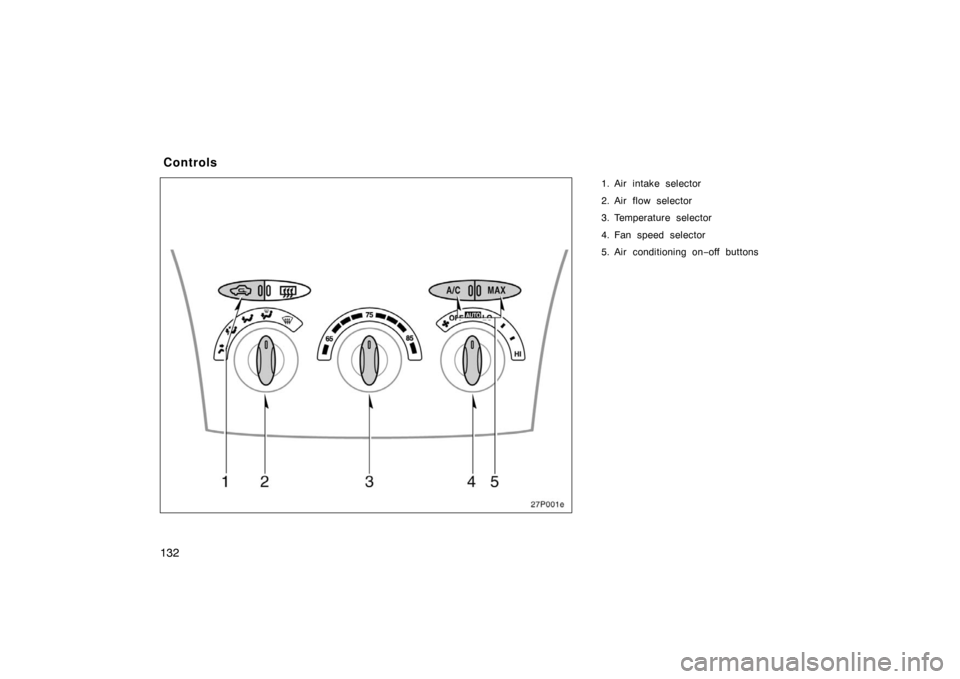
1. Air intake selector
2. Air flow selector
3. Temperature selector
4. Fan speed selector
5. Air conditioning on−off buttons
Controls
27P001e
Page 146 of 258
133
“AUTO” position (for fan speed)
For automatic operation of the air condi-
tioning, turn the fan speed selector knob
to “AUTO” position.
In the automatic operation mode, the air
conditioning selects the most suitable fan
speed according to the temperature.
You may use manual controls if you want
to select your own settings.
Fan speed selector
Turn the knob to adjust the fan speed—to
the right to increase, to the left to de-
crease.
In automatic operation, you do not have
to adjust the fan speed unless you desire
another fan speed mode.
Temperature selector
Turn the knob to adjust the temperature
to the right to warm and then to the left
to cool.
27p002
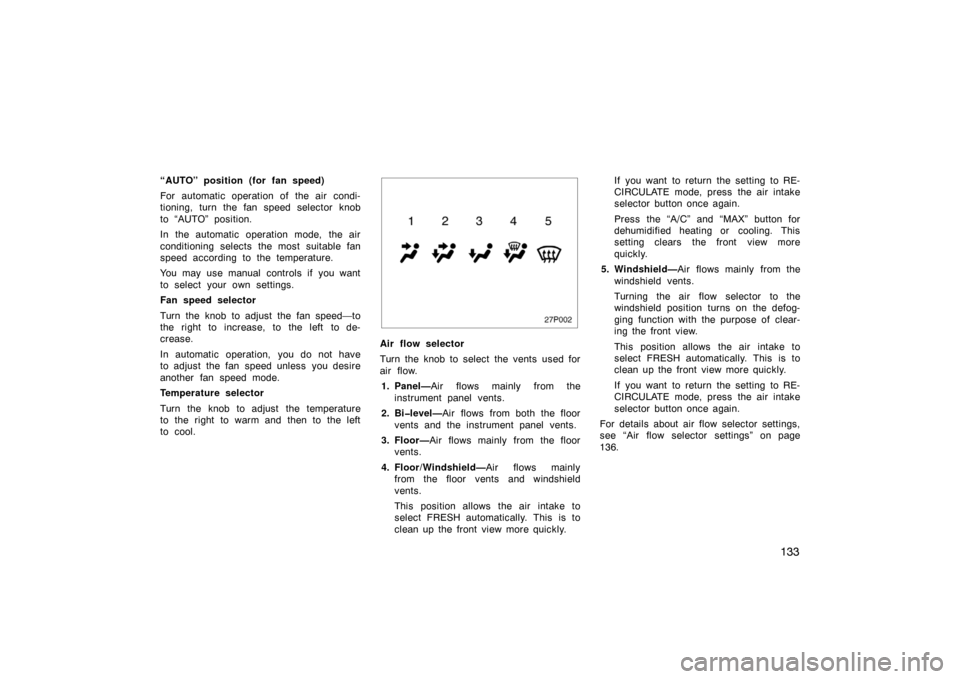
Air flow selector
Turn the knob to select the vents used for
air flow.1. Panel— Air flows mainly from the
instrument panel vents.
2. Bilevel— Air flows from both the floor
vents and the instrument panel vents.
3. Floor— Air flows mainly from the floor
vents.
4. Floor/Windshield— Air flows mainly
from the floor vents and windshield
vents.
This position allows the air intake to
select FRESH automatically. This is to
clean up the front view more quickly. If you want to return the setting to RE-
CIRCULATE mode, press the air intake
selector button once again.
Press the “A/C” and “MAX” button for
dehumidified heating or cooling. This
setting clears the front view more
quickly.
5. Windshield— Air flows mainly from the
windshield vents.
Turning the air flow selector to the
windshield position turns on the defog-
ging function with the purpose of clear-
ing the front view.
This position allows the air intake to
select FRESH automatically. This is to
clean up the front view more quickly.
If you want to return the setting to RE-
CIRCULATE mode, press the air intake
selector button once again.
For details about air flow selector settings,
see “Air flow selector settings” on page
136.
Page 147 of 258
134
27p003a
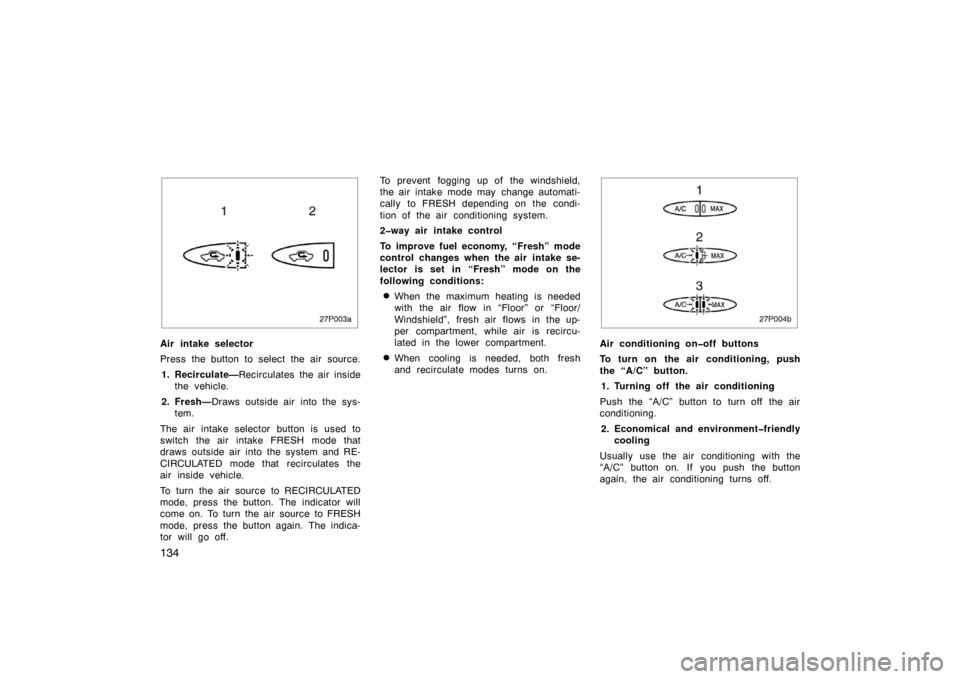
Air intake selector
Press the button to select the air source.1. Recirculate— Recirculates the air inside
the vehicle.
2. Fresh— Draws outside air into the sys-
tem.
The air intake selector button is used to
switch the air intake FRESH mode that
draws outside air into the system and RE-
CIRCULATED mode that recirculates the
air inside vehicle.
To turn the air source to RECIRCULATED
mode, press the button. The indicator will
come on. To turn the air source to FRESH
mode, press the button again. The indica-
tor will go off. To prevent fogging up of the windshield,
the air intake mode may change automati-
cally to FRESH depending on the condi-
tion of the air conditioning system.
2way air intake control
To improve fuel economy, “Fresh” mode
control changes when the air intake se-
lector is set in “Fresh” mode on the
following conditions:
�When the maximum heating is needed
with the air flow in “Floor” or “Floor/
Windshield”, fresh air flows in the up-
per compartment, while air is recircu-
lated in the lower compartment.
�When cooling is needed, both fresh
and recirculate modes turns on.
27p004b
Air conditioning onoff buttons
To turn on the air conditioning, push
the “A/C” button.
1. Turning off the air conditioning
Push the “A/C” button to turn off the air
conditioning. 2. Economical and environmentfriendly cooling
Usually use the air conditioning with the
“A/C” button on. If you push the button
again, the air conditioning turns off.
Page 148 of 258

135
3. Powerful cooling and dehumidifying
If the air conditioning does not work well
with the “A/C” button on, push the “MAX”
button. To cancel the “MAX” mode, push
the “MAX” button again. To turn off the air
conditioning, push the “A/C” button.
With the “MAX” button on, the gasoline
engine is frequently used.
The air conditioning may not turn on with
the selector lever in “N” position because
the gasoline engine cannot start.
If the “A/C” button indicator flashes, there
is a problem in the air conditioning system
and the air conditioning automatically
shuts off. If this happens, take your ve-
hicle to your Toyota dealer for service. For economical and environmentfriend-
ly use
Usually, use the air conditioning with the
“A/C” button on (economical and environ-
ment
−friendly cooling).
In this mode the gasoline engine starts
and stops automatically and good fuel
economy driving is achieved.
To use the air conditioning in economi-
cal and environmentfriendly way, we
recommend the following setting: 1. Lower the setting temperature if you feel a little hot with the “A/C” button
on.
2. If you feel still hot with the “A/C” but- ton on, push the “MAX” button also.
After the compartment cools, turn off
the “MAX” mode only.
Page 149 of 258
136
Air flow selector settingsOperating tips
�To cool off your Toyota after it has
been parked in the hot sun, drive with
the windows open for a few minutes.
This vents the hot air, allowing the air
conditioning to cool the interior more
quickly.
�Make sure the air intake grilles in front
of the windshield are not blocked (by
leaves or snow, for example).
�On humid days, do not blow cold air
on the windshield. The windshield could
fog up because of the difference in air
temperature on the inside and outside
of the windshield.
�Keep the area under the front seats
clear to allow air to circulate through-
out the vehicle.
�On cold days, set the fan speed to
high for a minute to help clear the
intake ducts of snow or moisture. This
can reduce the amount of fogging on
the windows.
�When driving on dusty roads, close all
windows. If dust thrown up by the ve-
hicle is still drawn into the vehicle after
closing the windows, it is recommended
that the air intake selector be set to
FRESH and the fan speed selector to
any setting except “OFF”.
27p005
Page 150 of 258
137
�
If following another vehicle on a dusty
road, or driving in windy and dusty
conditions, it is recommended that the
air intake selector be temporarily set to
RECIRCULATE, which will close off the
outside passage and prevent outside
air and dust from entering the vehicle
interior.
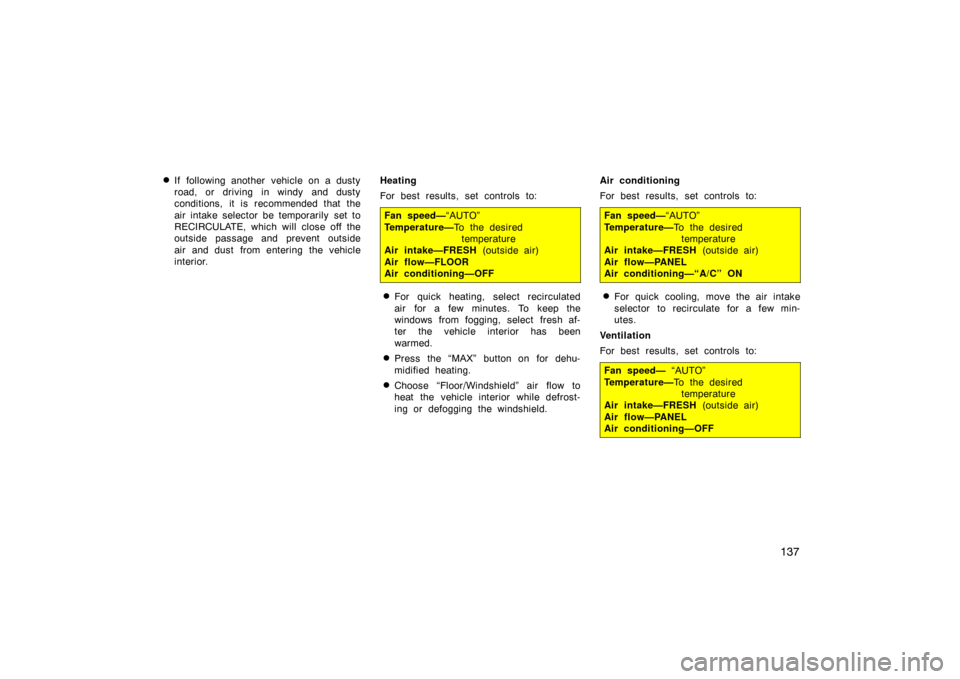
Heating
For best results, set controls to:
Fan speed—
“AUTO”
Temperature— To the desired
temperature
Air intake—FRESH (outside air)
Air flow—FLOOR
Air conditioning—OFF
�For quick heating, select recirculated
air for a few minutes. To keep the
windows from fogging, select fresh af-
ter the vehicle interior has been
warmed.
�Press the “MAX” button on for dehu-
midified heating.
�Choose “Floor/Windshield” air flow to
heat the vehicle interior while defrost-
ing or defogging the windshield. Air conditioning
For best results, set controls to:
Fan speed—
“AUTO”
Temperature— To the desired
temperature
Air intake—FRESH (outside air)
Air flow—PANEL
Air conditioning—“A/C” ON
�For quick cooling, move the air intake
selector to recirculate for a few min-
utes.
Ventilation
For best results, set controls to:
Fan speed— “AUTO”
Temperature— To the desired
temperature
Air intake—FRESH (outside air)
Air flow—PANEL
Air conditioning—OFF