’02 L/C U (L/O 0108)
195
Dinghy towing
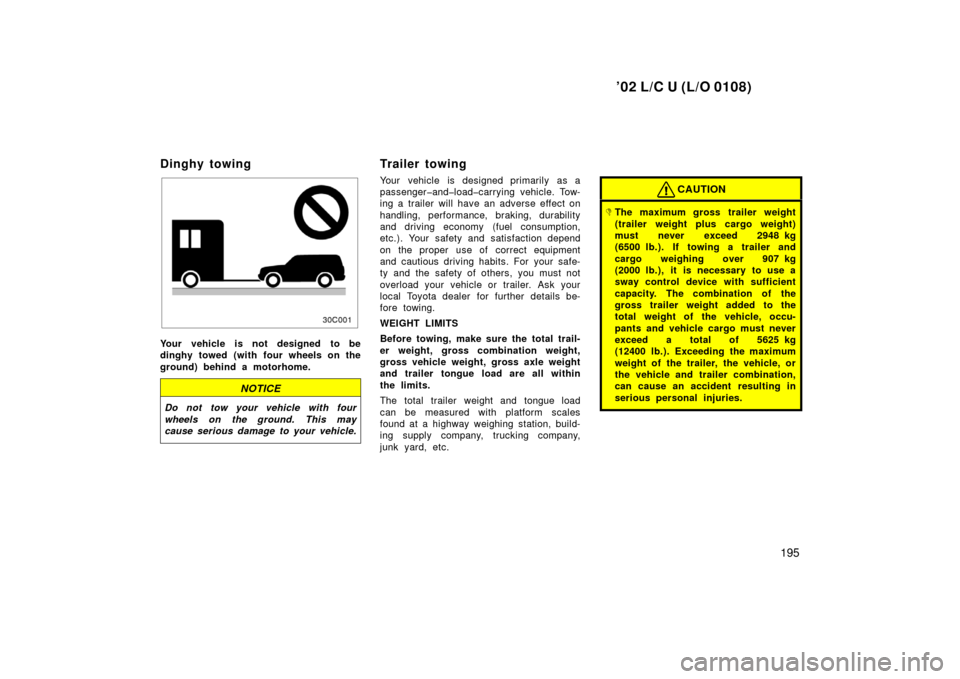
Your vehicle is not designed to be
dinghy towed (with four wheels on the
ground) behind a motorhome.
NOTICE
Do not tow your vehicle with four
wheels on the ground. This may
cause serious damage to your vehicle.
Trailer towing
Your vehicle is designed primarily as a
passengerandloadcarrying vehicle. Tow-
ing a trailer will have an adverse effect on
handling, performance, braking, durability
and driving economy (fuel consumption,
etc.). Your safety and satisfaction depend
on the proper use of correct equipment
and cautious driving habits. For your safe-
ty and the safety of others, you must not
overload your vehicle or trailer. Ask your
local Toyota dealer for further details be-
fore towing.
WEIGHT LIMITS
Before towing, make sure the total trail-
er weight, gross combination weight,
gross vehicle weight, gross axle weight
and trailer tongue load are all within
the limits.
The total trailer weight and tongue load
can be measured with platform scales
found at a highway weighing station, build-
ing supply company, trucking company,
junk yard, etc.CAUTION
�The maximum gross trailer weight
(trailer weight plus cargo weight)
must never exceed 2948 kg
(6500 lb.). If towing a trailer and
cargo weighing over 907 kg
(2000 lb.), it is necessary to use a
sway control device with sufficient
capacity. The combination of the
gross trailer weight added to the
total weight of the vehicle, occu-
pants and vehicle cargo must never
exceed a total of 5625 kg
(12400 lb.). Exceeding the maximum
weight of the trailer, the vehicle, or
the vehicle and trailer combination,
can cause an accident resulting in
serious personal injuries.
’02 L/C U (L/O 0108)
196
�Trailer hitch assemblies have differ-
ent weight capacities established by
the hitch manufacturer. Even though
the vehicle may be physically capa-
ble of towing a higher weight, the
operator must determine the maxi-
mum weight rating of the particular
hitch assembly and never exceed
the maximum weight rating speci-
fied for the trailerhitch. Exceeding
the maximum weight rating set by
the trailer hitch manufacturer can
cause an accident resulting in seri-
ous personal injuries.
�The gross vehicle weight must not
exceed the Gross Vehicle Weight
Rating (GVWR) indicated on the
Certification Label. The gross ve-
hicle weight is the sum of weights
of the unloaded vehicle, driver, pas-
sengers, luggage, hitch and trailer
tongue load. It also includes the
weight of any special equipment
installed on your vehicle.
�The load on either the front or rear
axle resulting from distribution of
the gross vehicle weight on both
axles must not exceed the Gross
Axle Weight Rating (GAWR) listed
on the Certification Label.
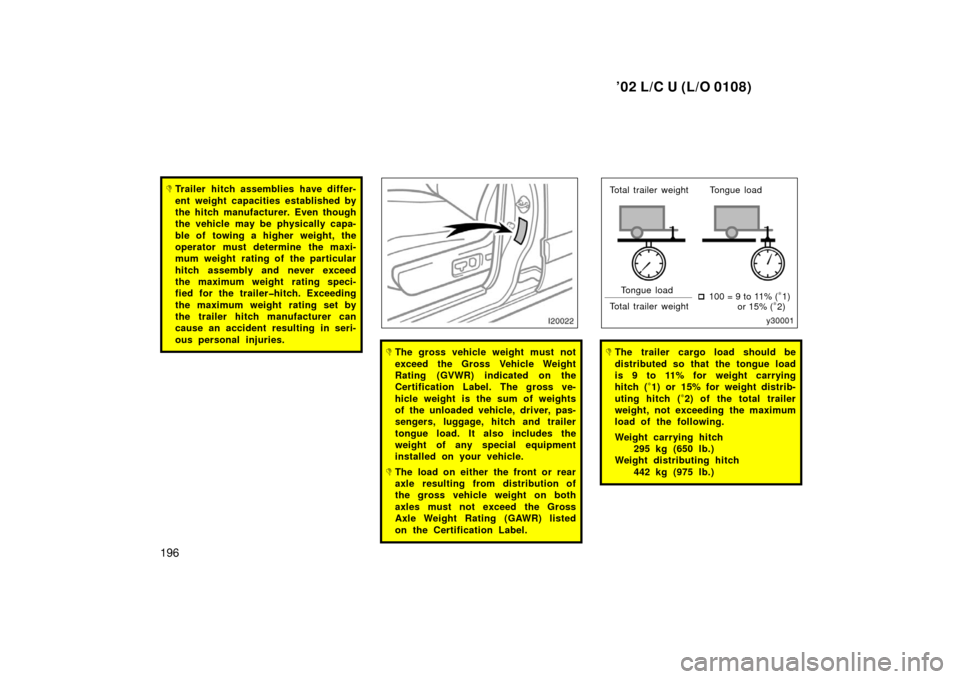
Total trailer weight Tongue loadTongue load
Total trailer weight �
100 = 9 to 11% (
∗1)
or 15% (∗2)
�The trailer cargo load should be
distributed so that the tongue load
is 9 to 11% for weight carrying
hitch (
∗1) or 15% for weight distrib-
uting hitch (∗2) of the total trailer
weight, not exceeding the maximum
load of the following.
Weight carrying hitch 295 kg (650 lb.)
Weight distributing hitch
442 kg (975 lb.)