Page 105 of 286
’02 L/C U (L/O 0108)
101
NOTICE
�Do not remove the thermostat in
the engine cooling system as this
may cause the engine to overheat.
The thermostat is designed to con-
trol the flow of coolant to keep the
temperature of the engine within
the specified operating range.
� Do not continue driving with an
overheated engine. See ”If your ve-
hicle overheats” in Section 4.
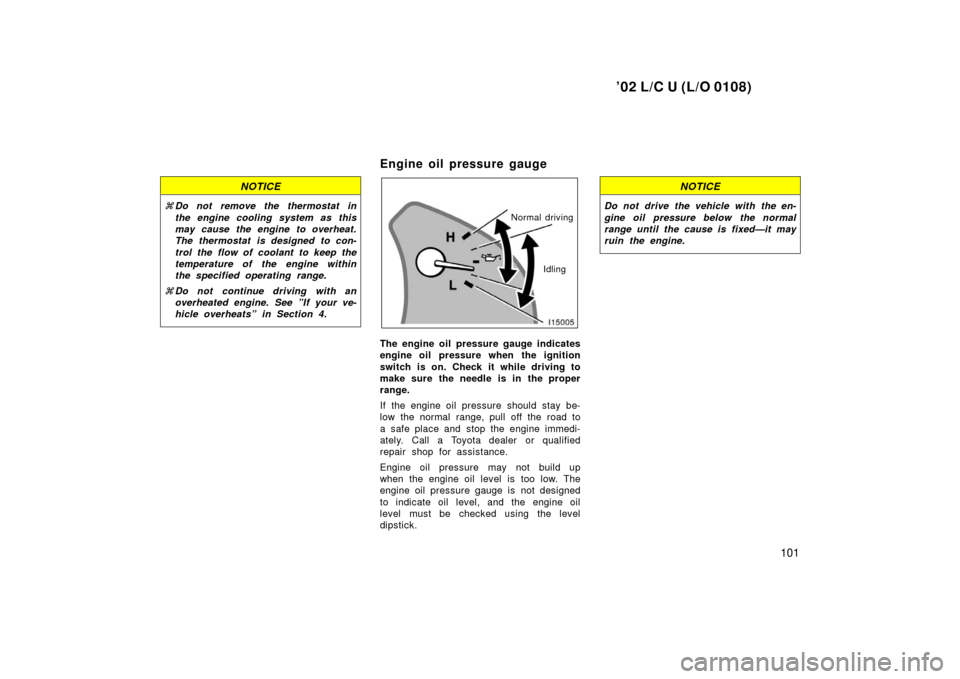
Engine oil pressure gauge
Idling
Normal driving
The engine oil pressure gauge indicates
engine oil pressure when the ignition
switch is on. Check it while driving to
make sure the needle is in the proper
range.
If the engine oil pressure should stay be-
low the normal range, pull off the road to
a safe place and stop the engine immedi-
ately. Call a Toyota dealer or qualified
repair shop for assistance.
Engine oil pressure may not build up
when the engine oil level is too low. The
engine oil pressure gauge is not designed
to indicate oil level, and the engine oil
level must be checked using the level
dipstick.
NOTICE
Do not drive the vehicle with the en-
gine oil pressure below the normal
range until the cause is fixed—it may
ruin the engine.
Page 182 of 286
’02 L/C U (L/O 0108)
178�
Oil is also used to lubricate the stems
of the intake valves. Some of this oil
is sucked into the combustion chamber
together with the intake air and is
burned along with the fuel. High tem-
perature exhaust gases also burn the
oil used to lubricate the exhaust valve
stems.
The amount of engine oil consumed de-
pends on the viscosity of the oil, the
quality of the oil and the conditions the
vehicle is driven under.
More oil is consumed by highspeed driv-
ing and frequent acceleration and decel-
eration.
A new engine consumes more oil, since
its pistons, piston rings and cylinder walls
have not become conditioned.
When judging the amount of oil con-
sumption, note that the oil may become
diluted and make it difficult to judge
the true level accurately. As an example, if a vehicle is used for
repeated short trips, and consumes a nor-
mal amount of oil, the dipstick may not
show any drop in the oil level at all, even
after 1000 km (600 miles) or more. This
is because the oil is gradually becoming
diluted with fuel or moisture, making it
appear that the oil level has not changed.
The diluting ingredients evaporate out
when the vehicle is then driven at high
speeds, as on an expressway, making it
appear that oil is excessively consumed
after driving at high speeds.
IMPORTANCE OF ENGINE OIL LEVEL
CHECK
One of the most important points in prop-
er vehicle maintenance is to keep the en-
gine oil at the optimum level so that oil
function will not be impaired. Therefore, it
is essential that the oil level be checked
regularly. Toyota recommends that the oil
level be checked every time you refuel
the vehicle.
NOTICE
Failure to check the oil level regularly
could lead to serious engine trouble
due to insufficient oil.
For detailed information on oil level check,
see ”Checking the engine oil level” in Sec-
tion 72.
Page 239 of 286
’02 L/C U (L/O 0108)
235
Battery electrolyte level
Make sure the electrolyte level of all bat-
tery cells is between upper and lower lev-
el lines on the case. Add only distilled
water when replenishing. See Section 73
for additional information.
Brake fluid level
Make sure the brake fluid level is correct.
See Section 72 for additional information.
Engine oil level
Check the level on the dipstick with the
engine turned off and the vehicle parked
on a level spot. See Section 72 for addi-
tional information.
Power steering fluid level
Check the level through the reservoir. The
level should be in the ”HOT” or ”COLD”
range depending on the fluid temperature.
See Section 72 for additional information.
Exhaust system
If you notice any change in the sound of
the exhaust or smell exhaust fumes, have
the cause located and corrected immedi-
ately. (See ”Engine exhaust cautions” in
Section 2.)Be on the alert for changes in perfor-
mance, sounds, and visual tipoffs that
indicate service is needed. Some impor-
tant clues are as follows:
�Engine missing, stumbling, or pinging
�Appreciable loss of power
�Strange engine noises
�A fluid leak under the vehicle (however,
water dripping from the air conditioning
after use is normal.)
�Change in exhaust sound (This may
indicate a dangerous carbon monoxide
leak. Drive with the windows open and
have the exhaust system checked im-
mediately.)
�Flatlooking tire; excessive tire squeal
when cornering; uneven tire wear
�Vehicle pulls to one side when driving
straight on a level road
�Strange noises related to suspension
movement
�Loss of brake effectiveness; spongy
feeling brake pedal; pedal almost
touches floor; vehicle pulls to one side
when braking
�Engine coolant temperature continually
higher than normal
�Engine continually runs hot; oil pres-
sure gauge stays low
If you notice any of these clues, take your
vehicle to your Toyota dealer as soon as
possible. It probably needs adjustment or
repair.
CAUTION
Do not continue driving with the ve-
hicle unchecked. It could result in se-
rious vehicle damage and possibly
personal injury.
Does your vehicle need
repairing?
Page 242 of 286
’02 L/C U (L/O 0108)
238
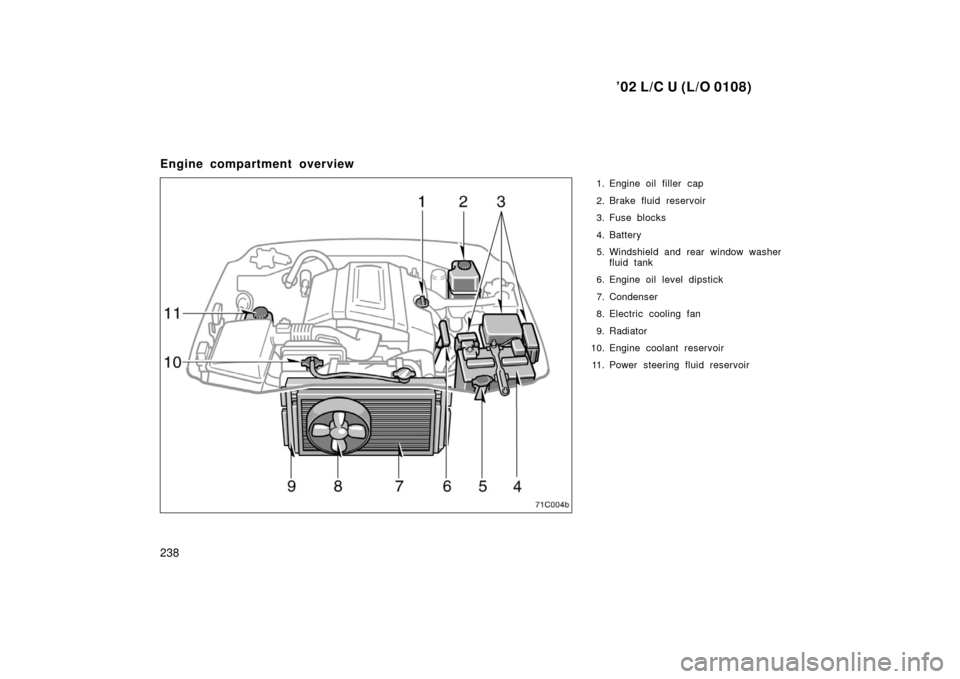
Engine compartment overview
1. Engine oil filler cap
2. Brake fluid reservoir
3. Fuse blocks
4. Battery
5. Windshield and rear window washerfluid tank
6. Engine oil level dipstick
7. Condenser
8. Electric cooling fan
9. Radiator
10. Engine coolant reservoir 11. Power steering fluid reservoir
Page 248 of 286
’02 L/C U (L/O 0108)
244
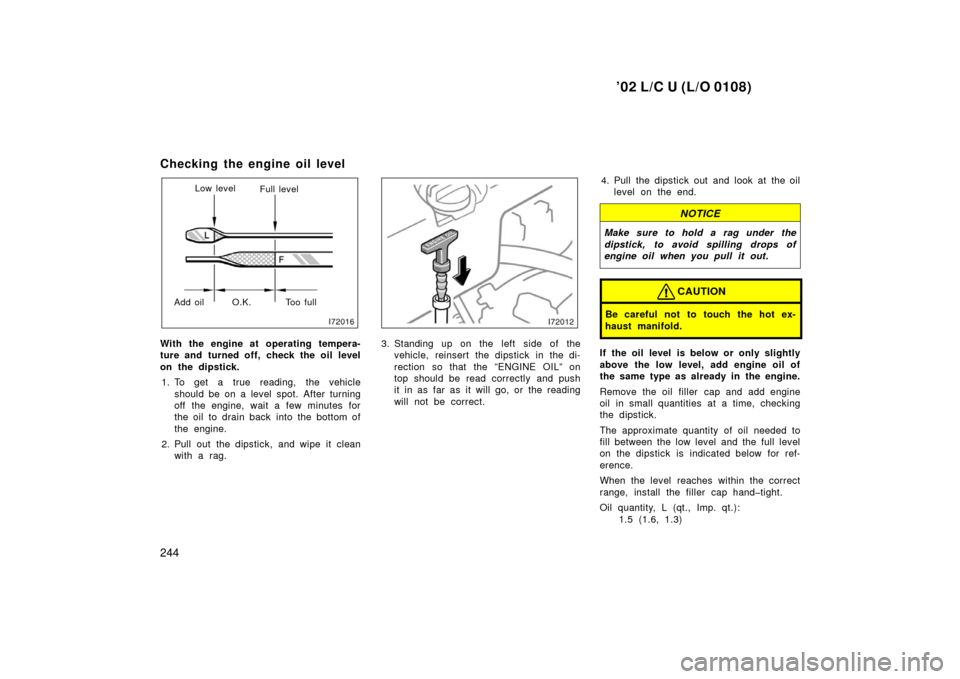
Checking the engine oil level
Low levelFull level
Add oil Too full O.K.
With the engine at operating tempera-
ture and turned off, check the oil level
on the dipstick.
1. To get a true reading, the vehicle should be on a level spot. After turning
off the engine, wait a few minutes for
the oil to drain back into the bottom of
the engine.
2. Pull out the dipstick, and wipe it clean with a rag.3. Standing up on the left side of thevehicle, reinsert the dipstick in the di-
rection so that the ”ENGINE OIL” on
top should be read correctly and push
it in as far as it will go, or the reading
will not be correct. 4. Pull the dipstick out and look at the oil
level on the end.
NOTICE
Make sure to hold a rag under the
dipstick, to avoid spilling drops of
engine oil when you pull it out.
CAUTION
Be careful not to touch the hot ex-
haust manifold.
If the oil level is below or only slightly
above the low level, add engine oil of
the same type as already in the engine.
Remove the oil filler cap and add engine
oil in small quantities at a time, checking
the dipstick.
The approximate quantity of oil needed to
fill between the low level and the full level
on the dipstick is indicated below for ref-
erence.
When the level reaches within the correct
range, install the f iller cap handtight.
Oil quantity, L (qt., Imp. qt.): 1.5 (1.6, 1.3)
Page 249 of 286
’02 L/C U (L/O 0108)
245
NOTICE
�Be careful not to drop the engine
oil on the vehicle components.
� Avoid overfilling, or the engine
could be damaged.
� Check the oil level on the dipstick
once again after adding the oil.
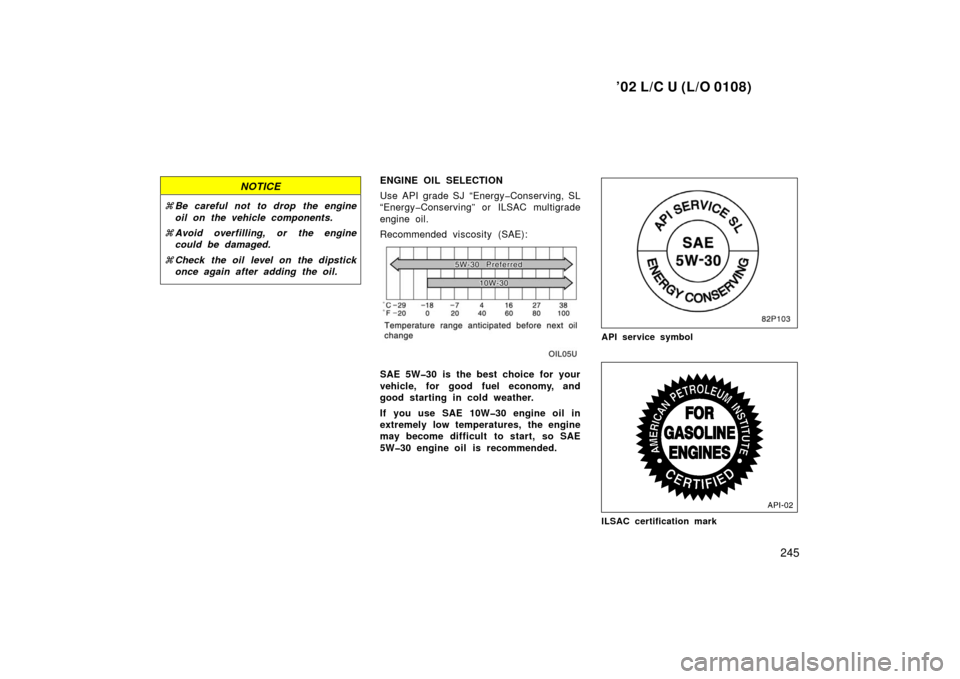
ENGINE OIL SELECTION
Use API grade SJ “EnergyConserving, SL
“EnergyConserving” or ILSAC multigrade
engine oil.
Recommended viscosity (SAE):
SAE 5W30 is the best choice for your
vehicle, for good fuel economy, and
good starting in cold weather.
If you use SAE 10W30 engine oil in
extremely low temperatures, the engine
may become difficult to start, so SAE
5W30 engine oil is recommended.
API service symbol
ILSAC certification mark