Page 179 of 286
’02 L/C U (L/O 0108)
175
GASOLINE QUALITY
In a very few cases, you may experience
driveability problems caused by the partic-
ular gasoline that you are using. If you
continue to have unacceptable driveability,
try changing gasoline brands. If that does
not rectify your problem, then consult your
Toyota dealer.
NOTICE
�Do not use gasohol other than
stated above. It will cause fuel sys-
tem damage or vehicle performance
problems.
� If drive ability problems are occur
(poor hot starting, vaporizing, en-
gine knock, etc.), discontinue the
use.
� Take care not to spill gasohol dur-
ing refueling. Gasohol may cause
paint damage.
FUEL TANK CAPACITY
96 L (25.4 gal., 21.1 Imp. gal.)
Operation in foreign countries
If you plan to drive your Toyota in
another country...
First, comply with the vehicle registration
laws.
Second, confirm the availability of the
correct fuel (unleaded and minimum oc-
tane number).
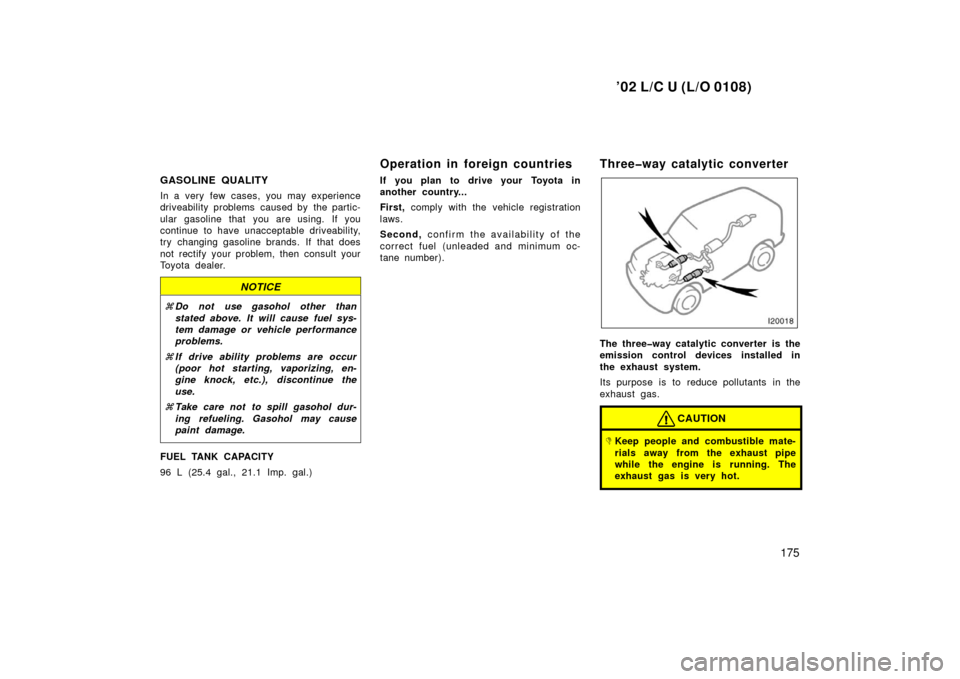
Threeway catalytic converter
The threeway catalytic converter is the
emission control devices installed in
the exhaust system.
Its purpose is to reduce pollutants in the
exhaust gas.
CAUTION
�Keep people and combustible mate-
rials away from the exhaust pipe
while the engine is running. The
exhaust gas is very hot.
Page 253 of 286
’02 L/C U (L/O 0108)
249
Clean all dirt from outside of the reservoir
tank and look at the fluid level. If the fluid
is cold, the level should be in the ”COLD”
range. Similarly, if it is hot, the fluid level
should be in the ”HOT” range. If the level
is at the low side of either range, add
automatic transmission fluid DEXRON�II
or III to bring the level within the range.
To remove the reservoir cap, turn it coun-
terclockwise and lift up. To reinstall it,
turn it clockwise. After replacing the filler
cap, visually check the steering box case,
vane pump and hose connections for
leaks or damage.
CAUTION
The reservoir tank may be hot so be
careful not to burn yourself.
NOTICE
Avoid overfilling, or the power steer-
ing could be damaged.
Checking tire pressure
Keep your tire pressures at the proper
level.
The recommended cold tire pressures, tire
size and the vehicle capacity weight are
given in Section 8.
You should check the tire pressures every
two weeks, or at least once a month. And
don’t forget the spare!
Incorrect tire pressure can reduce tire
life and make your vehicle less safe to
drive.
Low tire pressure results in excessive
wear, poor handling, reduced fuel econo-
my, and the possibility of blowouts from
overheated tires. Also, low tire pressure
can cause poor sealing of the tire bead.
If the tire pressure is excessively low,
there is the possibility of w heel deforma-
tion and/or tire separation.
High tire pressure produces a harsh ride,
handling problems, excessive wear at the
center of the tire tread, and a greater
possibility of tire damage from road haz-
ards.
If a tire frequently needs ref illing, have it
checked by your Toyota dealer. The following instructions for checking
tire pressure should be observed:
�The pressure should be checked only
when the tires are cold.
If your ve-
hicle has been parked for at least 3
hours and has not been driven for
more than 1.5 km or 1 mile since, you
will get an accurate cold tire pressure
reading.
�Always use a tire pressure gauge.
The appearance of a tire can be mis-
leading. Besides, tire pressures that
are even just a few pounds off can
degrade ride and handling.
�Do not bleed or reduce tire pressure
after driving. It is normal for the tire
pressure to be higher after driving.
�Never exceed the vehicle capacity
weight. The passenger and luggage
weight should be located so that the
vehicle is balanced.
�Be sure to reinstall the tire inflation
valve caps. Without the valve caps,
dirt or moisture could get into the valve
core and cause air leakage. If the caps
have been lost, have new ones put on
as soon as possible.
Page 272 of 286
’02 L/C U (L/O 0108)
268
Dimensions and weight
Overall length mm (in.) 4890 (192.5)
Overall width mm (in.) 1940 (76.4)
Overall height mm (in.) 1875 (73.8)
∗1
Wheelbase mm (in.) 2850 (112.2)
Front tread mm (in.) 1620 (63.8)
Rear tread mm (in.) 1615 (63.6)
Vehicle capacity weight
(occupants + luggage)
kg (lb.) 590 (1300)
562 (1240)
∗2
∗ 1
: Unladen vehicle∗2: With third seats
Engine
Model:
2UZFE
Type: 8 cylinder V type, 4 cycle, gasoline
Bore and stroke, mm (in.): 94.0 � 84.0 (3.70 � 3.30)
Displacement, cm
3 (cu. in.):
4664 (284.6)
Fuel
Fuel type: Unleaded gasoline, Octane Rating 87
(Research Octane Number 91) or higher.
For improved vehicle performance, the
use of premium unleaded gasoline with
an Octane Rating of 91 (Research Oc-
tane Number 96) or higher is recom-
mended.
Fuel tank capacity, L (gal., Imp. gal.): 96 (25.4, 21.1)
Page 283 of 286

’02 L/C U (L/O 0108)
v
Publication No. OM60945U
Part No. 01999-60945
Printed in Japan 01−0108 −00
(U)
Quick index
� If a service reminder indicator or warning buzzer comes on cxlix . . .
� If your vehicle will not start ccxcii . . . . . . . . . . . . . . . . . . . . . . . . . . . . . . . . .
� If your engine stalls while driving ccxcvii . . . . . . . . . . . . . . . . . . . . . . . . . . .
� If your vehicle overheats ccxcviii
. . . . . . . . . . . . . . . . . . . . . . . . . . . . . . . . . .
� If you have a flat tire ccc . . . . . . . . . . . . . . . . . . . . . . . . . . . . . . . . . . . . .\
. . . .
� If your vehicle needs to be towed cccxiii
. . . . . . . . . . . . . . . . . . . . . . . . . .
� Tips for driving during break-in period ccxlvii . . . . . . . . . . . . . . . . . . . . . . .
� How to start the engine cclxx . . . . . . . . . . . . . . . . . . . . . . . . . . . . . . . . . . . . .\
� General maintenance cccxxxiii
. . . . . . . . . . . . . . . . . . . . . . . . . . . . . . . . . . . . .\
� Complete index NO TAG . . . . . . . . . . . . . . . . . . . . . . . . . . . . . . . . . . . . .\
. . . . .
Gas station information
Fuel type:
UNLEADED gasoline, Octane Rating 87 (Research Octane Number 91)
or higher. For improved vehicle performance, the use of premium unleaded
gasoline with an Octane Rating of 91 (Research Octane Number 96) or
higher is recommended.
See page ccxlvii for detailed information.
Fuel tank capacity: 96 L (25.4 gal., 21.1 lmp. gal.)
Engine oil:
API grade SJ “Energy −Conserving”, SL “Energy −Conserving” or ILSAC
multigrade engine oil is recommended.
See page cccxlix for detailed information.
Automatic transmission fluid: Automatic transmission fluid D −II or DEXRON
�III (DEXRON�II)
Tire information: See pages ccclv through ccclxii.
Tire pressure: See page ccclxxxv.
U7
I