Page 142 of 293

AP_Camry_U (L/O 0201)
1382002 MY CAMRY_U (OM33567U)
TRACK (Track up/down button):
compact disc auto changer
By using this button, you can skip up or
down to a different track.
Push either side of the track button until
the number of the track you want to listen
to appears on the display. If you want to
return to the beginning of the current
track, quickly push the down side of the
button one time.
TRAF (Traffic)
This button turns the traffic announcement
(TA) feature on and off.
By pushing “TRAF” button, “TRAF SEEK”
appears on the display and the radio will
start seeking any traffic program station.
When a traffic program station is found,
“< >” will be displayed () and you
will hear a beep.
After the traffic announcement program is
over, a beep sounds and the display re-
turns to the previous mode.If no traffic program station is found, “NO
TRAF INFO” appears on the display for a
few seconds and the display returns to
the previous mode. However, if the
“TRAF” button is pushed when the cas-
sette player or compact disc player is on,
the radio will start seeking traffic program
stations.
TA volume memory function—The volume
level when receiving the traffic announce-
ment is memorized.
When “TA” is received next time, the sys-
tem compares the volume before “TA” is
received and the memorized TA volume
and automatically selects the louder vol-
ume. However, the range of volume
memory is limited: if the volume received
previously is less than the minimum, this
volume will be used.
You can adjust the volume independently
from the memorized TA volume range
while receiving a TA station.
Traffic announcement can be canceled by
turning RDS off, or pressing the “TRAF”
button again.TUNE (Tuning)
Your Toyota has an electronic tuning radio
(ETR). Turn the knob clockwise to step up
the frequency. Turn the knob counterclock-
wise to step down the frequency.
TYPE (Program Types)
When you push the “TYPE” button while
receiving an RDS station, the current pro-
gram type appears on the display.
Each time you push the “TYPE” button,
the program type changes as in the fol-
lowing:
�ROCK
�EASY LIS (Easy listening)
�CLS/JAZZ (Classical music and Jazz)
�R&B (Rhythm and Blues)
�INFORM (Information)
�RELIGION
�MISC
�ALERT (Emergency message)
ALERT: If an emergency broadcast is re-
ceived during reception of anything other
than AM broadcasting, you will hear a
beep and “ALERT” appears on the display.
Page 143 of 293

AP_Camry_U (L/O 0201)
1392002 MY CAMRY_U (OM33567U)
NOTICE
To ensure the correct audio system
operation:
�Be careful not to spill beverages
over the audio system.
� Do not put anything other than a
cassette tape or Compact Disc into
the slot.
� The use of cellular phone inside or
near the vehicle may cause a noise
from the speakers of the audio sys-
tem which you are listening to.
However, this does not indicate a
malfunction.
RADIO RECEPTION
Usually, a problem with radio reception
does not mean there is a problem with
your radio—it is just the normal result of
conditions outside the vehicle.
For example, nearby buildings and terrain
can interfere with FM reception. Power
lines or telephone wires can interfere with
AM signals. And of course, radio signals
have a limited range. The farther you are
from a station, the weaker its signal will
be. In addition, reception conditions
change constantly as your vehicle moves. Here are some common reception prob-
lems that probably do not indicate a prob-
lem with your radio:
FM
Fading and drifting stations—Generally, the
effective range of FM is about 40 km (25
miles). Once outside this range, you may
notice fading and drifting, which increase
with the distance from the radio transmit-
ter. They are often accompanied by distor-
tion.
Multi
−path—FM signals are reflective,
making it possible for two signals to reach
your antenna at the same time. If this
happens, the signals will cancel each oth-
er out, causing a momentary flutter or
loss of reception.
Static and fluttering—These occur when
signals are blocked by buildings, trees, or
other large objects. Increasing the bass
level may reduce static and fluttering.
Station swapping—If the FM signal you
are listening to is interrupted or weak-
ened, and there is another strong station
nearby on the FM band, your radio may
tune in the second station until the origi-
nal signal can be picked up again. AM
Fading—AM broadcasts are reflected by
the upper atmosphere—especially at night.
These reflected signals can interfere with
those received directly from the radio sta-
tion, causing the radio station to sound
alternately strong and weak.
Station interference—When a reflected sig-
nal and a signal received directly from a
radio station are very nearly the same
frequency, they can interfere with each
other, making it difficult to hear the broad-
cast.
Static—AM is easily affected by external
sources of electrical noise, such as high
tension power lines, lightening, or electri-
cal motors. This results in static.
CARING FOR YOUR CASSETTE PLAYER
AND TAPES
For the best performance for your cas-
sette player and tapes:
Clean the tape head and other parts regu-
larly.
�A dirty tape head or tape path can
decrease sound quality and tangle your
cassette tapes. The easiest way to
clean them is by using a cleaning tape.
(A wet type is recommended.)
Car audio system operating
hints
Page 144 of 293
AP_Camry_U (L/O 0201)
1402002 MY CAMRY_U (OM33567U)
Use high−quality cassettes.
�Low −quality cassette tapes can cause
many problems, including poor sound,
inconsistent playing speed, and
constant auto− reversing. They can also
get stuck or tangled in the cassette
player.
�Do not use a cassette if it has been
damaged or tangled or if its label is
peeling off.
�Do not leave a cassette in the player
if you are not listening to it, especially
if it is hot outside.
�Store cassettes in their cases and out
of direct sunlight.
�Avoid using cassettes with a total play-
ing time longer than 100 minutes (50
minutes per side). The tape used in
these cassettes is thin and could get
stuck or tangled in the cassette player.
CARING FOR YOUR COMPACT DISC
PLAYER AND DISCS
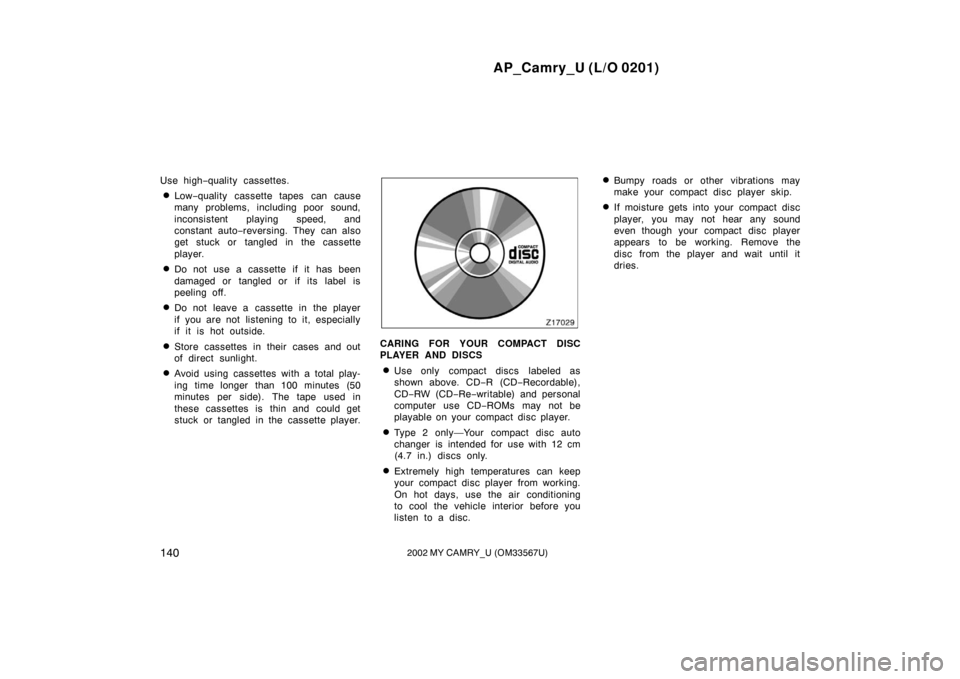
�Use only compact discs labeled as
shown above. CD −R (CD −Recordable),
CD− RW (CD −Re −writable) and personal
computer use CD −ROMs may not be
playable on your compact disc player.
�Type 2 only—Your compact disc auto
changer is intended for use with 12 cm
(4.7 in.) discs only.
�Extremely high temperatures can keep
your compact disc player from working.
On hot days, use the air conditioning
to cool the vehicle interior before you
listen to a disc.
�Bumpy roads or other vibrations may
make your compact disc player skip.
�If moisture gets into your compact disc
player, you may not hear any sound
even though your compact disc player
appears to be working. Remove the
disc from the player and wait until it
dries.
Page 145 of 293
AP_Camry_U (L/O 0201)
1412002 MY CAMRY_U (OM33567U)
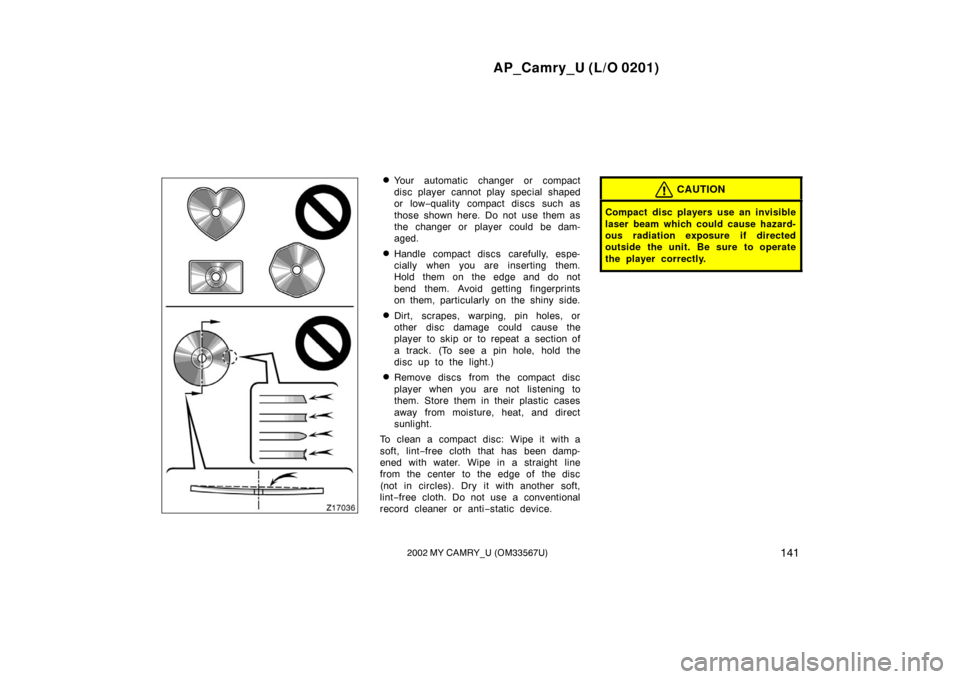
�Your automatic changer or compact
disc player cannot play special shaped
or low−quality compact discs such as
those shown here. Do not use them as
the changer or player could be dam-
aged.
�Handle compact discs carefully, espe-
cially when you are inserting them.
Hold them on the edge and do not
bend them. Avoid getting fingerprints
on them, particularly on the shiny side.
�Dirt, scrapes, warping, pin holes, or
other disc damage could cause the
player to skip or to repeat a section of
a track. (To see a pin hole, hold the
disc up to the light.)
�Remove discs from the compact disc
player when you are not listening to
them. Store them in their plastic cases
away from moisture, heat, and direct
sunlight.
To clean a compact disc: Wipe it with a
soft, lint −free cloth that has been damp-
ened with water. Wipe in a straight line
from the center to the edge of the disc
(not in circles). Dry it with another soft,
lint −free cloth. Do not use a conventional
record cleaner or anti −static device.
CAUTION
Compact disc players use an invisible
laser beam which could cause hazard-
ous radiation exposure if directed
outside the unit. Be sure to operate
the player correctly.
Page:
< prev 1-8 9-16 17-24