Page 231 of 308

’02 4Runner_U (L/O 0108)
2252002 MY 4RUNNER_U (OM 35787U)
To avoid serious personal injury and
damage to your vehicle which might re-
sult from battery explosion, acid burns,
electrical burns, or damaged electronic
components, these instructions must be
followed precisely.
If you are unsure about how to follow this
procedure, we strongly recommend that
you seek the help of a competent me-
chanic or towing service.
CAUTION
�Batteries contain sulfuric acid
which is poisonous and corrosive.
Wear protective safety glasses when
jump starting, and avoid spilling
acid on your skin, clothing, or ve-
hicle.
�If you should accidentally get acid
on yourself or in your eyes, remove
any contaminated clothing and flush
the affected area with water imme-
diately. Then get immediate medical
attention. If possible, continue to
apply water with a sponge or cloth
while en route to the medical office.
�The gas normally produced by a
battery will explode if a flame or
spark is brought near. Use only
standardized jumper cables and do
not smoke or light a match while
jump starting.
�Warning: Battery posts, terminals
and related accessories contain lead
and lead compounds, chemicals
known to the State of California to
cause cancer and reproductive
harm. Wash hands after handling.
NOTICE
The battery used for boosting must
be 12 V. Do not jump start unless you
are sure that the booster battery is
correct.
JUMP STARTING PROCEDURE
1. If the booster battery is installed in another vehicle, make sure the vehicles
are not touching. Turn off all unneces-
sary lights and accessories.
2. If required, remove all the vent plugs from the booster and discharged batter-
ies. Lay a cloth over the open vents
on the batteries. (This helps reduce the
explosion hazard, personal injuries and
burns.)
3. If the engine in the vehicle with the booster battery is not running, start it
and let it run for a few minutes. During
jump starting run the engine at about
2000 rpm with the accelerator pedal
lightly depressed.
(c) Jump starting
Page 233 of 308

’02 4Runner_U (L/O 0108)
2272002 MY 4RUNNER_U (OM 35787U)
5. Start your engine in the normal way.
After starting, run it at about 2000 rpm
for several minutes with the accelerator
pedal lightly depressed.
6. Carefully disconnect the cables in the exact reverse order: the negative cable
and then the positive cable.
7. Carefully dispose of the battery cover cloths—they may now contain sulfuric
acid.
8. If removed, replace all the battery vent plugs.
If the cause of your battery discharging is
not apparent (for example, lights left on),
you should have it checked. If your engine stalls while driving...
1. Reduce your speed gradually, keeping a straight line. Move cautiously off the
road to a safe place.
2. Turn on your emergency flashers.
3. Try starting the engine again.
If the engine will not start, see “If your
vehicle will not start”.
CAUTION
If the engine is not running, the pow-
er assist for the brakes and steering
will not work so steering and braking
will be much harder than usual.
If the engine speed does not increase with
the accelerator pedal depressed down to
about the middle position , there may be a
problem somewhere in your electronic
throttle control system.
At this time, if you depress the accelera-
tor pedal more firmly and slowly, you can
drive you vehicle at low speeds. Have
your vehicle checked by your Toyota deal-
er as soon as possible.
Even if the abnormality of the electronic
throttle control system is corrected during
low speed driving, the system may not be
recovered until the engine is stopped and
the ignition key is turned to “ACC” or
“LOCK” position.
CAUTION
Be especially careful to prevent erro-
neous pedal operation.
If your engine stalls while
driving If you cannot incr
ease the
engine speed
Page 260 of 308

’02 4Runner_U (L/O 0108)
2542002 MY 4RUNNER_U (OM 35787U)
INSIDE THE VEHICLE
Items listed below should be checked
regularly, e.g. while performing periodic
services, cleaning the vehicle, etc.
Lights
Make sure the headlights, stop lights, tail
lights, turn signal lights, and other lights
are all working. Check headlight aim.
Service reminder indicators and warning
buzzers
Check that all service reminder indicators
and warning buzzers function properly.
Steering wheel
Check that it has the specified free play.
Be alert for changes in steering condition,
such as hard steering or strange noise.
Seats
Check that all seat controls such as seat
adjusters, seatback recliner, etc. operate
smoothly and that all latches lock securely
in any position. Check that the head re-
straint move up and down smoothly and
that the locks hold securely in any latched
position. For foldingdown rear seatbacks
and swingup rear seat cushions, check
that the latches lock securely. Seat belts
Check that the seat belt system such as
buckles, retractors and anchors operate
properly and smoothly. Make sure the belt
webbing is not cut, frayed, worn or dam-
aged.
Accelerator pedal
Check the pedal for smooth operation and
uneven pedal effort or catching.
Brake pedal
Check the pedal for smooth operation and
that the pedal has the proper clearance.
Check the brake booster function.
Brakes
At a safe place, check that the brakes do
not pull to one side when applied.
Parking brake
Check that the lever has the proper travel
and that, on a safe incline, your vehicle
is held securely with only the parking
brake applied.
Automatic transmission “Park” mecha-
nism
Check the lock release button of the se-
lector lever for proper and smooth opera-
tion. On a safe incline, check that your
vehicle is held securely with the selector
lever in “P” position and all brakes re-
leased.
IN THE ENGINE COMPARTMENT
Items listed below should be checked
from time to time, e.g. each time when
refueling.
Washer fluid
Make sure there is sufficient fluid in the
tank. See Section 73 for additional in-
formation.
Engine coolant level
Make sure the coolant level is between
the “F” and “L” lines on the seethrough
reservoir when the engine is cold. See
Section 72 for additional information.
Radiator, condenser and hoses
Check that the front of the radiator and
condenser are clean and not blocked with
leaves, dirt, or insects. See Section 72
for additional information.
Page 284 of 308
’02 4Runner_U (L/O 0108)
2782002 MY 4RUNNER_U (OM 35787U)
NOTICE
Never recharge the battery while the
engine is running. Also, be sure all
accessories are turned off.Ty p e A
Ty p e B
Ty p e CGood
Good
Good Blown
Blown
Blown
If the headlights or other electrical
components do not work, check the
fuses. If any of the fuses are blown,
they must be replaced.
See “Fuse locations” in Section 71 for
locations of the fuses.
Turn the ignition switch and inoperative
component off. Pull a suspected fuse
straight out and check it.
Determine which fuse may be causing the
problem. The lid of the fuse box shows
the name of the circuit for each fuse. See
Section 8 of this manual for the functions
controlled by each circuit.
Checking and replacing fuses
Page 286 of 308

’02 4Runner_U (L/O 0108)
2802002 MY 4RUNNER_U (OM 35787U)
The following illustrations show how to
gain access to the bulbs. When replacing
a bulb, make sure the ignition switch and
light switch are off. Use bulbs with the
wattage ratings given in the table.
CAUTION
�To prevent yourself from burning,
do not replace the light bulbs while
they are hot.
�Halogen bulbs have pressurized gas
inside and require special handling.
They can burst or shatter if
scratched or dropped. Hold a bulb
only by its plastic or metal case.
Do not touch the glass part of a
bulb with bare hands.
NOTICE
Only use a bulb of the listed type.
The inside of the lens of exterior lights
such as headlights may temporarily fog up
when the lens becomes wet in the rain or
in a car wash. This is not a problem
because the fogging is caused by the
temperature difference between the outside
and inside of the lens, just like the
windshield fogged up in the rain. However,
if there is a large drop of water on the
inside of the lens, or if there is water
pooled inside the light, contact your
Toyota dealer. Light bulbsBulb
No.WTy p e
Headlights—60/55A
Front fog lights—55B
Parking and front
side marker lights—5C
Front turn signal
lights—21C
Rear turn signal
lights—21D
Stop/tail lights—21/5C
Backup lights—18C
License plate lights—5C
High mounted
stoplight92118C
Interior light—8E
Personal lights—8E
Glove box light—1.4C
Luggage
compartment light—8E
A: HB2 halogen bulbs
B: H3 halogen bulbs
C: Wedge base bulbs (clear)
D: Wedge base bulbs (amber)
E: Double end bulbs
Replacing light bulbs—
Page 287 of 308
’02 4Runner_U (L/O 0108)
2812002 MY 4RUNNER_U (OM 35787U)
1. Open the hood. Unplug the connec-
tor. Remove the rubber cover.
If the connector is tight, wiggle it.2. Release the bulb retaining spring and remove the bulb. Install a new
bulb and the bulb retaining spring.
To install a bulb, align the tabs of the
bulb with the cutouts of the mounting
hole.3. Install the rubber cover with the “TOP” mark upward and snuggle on
the boss. Plug in the connector.
Make sure the rubber cover fits snugly on
the connector and the headlight body.
Aiming is not necessary after replacing
the bulb. When aiming adjustment is nec-
essary, contact your Toyota dealer.
—Headlights
Page 288 of 308
’02 4Runner_U (L/O 0108)
2822002 MY 4RUNNER_U (OM 35787U)
1. Loosen the cover retaining screws
and remove the cover.2. Lift up the soft casing and discon-nect the cords.3. Release the bulb retaining springand remove the bulb. Install a new
bulb and the bulb retaining spring.
To install the bulb, align the cutouts of the
bulb with the protrusions of the mounting
hole.
—Front fog lights
Page 289 of 308
’02 4Runner_U (L/O 0108)
2832002 MY 4RUNNER_U (OM 35787U)
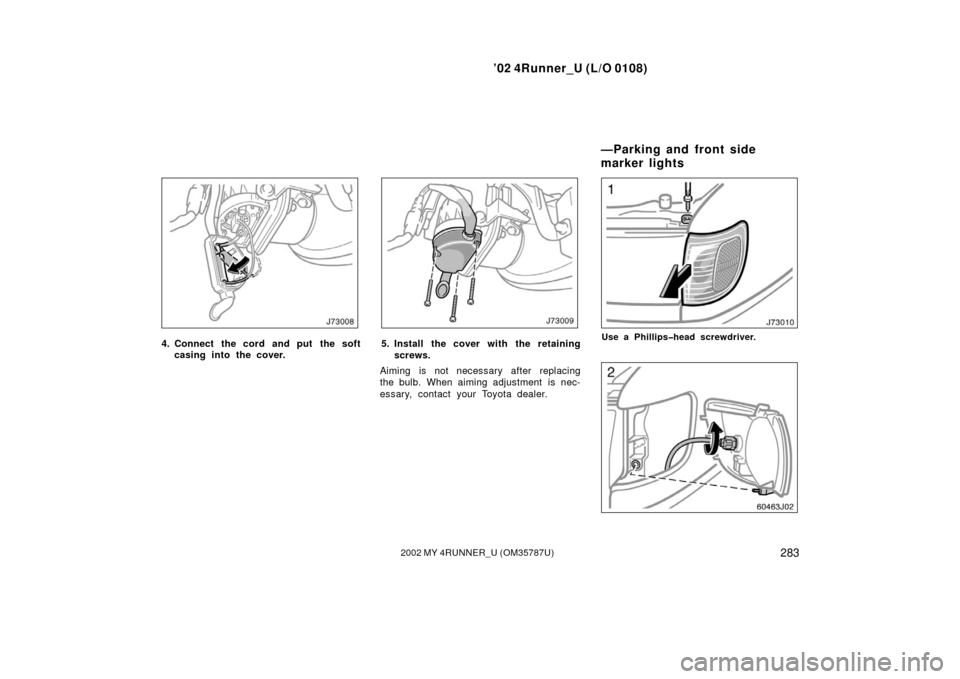
4. Connect the cord and put the soft
casing into the cover.5. Install the cover with the retaining
screws.
Aiming is not necessary after replacing
the bulb. When aiming adjustment is nec-
essary, contact your Toyota dealer.Use a Phillipshead screwdriver.
—Parking and front side
marker lights