Page 340 of 466
![SUBARU FORESTER 2002 SG / 2.G Owners Manual 9-4
HB8003BB
HG0106
Indicator location mark
Tread wear indicator bar
NOTE
[Automatic transmission vehicle not equipped with VDC (Vehicle Dy-
namics Control)] Before driving your vehicle with the tem](/manual-img/17/7200/w960_7200-339.png "SUBARU FORESTER 2002 SG / 2.G Owners Manual 9-4
HB8003BB
HG0106
Indicator location mark
Tread wear indicator bar
NOTE
[Automatic transmission vehicle not equipped with VDC (Vehicle Dy-
namics Control)] Before driving your vehicle with the tem")
9-4
HB8003BB
HG0106
Indicator location mark
Tread wear indicator bar
NOTE
[Automatic transmission vehicle not equipped with VDC (Vehicle Dy-
namics Control)] Before driving your vehicle with the temporaryspare tire, put a spare fuse inside the FWD connector located in theengine compartment and confirm that the Front-wheel drive warninglight comes on. The all wheel drive capability of the vehicle has now
been deactivated. After re-installing the conventional tire, removethe spare fuse from the FWD connector in order to reactivate allwheel drive.
Flat tires
WARNING
Do not jack up the vehicle on an incline or a loose road sur-
face. The jack can come out of the jacking point or sink into the ground and this can result in a severe accident. Use only the jack provided with your vehicle. The jack sup-
plied with the vehicle is designed only for changing a tire. Neverget under the vehicle while supporting the vehicle with this jack. Always turn the engine off before raising the flat tire off the
ground using the jack. Never swing or push the vehicle sup-ported with the jack. The jack can come out of the jacking pointdue to a jolt and this can result in a severe accident.
Page 368 of 466
Appearance care10-5
–
CONTINUED –
the fog light’s horizontal center line. Then, turn the protector clockwise
until it stops. Finally, check that the protector ’s horizontal bars are parallel
with the fog light ’s horizontal center line.
Corrosion protection
Your SUBARU has been designed and built to resist corrosion. Special
materials and protective finishes have been used on most parts of the
vehicle to help maintain fine appearance, strength, and reliable opera-tion. Most common causes of corrosion
The most common causes of corrosion are:
1. The accumulation of moisture retaining dirt and debris in body
panel sections, cavities, and other areas.
2. Damage to paint and other protective coatings caused by graveland stone chips or minor accidents.
Corrosion is accelerated on the vehicle when:
1. It is exposed to road salt or dust control chemicals, or used in
coastal areas where there is more salt in the air, or in areas where
there is considerable industrial pollution.
2. It is driven in areas of high humidity, especially when temperatures
range just above freezing.
3. Dampness in certain parts of the vehicle remains for a long time,
even though other parts of the vehicle may be dry.
4. High temperatures will cause corrosion to parts of the vehicle
which cannot dry quickly due to lack of proper ventilation. To help prevent corrosion
Wash the vehicle frequently. If you drive on salted roads in the winter
or if you live in a coastal area, you should flush the underbody with
fresh water frequently.
After the winter has ended, it is recommended that the underbody be
given a very thorough washing.
Page 412 of 466
11-42
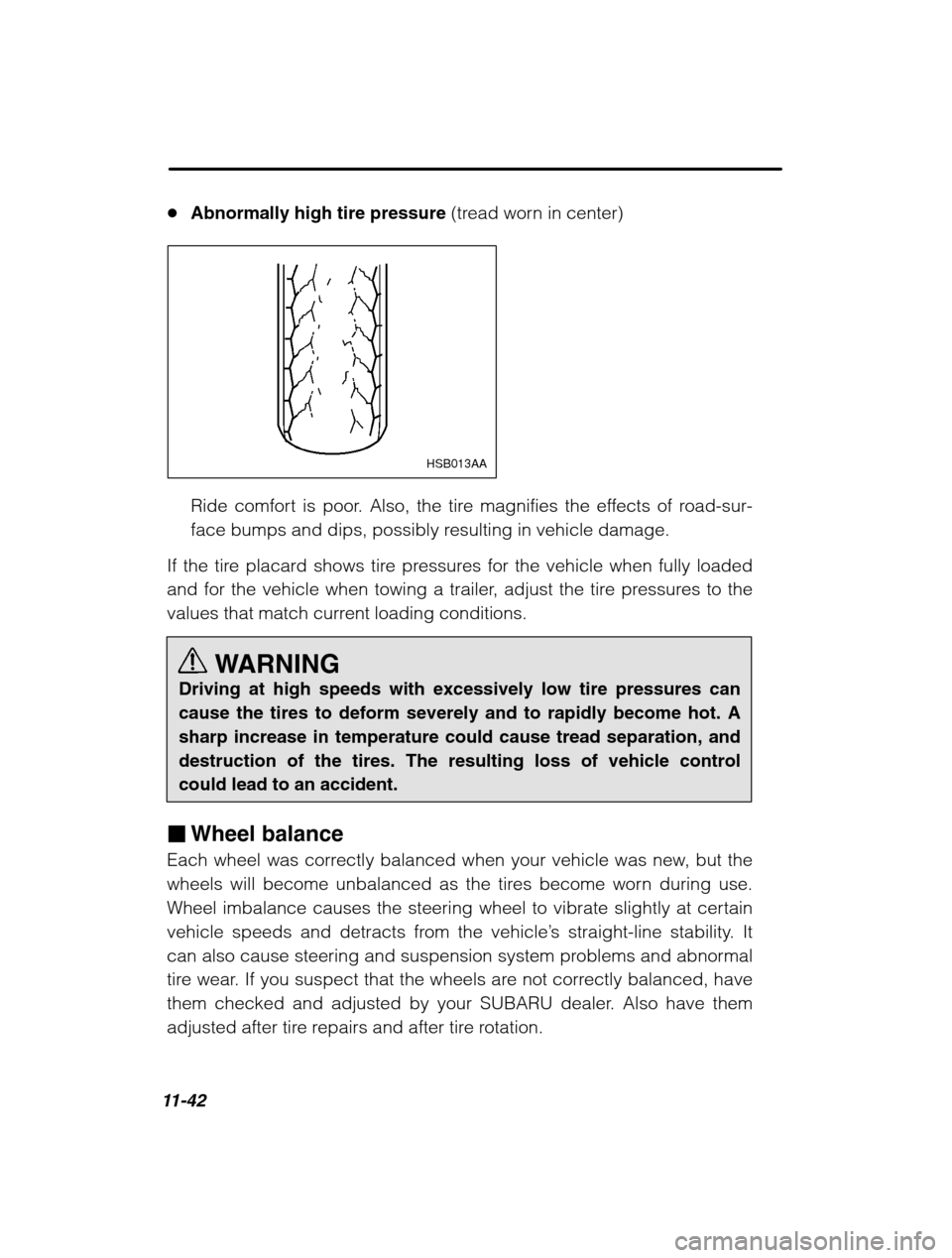
Abnormally high tire pressure (tread worn in center)
HSB013AA
Ride comfort is poor. Also, the tire magnifies the effects of road-sur-
face bumps and dips, possibly resulting in vehicle damage.
If the tire placard shows tire pressures for the vehicle when fully loaded
and for the vehicle when towing a trailer, adjust the tire pressures to the
values that match current loading conditions.
WARNING
Driving at high speeds with excessively low tire pressures can
cause the tires to deform severely and to rapidly become hot. Asharp increase in temperature could cause tread separation, and
destruction of the tires. The resulting loss of vehicle controlcould lead to an accident.
Wheel balance
Each wheel was correctly balanced when your vehicle was new, but the
wheels will become unbalanced as the tires become worn during use.
Wheel imbalance causes the steering wheel to vibrate slightly at certain
vehicle speeds and detracts from the vehicle ’s straight-line stability. It
can also cause steering and suspension system problems and abnormal
tire wear. If you suspect that the wheels are not correctly balanced, have
them checked and adjusted by your SUBARU dealer. Also have them
adjusted after tire repairs and after tire rotation.
Page 422 of 466
11-52
It is unnecessary to periodically check the battery fluid level or periodi-
cally refill with distilled water. FusesCAUTION
Never replace a fuse with one having a higher rating or with mate-
rial other than a fuse because serious damage or a fire could re-sult.
HBB008DA HB8003CA
The fuses are designed to melt during an overload to prevent damage to
the wiring harness and electrical equipment. The fuses are located intwo fuse boxes. One is located under the instrument panel behind the
coin tray on the driver’s seat side. The other one is housed in the engine
compartment. The fuse puller and spare fuses are stored in the main
fuse box cover in the engine compartment.
If any lights, accessories or other electrical controls do not operate, in-
spect the corresponding fuse. If a fuse has blown, replace it.
Page 444 of 466
12-6
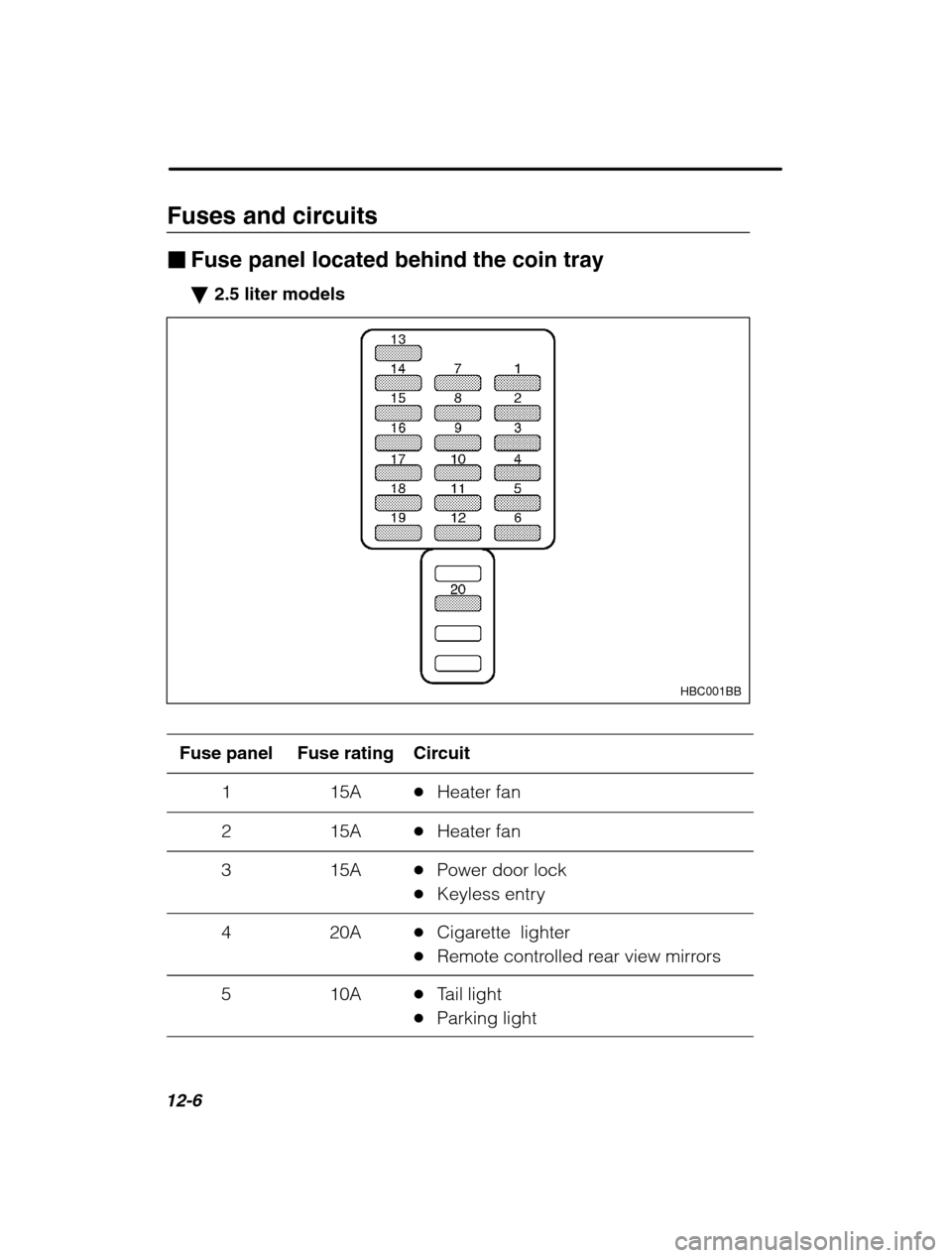
Fuses and circuits Fuse panel located behind the coin tray 2.5 liter models
HBC001BB
Fuse panelFuse ratingCircuit
115AHeater fan
215AHeater fan
315APower door lock
Keyless entry
420ACigarette lighter
Remote controlled rear view mirrors
510ATail light
Parking light
Page 445 of 466
Specifications12-7
–
CONTINUED –
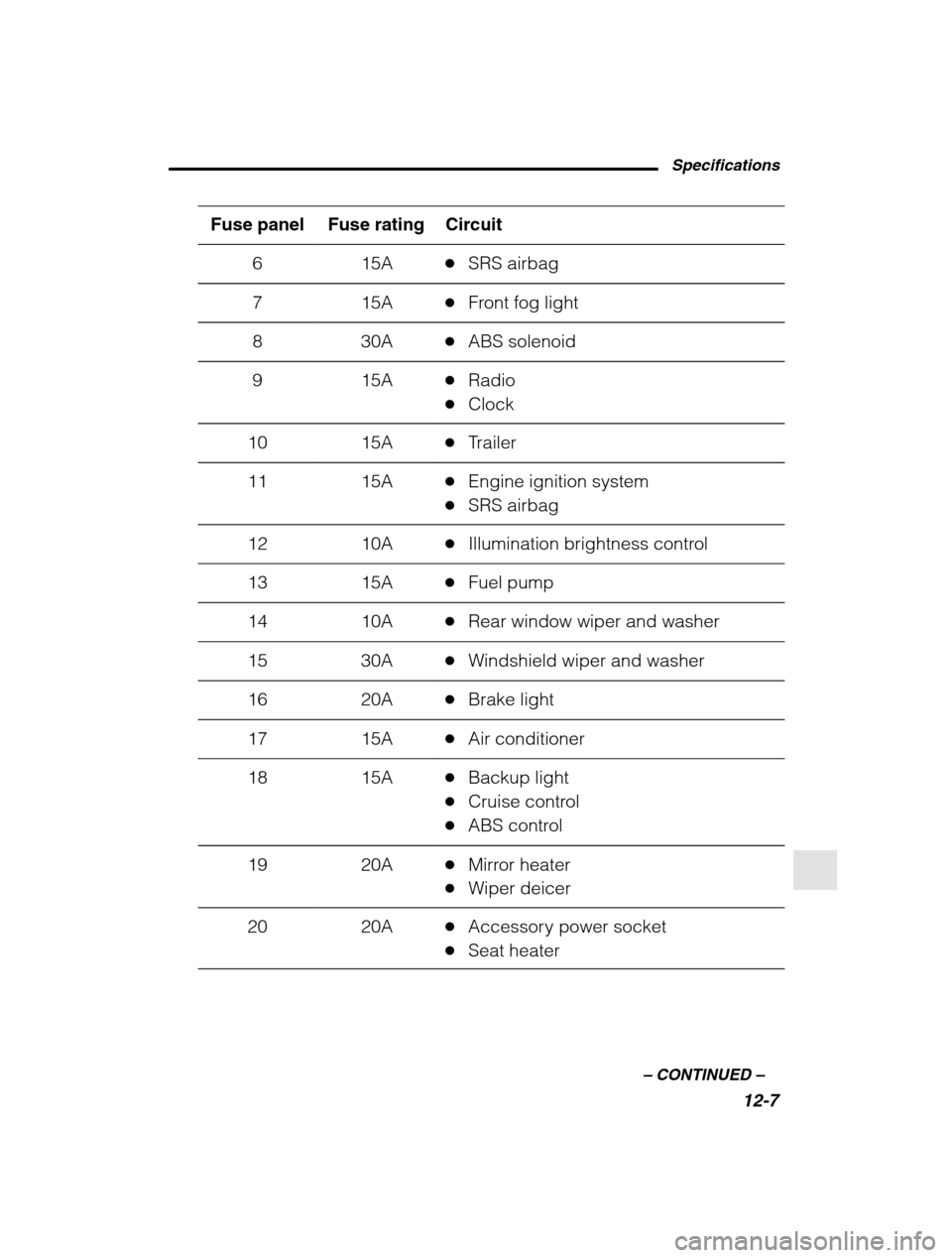
Fuse panel Circuit Fuse rating
615ASRS airbag
715AFront fog light
830AABS solenoid
915ARadio
Clock
1015ATrailer
1115AEngine ignition system
SRS airbag
1210AIllumination brightness control
1315AFuel pump
1410ARear window wiper and washer
1530AWindshield wiper and washer
1620ABrake light
1715AAir conditioner
1815ABackup light
Cruise control
ABS control
1920AMirror heater
Wiper deicer
2020AAccessory power socket
Seat heater
Page 446 of 466
12-8
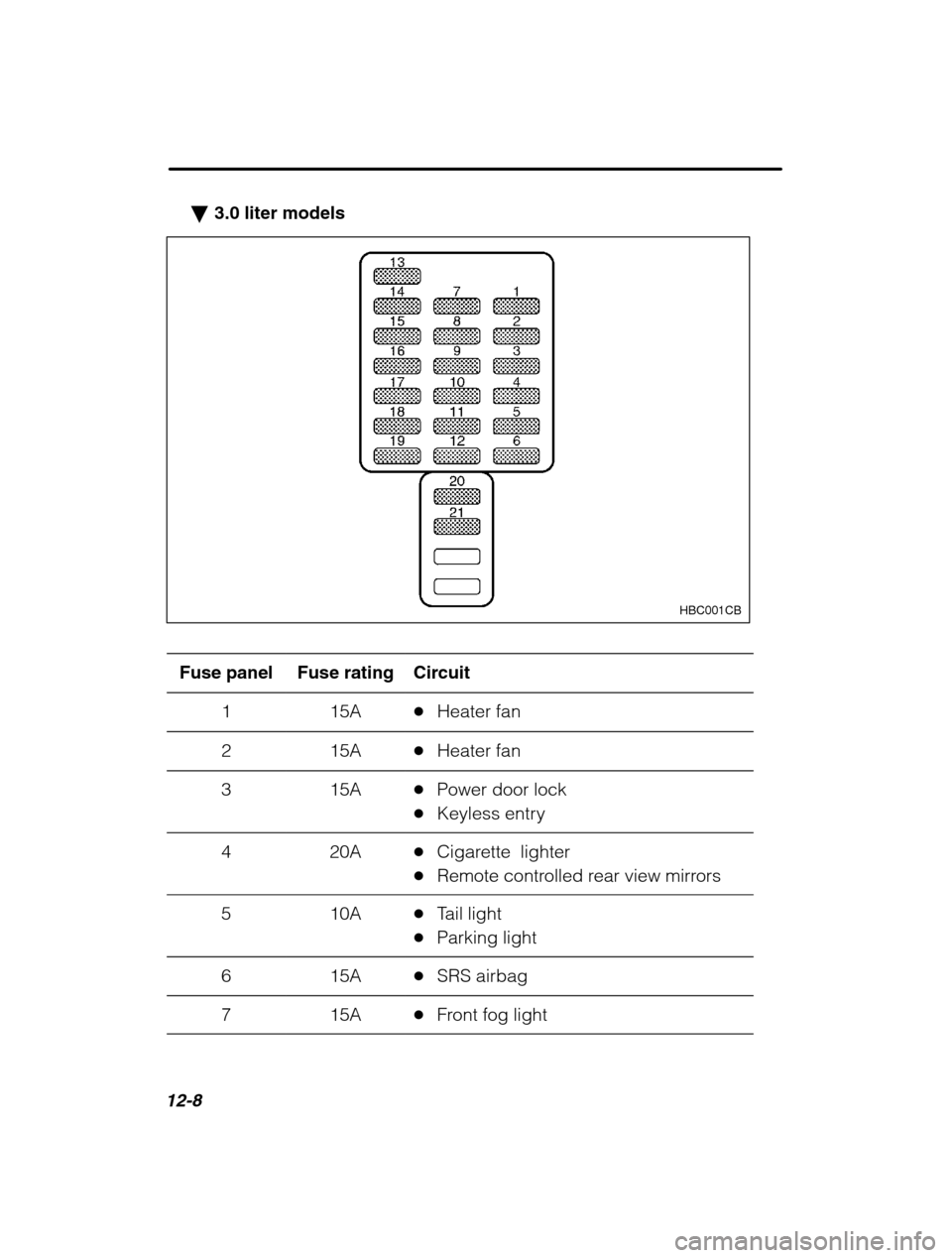
3.0 liter models
HBC001CB
Fuse panelFuse ratingCircuit
115AHeater fan
215AHeater fan
315APower door lock
Keyless entry
420ACigarette lighter
Remote controlled rear view mirrors
510ATail light
Parking light
615ASRS airbag
715AFront fog light
Page 447 of 466
Specifications12-9
–
CONTINUED –
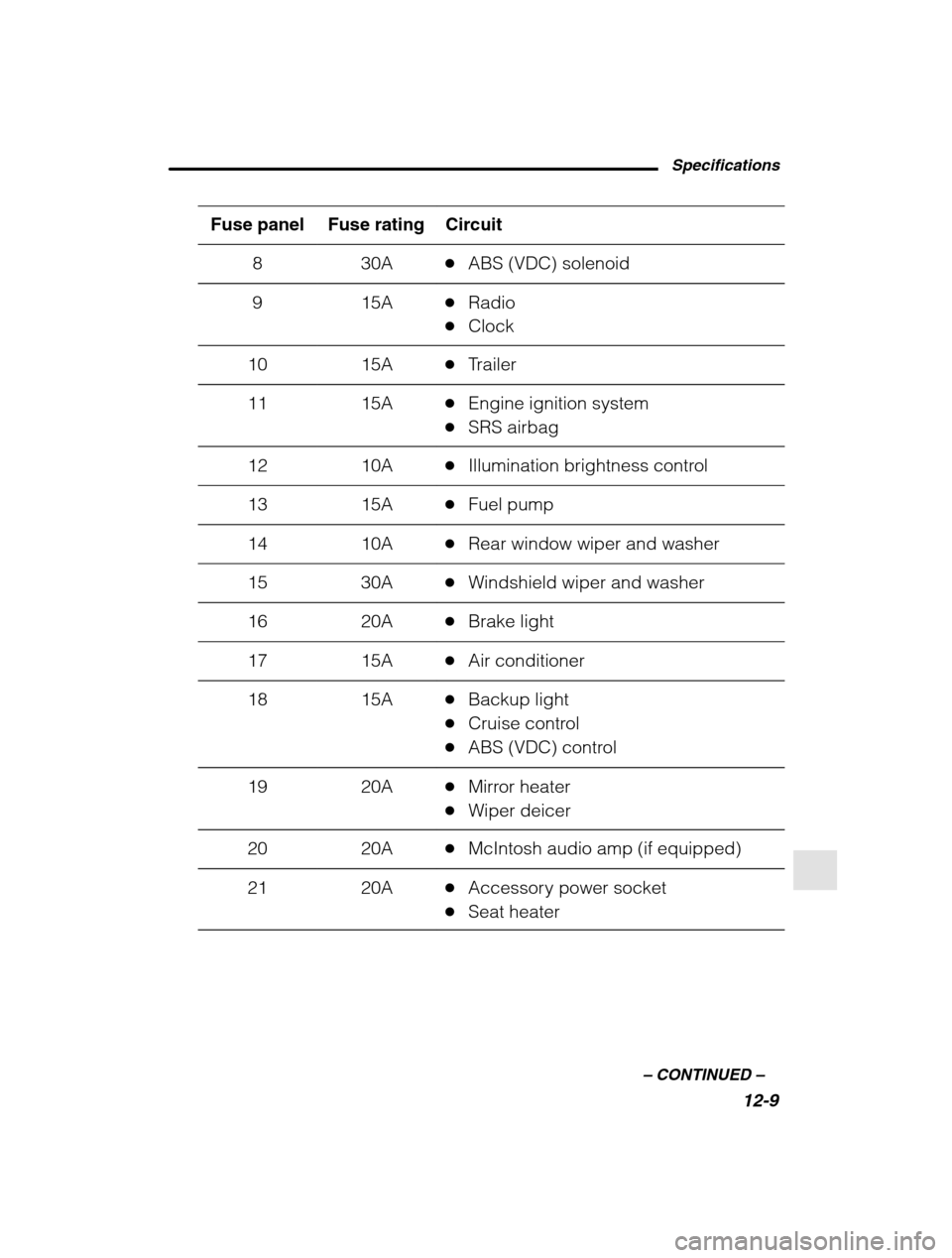
Fuse panel Circuit Fuse rating
830AABS (VDC) solenoid
915ARadio
Clock
1015ATrailer
1115AEngine ignition system
SRS airbag
1210AIllumination brightness control
1315AFuel pump
1410ARear window wiper and washer
1530AWindshield wiper and washer
1620ABrake light
1715AAir conditioner
1815ABackup light
Cruise control
ABS (VDC) control
1920AMirror heater
Wiper deicer
2020AMcIntosh audio amp (if equipped)
2120AAccessory power socket
Seat heater