2002 SAAB 9-5 oil
[x] Cancel search: oilPage 193 of 272
193 Car care and technical information
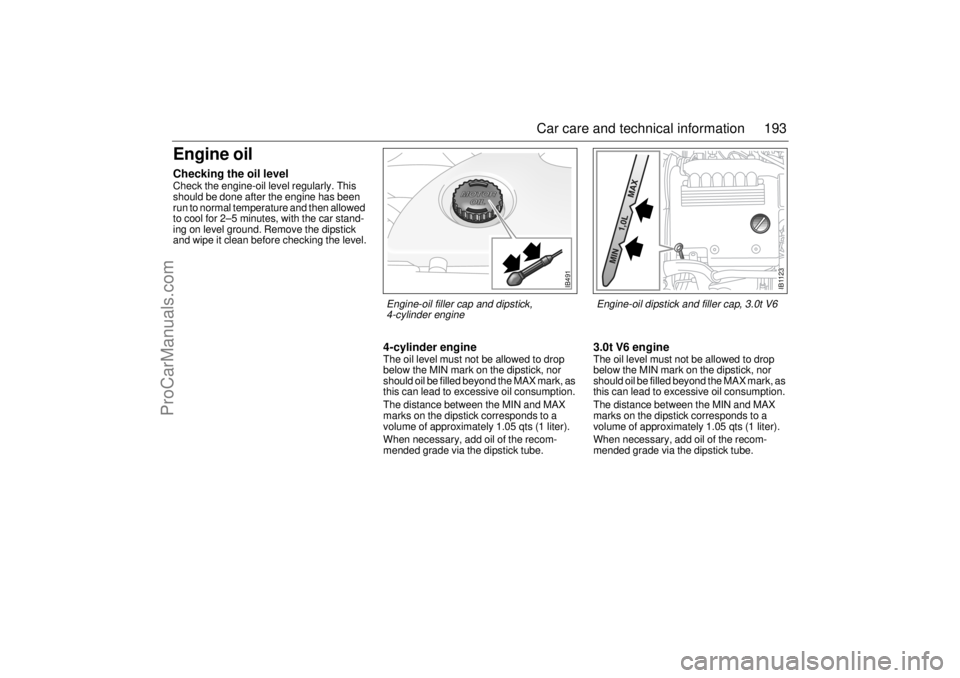
Engine oilChecking the oil level Check the engine-oil level regularly. This
should be done after the engine has been
run to normal temperature and then allowed
to cool for 2–5 minutes, with the car stand-
ing on level ground. Remove the dipstick
and wipe it clean before checking the level.
4-cylinder engine The oil level must not be allowed to drop
below the MIN mark on the dipstick, nor
should oil be filled beyond the MAX mark, as
this can lead to excessive oil consumption.
The distance between the MIN and MAX
marks on the dipstick corresponds to a
volume of approximately 1.05 qts (1 liter).
When necessary, add oil of the recom-
mended grade via the dipstick tube.
3.0t V6 engine The oil level must not be allowed to drop
below the MIN mark on the dipstick, nor
should oil be filled beyond the MAX mark, as
this can lead to excessive oil consumption.
The distance between the MIN and MAX
marks on the dipstick corresponds to a
volume of approximately 1.05 qts (1 liter).
When necessary, add oil of the recom-
mended grade via the dipstick tube.
IB491
Engine-oil filler cap and dipstick,
4-cylinder engine
IB1123
Engine-oil dipstick and filler cap, 3.0t V6
ProCarManuals.com
Page 194 of 272

194 Car care and technical informationOil changingThe engine oil must be changed in accor-
dance with the service program, see page
244.
Oil volume and grade, see page 251.
Oil changing should be carried out on a
warm engine.
1 Unscrew the drain plug in the bottom of
the sump and leave the oil to drain into
an oil tray or other suitable receptacle for
at least ten minutes. Take care, as the oil
may be hot.
2 After the oil has been drained, unscrew
and remove the oil filter.
3 Fit a new filter and tighten it by hand.
4 Refit the drain plug with a new washer.
5 Fill with new engine oil.
Run the engine to normal temperature and
check the oil level.
NOTEChange of engine oil and oil filter may be
required more frequently (5000-mile
intervals (8,000 km)) if any one of the fol-
lowing conditions apply to the car:
Most trips are less than 5 to 10 miles (8
to 16 km). This is particularly important
when outside temperatures are below
freezing.
Most trips include extensive idling
(such as frequent stop-and-go driving).
Most trips are through dusty areas.
You frequently tow a trailer or use a car-
rier on top of your vehicle.
If the vehicle is used for delivery ser-
vice, police, taxi or other commercial
applications.
IB493
Drain plug and oil filter, 4-cylinder engine
IB494
Drain plug and oil filter, 3.0t V6
ProCarManuals.com
Page 195 of 272

195 Car care and technical information
Transmission fluidManual transmission Check and top up the fluid in accordance
with the service program.
If original fluid cannot can be obtained for
topping up (see page 254), automatic trans-
mission fluid Dextron III (synthetic fluid) can
be used. If so, the car should be taken to an
authorized Saab dealer as soon as possible
to have the reason for low fluid level cor-
rected and original fluid installed.Automatic transmission Check the fluid level as follows:
1 Stand the car on level ground and apply
the parking brake. The automatic trans-
mission fluid must be at normal running
temperature, approximately 175°F
(80°C). This can be achieved by driving
the car for about 30 min on the open
road.
2 With the engine idling, move the selector
lever to D and wait for at least
15 seconds. Next, move the selector
lever to R and wait for 15 seconds again.
Finally, move the selector lever to P. Let
the engine idle.
3 Wipe the dipstick clean with a lint-free
cloth and put it back.
4 With the fluid at normal temperature, the
level should be between the MAX and
MIN marks on the dipstick. Top up, as
necessary, with Saab 3309 automatic
transmission fluid (mineral oil-based),
adding it through the dipstick pipe. The distance between the MIN and MAX
marks on the dipstick corresponds to a
volume of approximately 0.4 qts
(0.4 liter).
If the outside temperature is below 50°F
(10°C), the fluid will not reach the specified
temperature of 175°F (80°C). In this case,
the correct fluid level may be 0.8 in (20 mm)
below the MAX mark.
WARNING
Prolonged and repeated exposure of
the skin to engine oil can cause seri-
ous skin disorders.
Avoid prolonged skin contact when-
ever possible. Wash the affected area
thoroughly with soap and water after
any contact.
Keep oil out of reach of children.
Do not touch the turbocharger or
manifold. These get very hot when the
engine has been running.
Do not spill oil on hot parts of the
engine as this could cause a fire. Used
engine oil is particularly flammable.
Protect the environment. Do not dis-
pose of oil in the ground or down a
drain. Dispose of all used oil and oil fil-
ters at an appropriate disposal facility.
NOTEIf there is a smell of burning fluid or the
fluid is black, change the fluid.
IB1923
Dipstick for automatic-transmission fluid
ProCarManuals.com
Page 196 of 272

196 Car care and technical informationCoolant The expansion tank is transparent to facili-
tate checking of the coolant level.
When the engine is cold, the coolant must
not lie over the KALT/COLD mark on the
expansion tank.
If the message ”FILL COOLANT FLUID” is
displayed on the SID, check the level of fluid
in the expansion tank.
Top up, as necessary, with equal parts of
clean water and Saab-approved coolant.
If the expansion tank is empty when coolant
is added, run the engine to normal temper-
ature and top up again, as necessary.
Coolant The cooling system is charged at the factory
with coolant containing a 50% concentra-
tion of a combined antifreeze and corrosion
inhibitor. A weaker mixture will result in
reduced anticorrosion protection. For pro-
tection against freezing in very cold
weather, a stronger concentration will be
needed.
A 60% concentration of antifreeze will pro-
vide protection at temperatures down to
-58 F (-50°C).
The coolant does not normally have to be
changed during the service life of the car.
The type of coolant used has a reddish color
and should not be mixed with other types of
coolant. Saab Original coolant should be
used all year round. Only use coolant
approved by Saab.
WARNING
Proceed with caution if the radiator is
boiling when you open the hood.
Never remove the expansion-tank
filler cap when the radiator is boiling.
Loosen the cap carefully, and let the
engine cool before removing the cap.
The cooling system is pressurized –
hot coolant and vapor can escape
when the filler cap is released.
Exercise care when adding coolant.
Coolant on hot surfaces constitutes a
fire risk.
NOTEAlways mix the antifreeze with the
appropriate volume of water before
adding it to the cooling system.
If pure antifreeze is added, the engine
could still freeze and be damaged. This is
because the antifreeze will not mix
properly with the coolant before the
thermostat has opened to allow full
circulation.
IB1338
Coolant expansion tank
ProCarManuals.com
Page 198 of 272

198 Car care and technical informationPower steering fluidCheck the level of the power steering fluid in
the reservoir regularly, in accordance with
the service program.
The wheels should point forward during the
check.
Clean around the cap before it is
unscrewed. Clean the dipstick. Screw in the
cap completely again before checking the
level.
The oil should lie between the MAX and MIN
marks when the oil temperature is about
70°F (+20°C). If the oil is colder the level can
be lower, and in higher temperatures the
level can be higher, both of which are
acceptable.
Top up with ”Power Steering Fluid
CHF 11S” (part number 8996860).
Air filter
WARNING
Do not fill the power steering fluid to
above the MAX mark. Too much fluid can
result in leakage.
Power steering fluid on hot engine com-
ponents constitutes a fire risk.
WARNING
For Service and Repair, parts equivalent
to those used by Saab should be used.
Be aware that some non standard
replacement parts may put you in an
unsafe condition, even if they might fit.
IB501
Power steering fluid reservoir
ProCarManuals.com
Page 220 of 272

220 Car care and technical informationFuse box under hood
Fuses
Relays
# Amp Function
1 40 Radiator fan, high speed
2 60 ABS/TCS/ESP
3– –
4 7,5 Load angle sensor (cars with xenon headlights)
5 15 Heater
6 10 A/C; car alarm siren
7 15 Bulb test
8––
9––
10 15 High beam headlight, left
11 15 Low beam headlight left
12 15 High beam headlight, right
13 15 Low beam headlight, right
14 30 Radiator fan, high speed
15 15 Fog lights (front spoiler)
16 30 Wiper, rear ; headlight washers
17 15 Horn
18 – –
# Function
1 Bulb test; head light; high beam flasher
2 Headlight washer
3 Front fog lights
4 Wiper, rear (9-5 Wagon)
5–
6–
7 Rain sensor
8 Radiator fan, low speed
9 Radiator fan, high speed
10 A/C-compressor
11 Radiator fan, high speed, right fan
43
2
IB1797
2 1
14 1312 7 6
5 1
15 168
11
10 9
178 5
17 14 11 7 4
16 13 69
10 3
15 12
ProCarManuals.com
Page 232 of 272

232 Car care and technical informationSafety beltsRegularly check the function of the safety
belts as follows:
Hold the diagonal strap and pull it sharply.
The safety belt should
lock
and it should
not be possible to withdraw it further.
Check the anchorage points in the floor.
They must not have suffered rust damage.
There must be no frayed threads in the web-
bing.
Safety belts must not come into contact with
substances such as polishes, oils or other
chemicals. If the straps are dirty, wash them
with warm water and a detergent or have
them replaced.
Upholstery and trimTo remove fluff or hairs from the seat uphol-
stery or headlining, use a moist, lint-free
cloth or a special lint remover (brush or
roller). Remove any dirty marks using a
cloth moistened with lukewarm soapy
water.
When using a stain remover, always work
from the outside towards the center to avoid
leaving a ring. If a soiled ring or spot should
remain, it can usually be removed using
lukewarm soapy water or water alone.
Wet patches left by spilt soft drinks or thin oil
must be wiped off immediately using an
absorbent material, such as kitchen paper,
and treated with stain remover.
Alcohol is recommended for removing
grease or oil stains, and a semi-stiff brush
may also be used.
Cleaning and caring for leather
upholsteryThe principal reason for treating leather
upholstery is to maintain its elegant appear-
ance and to provide it with a protective film.
Discoloration caused by dust and wear
mainly affects the lighter shades, although
this is not detrimental to the leather –
indeed, the patina resulting from use is often
considered desirable in leather. But if the
leather is allowed to become too grubby, it
can start to look shabby.
It is a good idea to clean and recondition the
leather twice a year – in conjunction with a
general spring-cleaning of the car – after the
winter and in the autumn, for instance. In
hot, dry climates, the leather will need to be
treated more frequently. Recommended
conditioner – Saab Leather Care Lotion.
Do not use unknown harsh polishing
agents, cleaning agents, sprays, coarse
soap or hot water.Textile carpetingVacuum clean the carpeting regularly. Car-
pets can also be cleaned using a brush, or
carpet shampoo applied with a sponge. Do
not use vacuum cleaners outdoors unless
they are properly grounded.
WARNING
If the car is involved in a crash, the safety
belts, belt pretensioners and other com-
ponents must be inspected by an autho-
rized Saab dealer.
Never make any alterations or repairs to
the safety belt yourself but visit an autho-
rized Saab dealer.
ProCarManuals.com
Page 235 of 272

235 Car care and technical information
Two-coat enamel As the name implies, two-coat enamel is
applied in two operations. The first coat, the
base color, contains the pigment, metal
flakes and binder. The second coat consists
of a clear enamel, which provides the final
gloss for the paintwork and protects the
base from moisture and environmental con-
taminants.
Touch-up stone-chip damage as follows:
1 Thoroughly clean the damaged area.
2 Apply the primer, base color and finally,
the enamel. To achieve the best finish,
apply two or three coats of primer.
Anti-corrosion
treatmentThe entire car is corrosion-protected at the
factory in different stages by an electrolytic
immersion coating and a polyester-based
protective coating to protect against corro-
sion caused by stones flung up by the
wheels. A thin penetrating anti-rust oil is
also applied in cavities and body members.
In addition to conventional anti-corrosion
treatment like painting, underbody treat-
ment and cavity treatment, most of the body
panel surfaces are galvanized. These
include the hood, the doors and the under-
body.
The anti-corrosion treatment on the under-
side of the car and inside the wheel arches
is particularly exposed to constant wear and
possible damage, the degree of which will
obviously depend on driving conditions.
IB1334
Surface-treatment composition 1 Body panel
2 Zinc (certain panel sections only) 7.5 µm
3 Phosphate coating
4 Cathodic ED 28 µm
5 Intermediate coat 35 µm
6 Metallic base 15 µm
7 Clear enamel /solid enamel 40 µm
ProCarManuals.com