Page 172 of 427
2-109
Head-Up Display (HUD) (Option)
CAUTION:
If the HUD image is too bright, or too high in
your field of view, it may take you more time to
see things you need to see when it's dark outside.
Be sure to keep the HUD image dim and placed
low in your field of view.
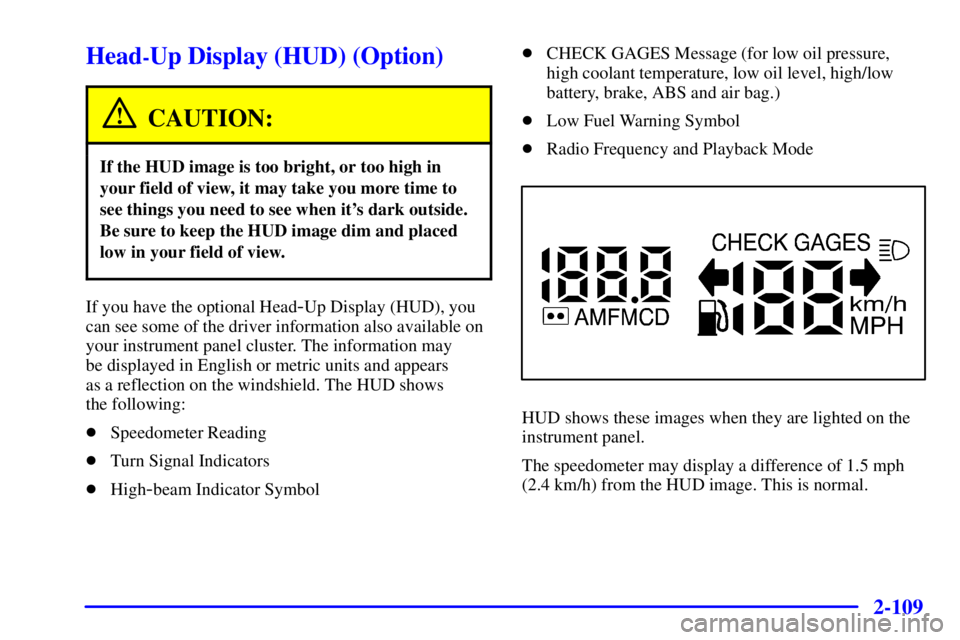
If you have the optional Head-Up Display (HUD), you
can see some of the driver information also available on
your instrument panel cluster. The information may
be displayed in English or metric units and appears
as a reflection on the windshield. The HUD shows
the following:
�Speedometer Reading
�Turn Signal Indicators
�High
-beam Indicator Symbol�CHECK GAGES Message (for low oil pressure,
high coolant temperature, low oil level, high/low
battery, brake, ABS and air bag.)
�Low Fuel Warning Symbol
�Radio Frequency and Playback Mode
HUD shows these images when they are lighted on the
instrument panel.
The speedometer may display a difference of 1.5 mph
(2.4 km/h) from the HUD image. This is normal.
Page 181 of 427

3-7
Be sure not to cover the sensor located on the top of the
instrument panel near the windshield. This sensor
regulates interior temperatures based on sun load.
To avoid blowing cold air through the system in cold
weather, the automatic system will delay turning on the
fan until warm air is available. The length of delay
depends on engine coolant temperature. Pressing the fan
button will override this delay and cancel the automatic
mode, returning the system to manual mode.
The EXT (exterior) temperature sensor is located in the
front of the vehicle behind the grill. The EXT temperature
displayed may not be accurate for a few minutes if you
have restarted the engine after it was already warmed.
Air Conditioning
On hot days, open the windows long enough to let hot
air inside the vehicle escape. This reduces the time it
takes for your vehicle to cool down. Then keep your
windows closed for the air conditioner to work its best.
If you have the standard system, for quick cool
-down on
very hot days, use the airflow from the instrument panel
outlets, press RECIRC and A/C with the temperature knob in
the blue area. If this maximum A/C setting is used for long
periods of time, the air in your vehicle may become too cold
and dry. For normal cooling on hot days, use A/C without
recirculation with the temperature knob in the blue area.If you have the electronic system, in AUTO mode
the system will cool and dehumidify the air inside
the vehicle. Also while in AUTO mode, the system
will maximize its performance by using recirculation
as necessary.
On cool, but sunny days, with the standard system or
through manual operation of the electronic system, use
bi
-level to deliver warm air to the floor and cooler air to
the instrument panel outlets. To warm or cool the air
delivered, turn the temperature knobs.
Heating
If you have the standard system, on cold days use the
floor ducts with the temperature knob in the red area. If
you have the electronic system, press AUTO and adjust
the temperature by turning the temperature knob up or
down. You may also adjust the electronic system
manually by pressing the MODE button and selecting
FLOOR. Again, adjust the temperature by turning the
temperature knobs.
With either system, outside air will be heated and sent
through the floor ducts. The heater works best if you
keep your windows closed while using it.
Page 275 of 427
5-12
Cooling System
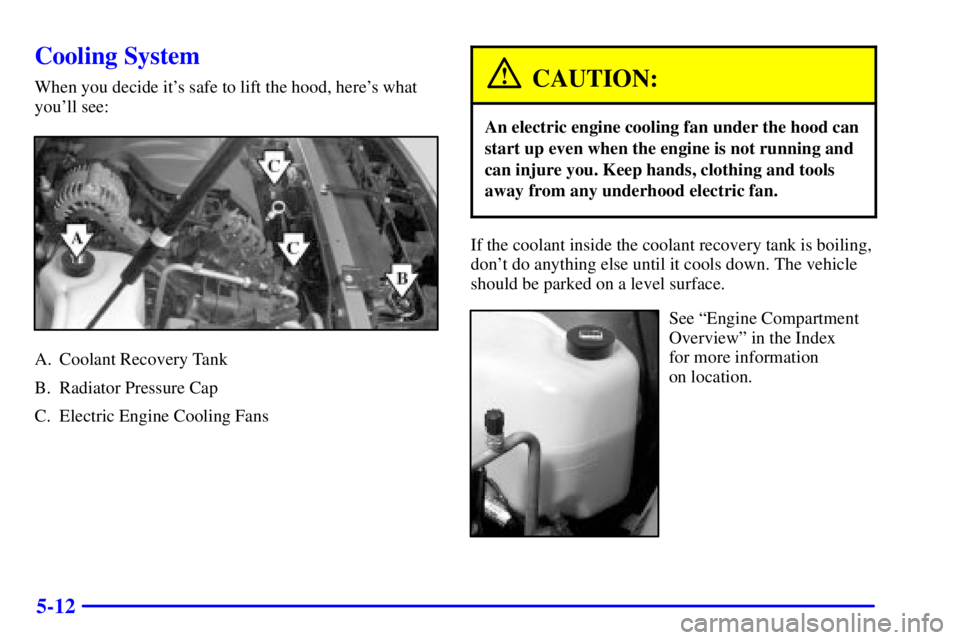
When you decide it's safe to lift the hood, here's what
you'll see:
A. Coolant Recovery Tank
B. Radiator Pressure Cap
C. Electric Engine Cooling Fans
CAUTION:
An electric engine cooling fan under the hood can
start up even when the engine is not running and
can injure you. Keep hands, clothing and tools
away from any underhood electric fan.
If the coolant inside the coolant recovery tank is boiling,
don't do anything else until it cools down. The vehicle
should be parked on a level surface.
See ªEngine Compartment
Overviewº in the Index
for more information
on location.
Page 276 of 427
5-13
The coolant level should be at or above the FULL
COLD mark (if the engine is hot, the coolant level
should be at FULL HOT). If it isn't, you may have a
leak at the pressure cap or in the radiator hoses, heater
hoses, radiator, water pump or somewhere else in the
cooling system.
CAUTION:
Heater and radiator hoses, and other engine
parts, can be very hot. Don't touch them. If you
do, you can be burned.
Don't run the engine if there is a leak. If you run
the engine, it could lose all coolant. That could
cause an engine fire, and you could be burned.
Get any leak fixed before you drive the vehicle.
If there seems to be no leak, with the engine on,
check to see if the electric engine cooling fans are
running. If the engine is overheating, both fans should
be running. If they aren't, your vehicle needs service.
NOTICE:
Engine damage from running your engine
without coolant isn't covered by your warranty.
NOTICE:
When adding coolant, it is important that you use
only DEX
-COOL� (silicate-free) coolant.
If coolant other than DEX-COOL is added to
the system, premature engine, heater core or
radiator corrosion may result. In addition, the
engine coolant will require change sooner
-- at
30,000 miles (50 000 km) or 24 months,
whichever occurs first. Damage caused by the
use of coolant other than DEX
-COOL� is not
covered by your new vehicle warranty.
Page 277 of 427
5-14 How to Add Coolant to the Coolant
Recovery Tank
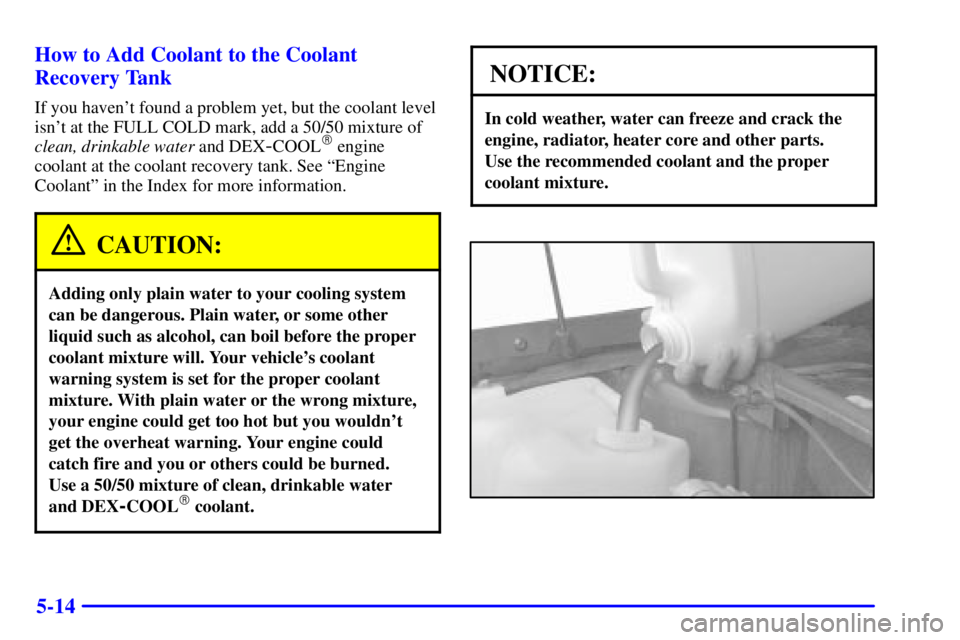
If you haven't found a problem yet, but the coolant level
isn't at the FULL COLD mark, add a 50/50 mixture of
clean, drinkable water and DEX
-COOL� engine
coolant at the coolant recovery tank. See ªEngine
Coolantº in the Index for more information.
CAUTION:
Adding only plain water to your cooling system
can be dangerous. Plain water, or some other
liquid such as alcohol, can boil before the proper
coolant mixture will. Your vehicle's coolant
warning system is set for the proper coolant
mixture. With plain water or the wrong mixture,
your engine could get too hot but you wouldn't
get the overheat warning. Your engine could
catch fire and you or others could be burned.
Use a 50/50 mixture of clean, drinkable water
and DEX
-COOL� coolant.
NOTICE:
In cold weather, water can freeze and crack the
engine, radiator, heater core and other parts.
Use the recommended coolant and the proper
coolant mixture.
Page 282 of 427
5-19
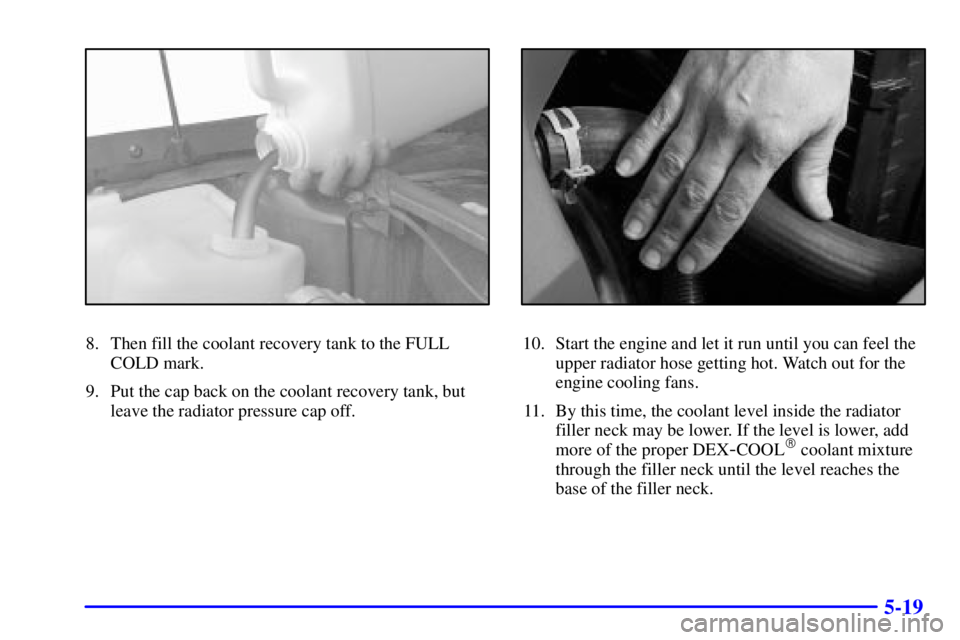
8. Then fill the coolant recovery tank to the FULL
COLD mark.
9. Put the cap back on the coolant recovery tank, but
leave the radiator pressure cap off.10. Start the engine and let it run until you can feel the
upper radiator hose getting hot. Watch out for the
engine cooling fans.
11. By this time, the coolant level inside the radiator
filler neck may be lower. If the level is lower, add
more of the proper DEX
-COOL� coolant mixture
through the filler neck until the level reaches the
base of the filler neck.
Page 296 of 427
6-
6-1
Section 6 Service and Appearance Care
Here you will find information about the care of your vehicle. This section begins with service and fuel information,
and then it shows how to check important fluid and lubricant levels. There is also technical information about your
vehicle, and a part devoted to its appearance care.
6
-2 Service
6
-3 Fuel
6
-5 Fuels in Foreign Countries
6
-6 Filling Your Tank
6
-9 Filling a Portable Fuel Container
6
-9 Checking Things Under the Hood
6
-12 Engine Oil
6
-17 Engine Air Cleaner/Filter
6
-19 Passenger Compartment Air Filter
(If Equipped)
6
-20 Supercharger Oil
6
-21 Automatic Transaxle Fluid
6
-25 Engine Coolant
6
-28 Radiator Pressure Cap
6
-28 Power Steering Fluid
6
-29 Windshield Washer Fluid
6
-31 Brakes6
-34 Battery
6
-36 Bulb Replacement
6
-45 Windshield Wiper Blade Replacement
6
-46 Tires
6
-57 Appearance Care
6
-58 Cleaning the Inside of Your Vehicle
6
-60 Care of Safety Belts
6
-61 Cleaning the Outside of Your Vehicle
6
-63 Sheet Metal Damage
6
-65 GM Vehicle Care/Appearance Materials
6
-66 Vehicle Identification Number (VIN)
6
-67 Electrical System
6
-71 Removing the Rear Seat Cushion
6
-77 Replacement Bulbs
6
-77 Capacities and Specifications
6
-78 Normal Maintenance Replacement Parts
Page 322 of 427
6-27 Checking Coolant
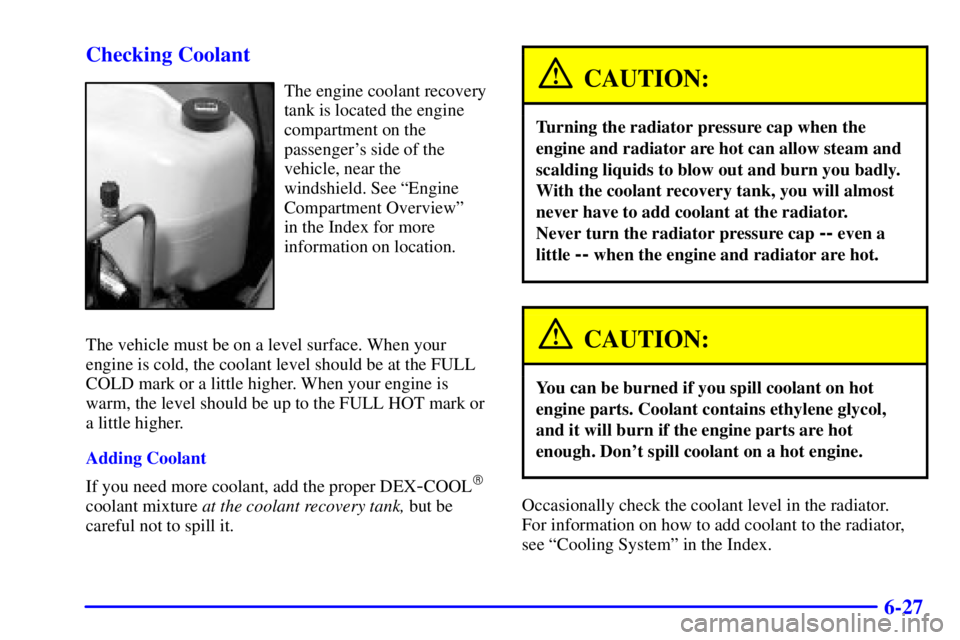
The engine coolant recovery
tank is located the engine
compartment on the
passenger's side of the
vehicle, near the
windshield. See ªEngine
Compartment Overviewº
in the Index for more
information on location.
The vehicle must be on a level surface. When your
engine is cold, the coolant level should be at the FULL
COLD mark or a little higher. When your engine is
warm, the level should be up to the FULL HOT mark or
a little higher.
Adding Coolant
If you need more coolant, add the proper DEX
-COOL�
coolant mixture at the coolant recovery tank, but be
careful not to spill it.
CAUTION:
Turning the radiator pressure cap when the
engine and radiator are hot can allow steam and
scalding liquids to blow out and burn you badly.
With the coolant recovery tank, you will almost
never have to add coolant at the radiator.
Never turn the radiator pressure cap
-- even a
little
-- when the engine and radiator are hot.
CAUTION:
You can be burned if you spill coolant on hot
engine parts. Coolant contains ethylene glycol,
and it will burn if the engine parts are hot
enough. Don't spill coolant on a hot engine.
Occasionally check the coolant level in the radiator.
For information on how to add coolant to the radiator,
see ªCooling Systemº in the Index.