Page 292 of 455

4-31 Dinghy Towing
Your vehicle was not designed to be towed with all of its
wheels on the ground. If you have a two
-wheel-drive
vehicle, it can be towed with two of its wheels on the
ground. See ªDolly Towingº following. If you have an
all
-wheel-drive vehicle, it cannot be towed with any of
its wheels on the ground. It can be towed with car
carrier equipment.
NOTICE:
Towing an all-wheel-drive vehicle with all four
wheels on the ground, or even with only two of its
wheels on the ground, will damage drivetrain
components. Don't tow an all
-wheel-drive vehicle
if any of its wheels will be on the ground.
Dolly Towing
If you have a two-wheel-drive vehicle, it can be towed
with two of its wheels on the ground. To dolly tow your
vehicle, do the following:
1. Put the front wheels on a dolly.
2. Put the vehicle in PARK (P).
3. Set the parking brake and then remove the key.
4. Clamp the steering wheel in a straight
-ahead position
with a clamping device designed for towing.
5. Release the parking brake.
If you have an all
-wheel-drive vehicle, it cannot be
towed with any of its wheels on the ground. It can be
towed with car carrier equipment.
NOTICE:
Towing an all-wheel-drive vehicle with all four
wheels on the ground, or even with only two of its
wheels on the ground, will damage drivetrain
components. Don't tow an all
-wheel-drive vehicle
if any of its wheels will be on the ground.
Page 294 of 455

4-33
If you put things inside your vehicle -- like suitcases,
tools, packages, or anything else
-- they will go as fast
as the vehicle goes. If you have to stop or turn quickly,
or if there is a crash, they'll keep going.
CAUTION:
Things you put inside your vehicle can strike
and injure people in a sudden stop or turn, or
in a crash.
�Put things in the cargo area of your vehicle.
Try to spread the weight evenly.
�Never stack heavier things, like suitcases,
inside the vehicle so that some of them are
above the tops of the seats.
�Don't leave an unsecured child restraint in
your vehicle.
�When you carry something inside the
vehicle, secure it whenever you can.
�Don't leave a seat folded down unless you
need to.
Electronic Level Control (Option)
On vehicles equipped with the optional electronic level
control, the rear of the vehicle is automatically kept
level as you load or unload your vehicle. However, you
should still not exceed the GVWR or the GAWR.
If the engine is running or the ignition key is in
ACCESSORY or when retained accessory power (RAP)
is active, you may hear the compressor operating when
you load or unload your vehicle, and periodically as the
system self
-adjusts. This is normal. See ªRetained
Accessory Powerº in the Index.
The compressor should operate for brief periods of time.
If the sound continues for an extended period of time,
your vehicle needs service.
Using heavier suspension components to get added
durability might not change your weight ratings. Ask
your dealer to help you load your vehicle the right way.
Page 305 of 455
5-2
Hazard Warning Flashers
Your hazard warning flashers let you warn others. They
also let police know you have a problem. Your front and
rear turn signal lamps will flash on and off.
Your hazard warning
flashers button is located on
top of the steering column.
Your hazard warning flashers work no matter what
position your key is in, and even if the key isn't in.
Press the button to make the front and rear turn signal
lamps flash on and off. Press the button again to turn the
flashers off.
When the hazard warning flashers are on, your turn
signals won't work.
Other Warning Devices
If you carry reflective triangles, you can set one up
at the side of the road about 300 feet (100 m) behind
your vehicle.
Page 331 of 455
5-28 Removing the Flat Tire and Installing
the Spare Tire
1. Loosen the wheel
nuts
-- but do
not remove
them
-- using the
folding wrench.
(Turn the handle about 180 degrees, then flip the
handle back to the starting position. This avoids
taking the wrench off the lug nut for each turn.)
For wheels with a wheel lock key, use the wheel lock
key between the lock nut and folding wrench. The
key is supplied in the front passenger door pocket.
NOTICE:
To help avoid damage to the lock nut or the
wheel lock key, do not use an impact wrench
with this key.
Page 357 of 455

6-16
When the system has calculated that oil life has
been diminished, it will indicate that an oil change is
necessary. A change engine oil message will come on.
Change your oil as soon as possible within the next
two times you stop for fuel. It is possible that, if you
are driving under the best conditions, the oil life system
may not indicate that an oil change is necessary for
over a year. However, your engine oil and filter must be
changed at least once a year and at this time the system
must be reset. It is also important to check your oil
regularly and keep it at the proper level.
If the system is ever reset accidentally, you must change
your oil at 3,000 miles (5 000 km) since your last oil
change. Remember to reset the oil life system whenever
the oil is changed.How to Reset the Change Engine Oil Message
The GM Oil Life System� calculates when to change
your engine oil and filter based on vehicle use. Anytime
your oil is changed, reset the system so it can calculate
when the next oil change is required. If a situation
occurs where you change your oil prior to a change
engine oil message being turned on, reset the system.
1. With the ignition key in RUN but the engine off,
repeatedly push the trip/reset button until OIL is
displayed on the Driver Information Center.
2. Once OIL is displayed, push and hold the trip/reset
button for five seconds. The number will disappear
and be replaced by 100 (indicating 100% oil
life remaining).
3. Turn the key to OFF.
If the change engine oil message comes back on,
the engine oil life monitor has not reset. Repeat
the procedure.
Page 371 of 455
6-30
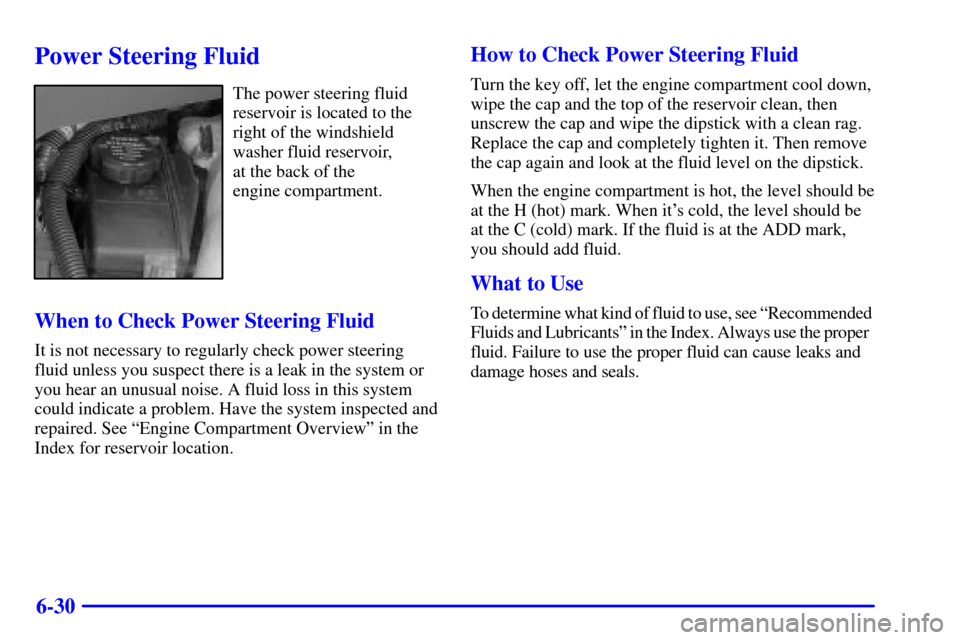
Power Steering Fluid
The power steering fluid
reservoir is located to the
right of the windshield
washer fluid reservoir,
at the back of the
engine compartment.
When to Check Power Steering Fluid
It is not necessary to regularly check power steering
fluid unless you suspect there is a leak in the system or
you hear an unusual noise. A fluid loss in this system
could indicate a problem. Have the system inspected and
repaired. See ªEngine Compartment Overviewº in the
Index for reservoir location.
How to Check Power Steering Fluid
Turn the key off, let the engine compartment cool down,
wipe the cap and the top of the reservoir clean, then
unscrew the cap and wipe the dipstick with a clean rag.
Replace the cap and completely tighten it. Then remove
the cap again and look at the fluid level on the dipstick.
When the engine compartment is hot, the level should be
at the H (hot) mark. When it's cold, the level should be
at the C (cold) mark. If the fluid is at the ADD mark,
you should add fluid.
What to Use
To determine what kind of fluid to use, see ªRecommended
Fluids and Lubricantsº in the Index. Always use the proper
fluid. Failure to use the proper fluid can cause leaks and
damage hoses and seals.
Page 406 of 455
6-65
Circuit Breakers
Usage
HEADLAMP Daytime Running Lamps (DRL)
Control Module, Headlamp and
Instrument Panel Dimmer Switch
PWR SLD DR Power Sliding Door
PWR WDO Front Power Windows
PWR/HEATED
SEAT PSDSix6
-Way Power Seats and Rear
Side Door Actuator Motor
FRT HVAC
HI BLWRBlower Motor Hi Speed
Relay ModuleFuses Usage
SWC
BACKLIGHTSteering Wheel Radio Control
Switches (Illumination)
PCM/PASS
KEY/CLUSTERInstrument Cluster to
PRNDL Indicators
PWR MIRROR Power Remote Control
Mirror Switch
CRUISE Cruise Control Module,
Switch and Release Switch
Blank Not Used
PCM/CRANK Powertrain Control Module
(PCM), Ignition Crank
PASS KEY PASS
-Key� III System
PWR LOCK Power Door Locks
HTD MIRROR Heated Mirrors
RH T/LP Driver's Side Taillamp
RR FOG LP Fog Lamps
CIGAR/DIC/
APO FRTCigarette Lighter, DIC, Front
Auxiliary Power Outlets
T/SIG Turn Signal Switch
PWR
QTR VENTInterior Lamp and Multifunction
Switch (Power Vent Switch)
Page 432 of 455

7-17 At Least Once a Year
Key Lock Cylinders Service
Lubricate the key lock cylinders with the lubricant
specified in Part D.
Body Lubrication Service
Lubricate all key lock cylinders, hood latch assemblies,
secondary latches, pivots, spring anchor and release
pawl, hood and door hinges, rear folding seats, fuel door
hinge, liftgate hinges, power sliding door cable and
sliding door track(s). Part D tells you what to use. More
frequent lubrication may be required when exposed to a
corrosive environment.Starter Switch Check
CAUTION:
When you are doing this check, the vehicle could
move suddenly. If it does, you or others could be
injured. Follow the steps below.
1. Before you start, be sure you have enough room
around the vehicle.
2. Firmly apply both the parking brake and the regular
brake. See ªParking Brakeº in the Index if necessary.
Do not use the accelerator pedal, and be ready to turn
off the engine immediately if it starts.
3. Try to start the engine in each gear. The starter
should work only in PARK (P) or NEUTRAL (N).
If the starter works in any other position, your
vehicle needs service.


