Page 238 of 393

4-37
The exit ramp can be curved, sometimes quite sharply.
The exit speed is usually posted.
Reduce your speed according to your speedometer, not
to your sense of motion. After driving for any distance
at higher speeds, you may tend to think you are going
slower than you actually are.
Before Leaving on a Long Trip
Make sure you're ready. Try to be well rested. If you
must start when you're not fresh
-- such as after a
day's work
-- don't plan to make too many miles that
first part of the journey. Wear comfortable clothing and
shoes you can easily drive in.
Is your vehicle ready for a long trip? If you keep it
serviced and maintained, it's ready to go. If it needs
service, have it done before starting out. Of course,
you'll find experienced and able service experts in
Oldsmobile dealerships all across North America.
They'll be ready and willing to help if you need it.Here are some things you can check before a trip:
�Windshield Washer Fluid: Is the reservoir full?
Are all windows clean inside and outside?
�Wiper Blades: Are they in good shape?
�Fuel, Engine Oil, Other Fluids: Have you checked
all levels?
�Lamps: Are they all working? Are the lenses clean?
�Tires: They are vitally important to a safe,
trouble-free trip. Is the tread good enough for
long
-distance driving? Are the tires all inflated to
the recommended pressure?
�Weather Forecasts: What's the weather outlook
along your route? Should you delay your trip a
short time to avoid a major storm system?
�Maps: Do you have up
-to-date maps?
Page 239 of 393
4-38
Highway Hypnosis
Is there actually such a condition as ªhighway hypnosisº?
Or is it just plain falling asleep at the wheel? Call it
highway hypnosis, lack of awareness, or whatever.
There is something about an easy stretch of road with
the same scenery, along with the hum of the tires on the
road, the drone of the engine, and the rush of the wind
against the vehicle that can make you sleepy. Don't let
it happen to you! If it does, your vehicle can leave the
road in less than a second, and you could crash and
be injured.
What can you do about highway hypnosis?
First, be aware that it can happen.
Then here are some tips:
�Make sure your vehicle is well ventilated,
with a comfortably cool interior.
�Keep your eyes moving. Scan the road ahead
and to the sides. Check your mirrors and your
instruments frequently.
�If you get sleepy, pull off the road into a rest, service
or parking area and take a nap, get some exercise, or
both. For safety, treat drowsiness on the highway as
an emergency.
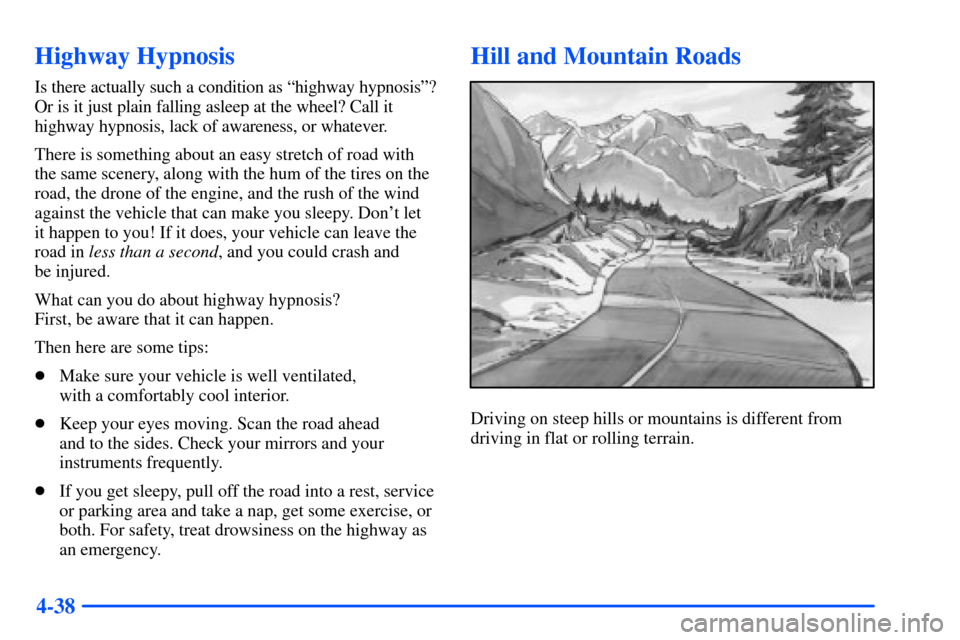
Hill and Mountain Roads
Driving on steep hills or mountains is different from
driving in flat or rolling terrain.
Page 248 of 393

4-47
Overload Protection
The air suspension system is equipped with overload
protection. Overload protection is designed to protect
the air suspension system, and it is an indicator to the
driver that the vehicle is overloaded. When the overload
protection mode is on, it will not allow damage to the
air compressor. However, do not overload the vehicle.
See ªLoading Your Vehicleº earlier in this section.
If the suspension remains at a low height, the rear axle
load has exceeded GAWR (Gross Axle Weight Rating).
When the overload protection mode is activated, the
compressor operates for about 30 seconds to one minute
without raising the vehicle depending on the amount
of overload. This will continue each time the ignition is
turned on until the rear axle load is reduced below GAWR.
Indicator Light
The indicator light on the inflator switch in the rear
passenger compartment also serves as an indicator for
internal system error. If the indicator light is flashing
without the load leveling function or the inflator being
active, turn off the ignition. The next day turn on the
ignition and check the indicator light. The vehicle can
be driven with the light flashing, but if it is you should
have the vehicle serviced as soon as possible.Adding a Snow Plow or
Similar Equipment
Your vehicle was neither designed nor intended for a
snow plow.
NOTICE:
Adding a snow plow or similar equipment to
your vehicle can damage it, and the repairs
wouldn't be covered by warranty. Do not
install a snow plow or similar equipment on
your vehicle.
Page 256 of 393

4-55 Parking on Hills
CAUTION:
You really should not park your vehicle, with a
trailer attached, on a hill. If something goes
wrong, your rig could start to move. People can
be injured, and both your vehicle and the trailer
can be damaged.
But if you ever have to park your rig on a hill, here's how
to do it:
1. Apply your regular brakes, but don't shift into
PARK (P) yet. Then turn your wheels into the
curb if facing downhill or into traffic if facing uphill.
2. Have someone place chocks under the trailer wheels.
3. When the wheel chocks are in place, release the
regular brakes until the chocks absorb the load.
4. Reapply the regular brakes. Then apply your parking
brake, and then shift into PARK (P).
5. Be sure the transfer case is in a drive gear
-- not
in NEUTRAL (N).
6. Release the regular brakes.
When You Are Ready to Leave After
Parking on a Hill
1. Apply your regular brakes and hold the pedal down
while you:
�start your engine,
�shift into a gear, and
�release the parking brake.
2. Let up on the brake pedal.
3. Drive slowly until the trailer is clear of the chocks.
4. Stop and have someone pick up and store the chocks.
Maintenance When Trailer Towing
Your vehicle will need service more often when you're
pulling a trailer. See the Maintenance Schedule for
more on this. Things that are especially important
in trailer operation are automatic transmission fluid
(don't overfill), engine oil, axle lubricant, belt, cooling
system and brake system. Each of these is covered
in this manual, and the Index will help you find them
quickly. If you're trailering, it's a good idea to review
these sections before you start your trip.
Check periodically to see that all hitch nuts and
bolts are tight.
Page 257 of 393
4-56 Trailer Wiring Harness
Your vehicle is equipped with a seven-wire trailer
towing harness. This harness has a seven
-pin universal
heavy
-duty trailer connector that is attached to a bracket
on the hitch platform. The seven
-wire harness contains the following
trailer circuits:
�Yellow: Left Stop/Turn Signal
�Dark Green: Right Stop/Turn Signal
�Brown: Running Lamps
�White: Ground
�Light Green: Back
-up Lamps
�Red: Battery Feed
�Dark Blue: Electric Brakes
If you need to tow a light
-duty trailer with a standard
four
-way round pin connector, an adapter connector is
available from your dealer.
Your vehicle is also equipped with wiring for an electric
trailer brake controller. These wires are located inside
the vehicle on the driver's side under the instrument
panel. These wires should be connected to an electric
trailer brake controller by your dealer or a qualified
service center.
Page 264 of 393
5-7
9. Connect the other end of
the negative (
-) cable to
the remote negative (
-)
terminal on the vehicle
with the dead battery.
10. Now start the vehicle with the good battery and run
the engine for a while.11. Try to start the vehicle that had the dead battery.
If it won't start after a few tries, it probably
needs service.
NOTICE:
Damage to your vehicle may result from electrical
shorting if jumper cables are removed incorrectly.
To prevent electrical shorting, take care that
they don't touch each other or any other metal.
The repairs wouldn't be covered by your warranty.
Page 265 of 393
5-8
Jumper Cable Removal
A. Heavy, Unpainted Metal Engine Part or Remote
Negative (
-) Terminal
B. Good Battery or Remote Positive (+) and Remote
Negative (
-) Terminals
C. Dead Battery or Remote Positive (+) TerminalTo disconnect the jumper cables from both vehicles,
do the following:
1. Disconnect the black negative (
-) cable from the
vehicle that had the dead battery.
2. Disconnect the black negative (
-) cable from the
vehicle with the good battery.
3. Disconnect the red positive (+) cable from the
vehicle with the good battery.
4. Disconnect the red positive (+) cable from the
other vehicle.
Towing Your Vehicle
Consult your dealer or a professional towing service if
you need to have your vehicle towed. See ªRoadside
Assistanceº and ªRecreational Vehicle Towingº in
the Index.
Page 267 of 393

5-10 If No Steam Is Coming From Your Engine
If you get an engine overheat warning but see or hear no
steam, the problem may not be too serious. Sometimes
the engine can get a little too hot when you:
�Climb a long hill on a hot day.
�Stop after high
-speed driving.
�Idle for long periods in traffic.
�Tow a trailer.
If you get the overheat warning with no sign of steam,
try this for a minute or so:
1. If your air conditioner is on, turn it off.
2. Turn on your heater to full hot at the highest fan
speed and open the window as necessary.
3. If you're in a traffic jam, shift to NEUTRAL (N);
otherwise, shift to the highest gear while
driving
-- DRIVE (D) or THIRD (3).If you no longer have the overheat warning,
you can drive. Just to be safe, drive slower for
about 10 minutes. If the warning doesn't come
back on, you can drive normally.
If the warning continues, pull over, stop, and park
your vehicle right away.
If there's still no sign of steam, push down the
accelerator until the engine speed is about twice as fast
as normal idle speed for at least three minutes while
you're parked. If you still have the warning, turn off
the engine and get everyone out of the vehicle until it
cools down.
You may decide not to lift the hood but to get service
help right away.


