Page 312 of 393

6-23
When the differential is cold, add enough lubricant to
raise the level to 1/2 inch (12 mm) below the filler
plug hole.
When the differential is at operating temperature
(warm), add enough lubricant to raise the level to
the bottom of the filler plug hole.
What to Use
Refer to the Maintenance Schedule to determine what
kind of lubricant to use. See ªRecommended Fluids
and Lubricantsº in the Index.
Engine Coolant
The cooling system in your vehicle is filled with
DEX
-COOL� engine coolant. This coolant is designed
to remain in your vehicle for 5 years or 150,000 miles
(240 000 km), whichever occurs first, if you add only
DEX
-COOL� extended life coolant.
The following explains your cooling system and how
to add coolant when it is low. If you have a problem
with engine overheating, see ªEngine Overheatingº
in the Index.A 50/50 mixture of clean, drinkable water and
DEX
-COOL� coolant will:
�Give freezing protection down to
-34�F (-37�C).
�Give boiling protection up to 265�F (129�C).
�Protect against rust and corrosion.
�Help keep the proper engine temperature.
�Let the warning lights and gages work as
they should.
NOTICE:
When adding coolant, it is important that you
use only DEX
-COOL� (silicate-free) coolant.
If coolant other than DEX-COOL is added to
the system, premature engine, heater core or
radiator corrosion may result. In addition, the
engine coolant will require change sooner
-- at
30,000 miles (50 000 km) or 24 months,
whichever occurs first. Damage caused by the
use of coolant other than DEX
-COOL� is not
covered by your new vehicle warranty.
Page 318 of 393
6-29
Brakes
Brake Fluid
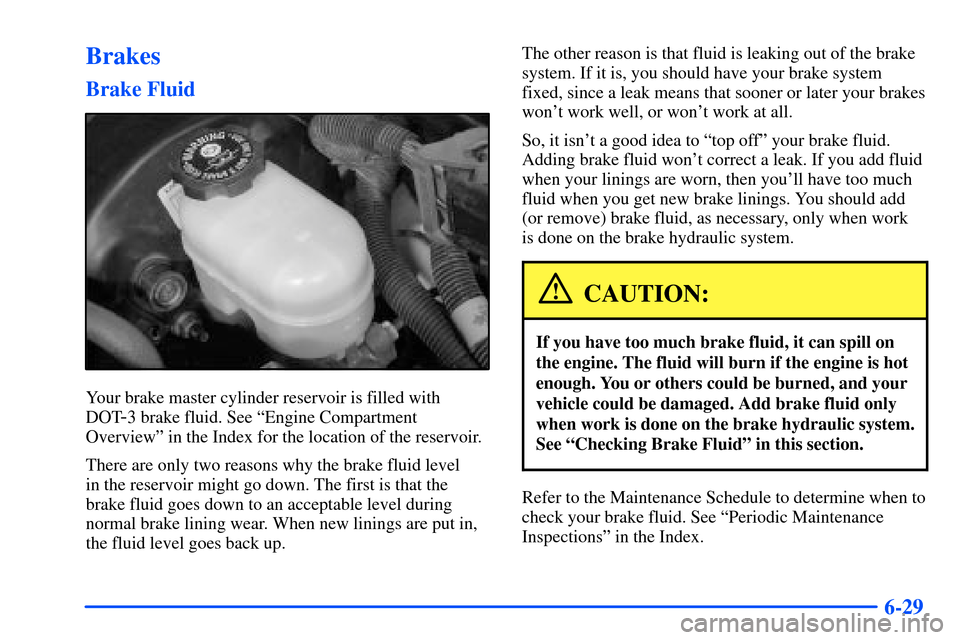
Your brake master cylinder reservoir is filled with
DOT
-3 brake fluid. See ªEngine Compartment
Overviewº in the Index for the location of the reservoir.
There are only two reasons why the brake fluid level
in the reservoir might go down. The first is that the
brake fluid goes down to an acceptable level during
normal brake lining wear. When new linings are put in,
the fluid level goes back up. The other reason is that fluid is leaking out of the brake
system. If it is, you should have your brake system
fixed, since a leak means that sooner or later your brakes
won't work well, or won't work at all.
So, it isn't a good idea to ªtop offº your brake fluid.
Adding brake fluid won't correct a leak. If you add fluid
when your linings are worn, then you'll have too much
fluid when you get new brake linings. You should add
(or remove) brake fluid, as necessary, only when work
is done on the brake hydraulic system.
CAUTION:
If you have too much brake fluid, it can spill on
the engine. The fluid will burn if the engine is hot
enough. You or others could be burned, and your
vehicle could be damaged. Add brake fluid only
when work is done on the brake hydraulic system.
See ªChecking Brake Fluidº in this section.
Refer to the Maintenance Schedule to determine when to
check your brake fluid. See ªPeriodic Maintenance
Inspectionsº in the Index.
Page 329 of 393

6-40 Tire Inspection and Rotation
Tires should be rotated every 6,000 to 8,000 miles
(10 000 to 13 000 km). Any time you notice unusual
wear, rotate your tires as soon as possible and check
wheel alignment. Also check for damaged tires or
wheels. See ªWhen It's Time for New Tiresº and
ªWheel Replacementº later in this section for more
information. Make sure the spare tire is stored securely.
Push, pull, and then try to rotate or turn the tire.
If it moves, use the wheel wrench to tighten the cable.
See ªStoring a Flat or Spare Tire and Toolsº in
the Index.
The purpose of regular rotation is to achieve more
uniform wear for all tires on the vehicle. The first
rotation is the most important. See ªScheduled
Maintenance Servicesº in the Index for scheduled
rotation intervals.
When rotating your tires, always use the correct rotation
pattern shown here.
After the tires have been rotated, adjust the front and rear
inflation pressures as shown on the Certification/Tire
label. Make certain that all wheel nuts are properly
tightened. See ªWheel Nut Torqueº in the Index.
Page 353 of 393
7-
7-1
Section 7 Maintenance Schedule
This section covers the maintenance required for your vehicle. Your vehicle needs these services to retain its safety,
dependability and emission control performance.
7
-2 Introduction
7
-4 Part A: Scheduled Maintenance Services
7
-5 Scheduled Maintenance
7
-15 Part B: Owner Checks and Services7
-20 Part C: Periodic Maintenance Inspections
7
-22 Part D: Recommended Fluids and Lubricants
7
-24 Part E: Maintenance Record
Page 355 of 393

7-3 How This Section is Organized
This maintenance schedule is divided into five parts:
ªPart A: Scheduled Maintenance Servicesº explains
what to have done and how often. Some of these
services can be complex, so unless you are technically
qualified and have the necessary equipment, you should
let your dealer's service department or another qualified
service center do these jobs.
CAUTION:
Performing maintenance work on a vehicle can
be dangerous. In trying to do some jobs, you can
be seriously injured. Do your own maintenance
work only if you have the required know
-how
and the proper tools and equipment for the job.
If you have any doubt, have a qualified technician
do the work.
If you want to get the service information, see ªService
and Owner Publicationsº in the Index.ªPart B: Owner Checks and Servicesº tells you
what should be checked and when. It also explains
what you can easily do to help keep your vehicle in
good condition.
ªPart C: Periodic Maintenance Inspectionsº explains
important inspections that your dealer's service
department or another qualified service center
should perform.
ªPart D: Recommended Fluids and Lubricantsº lists
some recommended products necessary to help keep
your vehicle properly maintained. These products, or
their equivalents, should be used whether you do the
work yourself or have it done.
ªPart E: Maintenance Recordº is a place for you
to record and keep track of the maintenance performed
on your vehicle. Keep your maintenance receipts.
They may be needed to qualify your vehicle for
warranty repairs.
Page 356 of 393

7-4
Part A: Scheduled
Maintenance Services
Using Your Maintenance Schedule
We at General Motors want to help you keep your
vehicle in good working condition. But we don't know
exactly how you'll drive it. You may drive very short
distances only a few times a week. Or you may drive
long distances all the time in very hot, dusty weather.
You may use your vehicle in making deliveries.
Or you may drive it to work, to do errands or in
many other ways.
Because of all the different ways people use their
vehicles, maintenance needs vary. You may need more
frequent checks and replacements. So please read the
following and note how you drive. If you have any
questions on how to keep your vehicle in good
condition, see your dealer.This part tells you the maintenance services you should
have done and when you should schedule them. If you
go to your dealer for your service needs, you'll know
that GM
-trained and supported service people will
perform the work using genuine GM parts.
The proper fluids and lubricants to use are listed in
Part D. Make sure whoever services your vehicle
uses these. All parts should be replaced and all
necessary repairs done before you or anyone else
drives the vehicle.
This schedule is for vehicles that:
�carry passengers and cargo within recommended
limits. You will find these limits on your vehicle's
Certification/Tire label. See ªLoading Your Vehicleº
in the Index.
�are driven on reasonable road surfaces within legal
driving limits.
�are driven off
-road in the recommended manner.
See ªOperating Your Vehicle Off Paved Roadsº in
the Index.
�use the recommended fuel. See ªFuelº in the Index.
Page 357 of 393
Scheduled Maintenance
7-5
The services shown in this schedule up to 100,000 miles
(166 000 km) should be performed after 100,000 miles
(166 000 km) at the same intervals. The services shown
at 150,000 miles (240 000 km) should be performed at
the same interval after 150,000 miles (240 000 km).
See ªOwner Checks and Servicesº and ªPeriodic
Maintenance Inspectionsº following.Footnotes
� The U.S. Environmental Protection Agency or the
California Air Resources Board has determined that
the failure to perform this maintenance item will not
nullify the emission warranty or limit recall liability
prior to the completion of the vehicle's useful life.
We, however, urge that all recommended maintenance
services be performed at the indicated intervals and
the maintenance be recorded.
+ A good time to check your brakes is during tire
rotation. See ªBrake System Inspectionº under
ªPeriodic Maintenance Inspectionsº in Part C
of this schedule.
Page 358 of 393
Scheduled Maintenance
7-6Engine Oil Scheduled Maintenance
Change engine oil and filter as indicated by
the GM Oil Life System� (or every 12 months,
whichever occurs first). Reset the system. The system
will show you when to change the oil
-- usually between
3,000 miles (5 000 km) and 12,000 miles (20 000 km)
since your last oil change. Under severe conditions, the
indicator may come on before 3,000 miles (5 000 km).
Never drive your vehicle more than 12,000 miles
(20 000 km) or 12 months without an oil and
filter change.The system won't detect dust in the oil. So if you
drive in a dusty area, be sure to change your oil and
filter every 3,000 miles (5 000 km) or sooner if the
CHANGE ENG OIL light appears. Remember to
reset the Oil Life System when the oil and filter have
been changed. See ªOil Life Systemº in the Index
for information on resetting.
An Emission Control Service.


