Page 69 of 393

2-
2-1
Section 2 Features and Controls
Here you can learn about the many standard and optional features on your vehicle, and information on starting,
shifting and braking. Also explained are the instrument panel and the warning systems that tell you if everything is
working properly
-- and what to do if you have a problem.
2
-2 Windows
2
-4 Keys
2
-6 Door Locks
2
-10 Remote Keyless Entry System
2
-13 Liftgate/Liftglass
2
-14 Theft
2
-15 Content Theft-Deterrent (If Equipped)
2
-17 Passlock�
2-18 New Vehicle ªBreak-Inº
2
-18 Ignition Positions
2
-19 Starting Your Engine
2
-21 Engine Coolant Heater (If Equipped)
2
-22 Automatic Transmission Operation
2
-25 Parking Brake
2
-26 Shifting Into PARK (P)
2
-28 Shifting Out of PARK (P)
2
-28 Parking Over Things That Burn
2
-29 Engine Exhaust
2
-29 Running Your Engine While You're Parked2
-30 Locking Rear Axle
2
-30 All-Wheel Drive (Option)
2
-30 Horn
2
-31 Tilt Wheel
2
-31 Turn Signal/Multifunction Lever
2
-39 Exterior Lamps
2
-42 Interior Lamps
2
-44 Mirrors
2
-48 Storage Compartments
2
-53 Ashtrays and Cigarette Lighter
2
-55 Accessory Power Outlets
2
-56 OnStar� System (If Equipped)
2
-60 Sunroof (Option)
2
-60 HomeLink� Transmitter
2
-64 Instrument Panel -- Your Information System
2
-66 Instrument Panel Cluster
2
-68 Warning Lights, Gages and Indicators
2
-82 Driver Information Center (DIC)
Page 81 of 393

2-13
To replace the battery in the remote keyless entry
transmitter do the following:
1. Insert a thin coin in the slot between the covers of the
transmitter housing. Gently pry the transmitter apart.
2. Remove and replace the battery with a three
-volt
CR2032 or equivalent battery, positive (+) side down.
3. Align the covers and snap them together.
4. Check the operation of the transmitter.
Liftgate/Liftglass
CAUTION:
It can be dangerous to drive with the liftgate or
liftglass open because carbon monoxide (CO) gas
can come into your vehicle. You can't see or smell
CO. It can cause unconsciousness and even death.
If you must drive with the liftgate or liftglass
open or if electrical wiring or other cable
connections must pass through the seal
between the body and the liftgate or liftglass:
�Make sure all other windows are shut.
�Turn the fan on your heating or cooling
system to its highest speed with the setting
on panel or bi
-level with recirculation off.
That will force outside air into your vehicle.
See ªComfort Controlsº in the Index.
�If you have air outlets on or under the
instrument panel, open them all the way.
See ªEngine Exhaustº in the Index.
Page 100 of 393

2-32 Turn and Lane Change Signals
The turn signal has two upward (for right) and two
downward (for left) positions. These positions allow
you to signal a turn or a lane change.
To signal a turn, move the lever all the way up
or down. When the turn is finished, the lever will
return automatically.
An arrow on the instrument
panel cluster will flash in
the direction of the turn or
lane change.
To signal a lane change, just raise or lower the lever
until the arrow starts to flash. Hold it there until you
complete your lane change. The lever will return by
itself when you release it. When signaling a lane
change a light will flash on the bottom of the driver's
or passenger's outside rearview mirror.As you signal a turn or a lane change, if the arrows flash
more quickly than normal, a signal bulb may be burned
out and other drivers won't see your turn signal.
If a bulb is burned out, replace it to help avoid an
accident. If the arrows don't go on at all when you
signal a turn, check the fuse (see ªFuses and Circuit
Breakersº in the Index) and for burned
-out bulbs.
If you have a trailer towing option with added wiring for
the trailer lamps, a different turn signal flasher is used.
With this flasher installed, the signal indicator will flash
even if a turn signal bulb is burned out. Check the front
and rear turn signal lamps regularly to make sure they
are working.
Turn Signal On Chime
If your turn signal is left on for more than 3/4 of a mile
(1.2 km), a chime will sound at each flash of the turn
signal. To turn off the chime, move the turn signal lever
to the center.
Page 101 of 393
2-33 Headlamp High/Low-Beam Changer
To change the headlamps from low to high beam,
push the lever toward the instrument panel. To return
to low
-beam headlamps pull the multifunction lever
toward you. Then release it.
When the high beams
are on, this indicator light
on the instrument panel
cluster will also be on.
Flash-to-Pass Feature
This feature lets you use your high-beam headlamps to
signal a driver in front of you that you want to pass. It works
even if your headlamps are in the automatic position.
To use it, pull the turn signal lever toward you,
then release it.
If your headlamps are in the automatic position or on
low beam, your high
-beam headlamps will turn on.
They'll stay on as long as you hold the lever toward
you. The high
-beam indicator on the instrument panel
cluster will come on. Release the lever to return to
normal operation.
Page 103 of 393
2-35 Windshield Washer
There's a paddle marked with the windshield washer
symbol on the top of the multifunction lever.
To spray washer fluid on the windshield, push the
paddle. The wipers will clear the window and then
either stop or return to your preset speed.
CAUTION:
In freezing weather, don't use your washer until
the windshield is warmed. Otherwise the washer
fluid can form ice on the windshield, blocking
your vision.
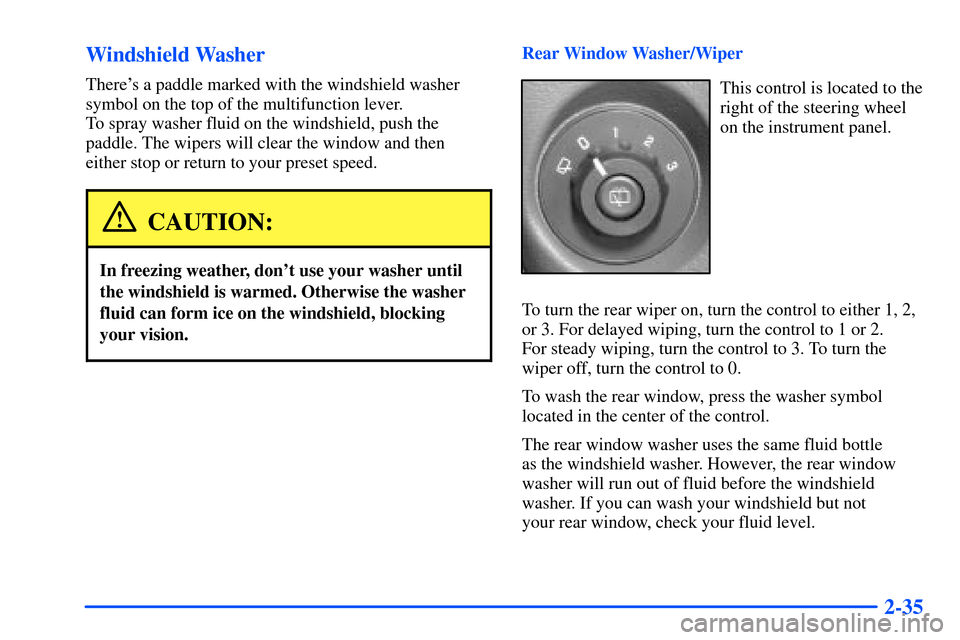
Rear Window Washer/Wiper
This control is located to the
right of the steering wheel
on the instrument panel.
To turn the rear wiper on, turn the control to either 1, 2,
or 3. For delayed wiping, turn the control to 1 or 2.
For steady wiping, turn the control to 3. To turn the
wiper off, turn the control to 0.
To wash the rear window, press the washer symbol
located in the center of the control.
The rear window washer uses the same fluid bottle
as the windshield washer. However, the rear window
washer will run out of fluid before the windshield
washer. If you can wash your windshield but not
your rear window, check your fluid level.
Page 105 of 393

2-37
Setting Cruise Control
CAUTION:
If you leave your cruise control switch on when
you're not using cruise, you might hit a button
and go into cruise when you don't want to.
You could be startled and even lose control.
Keep the cruise control switch off until you
want to use cruise control.
1. Move the cruise control switch to on.
2. Get up to the speed you want.
3. Press in the set button at the end of the lever
and release it.
4. Take your foot off the accelerator pedal.
The accelerator petal will not go down.
United States Canada
The CRUISE light on the instrument panel cluster will
illuminate when the cruise control is engaged.
Resuming a Set Speed
Suppose you set your cruise control at a desired speed
and then you apply the brake. This, of course, shuts off
the cruise control. But you don't need to reset it.
Once you're going about 25 mph (40 km/h) or more,
you can move the cruise control switch briefly from on
to resume/accelerate.
You'll go right back up to your chosen speed and
stay there.
If you hold the switch at resume/accelerate the vehicle
will keep going faster until you release the switch or
apply the brake. So unless you want to go faster,
don't hold the switch at resume/accelerate.
Page 107 of 393

2-39
Exterior Lamps
Your exterior lamps knob is
on the driver's side of your
instrument panel.
Turn the knob clockwise to the parking lamps
symbol to manually turn on the following:
�Parking Lamps
�Sidemarker Lamps
�Taillamps
�License Plate Lamps
�Instrument Panel Lights
Turn the knob clockwise to the master lamp symbol
to turn on all the lamps listed as well as the headlamps.
Turn the knob all the way counterclockwise to turn
off your lamps and put the system in automatic
headlamp mode.
Automatic Headlamp System
When it is dark enough outside, your automatic
headlamp system will turn on your headlamps at the
normal brightness along with other lamps such as the
taillamps, sidemarker, parking lamps and the instrument
panel lights. The radio lights will also be on.
Your vehicle is equipped with a light sensor on the top
of the instrument panel. Be sure it is not covered or
the system will be on whenever the ignition is on.
The system may also turn on your lights when driving
through a parking garage, heavy overcast weather or
a tunnel. This is normal.
There is a delay in the transition between the daytime
and nighttime operation of the Daytime Running Lamps
(DRL) and the automatic headlamp systems so that
driving under bridges or bright overhead street lights
does not affect the system. The DRL and automatic
headlamp system will only be affected when the light
sensor sees a change in lighting lasting longer than
the delay.
Page 108 of 393

2-40
To idle your vehicle with the automatic headlamp
system off, set the parking brake while the ignition is
off. Then start your vehicle. The automatic headlamp
system will stay off until you release the parking brake,
or until you shift out of park.
You may be able to turn off your automatic headlamp
system. See ªDaytime Running Lamps (DRL)º later in
this section for more information.
As with any vehicle, you should turn on the regular
headlamp system when you need it.
Lamps On Reminder
A reminder tone will sound when your headlamps or
parking lamps are manually turned on, the driver's door
is open and your ignition is in LOCK or ACCESSORY.
To turn the tone off, turn the knob all the way
counterclockwise. In the automatic mode, the headlamps
turn off once the ignition key is in LOCK.
Daytime Running Lamps
Daytime Running Lamps (DRL) can make it easier
for others to see the front of your vehicle during
the day. DRL can be helpful in many different
driving conditions, but they can be especially helpful
in the short periods after dawn and before sunset.
Fully functional daytime running lamps are required
on all vehicles first sold in Canada.
The DRL system will make your headlamps come on
at reduced brightness when the following conditions
are met:
�The ignition is on,
�the exterior lamps knob is in automatic
headlamp mode,
�the light sensor detects daytime light, and
�the transmission is not in PARK (P).
When the DRL are on, only your headlamps will be on.
The taillamps, sidemarker and other lamps won't be on.
The instrument panel won't be lit up either.
