Page 132 of 343

2-70
If the Light Is Flashing
The following may prevent more serious damage to
your vehicle:
�Reducing vehicle speed.
�Avoiding hard accelerations.
�Avoiding steep uphill grades.
�If you are towing a trailer, reduce the amount of
cargo being hauled as soon as it is possible.
If the light stops flashing and remains on steady,
see ªIf the Light Is On Steadyº following.
If the light continues to flash, when it is safe to do so,
stop the vehicle. Find a safe place to park your vehicle.
Turn the key off, wait at least 10 seconds and restart the
engine. If the light remains on steady, see ªIf the Light
Is On Steadyº following. If the light is still flashing,
follow the previous steps, and drive the vehicle to your
dealer or qualified service center for service.If the Light Is On Steady
You may be able to correct the emission system
malfunction by considering the following:
Did you recently put fuel into your vehicle?
If so, reinstall the fuel cap, making sure to fully
install the cap. See ªFilling Your Tankº in the Index.
The diagnostic system can determine if the fuel cap
has been left off or improperly installed. A loose or
missing fuel cap will allow fuel to evaporate into the
atmosphere. A few driving trips with the cap properly
installed should turn the light off.
Did you just drive through a deep puddle of water?
If so, your electrical system may be wet. The condition
will usually be corrected when the electrical system
dries out. A few driving trips should turn the light off.
Page 137 of 343

2-75 Service Vehicle Soon Light
This light will come on
briefly when you turn
on the ignition.
It will stay on, or come on and a chime will sound if it
detects a problem on the vehicle, such as a Daytime
Running Lamps (DRL) or an Automatic Light Control
(ALC) malfunction. If this happens, see your dealer as
soon as possible.
Fuel Gage
United States CanadaYour fuel gage tells you about how much fuel you
have left, when the ignition is on. When the indicator
nears empty, the light will come on and you will hear a
chime. You still have a little fuel left, but you should get
more soon.
Here are four things that some owners ask about.
None of these show a problem with your fuel gage:
�At the service station, the gas pump shuts off
before the gage reads full.
�It takes a little more or less fuel to fill up than the
gage indicated. For example, the gage may have
indicated the tank was half full, but it actually took a
little more or less than half the tank's capacity to fill
the tank.
�The indicator moves a little when you turn a corner
or speed up.
�The gage goes back to empty when you turn off
the ignition.
Page 140 of 343

3-3
Mode Buttons
A/C (Air Conditioning): Press A/C to operate the
air conditioning. The light will glow when the button is
pressed to indicate that the air conditioning system has
been turned on. The fan knob must be set to a speed for
the air conditioning to operate.
(Outside Air): Press this button to force the
system to use outside air.
Pressing this button will cancel the recirculation button.
(Recirculation): Press this button to limit the
amount of outside air entering your vehicle. This is
helpful when you are trying to limit odors entering
your vehicle. Press it again to turn off the recirculation.
Pressing this button will cancel the outside air button.
Recirculation is not available when the defog or front
defroster mode is selected, or when the fan is off. When
recirculation is selected, the air conditioning compressor
will run automatically to help dry the air in the vehicle.
Air Conditioning
The air conditioner and heater work best if you keep
your windows closed while using them. Your vehicle
also has the flow
-through ventilation system described
later in this section.
For normal cooling on hot days, use vent mode with the
temperature knob in the blue area and the A/C button
pressed in.
On very hot days, begin by opening the windows long
enough to let hot inside air escape. This reduces the time
it takes for your vehicle to cool down, which should
help fuel economy.
For quicker cool
-down on very hot days, use vent mode
with the temperature knob all the way in the blue area
and the A/C button pressed in. Begin with the outside air
button pressed for a few minutes, or until the vehicle
begins to feel cool. Then push the recirculation button.
If the recirculation setting is used for long periods of
time, the air in your vehicle may become too dry.
Page 199 of 343
4-34
Loading Your Vehicle
Two labels on your vehicle show how much weight it
may properly carry. The Tire
-Loading Information label
found on the rear edge of the driver's door tells you the
proper size, speed rating and recommended inflation
pressures for the tires on your vehicle. It also gives you
important information about the number of people that
can be in your vehicle and the total weight that you can
carry. This weight is called the Vehicle Capacity Weight,
and includes the weight of all occupants, cargo and all
nonfactory
-installed options.
The other label is the Certification label, found on
the rear edge of the driver's door. It tells you the
gross weight capacity of your vehicle, called the Gross
Vehicle Weight Rating (GVWR). The GVWR includes
the weight of the vehicle, all occupants, fuel and cargo.
Never exceed the GVWR for your vehicle, or the Gross
Axle Weight Rating (GAWR) for either the front or
rear axle.
Page 201 of 343
4-36
Towing a Trailer
CAUTION:
If you don't use the correct equipment and drive
properly, you can lose control when you pull a
trailer. For example, if the trailer is too heavy,
the brakes may not work well
-- or even at all.
You and your passengers could be seriously
injured. You may also damage your vehicle;
the resulting repairs would not be covered by
your warranty. Pull a trailer only if you have
followed all the steps in this section. Ask your
dealer for advice and information about towing
a trailer with your vehicle.
Your vehicle can tow a trailer if it is equipped with the
proper trailer towing equipment. To identify what the
vehicle trailering capacity is for your vehicle, you
should read the information in ªWeight of the Trailerº
that appears later in this section. But trailering is
different than just driving your vehicle by itself.
Trailering means changes in handling, durability and
fuel economy. Successful, safe trailering takes correct
equipment, and it has to be used properly.
That's the reason for this part. In it are many
time
-tested, important trailering tips and safety rules.
Many of these are important for your safety and that
of your passengers. So please read this section carefully
before you pull a trailer.
Load
-pulling components such as the engine, transaxle,
wheel assemblies and tires are forced to work harder
against the drag of the added weight. The engine is
required to operate at relatively higher speeds and under
greater loads, generating extra heat. What's more, the
trailer adds considerably to wind resistance, increasing
the pulling requirements.
Page 238 of 343

6-
6-1
Section 6 Service and Appearance Care
Here you will find information about the care of your vehicle. This section begins with service and fuel information,
and then it shows how to check important fluid and lubricant levels. There is also technical information about your
vehicle, and a part devoted to its appearance care.
6
-2 Service
6
-3 Fuel
6
-5 Fuels in Foreign Countries
6
-6 Filling Your Tank
6
-8 Filling a Portable Fuel Container
6
-9 Checking Things Under the Hood
6
-13 Engine Oil
6
-20 Engine Air Cleaner/Filter
6
-22 Automatic Transaxle Fluid
6
-23 Manual Transaxle Fluid
6
-23 Hydraulic Clutch
6
-24 Engine Coolant
6
-28 Power Steering Fluid
6
-28 Windshield Washer Fluid
6
-30 Brakes6
-33 Battery
6
-34 Bulb Replacement
6
-39 Windshield Wiper Blade Replacement
6
-40 Tires
6
-51 Appearance Care
6
-51 Cleaning the Inside of Your Vehicle
6
-54 Care of Safety Belts
6
-55 Cleaning the Outside of Your Vehicle
6
-58 Finish Damage
6
-59 GM Vehicle Care/Appearance Materials
6
-60 Vehicle Identification Number (VIN)
6
-61 Electrical System
6
-66 Replacement Bulbs
6
-66 Capacities and Specifications
6
-68 Normal Maintenance Replacement Parts
Page 243 of 343
6-6
Filling Your Tank
CAUTION:
Gasoline vapor is highly flammable. It burns
violently, and that can cause very bad injuries.
Don't smoke if you're near gasoline or refueling
your vehicle. Keep sparks, flames and smoking
materials away from gasoline.
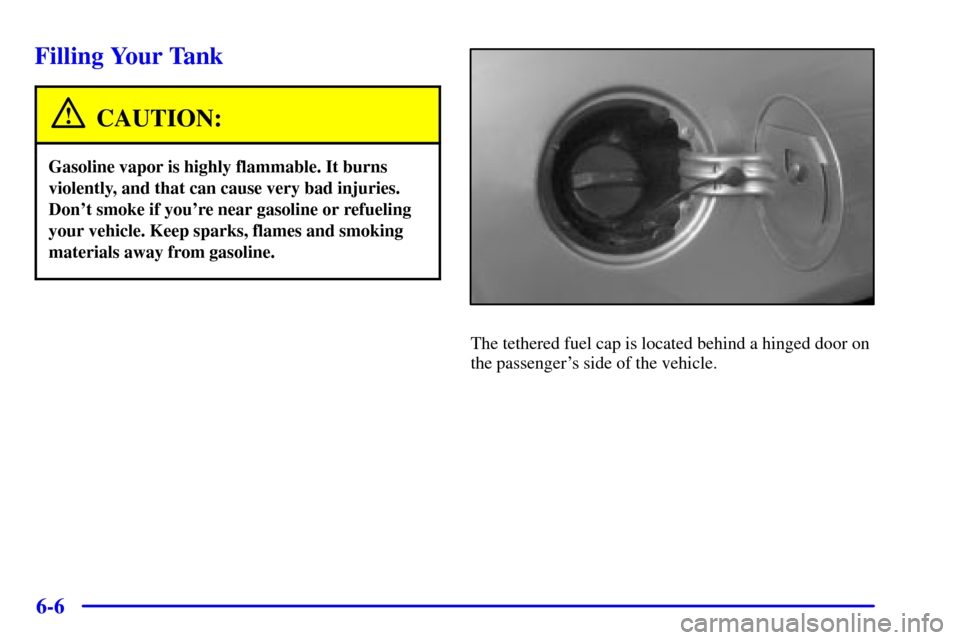
The tethered fuel cap is located behind a hinged door on
the passenger's side of the vehicle.
Page 244 of 343
6-7
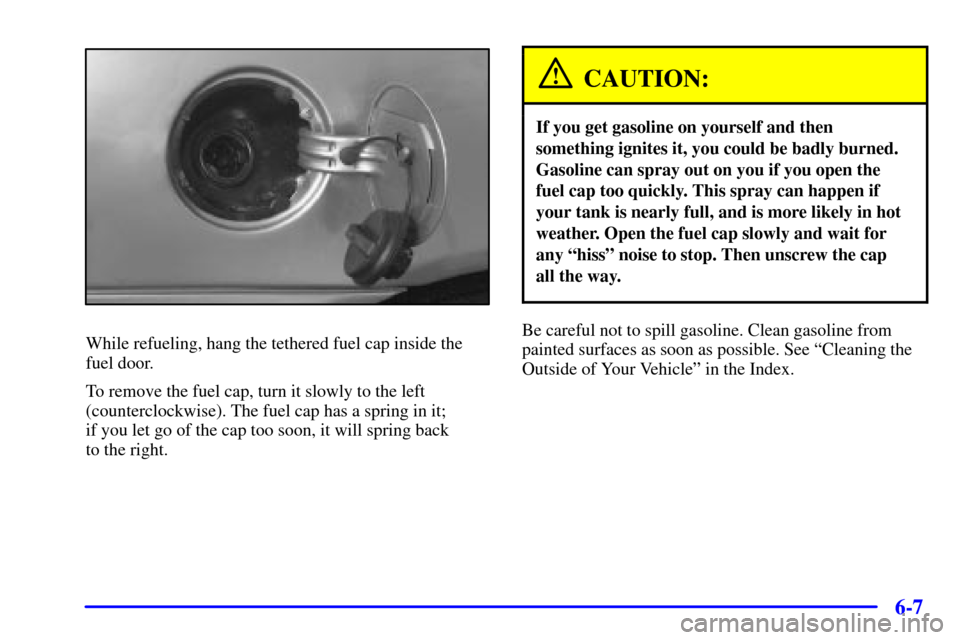
While refueling, hang the tethered fuel cap inside the
fuel door.
To remove the fuel cap, turn it slowly to the left
(counterclockwise). The fuel cap has a spring in it;
if you let go of the cap too soon, it will spring back
to the right.
CAUTION:
If you get gasoline on yourself and then
something ignites it, you could be badly burned.
Gasoline can spray out on you if you open the
fuel cap too quickly. This spray can happen if
your tank is nearly full, and is more likely in hot
weather. Open the fuel cap slowly and wait for
any ªhissº noise to stop. Then unscrew the cap
all the way.
Be careful not to spill gasoline. Clean gasoline from
painted surfaces as soon as possible. See ªCleaning the
Outside of Your Vehicleº in the Index.