Page 143 of 343
3-6
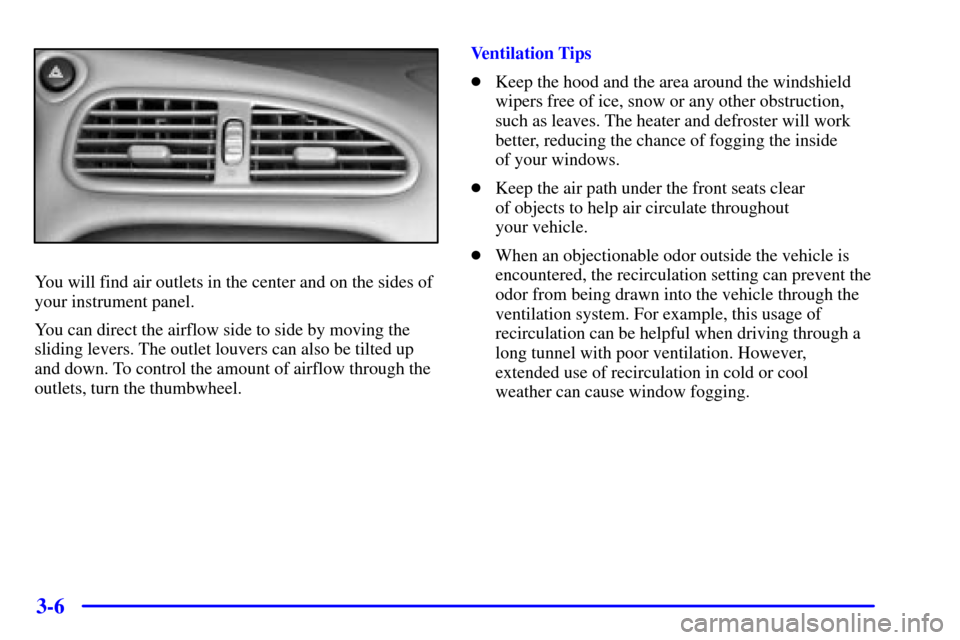
You will find air outlets in the center and on the sides of
your instrument panel.
You can direct the airflow side to side by moving the
sliding levers. The outlet louvers can also be tilted up
and down. To control the amount of airflow through the
outlets, turn the thumbwheel.Ventilation Tips
�Keep the hood and the area around the windshield
wipers free of ice, snow or any other obstruction,
such as leaves. The heater and defroster will work
better, reducing the chance of fogging the inside
of your windows.
�Keep the air path under the front seats clear
of objects to help air circulate throughout
your vehicle.
�When an objectionable odor outside the vehicle is
encountered, the recirculation setting can prevent the
odor from being drawn into the vehicle through the
ventilation system. For example, this usage of
recirculation can be helpful when driving through a
long tunnel with poor ventilation. However,
extended use of recirculation in cold or cool
weather can cause window fogging.
Page 196 of 343
4-31 Dinghy Towing
To tow your vehicle with all four wheels on the ground,
follow these steps:
1. Position the vehicle to tow and then secure it.
2. Turn the ignition switch to OFF.
3. Set the parking brake.
4. To prevent your battery from draining while the
vehicle is being towed, remove the following fuses
from the left side instrument panel fuse block:
WIPER, PCM ACC and IPC/BFC ACC. See
ªInstrument Panel Fuse Block
-- Driver's Sideº in
the Index for the location of these fuses.
5. Turn the ignition switch to ACCESSORY.
6. Shift your transaxle to NEUTRAL (N).
7. Release the parking brake.
Page 206 of 343
4-41 Making Turns
NOTICE:
Making very sharp turns while trailering
could cause the trailer to come in contact with
the vehicle. Your vehicle could be damaged.
Avoid making very sharp turns while trailering.
When you're turning with a trailer, make wider turns than
normal. Do this so your trailer won't strike soft shoulders,
curbs, road signs, trees or other objects. Avoid jerky or
sudden maneuvers. Signal well in advance.
Turn Signals When Towing a Trailer
When you tow a trailer, your vehicle may need a
different turn signal flasher and/or extra wiring.
Check with your dealer. The arrows on your
instrument panel will flash whenever you signal a
turn or lane change. Properly hooked up, the trailer
lamps will also flash, telling other drivers you're about
to turn, change lanes or stop.
When towing a trailer, the arrows on your instrument
panel will flash for turns even if the bulbs on the
trailer are burned out. Thus, you may think drivers
behind you are seeing your signal when they are not.
It's important to check occasionally to be sure the
trailer bulbs are still working.
Page 210 of 343
5-2
Hazard Warning Flashers
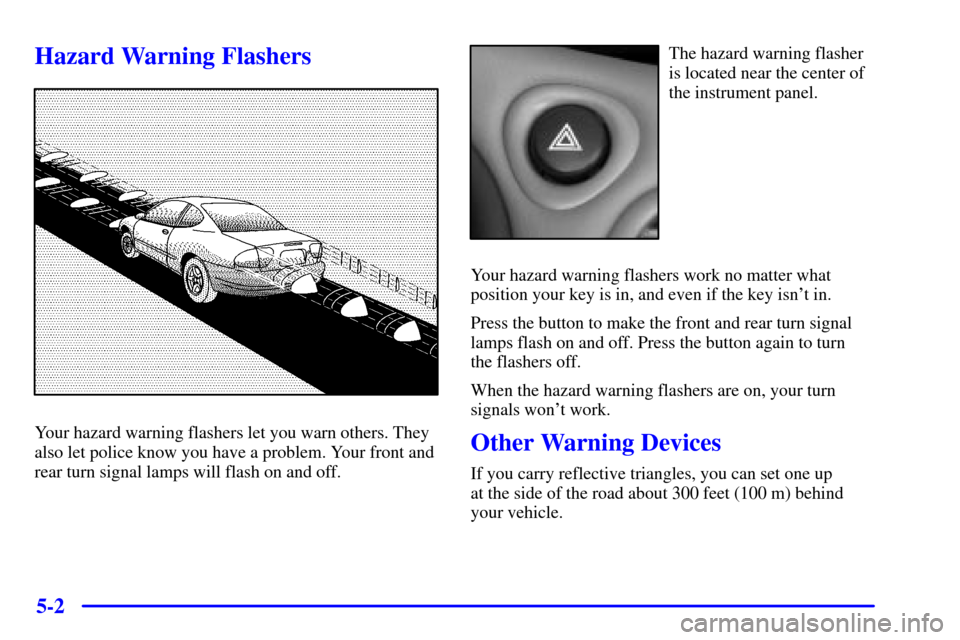
Your hazard warning flashers let you warn others. They
also let police know you have a problem. Your front and
rear turn signal lamps will flash on and off.
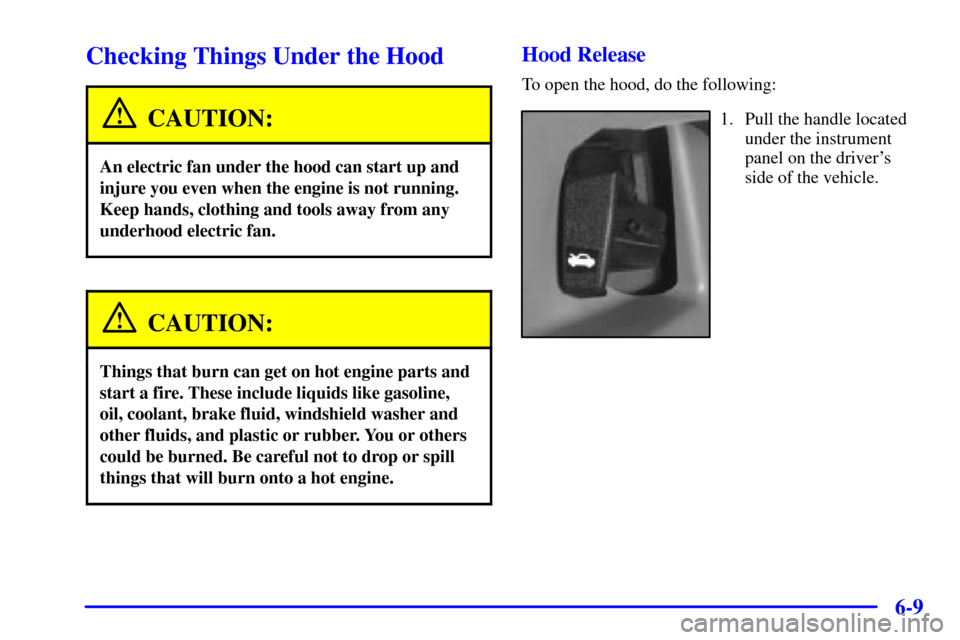
The hazard warning flasher
is located near the center of
the instrument panel.
Your hazard warning flashers work no matter what
position your key is in, and even if the key isn't in.
Press the button to make the front and rear turn signal
lamps flash on and off. Press the button again to turn
the flashers off.
When the hazard warning flashers are on, your turn
signals won't work.
Other Warning Devices
If you carry reflective triangles, you can set one up
at the side of the road about 300 feet (100 m) behind
your vehicle.
Page 217 of 343
5-9
Engine Overheating
You will find a coolant temperature gage and a low
coolant warning light on your vehicle's instrument
panel. See ªEngine Coolant Temperature Gageº and
ªLow Coolant Warning Lightº in the Index.
If Steam Is Coming From Your Engine
CAUTION:
Steam from an overheated engine can burn you
badly, even if you just open the hood. Stay away
from the engine if you see or hear steam coming
from it. Just turn it off and get everyone away
from the vehicle until it cools down. Wait until
there is no sign of steam or coolant before you
open the hood.
If you keep driving when your engine is
overheated, the liquids in it can catch fire.
You or others could be badly burned. Stop your
engine if it overheats, and get out of the vehicle
until the engine is cool.
Page 246 of 343
6-9
Checking Things Under the Hood
CAUTION:
An electric fan under the hood can start up and
injure you even when the engine is not running.
Keep hands, clothing and tools away from any
underhood electric fan.
CAUTION:
Things that burn can get on hot engine parts and
start a fire. These include liquids like gasoline,
oil, coolant, brake fluid, windshield washer and
other fluids, and plastic or rubber. You or others
could be burned. Be careful not to drop or spill
things that will burn onto a hot engine.
Hood Release
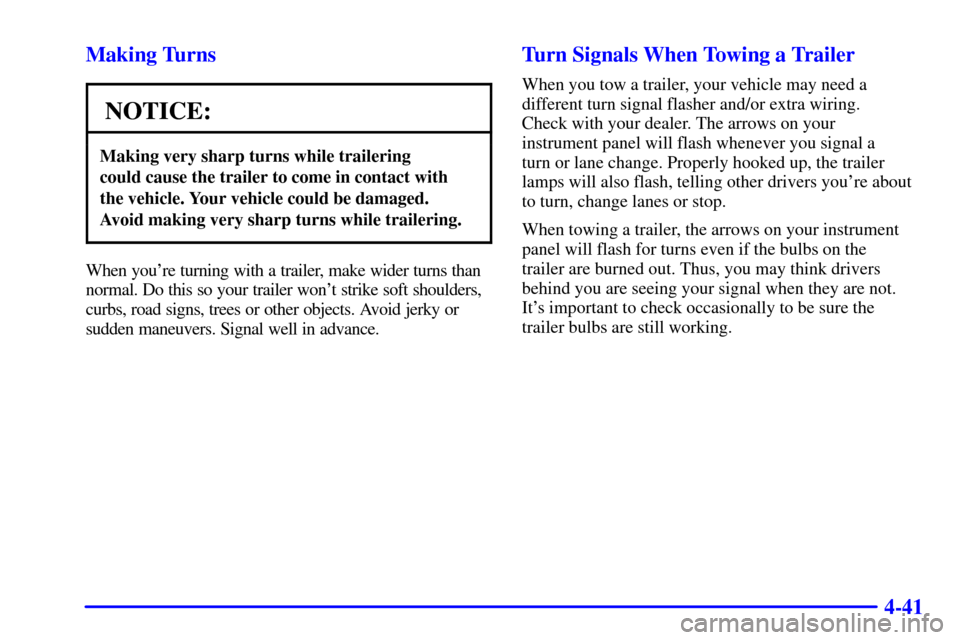
To open the hood, do the following:
1. Pull the handle located
under the instrument
panel on the driver's
side of the vehicle.
Page 256 of 343

6-19
How to Reset the Change Oil Light
The GM Oil Life System� calculates when to change
your engine oil and filter based on vehicle use. Anytime
your oil is changed, reset the system so it can calculate
when the next oil change is required. If a situation
occurs where you change your oil prior to a CHANGE
OIL light being turned on, reset the system.
After the oil has been changed, the oil life indicator
must be reset. To reset the oil life indicator, do
the following:
1. With the ignition key in ON, press the RESET
button located in the driver's side instrument panel
fuse block. See ªInstrument Panel Fuse Blockº in
the Index.
2. When the CHANGE OIL light starts to flash, press
and hold the RESET button again.
The reset is complete when you hear the chimes
sound and the CHANGE OIL light goes out.
If your vehicle is equipped with a 2.2L L4 ECOTEC
engine, it has a unique oil filter element. When
reinstalling the filter cap do not exceed 18 lb
-ft
(25 N´m). Inspect the condition of the O
-ring and
replace if damaged.
See your dealer for additional information.
What to Do with Used Oil
Used engine oil contains certain elements that may be
unhealthy for your skin and could even cause cancer.
Don't let used oil stay on your skin for very long. Clean
your skin and nails with soap and water, or a good hand
cleaner. Wash or properly throw away clothing or rags
containing used engine oil. See the manufacturer's
warnings about the use and disposal of oil products.
Used oil can be a threat to the environment. If you
change your own oil, be sure to drain all the oil from the
filter before disposal. Never dispose of oil by putting it
in the trash, pouring it on the ground, into sewers, or
into streams or bodies of water. Instead, recycle it by
taking it to a place that collects used oil. If you have a
problem properly disposing of your used oil, ask
your dealer, a service station or a local recycling center
for help.
Page 266 of 343
6-29 Adding Washer Fluid
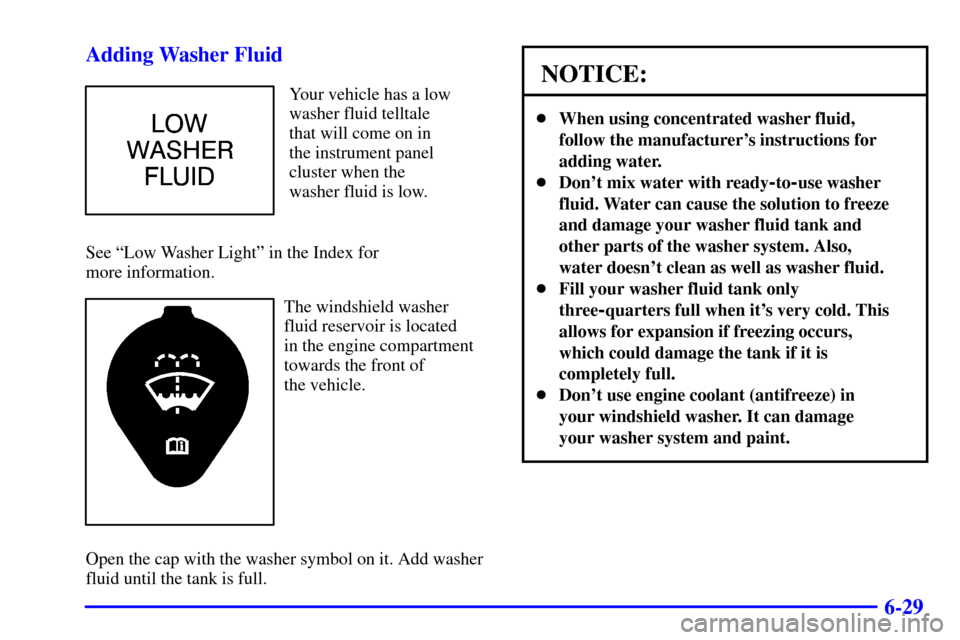
Your vehicle has a low
washer fluid telltale
that will come on in
the instrument panel
cluster when the
washer fluid is low.
See ªLow Washer Lightº in the Index for
more information.
The windshield washer
fluid reservoir is located
in the engine compartment
towards the front of
the vehicle.
Open the cap with the washer symbol on it. Add washer
fluid until the tank is full.
NOTICE:
�When using concentrated washer fluid,
follow the manufacturer's instructions for
adding water.
�Don't mix water with ready
-to-use washer
fluid. Water can cause the solution to freeze
and damage your washer fluid tank and
other parts of the washer system. Also,
water doesn't clean as well as washer fluid.
�Fill your washer fluid tank only
three
-quarters full when it's very cold. This
allows for expansion if freezing occurs,
which could damage the tank if it is
completely full.
�Don't use engine coolant (antifreeze) in
your windshield washer. It can damage
your washer system and paint.