Page 200 of 343
4-35
And, if you do have a heavy load, you should spread
it out. Don't carry more than 132 lbs. (60 kg) in
your trunk.
CAUTION:
Do not load your vehicle any heavier than the
GVWR, or either the maximum front or rear
GAWR. If you do, parts on your vehicle can
break, and it can change the way your vehicle
handles. These could cause you to lose control
and crash. Also, overloading can shorten the life
of your vehicle.
CAUTION:
Things you put inside your vehicle can strike
and injure people in a sudden stop or turn,
or in a crash.
�Put things in the trunk of your vehicle.
In a trunk, put them as far forward as
you can. Try to spread the weight evenly.
�Never stack heavier things, like suitcases,
inside the vehicle so that some of them are
above the tops of the seats.
�Don't leave an unsecured child restraint
in your vehicle.
�When you carry something inside the
vehicle, secure it whenever you can.
�Don't leave a seat folded down unless
you need to.
Page 205 of 343
4-40 Driving with a Trailer
Towing a trailer requires a certain amount of experience.
Before setting out for the open road, you'll want to get
to know your rig. Acquaint yourself with the feel of
handling and braking with the added weight of the
trailer. And always keep in mind that the vehicle you
are driving is now a good deal longer and not nearly
as responsive as your vehicle is by itself.
Before you start, check the trailer hitch and platform
(and attachments), safety chains, electrical connector,
lamps, tires and mirror adjustment. If the trailer has
electric brakes, start your vehicle and trailer moving
and then apply the trailer brake controller by hand to
be sure the brakes are working. This lets you check
your electrical connection at the same time.
During your trip, check occasionally to be sure that the
load is secure, and that the lamps and any trailer brakes
are still working.
Following Distance
Stay at least twice as far behind the vehicle ahead as
you would when driving your vehicle without a trailer.
This can help you avoid situations that require heavy
braking and sudden turns.
Passing
You'll need more passing distance up ahead when
you're towing a trailer. And, because you're a good
deal longer, you'll need to go much farther beyond
the passed vehicle before you can return to your lane.
Backing Up
Hold the bottom of the steering wheel with one hand.
Then, to move the trailer to the left, just move that
hand to the left. To move the trailer to the right, move
your hand to the right. Always back up slowly and,
if possible, have someone guide you.
Page 234 of 343
5-26 Storing the Flat Tire and Tools
CAUTION:
Storing a jack, a tire or other equipment in the
passenger compartment of the vehicle could
cause injury. In a sudden stop or collision, loose
equipment could strike someone. Store all these
in the proper place.
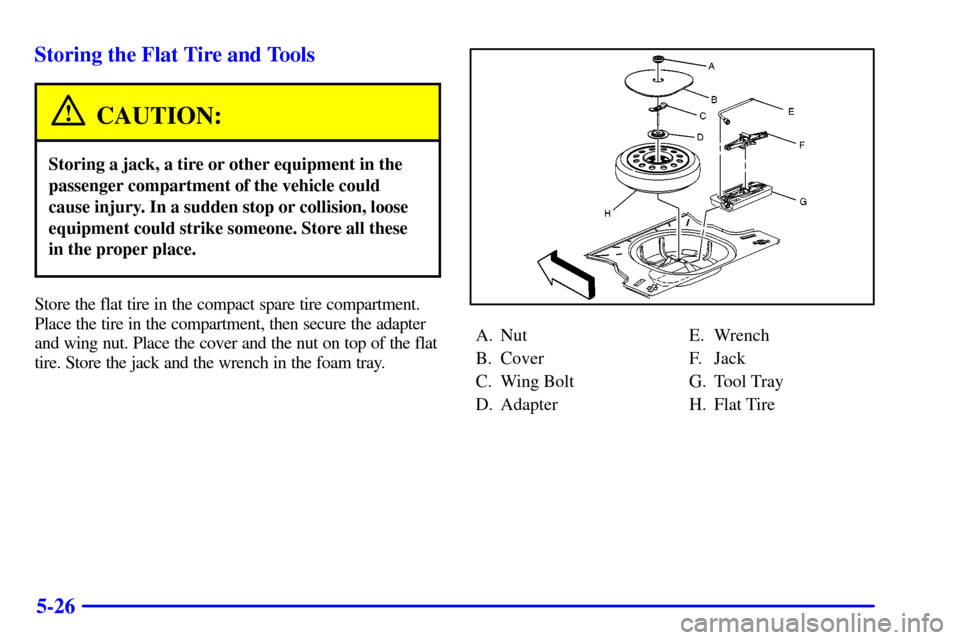
Store the flat tire in the compact spare tire compartment.
Place the tire in the compartment, then secure the adapter
and wing nut. Place the cover and the nut on top of the flat
tire. Store the jack and the wrench in the foam tray.
A. Nut
B. Cover
C. Wing Bolt
D. AdapterE. Wrench
F. Jack
G. Tool Tray
H. Flat Tire
Page 271 of 343
6-34
Bulb Replacement
For the type of bulb to use, see ªReplacement Bulbsº in
the Index. For any bulb changing procedure not listed in
this section, contact your dealer.
Halogen Bulbs
CAUTION:
Halogen bulbs have pressurized gas inside and
can burst if you drop or scratch the bulb. You or
others could be injured. Be sure to read and
follow the instructions on the bulb package.
Headlamps
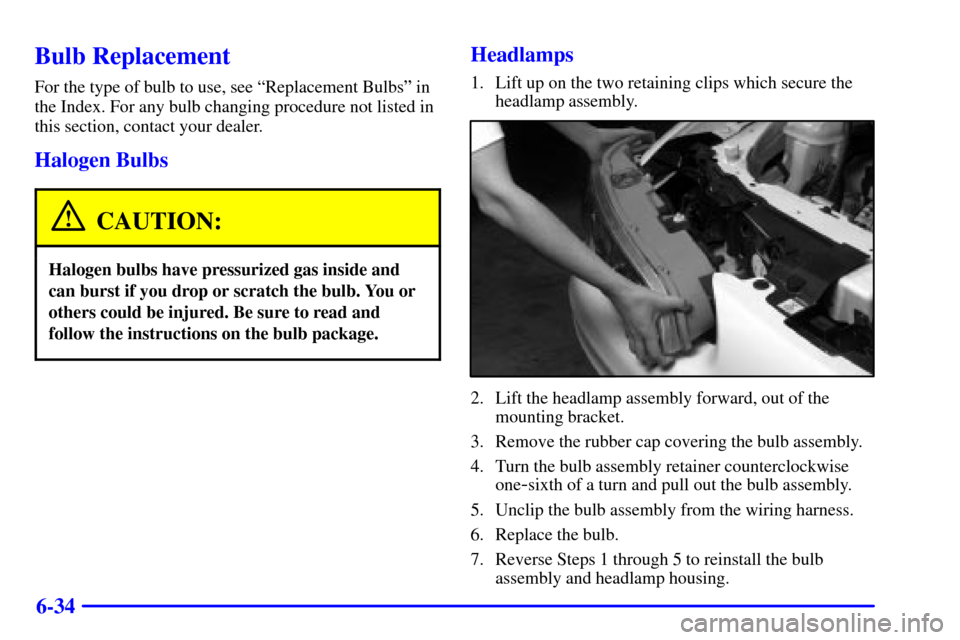
1. Lift up on the two retaining clips which secure the
headlamp assembly.
2. Lift the headlamp assembly forward, out of the
mounting bracket.
3. Remove the rubber cap covering the bulb assembly.
4. Turn the bulb assembly retainer counterclockwise
one
-sixth of a turn and pull out the bulb assembly.
5. Unclip the bulb assembly from the wiring harness.
6. Replace the bulb.
7. Reverse Steps 1 through 5 to reinstall the bulb
assembly and headlamp housing.
Page 287 of 343
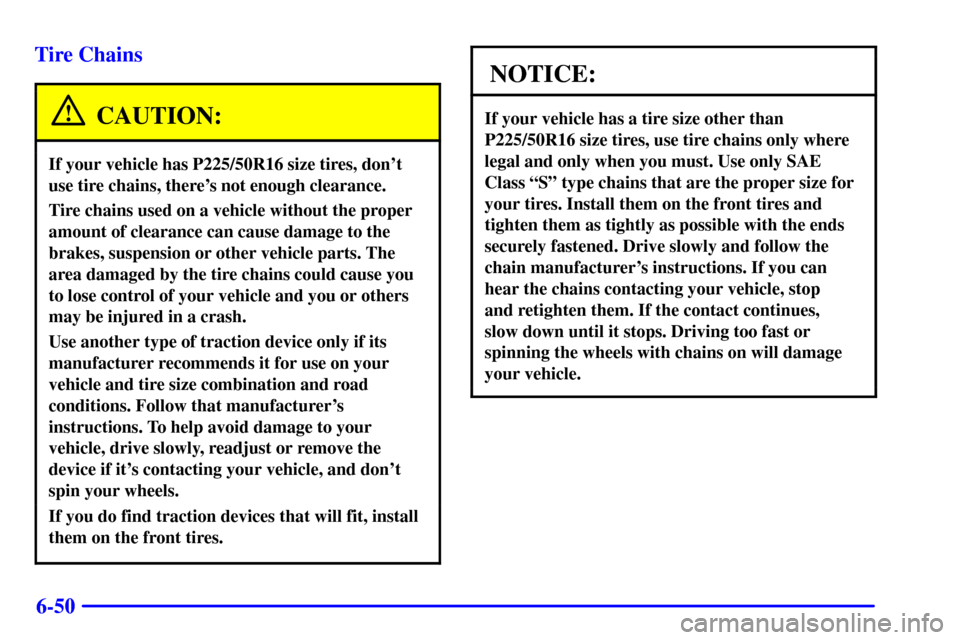
6-50 Tire Chains
CAUTION:
If your vehicle has P225/50R16 size tires, don't
use tire chains, there's not enough clearance.
Tire chains used on a vehicle without the proper
amount of clearance can cause damage to the
brakes, suspension or other vehicle parts. The
area damaged by the tire chains could cause you
to lose control of your vehicle and you or others
may be injured in a crash.
Use another type of traction device only if its
manufacturer recommends it for use on your
vehicle and tire size combination and road
conditions. Follow that manufacturer's
instructions. To help avoid damage to your
vehicle, drive slowly, readjust or remove the
device if it's contacting your vehicle, and don't
spin your wheels.
If you do find traction devices that will fit, install
them on the front tires.
NOTICE:
If your vehicle has a tire size other than
P225/50R16 size tires, use tire chains only where
legal and only when you must. Use only SAE
Class ªSº type chains that are the proper size for
your tires. Install them on the front tires and
tighten them as tightly as possible with the ends
securely fastened. Drive slowly and follow the
chain manufacturer's instructions. If you can
hear the chains contacting your vehicle, stop
and retighten them. If the contact continues,
slow down until it stops. Driving too fast or
spinning the wheels with chains on will damage
your vehicle.
Page 337 of 343

8-6
Oldsmobile Roadside Assistance
Program Features and Benefits
Security While You Travel
1-800-442-OLDS (6537)
As the proud owner of a new Oldsmobile vehicle, you
are automatically enrolled in the Oldsmobile Roadside
Assistance program.This value
-added service is intended to provide you
with peace of mind as you drive in the city or travel
the open road.
Oldsmobile's Roadside Assistance toll
-free number is
staffed by courteous and capable Roadside Assistance
Representatives who are available 24 hours a day,
365 days a year.
We will provide the following services during the
Bumper
-to-Bumper warranty period, at no expense
to you:
�Fuel delivery
�Lock
-out service (identification required)
�Tow to the nearest dealership for warranty service
or in the event of a vehicle
-disabling accident
�Flat tire change
�Jump starts
�Minor repairs to disabled vehicles
�Assistance when vehicle is mired in sand, mud
or snow
�Trip routing
�Trip interruption expense benefits
�Dealership locator service
Page 338 of 343

8-7
Oldsmobile Roadside Assistance specifically excludes
coverage for mounting, dismounting or changing of
snow tires, chains or other traction devices.
In some cases, where service is impractical, the driver
may be authorized to obtain other service for which
reimbursement is provided.
In many instances, mechanical failures are covered under
Oldsmobile's comprehensive warranty. However, when
other services are utilized, our Roadside Assistance
Representatives will explain any payment obligations
you might incur.
For prompt and efficient assistance when calling,
please provide the following to the Roadside
Assistance Representative:
�Location of vehicle
�Telephone number of your location
�Vehicle model, year and color
�Mileage of vehicle
�Vehicle Identification Number (VIN)
�Vehicle license plate numberOldsmobile reserves the right to limit services or
reimbursement to an owner or driver when, in
Oldsmobile's judgement, the claims become
excessive in frequency or type of occurrence.
While we hope you never have the occasion to
use our service, it is added security while traveling
for you and your family. Remember, we're only
a phone call away. Oldsmobile Roadside
Assistance
-- 1-800-442-OLDS (6537),
text telephone (TTY) users, call 1
-888-889-2438.
Canadian Roadside Assistance
Vehicles purchased in Canada have an extensive
roadside assistance program accessible from anywhere
in Canada or the United States. Please refer to the
Warranty and Owner Assistance Information book or
call 1
-800-268-6800 for emergency services.