2002 NISSAN SENTRA heater
[x] Cancel search: heaterPage 142 of 235
cWhenever working on or near a bat-
tery, always wear suitable eye pro-
tectors (for example, goggles or in-
dustrial safety spectacles) and
remove rings, metal bands, or any
other jewelry. Do not lean over the
battery when jump starting.
cDo not attempt to jump start a frozen
battery. It could explode and cause
serious injury.
cYour vehicle has an automatic en-
gine cooling fan. It could come on at
any time. Keep hands and other ob-
jects away from it.
Always follow the instructions below.
Failure to do so could result in damage
to the charging system and cause per-
sonal injury.
1.
If the booster battery is in another vehicle,
position the two vehicles to bring their
batteries into close proximity to each other.
Do not allow the two vehicles to touch.
2. Apply the parking brake. Move the selec-
tor lever to N (Neutral) (on automatic
transmission models, move the shift se-
lector lever to P (Park)). Switch off all
unnecessary electrical systems (lights,heater, air conditioner, etc.).
3. Cover the battery with an old cloth to
reduce explosion hazard.
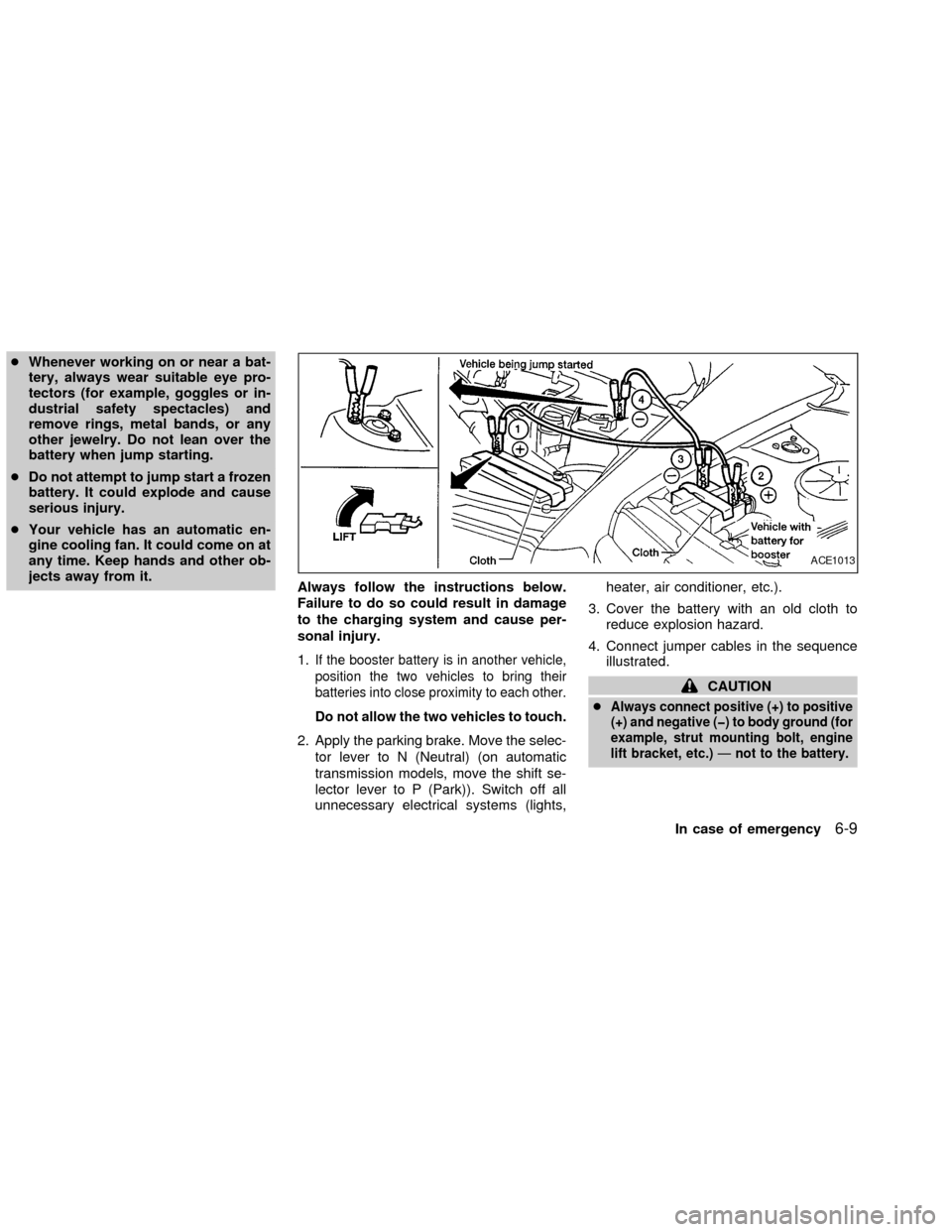
4. Connect jumper cables in the sequence
illustrated.
CAUTION
c
Always connect positive (+) to positive
(+) and negative (þ) to body ground (for
example, strut mounting bolt, engine
lift bracket, etc.)Ðnot to the battery.
ACE1013
In case of emergency6-9
ZX
Page 143 of 235
cMake sure the jumper cables do not
touch moving parts in the engine com-
partment and that the cable clamps do
not contact any other metal.
5. Start the engine of the booster vehicle
and let it run for a few minutes.
6. Keep the engine speed of the booster
vehicle at about 2,000 rpm, and start the
engine of the vehicle being jump started.
CAUTION
Do not keep the starter motor engaged
for more than 10 seconds. If the engine
does not start right away, turn the key
off and wait 3 to 4 seconds before
trying again.
7. After starting the engine, carefully dis-
connect the negative cable and then the
positive cable.
8. Be sure to dispose of the cloth used to
cover the vent holes as it may be con-
taminated with corrosive acid.
CAUTION
cAutomatic transmission models can-
not be push started. This may cause
transmission damage.
cThree way catalyst equipped models
should not be started by pushing.
The three way catalyst may be dam-
aged.
cNever try to start the vehicle by tow-
ing it. When the engine starts, the
forward surge could cause the ve-
hicle to collide with the tow vehicle.If your vehicle is overheating (indicated by
an extremely high temperature gauge read-
ing), or if you feel a lack of engine power,
detect abnormal noise, etc., take the follow-
ing steps.
WARNING
cDo not continue to drive if your ve-
hicle overheats. Doing so could
cause a vehicle fire.
cTo avoid the danger of being
scalded, never remove the radiator
cap while the engine is still hot.
When the radiator cap is removed,
pressurized hot water will spurt out,
possibly causing serious injury.
cDo not open the hood if steam is
coming out.
1. Move the vehicle safely off the road,
apply the parking brake and move the
selector lever to N (Neutral) (manual
transmission) or the shift selector lever to
P (Park) (automatic transmission).
Do not stop the engine.
2. Turn off the air conditioner. Open all the
windows, move the heater or air condi-
tioner temperature control to maximum
PUSH STARTING IF YOUR VEHICLE
OVERHEATS
6-10In case of emergency
ZX
Page 159 of 235

warning lights and chimes are operating
properly.
Windshield wiper and washer*Check that
the wipers and washer operate properly and
that the wipers do not streak.
Windshield defrosterCheck that the air
comes out of the defroster outlets properly
and in sufficient quantity when operating the
heater or air conditioner.
Steering wheelCheck for changes in the
steering conditions, such as excessive free-
play, hard steering or strange noises.
SeatsCheck seat position controls such as
seat adjusters, seatback recliner, etc. to
ensure they operate smoothly and all
latches lock securely in every position.
Check that the head restraints move up and
down smoothly and the locks (if so
equipped) hold securely in all latched posi-
tions.
Seat beltsCheck that all parts of the seat
belt system (e.g., buckles, anchors, adjust-
ers and retractors) operate properly and
smoothly, and are installed securely. Check
the belt webbing for cuts, fraying, wear or
damage.Accelerator pedalCheck the pedal for
smooth operation and make sure the pedal
does not catch or require uneven effort.
Keep the floor mat away from the pedal.
Clutch pedal*Make sure the pedal oper-
ates smoothly and check that it has the
proper free travel.
BrakesCheck that the brakes do not pull
the vehicle to one side when applied.
Brake pedal and booster*Check the pedal
for smooth operation and make sure it has
the proper distance under it when de-
pressed fully. Check the brake booster func-
tion. Be certain to keep the floor mat away
from the pedal.
Parking brake*Check that the lever has
the proper travel and confirm that your
vehicle is held securely on a fairly steep hill
with only the parking brake applied.
Automatic transmission P (Park) posi-
tion mechanismCheck that the lock re-
lease button on the selector lever operates
properly and smoothly. On a fairly steep hill
check that your vehicle is held securely with
the selector lever in the P position without
applying any brakes.Under the hood and vehicle
The maintenance items listed here should
be checked periodically (e.g., each time you
check the engine oil or refuel).
Additional information on the following
items with an ``*'' is found later in this
section.
Windshield washer fluid*Check that there
is adequate fluid in the reservoir.
Engine oil level*Check the level after
parking the vehicle on a level surface with
the engine off. Wait a few minutes for the oil
to drain back into the oil pan.
Brake and clutch fluid levels*Make sure
that the brake and clutch fluid level is be-
tween the MIN and MAX lines on the reser-
voir.
Power steering fluid level* and lines
Check the level when the fluid is cold, with
the engine off. Check the lines for proper
attachment, leaks, cracks, etc.
Automatic transmission fluid level*
Check the level after putting the selector
lever in P with the engine idling at operating
temperature.
8-4Maintenance and do-it-yourself
ZX
Page 165 of 235
If the cooling system frequently requires
coolant, have it checked by an autho-
rized NISSAN dealer.
CHANGING ENGINE COOLANT
cMajor cooling system repairs should be
performed by an authorized NISSAN
dealer. The service procedures can be
found in the NISSAN Service Manual.
cImproper servicing can result in reduced
heater performance and engine over-
heating.
WARNING
cTo avoid the danger of being
scalded, never change the coolant
when the engine is hot.
cNever remove the radiator cap when
the engine is hot. Serious burns
could be caused by high pressure
fluid escaping from the radiator.
cAvoid direct skin contact with used
coolant. If skin contact is made,
wash thoroughly with soap or hand
cleaner as soon as possible.cKeep coolant out of reach of children
and pets.
Engine coolant must be disposed of
properly. Check your local regulations.
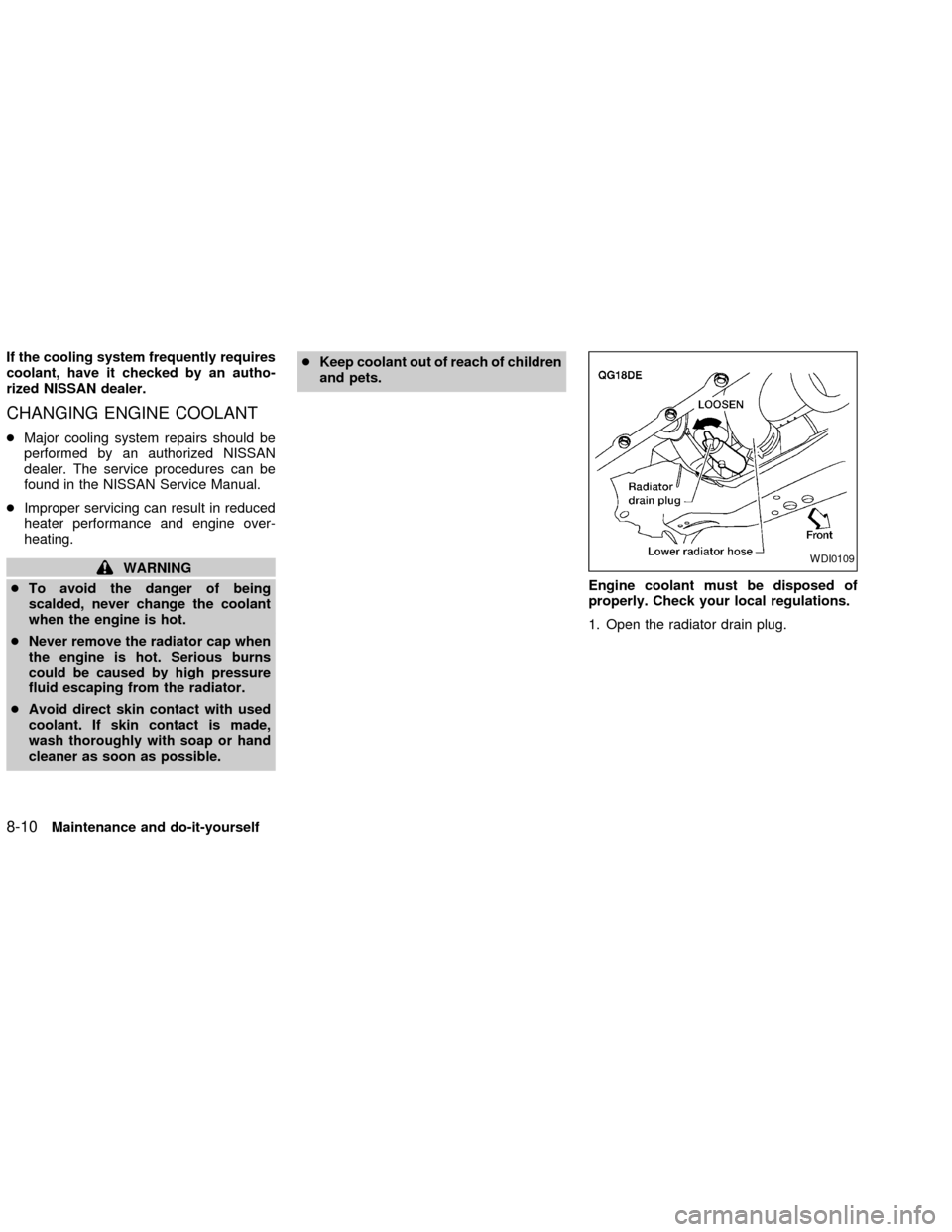
1. Open the radiator drain plug.WDI0109
8-10Maintenance and do-it-yourself
ZX
Page 228 of 235

10 Index
A
Air bag (See supplemental restraint
system) ........................................................ 1-6
Air bag warning light .......................... 1-16, 2-9
Air cleaner housing filter ............................ 8-24
Air conditioner
Air conditioner operation ........................ 4-5
Air conditioner specification label ......... 9-12
Air conditioner system refrigerant and
lubrication recommendations.................. 9-7
Heater and air conditioner controls ........ 4-3
Servicing air conditioner ......................... 4-9
Air flow charts .............................................. 4-6
Alarm system (See vehicle security
system) ...................................................... 2-11
Anchor point locations ............................... 1-34
Antenna...................................................... 4-19
Anti-lock brake system (ABS).................... 5-19
Anti-lock brake warning light ....................... 2-7
Ashtray (See cigarette lighter and
ashtray) ...................................................... 2-20
Audio system
Compact Disc (CD) changer ................ 4-17
FM-AM radio with compact disc (CD)
player .................................................... 4-12
Automatic
Automatic power window switch .......... 2-25Automatic transmission fluid (ATF) ...... 8-15
Driving with automatic transmission ....... 5-7
Transmission selector lever lock
release .................................................. 5-10
B
Battery........................................................ 8-19
Battery
Charge warning light .............................. 2-8
Battery replacement (See remote keyless
entry system) ............................................... 3-8
Before starting the engine ........................... 5-6
Belts (See drive belts) ............................... 8-22
Brake
Anti-lock brake system (ABS) .............. 5-19
Brake booster ....................................... 8-30
Brake fluid............................................. 8-18
Brake light (See stop light) ................... 8-40
Brake pedal .......................................... 8-30
Brake system ........................................ 5-19
Brake warning light ................................. 2-8
Brake wear indicators ................. 2-11, 8-30
Parking brake check ............................. 8-29
Parking brake operation ....................... 5-13
Self-adjusting brakes ............................ 8-30
Break-in schedule ...................................... 5-16
Bulb check/instrument panel ....................... 2-7Bulb replacement ....................................... 8-40
C
Capacities and recommended fuel/
lubricants...................................................... 9-2
Car phone or CB radio .............................. 4-20
Cargo (See vehicle loading information) ... 9-14
Child restraint with top tether strap ........... 1-34
Child restraints ........................ 1-20, 1-25, 1-32
Child safety rear door lock .......................... 3-4
Cigarette lighter (accessory) and
ashtray ....................................................... 2-20
Cleaning exterior and interior ...................... 7-2
Clock .......................................................... 4-13
Clutch
Clutch fluid ............................................ 8-18
Clutch pedal.......................................... 8-31
Cold weather driving .................................. 5-21
Controls
Heater and air conditioner controls ........ 4-3
Coolant
Capacities and recommended fuel/
lubricants ................................................ 9-2
Changing engine coolant...................... 8-10
Checking engine coolant level ............... 8-9
Engine coolant temperature gauge ........ 2-5
ZX
Page 230 of 235

H
Hazard warning flasher switch .................. 2-18
Head restraints ............................................ 1-5
Headlight aiming adjustment ..................... 8-37
Headlight and turn signal switch ............... 2-16
Headlights .................................................. 8-36
Heater
Heater and air conditioner controls ........ 4-3
Heater operation ..................................... 4-4
Hood release ............................................... 3-9
Horn ........................................................... 2-19
I
Ignition switch .............................................. 5-4
Immobilizer system ..................... 2-11, 3-2, 5-6
Increasing fuel economy............................ 5-16
Indicator lights and audible reminders
(See warning/indicator lights and audible
reminders) .................................................... 2-7
Inside mirror ............................................... 3-16
Instrument brightness control .................... 2-17
Interior light ................................................ 2-27
Interior trunk lid release ............................. 3-12
J
Jump starting ............................................... 6-8K
Key ............................................................... 3-2
Keyless entry system (See remote keyless
entry system) ............................................... 3-5
L
Labels
Air conditioner specification label ......... 9-12
Emission control information label........ 9-12
Engine serial number ........................... 9-11
F.M.V.S.S. certification label ................ 9-11
Vehicle identification number (VIN)
plate ...................................................... 9-10
Warning labels (for SRS) ..................... 1-16
LATCH (Lower Anchors and Tether for
Children) System ....................................... 1-32
License plate
Installing the license plate .................... 9-13
Light
Air bag warning light ..................... 1-16, 2-9
Brake light (See stop light) ................... 8-40
Bulb check/instrument panel .................. 2-7
Bulb replacement.................................. 8-40
Charge warning light .............................. 2-8
Front fog light switch ............................ 2-18
Headlight aiming adjustment ................ 8-37
Headlight and turn signal switch .......... 2-16
Headlights ............................................. 8-36
Interior light ........................................... 2-27Light bulbs ............................................ 8-36
Low washer fluid warning light ............... 2-9
Spotlights (See map light) .................... 2-27
Trunk light ............................................. 2-28
Warning/indicator lights and audible
reminders ................................................ 2-7
Lock
Child safety rear door lock ..................... 3-4
Door locks............................................... 3-3
Fuel filler lid lock opener lever ............. 3-13
Power door locks .................................... 3-4
Trunk lid lock opener lever ................... 3-10
M
Maintenance
General maintenance ............................. 8-3
Inside the vehicle.................................... 8-3
Maintenance precautions ....................... 8-5
Outside the vehicle ................................. 8-3
Seat belt maintenance.......................... 1-24
Under the hood and vehicle ................... 8-4
Malfunction indicator lamp (MIL) ............... 2-10
Manual windows ........................................ 2-25
Meters and gauges ...................................... 2-2
Mirror
Inside mirror.......................................... 3-16
Outside mirror control ........................... 3-16
Vanity mirror ......................................... 3-15
Multi-remote control system (See remote
keyless entry system) .................................. 3-5
10-3
ZX