2002 NISSAN QUEST spare tire
[x] Cancel search: spare tirePage 261 of 294
WARNING
cAfter rotating the tires, check and
adjust the tire pressure.
cRetighten the wheel nuts when the
vehicle has been driven for 600 miles
(1,000 km) (also in cases of a flat tire,
etc.).
cDo not include the spare tire in the
tire rotation.
cFor additional information regarding
tires, refer to ``Important Tire Safety
Information'' in the Warranty Infor-
mation Booklet (US) or ``Tire Safety
Information'' in the Warranty and
Roadside Assistance Information
booklet (Canada).
Tire wear and damage
WARNING
cTires should be periodically in-
spected for wear, cracking, bulging,
or objects caught in the tread. If
excessive wear, cracks, bulging, or
deep cuts are found, the tire(s)
should be replaced.
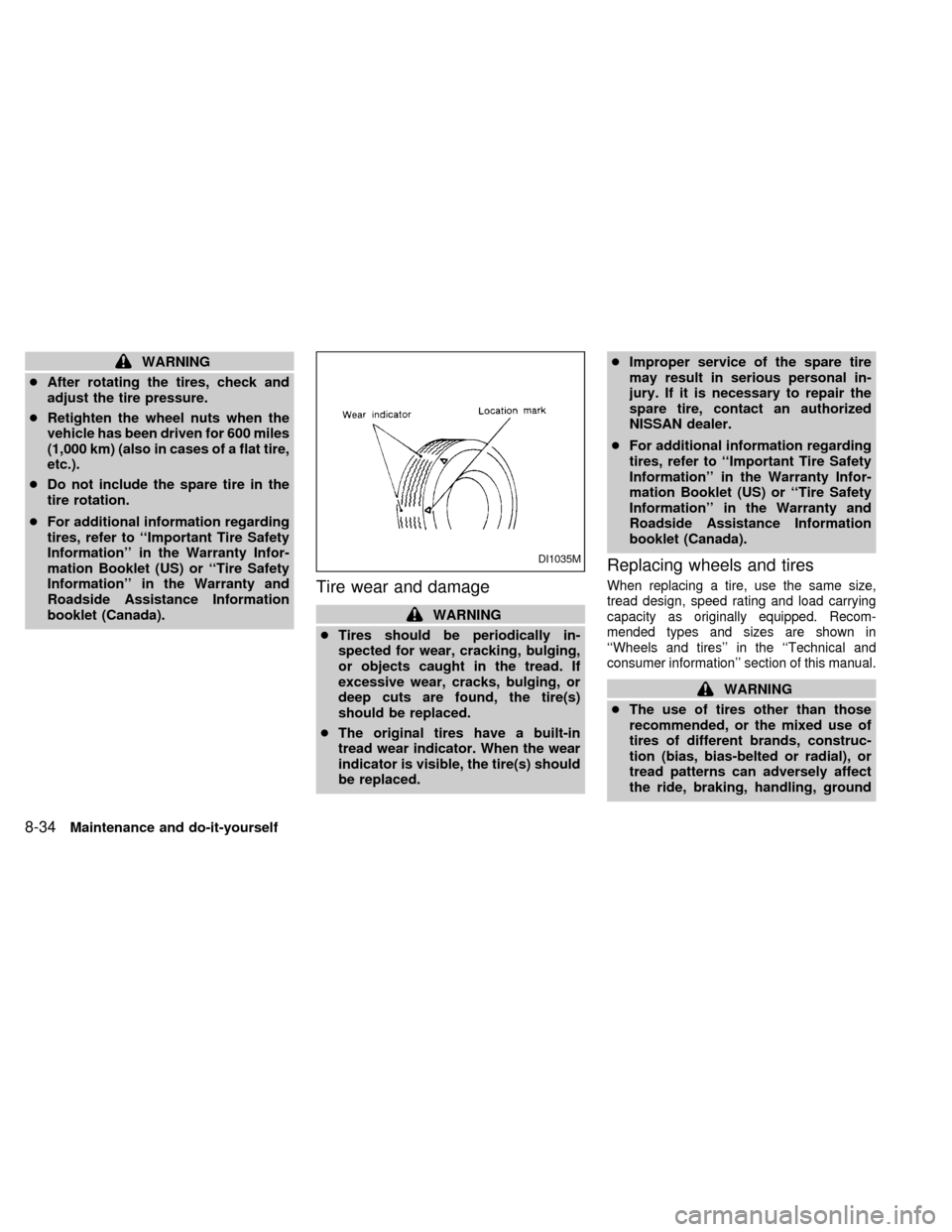
cThe original tires have a built-in
tread wear indicator. When the wear
indicator is visible, the tire(s) should
be replaced.cImproper service of the spare tire
may result in serious personal in-
jury. If it is necessary to repair the
spare tire, contact an authorized
NISSAN dealer.
cFor additional information regarding
tires, refer to ``Important Tire Safety
Information'' in the Warranty Infor-
mation Booklet (US) or ``Tire Safety
Information'' in the Warranty and
Roadside Assistance Information
booklet (Canada).
Replacing wheels and tires
When replacing a tire, use the same size,
tread design, speed rating and load carrying
capacity as originally equipped. Recom-
mended types and sizes are shown in
``Wheels and tires'' in the ``Technical and
consumer information'' section of this manual.
WARNING
cThe use of tires other than those
recommended, or the mixed use of
tires of different brands, construc-
tion (bias, bias-belted or radial), or
tread patterns can adversely affect
the ride, braking, handling, ground
DI1035M
8-34Maintenance and do-it-yourself
ZX
Page 262 of 294
clearance, body-to-tire clearance,
snow chain clearance, speedometer
calibration, headlight aim and
bumper height. Some of these ef-
fects may lead to accidents and
could result in serious personal in-
jury.
cIf the wheels are changed for any
reason, always replace with wheels
which have the same off-set dimen-
sion. Wheels of a different offset
could cause premature tire wear, de-
grading vehicle handling character-
istics and/or interference with the
brake discs/drums. Such interfer-
ence can lead to decreased braking
efficiency and/or early brake pad/
shoe wear. Refer to ªWheel/tire sizeº
in the ªTechnical and consumer in-
formationº section of this manual for
wheel off-set dimensions.
cDo not install a deformed wheel or
tire even if it has been repaired. Such
wheels or tires could have structural
damage and could fail without warn-
ing.cThe use of retread tires is not recom-
mended.
cFor additional information regarding
tires, refer to ``Important Tire Safety
Information'' in the Warranty Infor-
mation Booklet (US) or ``Tire Safety
Information'' in the Warranty and
Roadside Assistance Information
booklet (Canada).
Wheel balance
Unbalanced wheels may affect vehicle han-
dling and tire life. Even with regular use,
wheels can get out of balance. Therefore,
they should be balanced as required.
Wheel balance service should be performed
with the wheels off the vehicle. Spin balanc-
ing the front wheels on the vehicle could
lead to transmission damage.
cFor additional information regarding tires,
refer to ``Important Tire Safety Informa-
tion'' in the Warranty Information Booklet
(US) or ``Tire Safety Information'' in the
Warranty and Roadside Assistance Infor-
mation booklet (Canada).
Care of wheels
cWash the wheels when washing the ve-
hicle to maintain their appearance.
cClean the inner side of the wheels when
the wheel is changed or the underside of
the vehicle is washed.
cDo not use abrasive cleaners when
washing the wheels.
cInspect wheel rims regularly for dents or
corrosion. Such damage may cause loss
of pressure or poor seal at the tire bead.
c
NISSAN recommends waxing the road
wheels to protect against road salt in areas
where it is used during winter.
Spare tire (TEMPORARY USE
ONLY spare tire)
US only. Canadian vehicles are equipped
with a full size spare tire. Observe the
following precautions if the TEMPORARY
USE ONLY spare tire must be used, other-
wise your vehicle could be damaged or
involved in an accident.
Maintenance and do-it-yourself
8-35
ZX
Page 263 of 294
WARNING
cThe spare tire should be used only
for emergency use only. It should be
replaced by the standard tire at the
first opportunity to avoid possible
tire or diffential damage.
c
Drive carefully while the TEMPO-
RARY USE ONLY spare tire is in-
stalled. Avoid sharp turns and abrupt
braking while driving.
cPeriodically check spare tire infla-
tion pressure. Always keep the pres-
sure of the TEMPORARY USE ONLY
spare tire at 60 psi (420 kP, 4.2 bar).
Always keep the pressure of the full
size spare tire (if so equipped) at the
recommended pressure for standard
tires, as indicated on the tire placard.
For tire placard location, see ``Tire
placard'' in the index of this manual.
cWith the TEMPORARY USE ONLY
spare tire installed do not drive the
vehicle at speeds faster than 50 mph
(80 km/h).c
When driving on roads covered with
snow or ice, the TEMPORARY USE
ONLY spare tire should be used on
the rear wheel and the original tire
used on the front wheels (drive
wheels). Use tire chains only on the
front (original) tires.
cTire tread of the TEMPORARY USE
ONLY spare tire will wear at a faster
rate than the standard tire. Replace
the spare tire as soon as the tread
wear indicators appear.
cDo not use the spare tire on other
vehicles.
cDo not use more than one spare tire
at the same time.
cDo not tow a trailer when the TEM-
PORARY USE ONLY spare tire is
installed.
CAUTION
cDo not use tire chains on the TEM-
PORARY USE ONLY spare tire. Tire
chains will not fit properly and may
cause damage to the vehicle.
cBecause the TEMPORARY USE
ONLY spare tire is smaller than the
original tire, ground clearance is re-
duced. To avoid damage to the ve-
hicle, do not drive over obstacles.
Also, do not drive the vehicle
through an automatic car wash since
it may get caught.
8-36Maintenance and do-it-yourself
ZX
Page 272 of 294

WHEELS AND TIRES
Wheels Steel 5.5JJ ý 15
Aluminum 6J ý 16
Offset in (mm) 1.77 (45)
Tire size Steel P215/70R15
Aluminum P215/65R16
Aluminum P225/60R16
Spare tires T135/90D16
P215/70R15
DIMENSIONS AND WEIGHTS
Overall length in (mm) 194.8 (4,949)
Overall width in (mm) 74.9 (1,903)
Overall height in (mm) 67.3 (1,710)
Front tread in (mm) 63.4 (1,610)
Rear tread in (mm) 63.4 (1,610)
Wheelbase in (mm) 112.2 (2,850)
Gross vehicle weight
rating lb (kg)
See the ``F.M.V.S.S. certification label''
on the left center pillar. Gross axle weight rating
Front lb (kg)
Rear lb (kg)
Technical and consumer information9-9
ZX
Page 276 of 294
WARNING
cIt is extremely dangerous to ride in a
cargo area inside the vehicle. In a
collision, people riding in these ar-
eas are more likely to be seriously
injured or killed.
cDo not allow people to ride in any
area of your vehicle that is not
equipped with seats and seat belts.
c
Be sure everyone in the vehicle is in a
seat with their seat belt properly fas-
tened.
TERMS
It is important to familiarize yourself with the
following terms before loading your vehicle:
c
Curb Weight (actual weight of your ve-
hicle) - vehicle weight including: standard
and optional equipment, fluids, emergency
tools, and spare tire assembly. This weight
does notinclude passengers and cargo.
cGVW (Gross Vehicle Weight) - curb
weight plus the combined weight of pas-
sengers and cargo.
cGVWR (Gross Vehicle Weight Rating) -maximum total weight (load) limit speci-
fied for the vehicle.
cGAWR (Gross Axle Weight Rating) -
maximum weight (load) limit specified for
the front or rear axle.
cGross combined weight - GVW plus the
total weight of the trailer and all its cargo.
DETERMINING VEHICLE LOAD
CAPACITY
The load capacity of this vehicle is deter-
mined by weight, not by available cargo
space. For example, a luggage rack, bike
carrier, cartop carrier or similar equipment
does not increase load carrying capacity of
your vehicle.
To determine vehicle load capacity:
Vehicle weight can be determined by using
a commercial-grade scale, found at places
such as a truck stop, gravel quarry, grain
elevator, or a scrap metal recycling facility.
1)
Determine the curb weight of your vehicle.
2) Compare the curb weight amount to the
GVWR specified for your vehicle to de-
termine how much more weight your
vehicle can carry.3) After loading (cargo & passengers), re-
weigh your vehicle to determine if either
GVWR or GAWR for your vehicle is
exceeded. If GVWR is exceeded, re-
move cargo as necessary. If either the
front or rear GAWR is exceeded, shift
the load or remove cargo as necessary.
LOADING TIPS
cThe GVW must not exceed GVWR or
GAWR specified on the F.M.V.S.S. Cer-
tification Label.
cDo not load the front and rear axle to the
GAWR. Doing so will exceed the GVWR.
WARNING
c
Properly secure all cargo to help pre-
vent it from sliding or shifting. Do not
place cargo higher than the seat-
backs. In a sudden stop or collision,
unsecured cargo could cause per-
sonal injury.
VEHICLE LOADING
INFORMATION
Technical and consumer information9-13
ZX
Page 292 of 294

Seat belt warning light ................................. 2-9
Seat positions ............................................ 1-20
Seating arrangements ............................... 1-19
Seats
Five passenger seating ........................ 1-28
Five passenger seating with cargo
room...................................................... 1-29
Flexible seating..................................... 1-12
Heated seats ........................................ 2-20
Integrated child safety seats ................ 1-73
Manual front seat adjustment ................. 1-3
Power support front seat ........................ 1-4
Seat positions ....................................... 1-20
Second row bench seat........................ 1-20
Second row bucket seats ..................... 1-24
Seven passenger seating ..................... 1-27
Sliding three-passenger seat.................. 1-7
Three-passenger bench seat in fully
forward position .................................... 1-29
Three-passenger bench seat in
storage position .................................... 1-27
Seats/floor mats ......................................... 1-19
Self-adjusting brakes ................................. 8-21
Seven passenger seating .......................... 1-27
Shift lock release ......................................... 5-7
Shifting
Automatic transmission .......................... 5-7
Sliding three-passenger seat ....................... 1-7
Spark plug replacement............................. 8-16
Speedometer ............................................... 2-5
Spotlights (See map light) ......................... 2-35
SRS warning label ..................................... 1-37Starting
Before starting the engine ...................... 5-5
Jump starting................................. 6-8, 8-15
Precautions when starting and driving ... 5-2
Push starting......................................... 6-10
Starting the engine ................................. 5-5
Steering
Power steering fluid ...................... 8-13, 9-2
Tilting steering wheel............................ 3-11
Stop light .................................................... 8-27
Storage
Overhead storage compartment........... 2-24
Under seat storage tray........................ 1-11
Sun shade.................................................. 2-33
Sunroof ...................................................... 2-33
Supplemental restraint system
Information and warning labels ............ 1-37
Switch
Autolamp switch ................................... 2-18
Automatic power window switch .......... 2-31
Hazard warning flasher switch ............. 2-19
Headlight control switch ....................... 2-16
Ignition switch ......................................... 5-4
Overdrive switch ..................................... 5-8
Rear window defogger switch .............. 2-16
Rear window wiper and washer
switches ................................................ 2-16
Turn signal switch................................. 2-19
Windshield wiper and washer switch ... 2-15T
Tabletop seats ........................................... 1-18
Tachometer .................................................. 2-5
Three-passenger bench seat..................... 1-50
Three-passenger bench seat in fully
forward position ......................................... 1-29
Three-passenger bench seat in storage
position....................................................... 1-27
Three-way catalyst....................................... 5-2
Tilting steering wheel ................................. 3-11
Timing belt ................................................... 9-7
Tire
Flat tire.................................................... 6-2
Spare tire .............................................. 8-35
Tire chains ............................................ 8-33
Tire placard........................................... 9-12
Tire pressure ........................................ 8-31
Tire rotation .......................................... 8-33
Tool kit .................................................... 6-3
Types of tires ........................................ 8-32
Uniform tire quality grading .................. 9-19
Wheels and tires ........................... 8-31, 9-9
Wheel/tire size ........................................ 9-9
Towing
Tow truck towing .................................. 6-12
Towing load/specification chart ............ 9-15
Trailer towing ........................................ 9-14
10-5
ZX