Page 239 of 288
SDI1116
LIGHTS8-30
Maintenance and do-it-yourself
Z
01.9.21/R50-D/V5
X
Page 240 of 288
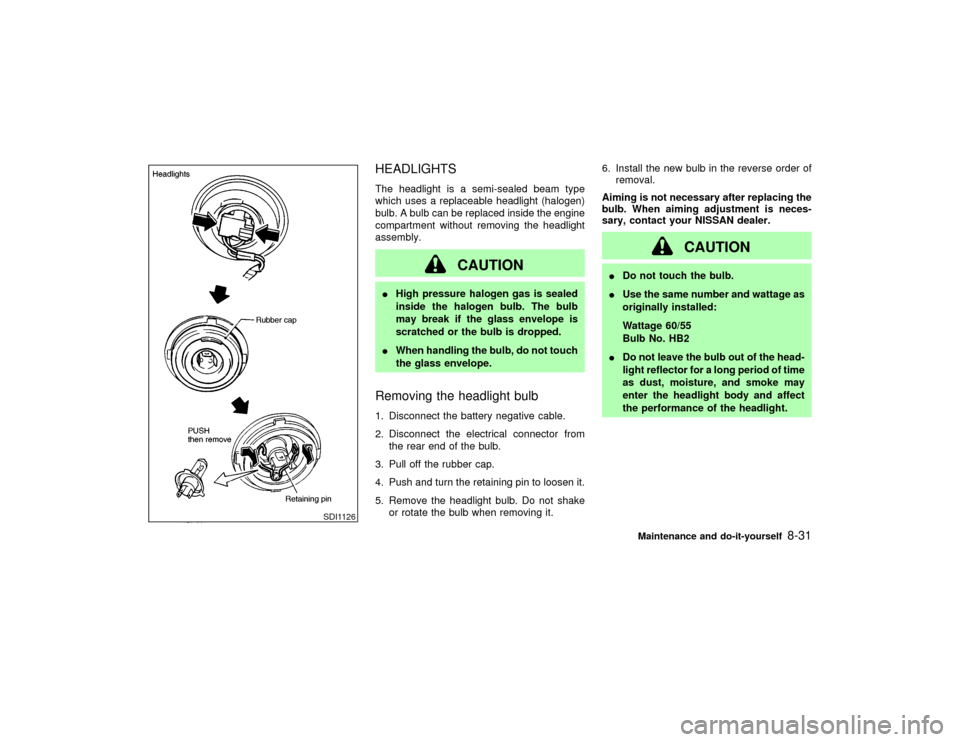
HEADLIGHTSThe headlight is a semi-sealed beam type
which uses a replaceable headlight (halogen)
bulb. A bulb can be replaced inside the engine
compartment without removing the headlight
assembly.
CAUTION
IHigh pressure halogen gas is sealed
inside the halogen bulb. The bulb
may break if the glass envelope is
scratched or the bulb is dropped.
IWhen handling the bulb, do not touch
the glass envelope.Removing the headlight bulb1. Disconnect the battery negative cable.
2. Disconnect the electrical connector from
the rear end of the bulb.
3. Pull off the rubber cap.
4. Push and turn the retaining pin to loosen it.
5. Remove the headlight bulb. Do not shake
or rotate the bulb when removing it.6. Install the new bulb in the reverse order of
removal.
Aiming is not necessary after replacing the
bulb. When aiming adjustment is neces-
sary, contact your NISSAN dealer.
CAUTION
IDo not touch the bulb.
IUse the same number and wattage as
originally installed:
Wattage 60/55
Bulb No. HB2
IDo not leave the bulb out of the head-
light reflector for a long period of time
as dust, moisture, and smoke may
enter the headlight body and affect
the performance of the headlight.
SDI1126
Maintenance and do-it-yourself
8-31
Z
01.9.21/R50-D/V5
X
Page 241 of 288
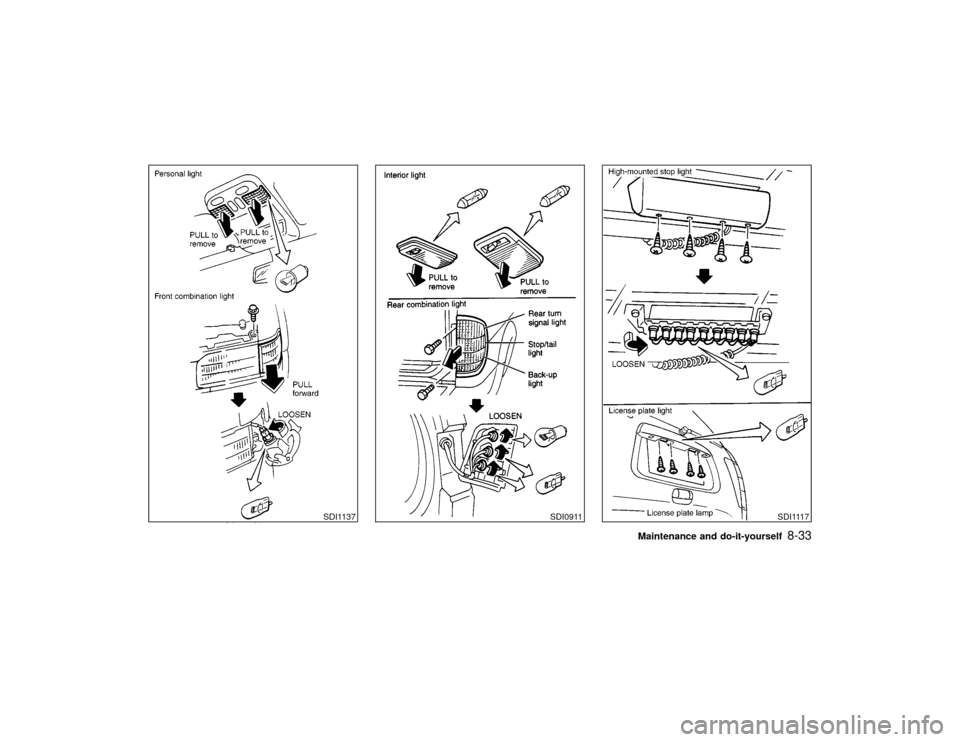
Replacement proceduresAll other lights are either type A, B, C or D.
When replacing a bulb, first remove the lens
and/or cover.
Item Wattage (W) Bulb No.
Front combination light 21/5 7443
Front fog light (H3 type) 55
Rear combination light
Turn signal 27 1156NA
Stop/Tail 21/5 7443
Back-up 18 921
High mounted stop light 5 168
License plate light 5 168
Interior light 10 Ð
Vanity mirror light 1.4 Ð
Personal light 8 Ð
Bulb identification
MDI0006
8-32
Maintenance and do-it-yourself
Z
01.9.21/R50-D/V5
X
Page 242 of 288
SDI1137
SDI0911
SDI1117
Maintenance and do-it-yourself
8-33
Z
01.9.21/R50-D/V5
X
Page 243 of 288
If you have a flat tire, see ªFlat tireº in the
ª6. In case of emergencyº section.TIRE PRESSURE
Maximum inflation pressureDo not exceed the maximum inflation pres-
sures shown on the side wall of the tire.Tire inflation pressureCheck the tire pressure (including spare) at
least once a month and always prior to long
distance trip. Incorrect tire pressure may ad-
versely affect tire life and vehicle handling. Tire
pressure should be checked when tires are
SDI0980A
SDI0333B
DI0047
WHEELS AND TIRES
8-34
Maintenance and do-it-yourself
Z
01.9.21/R50-D/V5
X
Page 244 of 288
COLD. Tires are considered COLD after the
vehicle has been parked for three or more
hours, or driven less than 1 mile (1.6 km) at
moderate speeds. COLD tire pressures are
shown on the tire placard affixed to the inside
of the glove box lid.
WARNING
IImproperly inflated tires can fail sud-
denly and cause an accident.
IThe vehicle capacity weight is indi-
cated on the tire placard. Do not load
your vehicle beyond this capacity.
Overloading your vehicle may result
in reduced tire life, unsafe operating
conditions due to premature tire fail-
ure, or unfavorable handling charac-
teristics and could also lead to a
serious accident. Loading beyond the
specified capacity may also result in
failure of other vehicle components.
IBefore taking a long trip, or whenever
you have loaded your vehicle heavily,
use a tire pressure gauge to ensure
that the tire pressure is at the speci-
fied level.IDo not drive your vehicle over 85
MPH (140 km/h) unless it is equipped
with high speed capability tires. Driv-
ing faster than 85 MPH (140 km/h)
may result in tire failure, loss of con-
trol and possible injury.
IFor additional information regarding
tires, refer to ªImportant Tire Safety
Informationº in the Warranty Informa-
tion Booklet (US) or ªTire Safety In-
formationº in the Warranty Informa-
tion booklet (Canada).
TYPES OF TIRES
CAUTION
IWhen changing or replacing tires, be
sure all four tires are of the same type
(i.e., summer, all season or snow) and
construction. Your NISSAN dealer
may be able to help you with informa-
tion about tire type, size, speed rating
and availability. Replacement tires
may have a lower speed rating thanthe factory equipped tires, and may
not match the potential maximum ve-
hicle speed. Never exceed the maxi-
mum speed rating of the tire.
IFor additional information regarding
tires, refer to ªImportant Tire Safety
Informationº in the Warranty Informa-
tion Booklet (US) or ªTire Safety In-
formationº in the Warranty Informa-
tion booklet (Canada).
All season tiresNISSAN specifies all season tires on some
models to provide good performance for use
all year around, including snowy and icy road
conditions. All season tires are identified by
ALL SEASON and/or M&S on the tire sidewall.
Snow tires have better snow traction than all
season tires and may be more appropriate in
some areas.Summer tiresNISSAN specifies summer tires on some mod-
els to provide superior performance on dry
roads. Summer tire performance in snow and
ice will be substantially reduced. Summer tires
Maintenance and do-it-yourself
8-35
Z
01.9.21/R50-D/V5
X
Page 245 of 288

do not have the tire traction rating M&S on the
tire sidewall.
If you operate your vehicle in snowy or icy
conditions, NISSAN recommends the use of
SNOW or ALL SEASON tires on all four
wheels.Snow tiresIf snow tires are needed, it is necessary to
select tires equivalent in size and load rating to
the original equipment tires. If you do not, it
can adversely affect the safety and handling of
your vehicle.
Generally, snow tires will have lower speed
ratings than factory equipped tires and may
not match the potential maximum vehicle
speed. Never exceed the maximum speed
rating of the tire.
If you install snow tires on four wheel drive
models, they must also be the same size,
brand, construction and tread pattern on all
four wheels.
If you operate your vehicle in snowy or icy
conditions, NISSAN recommends the use of
SNOW or ALL SEASON tire on all four wheels.
For additional traction on icy roads, studded
tires may be used. However, some provinces
and states prohibit their use. Check local, stateand provincial laws before installing studded
tires. Skid and traction capabilities of studded
snow tires, on wet or dry surfaces, may be
poorer than that of non-studded snow tires.
TIRE CHAINSUse of tire chains is prohibited according to
location. Check the local laws before installing
tire chains. When installing tire chains, make
sure they are of proper size for the tires on
your vehicle and are installed according to the
chain manufacturer's suggestions.Use only
SAE class S chains.Other types may dam-
age your vehicle. Use chain tensioners when
recommended by the tire chain manufacturer
to ensure a tight fit. Loose end links of the tire
chain must be secured or removed to prevent
the possibility of whipping action damage to
the fenders or underbody. If possible, avoid
fully loading your vehicle when using tire
chains. In addition, drive at a reduced speed.
Otherwise, your vehicle may be damaged
and/or vehicle handling and performance may
be adversely affected.
Never install tire chains on TEMPORARY USE
ONLY spare tires.
Do not use tire chains on dry roads.
Tire chains must be installed only on the
rear wheels and not on the front wheels.Do not drive with tire chains on paved roads
which are clear of snow. Driving with chains in
such conditions can cause damage to the
various mechanisms of the vehicle due to
some overstress. When driving on clear paved
roads, be sure to change to 2WD.
8-36
Maintenance and do-it-yourself
Z
01.9.21/R50-D/V5
X
Page 246 of 288
CHANGING WHEELS AND TIRES
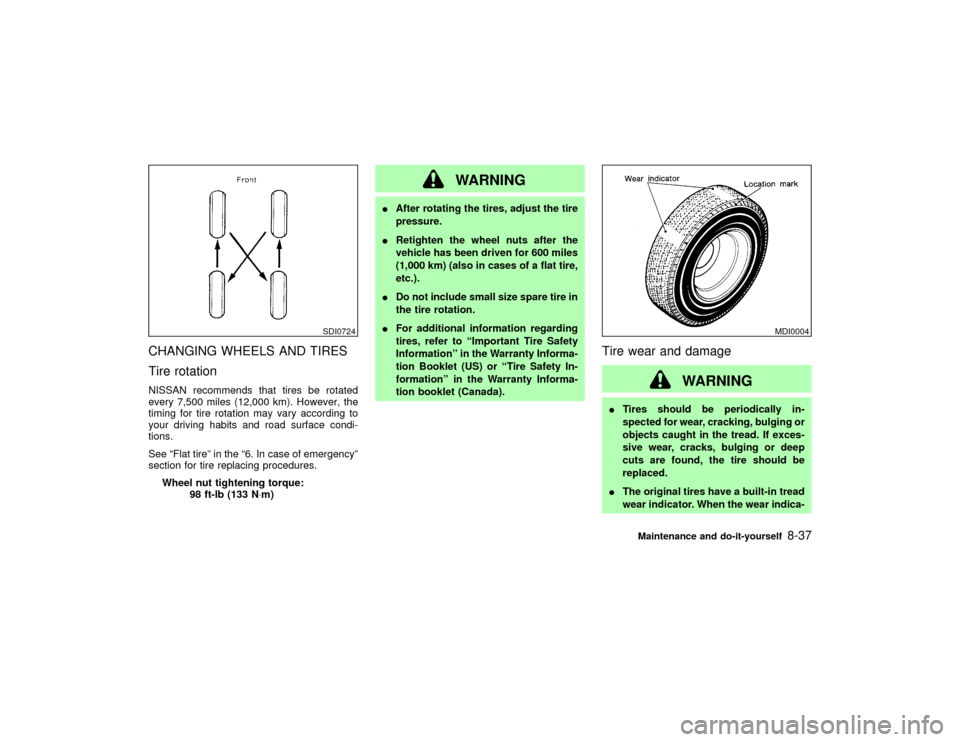
Tire rotationNISSAN recommends that tires be rotated
every 7,500 miles (12,000 km). However, the
timing for tire rotation may vary according to
your driving habits and road surface condi-
tions.
See ªFlat tireº in the ª6. In case of emergencyº
section for tire replacing procedures.
Wheel nut tightening torque:
98 ft-lb (133 N×m)
WARNING
IAfter rotating the tires, adjust the tire
pressure.
IRetighten the wheel nuts after the
vehicle has been driven for 600 miles
(1,000 km) (also in cases of a flat tire,
etc.).
IDo not include small size spare tire in
the tire rotation.
IFor additional information regarding
tires, refer to ªImportant Tire Safety
Informationº in the Warranty Informa-
tion Booklet (US) or ªTire Safety In-
formationº in the Warranty Informa-
tion booklet (Canada).
Tire wear and damage
WARNING
ITires should be periodically in-
spected for wear, cracking, bulging or
objects caught in the tread. If exces-
sive wear, cracks, bulging or deep
cuts are found, the tire should be
replaced.
IThe original tires have a built-in tread
wear indicator. When the wear indica-
SDI0724
MDI0004
Maintenance and do-it-yourself
8-37
Z
01.9.21/R50-D/V5
X