2002 NISSAN PATHFINDER service
[x] Cancel search: servicePage 248 of 288
age the transmission, transfer case and
differential gears.
If excessive tire wear is found, it is recom-
mended that all four tires be replaced with tires
of the same size, brand, construction and
tread pattern. The tire pressure and wheel
alignment should also be checked and cor-
rected as necessary. Contact your NISSAN
dealer.Wheel balanceUnbalanced wheels may affect vehicle han-
dling and tire life. Even with regular use,
wheels can get out of balance. Therefore, they
should be balanced as required.
Wheel balance service should be performed
with the wheels off the vehicle. Spin balancing
the rear wheels on the vehicle could lead to
transmission damage.
IFor additional information regarding tires,
refer to ªImportant Tire Safety Informationº
in the Warranty Information Booklet (US) or
ªTire Safety Informationº in the Warranty
Information booklet (Canada).Care of wheelsIWash the wheels when washing the vehicleto maintain their appearance.
IClean the inner side of the wheels when the
wheel is changed or the underside of the
vehicle is washed.
IDo not use abrasive cleaners when wash-
ing the wheels.
IInspect wheel rims regularly for dents or
corrosion. This may cause loss of pressure
or damage the tire bead.
INISSAN recommends that the road wheels
be waxed to protect against road salt in
areas where it is used during winter.
TEMPORARY USE ONLY spare tire
(if so equipped)U.S. only. Canadian vehicles are equipped
with a full size spare tire.
Observe the following precautions if the TEM-
PORARY USE ONLY spare tire must be used,
otherwise your vehicle could be damaged or
involved in an accident.
WARNING
IThe TEMPORARY USE ONLY spare
tire should be used only for emer-gency. It should be replaced by the
standard tire at the first opportunity.
IDrive carefully while the TEMPO-
RARY USE ONLY spare tire is in-
stalled.
Avoid sharp turns and abrupt braking
while driving.
IPeriodically check the TEMPORARY
USE ONLY spare tire inflation pres-
sure, and always keep it at 28 psi (190
kPa, 1.9 bar).
IAlways keep the pressure of the full
size spare tire (if so equipped) at the
recommended pressure for standard
tires, as indicated on the tire placard.
For tire placard location, see ªTire
placardº in the ª9. Technical and con-
sumer informationº section.
IDo not drive your vehicle at speeds
faster than 50 MPH (80 km/h).
IWhen driving on roads covered with
snow or ice, the small size spare tire
should be used on the rear wheel and
Maintenance and do-it-yourself
8-39
Z
01.9.21/R50-D/V5
X
Page 252 of 288

9 Technical and consumer informationCapacities and recommended fuel/lubricants ........... 9-2
Fuel recommendation........................................... 9-4
Engine oil and oil filter recommendation .............. 9-6
Recommended SAE oil viscosity number ............ 9-7
Air conditioning system refrigerant and lubricant
recommendations ................................................. 9-8
Specifications ............................................................ 9-9
Engine .................................................................. 9-9
Wheels and tires ..................................................... 9-11
Dimensions and weights .................................... 9-11
When traveling or registering your vehicle in another
country..................................................................... 9-12
Vehicle identification ............................................... 9-12
Vehicle identification number (VIN) plate ........... 9-12
Vehicle identification number (Chassis
number) .............................................................. 9-12
Engine serial number ......................................... 9-13
F.M.V.S.S. certification label .............................. 9-13
Emission control information label ..................... 9-14
Tire placard ........................................................ 9-14Air conditioner specification label ....................... 9-14
Vehicle loading information ..................................... 9-15
Terms ................................................................. 9-15
Determining vehicle payload capacity ................ 9-15
Securing the load ............................................... 9-16
Loading tips ........................................................ 9-16
Payload weight capacity ..................................... 9-17
Measurement of weights .................................... 9-17
Towing a trailer ....................................................... 9-17
Maximum load limits ........................................... 9-17
Towing load/specification chart .......................... 9-19
Towing safety ..................................................... 9-19
Uniform tire quality grading ................................ 9-21
Emission control system warranty .......................... 9-22
Reporting safety defects (US only) ......................... 9-22
Readiness for inspection/maintenance (I/M) test
(US only) ................................................................. 9-23
Owner's Manual/Service Manual order
information............................................................... 9-25
In the event of a collision ................................... 9-25
Z
01.9.21/R50-D/V5
X
Page 256 of 288

fuel additives (i.e.: fuel injector cleaner, octane
booster, intake valve deposit removers, etc.)
which are sold commercially. Many of these
additives intended for gum, varnish or deposit
removal may contain active solvents or similar
ingredients that can be harmful to the fuel
system and engine.Octane rating tipsIn most parts of North America, you should use
unleaded gasoline with an octane rating of at
least 91 AKI (Anti-Knock Index) number
(VQ35DE engine) or 87 AKI (Anti-knock Index)
number (VG33E engine). However, you may
use unleaded gasoline with an octane rating
as low as 85 AKI (Anti-Knock Index) number in
these high altitude areas [over 4,000 ft (1,219
m)] such as: Colorado, Montana, New Mexico,
Utah, Wyoming, northeastern Nevada, south-
ern Idaho, western South Dakota, western
Nebraska, and that part of Texas which is
directly south of New Mexico.
Using unleaded gasoline with an octane
rating lower than stated above can cause
persistent, heavy spark knock. (Spark
knock is a metallic rapping noise.) If se-
vere, this can lead to engine damage. If you
detect a persistent heavy spark knock even
when using gasoline of the stated octane
rating, or if you hear steady spark knockwhile holding a steady speed on level
roads, have your dealer correct the condi-
tion. Failure to correct the condition is
misuse of the vehicle, for which NISSAN is
not responsible.
Incorrect ignition timing will result in knocking,
after-run or overheating. This in turn may
cause excessive fuel consumption or damage
to the engine. If any of the above symptoms
are encountered, have your vehicle checked at
a NISSAN dealer or other competent service
facility.
However, now and then you may notice
light spark knock for a short time while
accelerating or driving up hills. This is no
cause for concern, because you get the
greatest fuel benefit when there is light
spark knock for a short time.
Technical and consumer information
9-5
Z
01.9.21/R50-D/V5
X
Page 259 of 288
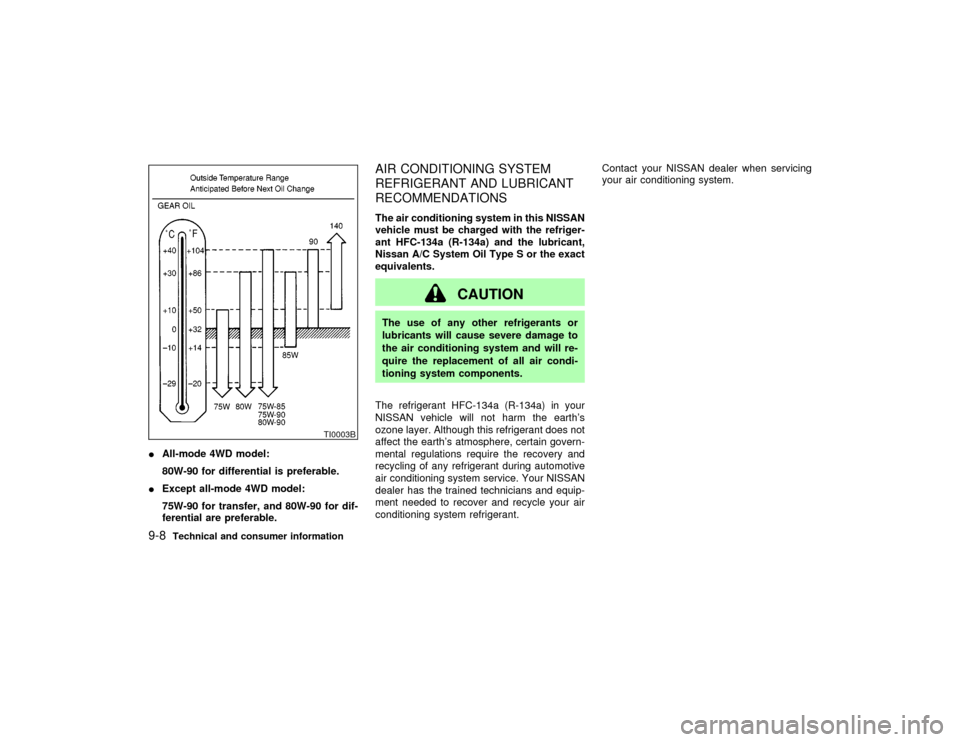
IAll-mode 4WD model:
80W-90 for differential is preferable.
IExcept all-mode 4WD model:
75W-90 for transfer, and 80W-90 for dif-
ferential are preferable.
AIR CONDITIONING SYSTEM
REFRIGERANT AND LUBRICANT
RECOMMENDATIONSThe air conditioning system in this NISSAN
vehicle must be charged with the refriger-
ant HFC-134a (R-134a) and the lubricant,
Nissan A/C System Oil Type S or the exact
equivalents.
CAUTION
The use of any other refrigerants or
lubricants will cause severe damage to
the air conditioning system and will re-
quire the replacement of all air condi-
tioning system components.
The refrigerant HFC-134a (R-134a) in your
NISSAN vehicle will not harm the earth's
ozone layer. Although this refrigerant does not
affect the earth's atmosphere, certain govern-
mental regulations require the recovery and
recycling of any refrigerant during automotive
air conditioning system service. Your NISSAN
dealer has the trained technicians and equip-
ment needed to recover and recycle your air
conditioning system refrigerant.Contact your NISSAN dealer when servicing
your air conditioning system.
TI0003B
9-8
Technical and consumer information
Z
01.9.21/R50-D/V5
X
Page 260 of 288

ENGINE
Model VQ35DE VG33E
Type Gasoline, 4-cycle Gasoline, 4-cycle
Cylinder arrangement 6-cylinder, V-slanted at 60É 6-cylinder, V-slanted at 60É
Bore´Stroke in (mm) 3.760´3.205 (95.5´81.4) 3.602´3.268 (91.5´83.0)
Displacement
cu in (cm
3)213.45 (3,498) 199.84 (3,275)
Firing order 1-2-3-4-5-6 1-2-3-4-5-6
Idle speed rpm
See the ªEmission control
labelº on the underside of the hood.See the ªEmission control
labelº on the underside of the hood. Ignition timing (BTDC)
degree/rpm
CO percentage at idle speed
[No air] %
Spark plug PL FR5A-11 (Standard) FR4AP-10 (Hot)
PL FR4A-11 (Service option) FR5AP-10 (Standard)
PL FR6A-11 (Service option) FR6AP-10 (Cold)
Spark plug gap in (mm) 0.043 (1.1) 0.039 (1.0)
Camshaft operation Timing chain Timing belt*1
Alternator belt size
Width´Length
in (mm)0.8409´46.26 (21.36´1,175) 0.8409´41.93 (21.36´1,065)
*1: Periodic maintenance is necessary. See ªPeriodic maintenanceº in the ªService and Maintenance Guideº for maintenance intervals.
SPECIFICATIONS
Technical and consumer information
9-9
Z
01.9.21/R50-D/V5
X
Page 272 of 288
However, for long steep grades, do not stay in
1st or 2nd gear when driving above 35 MPH
(56 km/h).
IIf the engine coolant rises to an extremely
high temperature when the air conditioning
system is on, turn off the air conditioner.
Coolant heat can be additionally vented by
opening the windows, switching the fan
control to high and setting the temperature
control to the HOT position.
ITrailer towing requires more fuel than nor-
mal circumstances.
IAvoid towing a trailer for the first 500 miles
(800 km).
IHave your vehicle serviced more often than
at intervals specified in the recommended
Maintenance Schedule.
When towing a trailer, change oil in the
transmission more frequently. See the
Maintenance Schedule.UNIFORM TIRE QUALITY
GRADINGDOT (Department of Transportation) Quality
Grades: All passenger car tire must conform to
Federal Safety Requirements in addition to
these grades.Quality grades can be found where applicable
on the tire sidewall between tread shoulder
and maximum section width. For example:
Treadwear 200 Traction AA Temperature A
TreadwearTreadwear grade is a comparative rating
based on tire wear rate when tested under
controlled conditions on specified government
test courses. For example, a tire graded 150
would wear one and a half (1-1/2) times as well
on the government course as a tire graded
100. However, relative tire performance de-
pends on actual driving conditions, and may
vary significantly due to variations in driving
habits, service practices and differences in
road characteristics and climate.Traction AA, A, B and CThe traction grades from highest to lowest are
AA, A, B, and C. Those grades represent the
tire's ability to stop on wet pavement as mea-
sured under controlled conditions on specified
government test surfaces of asphalt and con-
crete. A tire marked C may have poor traction
performance.
WARNING
The traction grade assigned to your ve-
hicle tires is based on straight-ahead
braking traction tests, and does not in-
clude acceleration, cornering, hydro-
planing, or peak traction characteristics.Temperature A, B and CTemperature grades are A (the highest), B,
and C. They represent a tire's resistance to
heat build-up, and its ability to dissipate heat
when tested under controlled conditions on a
specified indoor laboratory test wheel. Sus-
tained high temperature can cause tire mate-
rial to degenerate, reducing tire life. Excessive
temperatures can lead to sudden tire failure.
Grade C corresponds to a performance level
which all passenger car tires must meet under
the Federal Motor Vehicle Safety Standard No.
109. Grades A and B represent higher levels of
performance on laboratory test wheels than
the minimum required by law.Technical and consumer information
9-21
Z
01.9.21/R50-D/V5
X
Page 276 of 288

A genuine NISSAN Service Manual is the best
source of service and repair information for
your vehicle. Filled with wiring diagrams, illus-
trations and step-by-step diagnostic and ad-
justment procedures, this manual is the same
one used by the factory trained technicians
working at authorized NISSAN dealerships.
Also available are genuine NISSAN Owner's
Manuals, and genuine NISSAN Service and
Owner's Manuals for older NISSAN models.In the USA:
For current pricing and availability of genuine
NISSAN Service Manualsfor the 2000 model
year and later, contact:
Tweddle Litho Company
1-800-639-8841
www.nissan-techinfo.com
For current pricing and availability of genuine
NISSAN Service Manualsfor the 1999 model
year and prior, see an authorized NISSAN
dealer, or contact:
DDS Distribution Services, Ltd.
20770 Westwood Dr.
Strongsville OH 44136
1-800-247-5321For current pricing and availability of genuine
NISSAN Owner's Manualsfor the 2002
model year and prior, see an authorized
NISSAN dealer, or contact:
DDS Distribution Services, Ltd.
20770 Westwood Dr.
Strongsville OH 44136
1-800-247-5321
In Canada:
To purchase a copy of a genuine NISSAN
Service Manual or Owner's Manual please
contact your nearest NISSAN dealer. For the
phone number and location of a NISSAN
Dealer in your area call the NISSAN Satisfac-
tion Center at 1-800-387-0122 and a bilingual
NISSAN representative will assist you.
Also available are Genuine NISSAN Service
and Owner's Manuals for older NISSAN mod-
els.
IN THE EVENT OF A COLLISIONUnfortunately, accidents do occur. In this un-
likely event, there is some important informa-
tion you should know. Many insurance compa-
nies routinely authorize the use of non-
genuine collision parts in order to cut costs,
among other reasons.
OWNER'S MANUAL/SERVICE
MANUAL ORDER INFORMATION
Technical and consumer information
9-25
Z
01.9.21/R50-D/V5
X
Page 280 of 288

10 Index
A
ABS (Anti-lock brake system) ......................... 5-32
Air bag system
Front (See supplemental front airbag
system) ...................................................... 1-16
Side (See supplemental side air bag
system) ...................................................... 1-18
Air bag warning labels .................................... 1-20
Air bag warning light.............................. 1-21, 2-12
Air cleaner housing filter ................................. 8-23
Air conditioner
Air conditioner operation ...................... 4-2, 4-8
Air conditioner service ................ 4-2, 4-8, 4-10
Air conditioner specification label.............. 9-14
Air conditioning system refrigerant and
lubricant recommendations ................ 4-10, 9-8
Heater and air conditioner (automatic) ....... 4-8
Heater and air conditioner controls ............. 4-2
Servicing air conditioner .............................. 4-2
Air conditioner operation, Semiautomatic ......... 4-5
Air flow charts ................................................... 4-5
Alcohol, drugs and driving ................................ 5-4
Anchor point locations
Top tether strap ......................................... 1-41
Antenna........................................................... 4-31
Anti-lock Brake System (ABS) ........................ 5-32
Anti-lock brake warning light............................. 2-9Appearance care
Exterior appearance care ............................ 7-2
Interior appearance care ............................. 7-3
Armrest ............................................................. 1-9
Ashtray (See cigarette lighter and ashtray) .... 2-26
ATP warning light ........................................... 2-10
Audible reminders ........................................... 2-15
Audio operation precautions ........................... 4-12
Audio system .................................................. 4-11
Steering wheel audio controls ................... 4-30
Automatic
Automatic transmission fluid (ATF) ........... 8-16
Drive positioner ......................................... 3-16
Driving with automatic
transmission ....................................... 5-6, 5-10
Seat positioner, seat ................................. 3-16
Transmission park warning light ............... 2-10
Transmission selector lever lock release .. 5-13
Avoiding collision and rollover .......................... 5-4
B
Battery............................................................. 8-21
Battery saver system................................. 2-20
Battery replacement, (See remote keyless entry
system) ............................................................. 3-8
Before starting the engine ................................ 5-9
Belts (See drive belts) .................................... 8-22Brake
Anti-lock brake system (ABS) ................... 5-32
Brake and clutch fluid................................ 8-18
Brake booster ............................................ 8-26
Brake fluid ................................................. 8-18
Brake pedal ............................................... 8-25
Brake pedal check..................................... 8-26
Brake system............................................. 5-32
Parking brake check ........................ 5-16, 8-25
Parking brake operation ............................ 5-16
Warning light ............................................. 2-10
Break-in schedule ........................................... 5-19
Bulb check/instrument panel ............................ 2-9
Bulb replacement ............................................ 8-30
C
Capacities and recommended fuel/lubricants... 9-2
Car phone or CB radio ................................... 4-32
Cargo (See vehicle loading information) ........ 2-33
Cargo net ........................................................ 2-33
Cassette player (See audio system) .... 4-16, 4-23,
4-28
Catalytic converter, Three way catalyst............ 5-3
CD care and cleaning ..................................... 4-26
Child restraints ................................................ 1-31
Installation on front passenger seat .......... 1-42
Installation on rear seat outboard
positions .................................................... 1-35
Z
01.9.21/R50-D/V5
X