2002 NISSAN PATHFINDER door lock
[x] Cancel search: door lockPage 116 of 288

any positions other than ON.
4. Push the SET switch and, within 5 seconds,
push the memory switch 1 or 2 fully for at
least 1 second.
The indicator light for the pushed memory
switch will come on and stay on for approxi-
mately 5 seconds after pushing the switch.
After the indicator light goes off, the se-
lected positions are stored in the selected
memory (1 or 2).
If memory is stored in the same memory
switch, the previous memory will be de-
leted.
Confirming memory storageITurn the ignition ON and push the SET
switch. If the main memory has not been
stored, the indicator light will come on for
approximately 0.5 seconds. When the
memory has stored the position, the indica-
tor light will stay on for approximately 5
seconds.
IIf the battery cable is disconnected, or if the
fuse blows, the memory will be canceled. In
such a case, reset the desired positions
using the following procedures.
1. Open and close the driver's door more thantwo times with the ignition key in the LOCK
position.
2. Reset the desired position using the previ-
ous procedure.
Selecting the memorized position1. Set the automatic transmission selector le-
ver to the P (Park) position.
2. Turn the ignition ON.
3. Push the memory switch 1 or 2 fully for at
least 1 second.
The driver's seat will move to the memo-
rized position with the indicator light flash-
ing, and then the light will stay on for
approximately 5 seconds.
When the memory switch 1 or 2 is pushed with
the driver's door open and then the key in-
serted into the ignition switch within approxi-
mately 1 minute, the driver's seat will move to
the memorized position.System operationThe automatic drive positioner system will not
work or will stop operating under the following
conditions:
Iwhen the vehicle speed is above 4 MPH (7
km/h).Iwhen any two or more of the memory
switches are simultaneously pushed while
the automatic drive positioner is operating.
Iwhen the adjusting switch for the driver's
seat is turned on while the automatic drive
positioner is operating.
Iwhen the cancel switch located on the
instrument panel is pushed to cancel.
Iwhen the memory switch 1 or 2 is not
pushed for at least 1 second.
Iwhen the seat has been already moved to
the memorized position.
Iwhen no seat position is stored in the
memory switch.
Pre-driving checks and adjustments
3-17
Z
01.9.21/R50-D/V5
X
Page 150 of 288

5 Starting and drivingPrecautions when starting and driving ...................... 5-2
Exhaust gas (Carbon monoxide).......................... 5-2
Three way catalyst ............................................... 5-3
On-pavement and offroad driving precautions ..... 5-3
Avoiding collision and rollover .............................. 5-4
Drinking alcohol/drugs and driving ....................... 5-4
Driving safety precautions .................................... 5-4
Ignition switch............................................................ 5-6
Automatic transmission ........................................ 5-6
Manual transmission ............................................ 5-7
Key positions ........................................................ 5-8
Nissan vehicle immobilizer system ...................... 5-8
Before starting the engine ......................................... 5-9
Starting the engine .................................................... 5-9
Driving the vehicle ................................................... 5-10
Automatic transmission ...................................... 5-10
Manual transmission .......................................... 5-14
Parking brake .......................................................... 5-16
Cruise control (if so equipped) ................................ 5-17
Precautions on cruise control ............................. 5-17
Cruise control operations ................................... 5-17Break-in schedule ................................................... 5-19
Increasing fuel economy ......................................... 5-19
Using part time four wheel drive (4WD) ................. 5-20
Transfer case shifting procedures ...................... 5-21
Using all-mode four wheel drive (4WD) .................. 5-23
Transfer case shifting procedures ...................... 5-23
Parking/parking on hills ........................................... 5-30
Power steering ........................................................ 5-31
Brake system .......................................................... 5-32
Braking precautions............................................ 5-32
Anti-lock brake system (ABS) ............................ 5-32
Cold weather driving ............................................... 5-34
Freeing a frozen door lock ................................. 5-34
Anti-freeze .......................................................... 5-34
Battery ................................................................ 5-34
Draining of coolant water ................................... 5-34
Tire equipment ................................................... 5-34
Special winter equipment ................................... 5-35
Driving on snow or ice ....................................... 5-35
Engine block heater (if so equipped) ................. 5-35
Z
01.9.21/R50-D/V5
X
Page 158 of 288
IMake sure the area around the vehicle is
clear.
ICheck fluid levels such as engine oil, cool-
ant, brake and clutch fluid, window washer
fluid as frequently as possible, at least
whenever you refuel.
ICheck to be sure that all windows and light
lenses are clean.
IVisually inspect tires for their appearance
and condition. Also check tires for proper
inflation.
ILock all doors.
IPosition seat and adjust head restraints.
IAdjust inside and outside mirrors.
IFasten seat belts and ask all passengers to
do likewise.
ICheck the operation of warning lights when
key is turned to the ON (3) position.1. Apply the parking brake.
2.Automatic transmission:
Move the selector lever to P (Park position)
or N (Neutral position). (P preferred)
The selector lever cannot be moved out
of P and into any of the other gear
positions if the ignition key is turned to
LOCK or if the key is removed from the
switch.
The starter is designed not to operate if
the selector lever is in one of the driving
positions.
Manual transmission:
Move the gearshift lever to N (Neutral po-
sition), and depress the clutch pedal to the
floor while starting the engine.
The starter is designed not to operate
unless the clutch pedal is fully de-
pressed.
3. Crank the enginewith your foot off the
accelerator pedalby turning the ignition
key to START. Release the key when the
engine starts. If the engine starts, but fails
to run, repeat the above procedure.
Ð If the engine is very hard to start in
extremely cold or hot weather ÐUse the accelerator pedal to help start the
engine.
CAUTION
Do not operate the starter for more than
15 seconds at a time. If the engine does
not start, turn the key off and wait 10
seconds before cranking again, other-
wise the starter could be damaged.
4.Warm-up
Always allow the engine to idle for at least
30 seconds after starting. Drive at moder-
ate speed for a short distance first, espe-
cially in cold weather.
BEFORE STARTING THE ENGINE STARTING THE ENGINE
Starting and driving
5-9
Z
01.9.21/R50-D/V5
X
Page 183 of 288

FREEING A FROZEN DOOR LOCKTo prevent a door lock from freezing, apply
de-icer or glycerin to it through the key hole. If
the lock becomes frozen, heat the key before
inserting it into the key hole.ANTI-FREEZEIn the winter when it is anticipated that the
temperature will drop below 32ÉF (0ÉC), check
anti-freeze (ethylene glycol base) to assure
proper winter protection. For details, see ªEn-
gine cooling systemº in the ª8. Maintenance
and do-it-yourselfº section.BATTERYIf the battery is not fully charged during ex-
tremely cold weather conditions, the battery
fluid may freeze and damage the battery. To
maintain maximum efficiency, the battery
should be checked regularly. For details, see
ªBatteryº in the ª8. Maintenance and do-it-
yourselfº section.DRAINING OF COOLANT WATERIf the vehicle is to be left outside without
anti-freeze, drain the cooling system by open-
ing the drain valves located under the radiator
and on the engine block. Refill before operat-
ing the vehicle. See ªEngine cooling systemº in
the ª8. Maintenance and do-it-yourselfº sectionfor Changing Engine Coolant.
TIRE EQUIPMENT1. SUMMER tires are of a tread design to
provide superior performance on dry pave-
ment. However, the performance of these
tires will be substantially reduced in snowy
and icy conditions. If you operate your
vehicle on snowy or icy roads, NISSAN
recommends the use of MUD & SNOW or
ALL SEASON tires on all four wheels.
Please consult your NISSAN dealer for the
tire type, size, speed rating and availability
information.
2. For additional traction on icy roads, studded
tires may be used. However, some Prov-
inces and States prohibit their use, so,
before installing studded tires, check local,
state and provincial laws.
Skid and traction capabilities of studded
snow tires, on wet or dry surfaces, may be
poorer than that of non-studded snow tires.
3. TIRE CHAINS may be used if desired.
Make sure they are of proper size for the
tires on your vehicle and are installed ac-
cording to the chain manufacturer's sug-
gestions. Use of tire chains may be prohib-
ited according to location. Check the local
laws before installing tire chains. Wheninstalling tire chains, make sure they are of
proper size for the tires on your vehicle and
are installed according to the chain manu-
facturer's suggestions.Use only SAE
Class S chains.Other types may damage
your vehicle. Use chain tensioners when
recommended by the tire chain manufac-
turer to ensure a tight fit. Loose end links of
the tire chain must be secured or removed
to prevent the possibility of whipping action
damage to the fenders or underbody. If
possible, avoid fully loading your vehicle
when using tire chains. In addition, drive at
a reduced speed. Otherwise, your vehicle
may be damaged and/or vehicle handling
and performance may be adversely af-
fected.
Do not use the chains on dry roads.
Tire chains must be installed only on the
rear wheels and not on the front wheels.
Do not drive with tire chains on paved roads
which are clear of snow. Driving with chains
in such conditions can cause damage to the
various mechanisms of the vehicle due to
some overstress. When driving on clear
paved roads, be sure to change to 2WD.
4. For four wheel drive:
If you install snow tires, they must also be
the same size, brand, construction and
COLD WEATHER DRIVING5-34
Starting and driving
Z
01.9.21/R50-D/V5
X
Page 212 of 288

Wheel nuts*:
When checking the tires, make sure no nuts
are missing, and check for any loose nuts.
Tighten if necessary.
Tire rotation*:
Tires should be rotated every 7,500 miles
(12,000 km). However, the timing for tire rota-
tion may vary according to your driving habits
and road surface conditions.
Wheel alignment and balance:
If the vehicle should pull to either side while
driving on a straight and level road, or if you
detect uneven or abnormal tire wear, there
may be a need for wheel alignment.
If the steering wheel or seat vibrates at normal
highway speeds, wheel balancing may be
needed.
For additional information regarding tires, refer
to ªImportant Tire Safety Informationº in the
Warranty Information Booklet (US) or ªTire
Safety Informationº in the Warranty Informa-
tion booklet (Canada).
Windshield:Clean the windshield on a regu-
lar basis. Check the windshield at least every
six months for cracks or other damage. Have a
damaged windshield repaired by a qualified
repair facility.Windshield wiper blades*:
Check for cracks or wear if they do not wipe
properly.
Doors and engine hood:
Check that all doors and the engine hood,
operate properly. Also ensure that all latches
lock securely. Lubricate hinges, latches, rollers
and links if necessary. Make sure that the
secondary latch keeps the hood from opening
when the primary latch is released.
When driving in areas using road salt or other
corrosive materials, check lubrication fre-
quently.
Inside the vehicleLights*:
Clean the headlights on a regular basis. Make
sure that the headlights, stop lights, tail lights,
turn signal lights, and other lights are all oper-
ating properly and installed securely. Also
check headlight aim.INTERIOR MAINTENANCEThe maintenance items listed here should be
checked on a regular basis, such as when
performing periodic maintenance, cleaning the
vehicle, etc.Warning lights and chimes:
Make sure that all warning lights and chimes
are operating properly.
Windshield wiper and washer*:
Check that the wipers and washer operate
properly and that the wipers do not streak.
Windshield defroster:
Check that the air comes out of the defroster
outlets properly and in sufficient quantity when
operating the heater or air conditioner.
Steering wheel:
Check for changes in the steering conditions,
such as excessive freeplay, hard steering or
strange noises.
Seats:
Check seat position controls such as seat
adjusters, seatback recliner, etc. to ensure
they operate smoothly and that all latches lock
securely in every position. Check that the head
restraints move up and down smoothly and
that the locks (if so equipped) hold securely in
all latched positions.
Seat belts:
Check that all parts of the seat belt system
(e.g. buckles, anchors, adjusters and retrac-
Maintenance and do-it-yourself
8-3
Z
01.9.21/R50-D/V5
X
Page 268 of 288
This could result in loss of control
and cause personal injury.
PAYLOAD WEIGHT CAPACITYThe payload weight capacity is the maximum
total weight of passengers, optional equipment
(air conditioning, trailer hitch, etc.) and cargo
that your vehicle is designed to carry.
Before driving a loaded vehicle, confirm that
you do not exceed the Gross Vehicle Weight
Rating (GVWR) or the Gross Axle Weight
Rating (GAWR) for your vehicle. See ªVehicle
loading informationº earlier in this section for
details.
Also check tires for proper inflation pressures.
See the tire placard affixed to the glove box lid.
Payload Weight Capacity Unit: lb (kg)
VQ35DE
2WD 4WD
Automatic and
Manual Trans-
missionAutomatic and
Manual Trans-
mission
XE, SE, LE
US 980 (445) 970 (440)
Canada Ð 945 (430)
MEASUREMENT OF WEIGHTSSecure loose items to prevent weight shifts
that could affect the balance of your vehicle.
When the vehicle is loaded, drive to a scale
and weight the front and the rear wheels
separately to determine axle loads. Individual
axle loads should not exceed either of the
gross axle weight ratings (GAWR). The total of
the axle loads should not exceed the gross
vehicle weight rating (GVWR). These ratings
are given on the vehicle certification label that
is located on the driver's door lock pillar. If
weight ratings are exceeded, move or remove
items to bring all weights below the ratings.
CAUTION
Overloading can shorten the life of your
vehicle. Failures caused by overloading
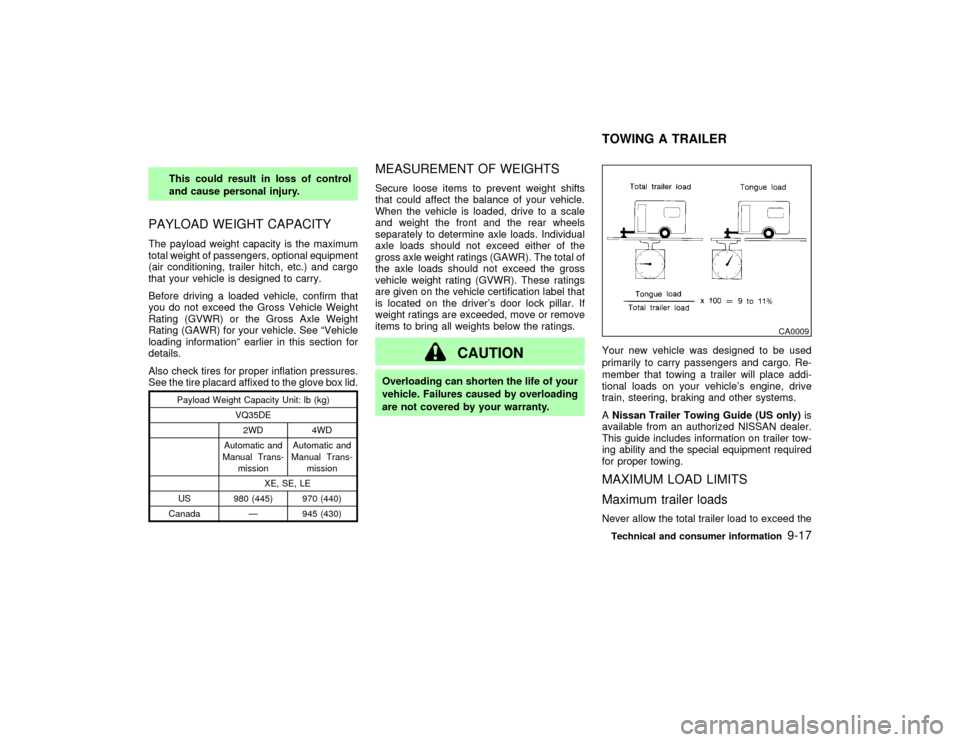
are not covered by your warranty.Your new vehicle was designed to be used
primarily to carry passengers and cargo. Re-
member that towing a trailer will place addi-
tional loads on your vehicle's engine, drive
train, steering, braking and other systems.
ANissan Trailer Towing Guide (US only)is
available from an authorized NISSAN dealer.
This guide includes information on trailer tow-
ing ability and the special equipment required
for proper towing.
MAXIMUM LOAD LIMITS
Maximum trailer loadsNever allow the total trailer load to exceed the
CA0009
TOWING A TRAILERTechnical and consumer information
9-17
Z
01.9.21/R50-D/V5
X
Page 281 of 288

Installation on rear seat center position .... 1-33
Precautions on child restraints .................. 1-31
Top tether strap anchor point locations .... 1-41
With top tether strap.................................. 1-40
Child safety ..................................................... 1-24
Child safety rear door lock................................ 3-4
Chimes, Audible reminders............................. 2-15
Cigarette lighter and ashtray .......................... 2-26
Circuit breaker, Fusible link ............................ 8-28
Cleaning exterior and interior .................... 7-2, 7-3
Clock ............................................................... 2-25
Clutch
Clutch pedal .............................................. 8-27
Fluid ........................................................... 8-18
Clutch housing drain (4x4 only) ...................... 8-40
Cold weather driving ....................................... 5-34
Compact Disc (CD) player (See audio
system) ........................................................... 4-17
Compact spare tire ......................................... 8-39
Compass display .............................................. 2-7
Console box .................................................... 2-30
Controls
Heater and air conditioner controls ............. 4-2
Heater and air conditioner controls
(automatic)................................................... 4-8
Heater and semiautomatic air conditioner .. 4-3
Steering wheel audio controls ................... 4-30
Coolant
Capacities and recommended fuel/
lubricants ..................................................... 9-2
Changing engine coolant .......................... 8-10
Checking engine coolant level .................... 8-9
Corrosion protection ......................................... 7-4
Cover, Tonneau cover .................................... 2-33Cruise control.................................................. 5-17
Cup holders .................................................... 2-28
D
Daytime running light system ......................... 2-21
Defogger switch, Glass hatch and outside mirror
defogger switch............................................... 2-19
Dimensions and weights ................................. 9-11
Door open warning light ................................. 2-11
Drive belts ....................................................... 8-22
Drive positioner, Automatic ............................. 3-16
Driving
Cold weather driving ................................. 5-34
Driving with automatic transmission .. 5-6, 5-10
Driving with manual transmission ...... 5-7, 5-14
On-pavement and offroad driving ............... 5-3
Precautions when starting and driving ........ 5-2
Safety precautions....................................... 5-4
E
Economy, Fuel ................................................ 5-19
Electric sunroof ............................................... 2-36
Emission control information label .................. 9-14
Emission control system warranty .................. 9-22
Engine
Before starting the engine ........................... 5-9
Block heater .............................................. 5-35
Capacities and recommended fuel/
lubricants ..................................................... 9-2
Changing engine coolant .......................... 8-10
Changing engine oil .................................. 8-14Changing engine oil filter .......................... 8-15
Checking engine coolant level .................... 8-9
Checking engine oil level .......................... 8-13
Coolant temperature gauge ........................ 2-4
Engine compartment check locations ......... 8-7
Engine cooling system ................................ 8-9
Engine oil................................................... 8-13
Engine oil and oil filter recommendation..... 9-6
Engine oil viscosity ...................................... 9-6
Engine serial number ................................ 9-13
Engine specifications................................... 9-9
If your vehicle overheats ........................... 6-11
Starting the engine ...................................... 5-9
Exhaust gas (Carbon monoxide) ...................... 5-2
F
F.M.V.S.S. certification label........................... 9-13
Filter, Air cleaner housing filter ....................... 8-23
Flashers (See hazard warning flasher
switch) ............................................................. 2-23
Flat tire .............................................................. 6-2
Floor mat cleaning ............................................ 7-4
Fluid
Automatic transmission fluid (ATF) ........... 8-16
Brake and clutch fluid................................ 8-18
Brake fluid ................................................. 8-18
Capacities and recommended fuel/
lubricants ..................................................... 9-2
Engine coolant............................................. 8-9
Engine oil................................................... 8-13
Power steering fluid................................... 8-18
Window washer fluid ................................. 8-20
Z
01.9.21/R50-D/V5
X
10-2
Page 283 of 288

Vanity mirror light ...................................... 2-40
Warning/indicator lights and audible
reminders ........................................... 2-9, 2-13
Loading information (See vehicle loading
information) ..................................................... 9-15
Lock
Door locks ................................................... 3-2
Glass hatch lock ........................................ 3-11
Glove box lock........................................... 2-29
Power door lock .......................................... 3-2
Rear door lock ........................................... 3-10
Rear door opener ...................................... 3-10
Low fuel warning light ..................................... 2-12
Luggage hooks ............................................... 2-32
Luggage rack .................................................. 2-34
M
Maintenance
Battery ....................................................... 8-21
General maintenance .................................. 8-2
Inside the vehicle ........................................ 8-3
Maintenance precautions ............................ 8-5
Outside the vehicle...................................... 8-2
Seat belt maintenance .............................. 1-31
Under the hood and vehicle ........................ 8-4
Manual front seat adjustment ........................... 1-2
Meters and gauges ........................................... 2-3
Mirror
Inside mirror .............................................. 3-15
Outside mirror control................................ 3-15
Outside mirrors .......................................... 3-15N
Net, Cargo net ................................................ 2-33
New vehicle break-in ...................................... 5-19
Nissan vehicle Immobilizer System ................ 2-15
Nissan Vehicle Immobilizer System, Engine
start ................................................................... 5-8
O
Odometer .......................................................... 2-3
Oil
Capacities and recommended fuel/
lubricants ..................................................... 9-2
Changing engine oil .................................. 8-14
Changing engine oil filter .......................... 8-15
Checking engine oil level .......................... 8-13
Engine oil................................................... 8-13
Engine oil viscosity ...................................... 9-6
Outside mirror control ..................................... 3-15
Outside mirrors ............................................... 3-15
Outside temperature display ............................. 2-6
Overdrive switch ............................................. 5-13
Overheat, If your vehicle overheats................ 6-11
P
Parking
Brake check............................................... 8-25
Parking brake check.................................. 5-16
Parking brake operation ............................ 5-16
Parking on hills .......................................... 5-16
Parking/parking on hills .................................. 5-30Personal lights ................................................ 2-39
Phone, Car phone or CB radio ....................... 4-32
Power
Front seat adjustment ................................. 1-4
Power door lock .......................................... 3-2
Power outlet .............................................. 2-25
Power steering fluid................................... 8-18
Power steering system .............................. 5-31
Power windows ......................................... 2-35
Pre-tensioner seat belt system ....................... 1-19
Precautions
Audio operation precautions ..................... 4-12
Braking precautions................................... 5-32
Cruise control operations .......................... 5-18
Cruise control precautions ........................ 5-17
Driving safety............................................... 5-4
Maintenance precautions ............................ 8-5
On child restraints ..................................... 1-31
On seat belt usage .................................... 1-23
On-pavement and offroad driving
precautions .................................................. 5-3
Precautions on supplemental restraint
system ....................................................... 1-10
Precautions when starting and driving ........ 5-2
Push starting ................................................... 6-10
R
Rack, Luggage rack ........................................ 2-34
Radio
Car phone or CB radio .............................. 4-32
Steering wheel audio controls ................... 4-30
Readiness for inspection/maintenance (I/M) test
(US only) ......................................................... 9-23
Z
01.9.21/R50-D/V5
X
10-4