2002 NISSAN PATHFINDER cooling
[x] Cancel search: coolingPage 210 of 288

8 Maintenance and do-it-yourselfMaintenance requirements ........................................ 8-2
General maintenance ................................................ 8-2
Explanation of general maintenance items .......... 8-2
Interior maintenance............................................. 8-3
Maintenance precautions .......................................... 8-5
Engine compartment check locations ....................... 8-7
Engine cooling system .............................................. 8-9
Checking engine coolant level ............................. 8-9
Changing engine coolant ................................... 8-10
Engine oil ................................................................ 8-13
Checking engine oil level ................................... 8-13
Changing engine oil ........................................... 8-14
Changing engine oil filter ................................... 8-15
Automatic transmission fluid ................................... 8-16
Temperature conditions for checking ................. 8-17
Power steering fluid ................................................ 8-18
Brake and clutch fluid ............................................. 8-18
Brake fluid .......................................................... 8-18
Clutch fluid.......................................................... 8-19
Window washer fluid ............................................... 8-20
Window washer fluid reservoir ........................... 8-20
Battery ..................................................................... 8-21
Jump starting ...................................................... 8-21
Drive belts ............................................................... 8-22Spark plugs ............................................................. 8-23
Replacing spark plugs ........................................ 8-23
Air cleaner ............................................................... 8-23
Windshield wiper blades ......................................... 8-24
Cleaning ............................................................. 8-24
Replacing............................................................ 8-24
Parking brake and brake pedal ............................... 8-25
Checking parking brake ..................................... 8-25
Checking brake pedal ........................................ 8-26
Brake booster ..................................................... 8-26
Clutch pedal ............................................................ 8-27
Checking clutch pedal ........................................ 8-27
Fuses....................................................................... 8-27
Engine compartment .......................................... 8-27
Passenger compartment .................................... 8-28
Keyfob battery replacement ............................... 8-29
Lights ....................................................................... 8-30
Headlights........................................................... 8-31
Wheels and tires ..................................................... 8-34
Tire pressure ...................................................... 8-34
Types of tires...................................................... 8-35
Tire chains .......................................................... 8-36
Changing wheels and tires ................................. 8-37
Clutch housing drain............................... 8-40Z
01.9.21/R50-D/V5
X
Page 214 of 288
See ªPrecautions when starting and drivingº in
the ª5. Starting and drivingº section for exhaust
gas (carbon monoxide).
Underbody:
The underbody is frequently exposed to corro-
sive substances such as those used on icy
roads or to control dust. It is very important to
remove these substances, otherwise rust will
form on the floor pan, frame, fuel lines and
around the exhaust system. At the end of
winter, the underbody should be thoroughly
flushed with plain water, being careful to clean
those areas where mud and dirt may accumu-
late. For additional information, see ªCleaning
exteriorº in the ª7. Appearance and careº sec-
tion.
Fluid leaks:
Check under the vehicle for fuel, oil, water or
other fluid leaks after the vehicle has been
parked for a while. Water dripping from the air
conditioner after use is normal. If you should
notice any leaks or if gasoline fumes are
evident, check for the cause and have it cor-
rected immediately.When performing any inspection or mainte-
nance work on your vehicle, always take care
to prevent serious accidental injury to yourself
or damage to the vehicle. The following are
general precautions which should be closely
observed.
WARNING
IPark the vehicle on a level surface,
apply the parking brake securely and
block the wheels to prevent the ve-
hicle from moving. For a manual
transmission, move the shift lever to
Neutral. For an automatic transmis-
sion, move the selector lever to the P
(Park) position.
IBe sure the ignition key is in the OFF
or LOCK position when performing
any replacement or repair.
IIf you must work with the engine
running, keep your hands, clothing,
hair and tools away from moving fans
belts and any other moving parts.
IIt is advisable to secure or remove
any loose clothing and any jewelry,such as rings, watches, etc. before
working on your vehicle.
IAlways wear eye protection when-
ever you work on your vehicle.
IIf you must run the engine in an
enclosed space such as a garage, be
sure there is proper ventilation for
exhaust gases to escape.
INever get under the vehicle while it is
supported only by a jack. If it is nec-
essary to work under the vehicle,
support it with safety stands.
IKeep smoking materials, flame and
sparks away from fuel and battery.
IYour vehicle is equipped with an au-
tomatic engine cooling fan. It may
come on at any time without warning,
even if the ignition key is in the OFF
position and the engine is not run-
ning. To avoid injury, always discon-
nect the negative battery cable before
working near the fan.
IOn gasoline engine models with theMAINTENANCE PRECAUTIONS
Maintenance and do-it-yourself
8-5
Z
01.9.21/R50-D/V5
X
Page 218 of 288
The engine cooling system is filled at the
factory with a high-quality, year-round, anti-
freeze coolant solution. The anti-freeze solu-
tion contains rust and corrosion inhibitors,
therefore additional cooling system additives
are not necessary.
CAUTION
When adding or replacing the coolant,
be sure to use only a genuine NISSAN
anti-freeze coolant or equivalent with
the proper mixture ratio of 50% anti-
freeze and 50% demineralized water/
distilled water. The use of other types of
coolant solutions may damage your en-
gine cooling system.Outside tempera-
ture down to
Anti-
freezeDeminer-
alized
water or
distilled
water ÉC ÉF
þ35 þ30 50% 50%
WARNING
INever remove the radiator cap when
the engine is hot. Serious burns
could be caused by high pressure
fluid escaping from the radiator. Wait
until the engine and radiator cool
down. See ªIf your vehicle overheatsº
in the ª6. In case of emergencyº sec-
tion.
IThe radiator is equipped with a pres-
sure cap. To prevent engine damage,
use only a genuine NISSAN radiator
cap.
CHECKING ENGINE COOLANT
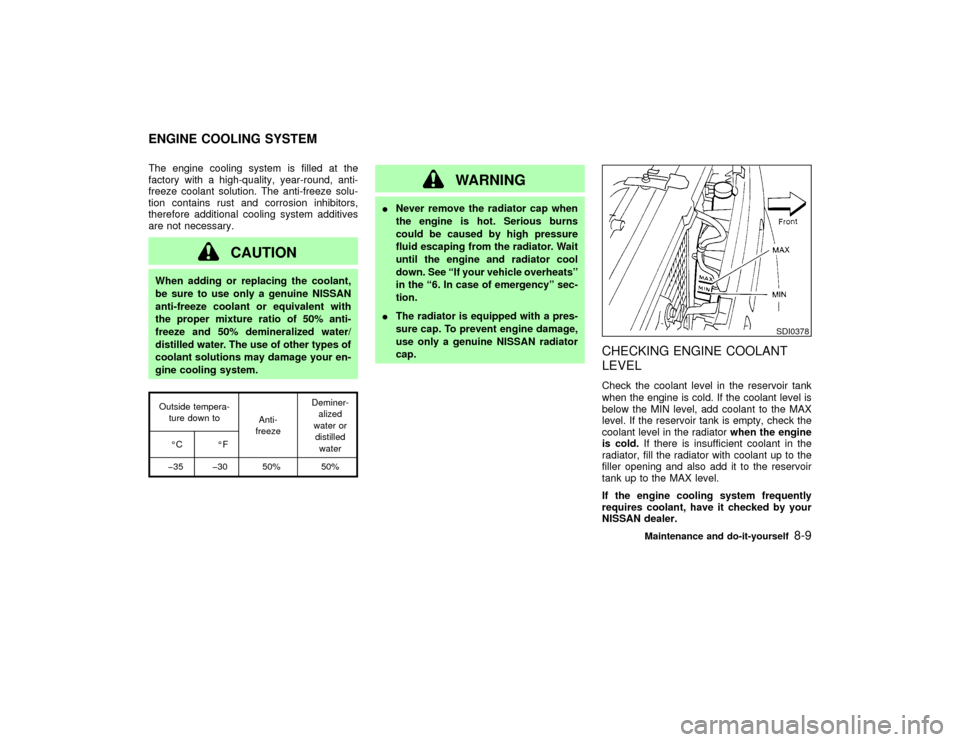
LEVELCheck the coolant level in the reservoir tank
when the engine is cold. If the coolant level is
below the MIN level, add coolant to the MAX
level. If the reservoir tank is empty, check the
coolant level in the radiatorwhen the engine
is cold.If there is insufficient coolant in the
radiator, fill the radiator with coolant up to the
filler opening and also add it to the reservoir
tank up to the MAX level.
If the engine cooling system frequently
requires coolant, have it checked by your
NISSAN dealer.
SDI0378
ENGINE COOLING SYSTEM
Maintenance and do-it-yourself
8-9
Z
01.9.21/R50-D/V5
X
Page 219 of 288
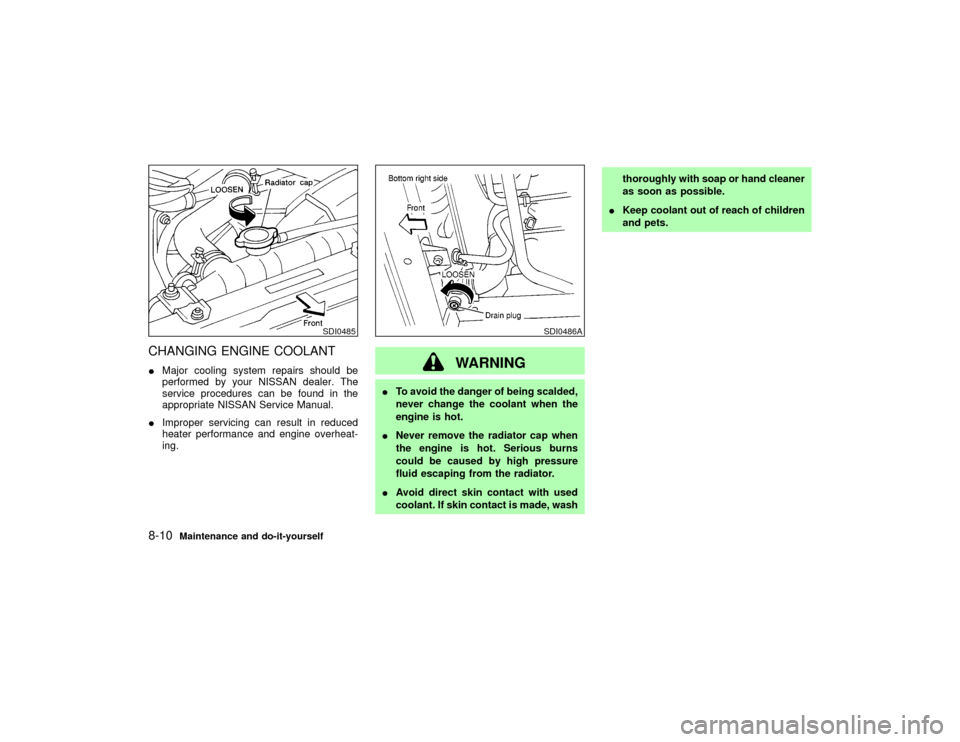
CHANGING ENGINE COOLANTIMajor cooling system repairs should be
performed by your NISSAN dealer. The
service procedures can be found in the
appropriate NISSAN Service Manual.
IImproper servicing can result in reduced
heater performance and engine overheat-
ing.
WARNING
ITo avoid the danger of being scalded,
never change the coolant when the
engine is hot.
INever remove the radiator cap when
the engine is hot. Serious burns
could be caused by high pressure
fluid escaping from the radiator.
IAvoid direct skin contact with used
coolant. If skin contact is made, washthoroughly with soap or hand cleaner
as soon as possible.
IKeep coolant out of reach of children
and pets.
SDI0485
SDI0486A
8-10
Maintenance and do-it-yourself
Z
01.9.21/R50-D/V5
X
Page 221 of 288
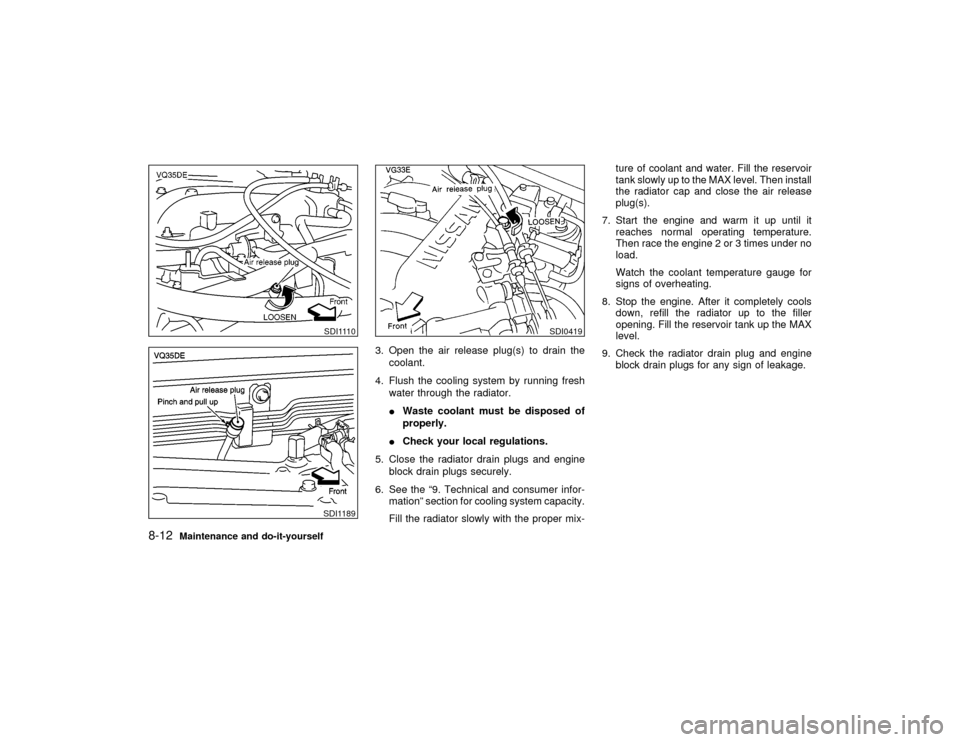
3. Open the air release plug(s) to drain the
coolant.
4. Flush the cooling system by running fresh
water through the radiator.
IWaste coolant must be disposed of
properly.
ICheck your local regulations.
5. Close the radiator drain plugs and engine
block drain plugs securely.
6. See the ª9. Technical and consumer infor-
mationº section for cooling system capacity.
Fill the radiator slowly with the proper mix-ture of coolant and water. Fill the reservoir
tank slowly up to the MAX level. Then install
the radiator cap and close the air release
plug(s).
7. Start the engine and warm it up until it
reaches normal operating temperature.
Then race the engine 2 or 3 times under no
load.
Watch the coolant temperature gauge for
signs of overheating.
8. Stop the engine. After it completely cools
down, refill the radiator up to the filler
opening. Fill the reservoir tank up the MAX
level.
9. Check the radiator drain plug and engine
block drain plugs for any sign of leakage.
SDI1110SDI1189
SDI0419
8-12
Maintenance and do-it-yourself
Z
01.9.21/R50-D/V5
X
Page 253 of 288

The following values are approximate capacities. The actual refill capacities may be a little different from them. When refilling, follow the
procedure instructed in the ª8. Maintenance and do-it-yourselfº section to determine the proper refill capacity.
Capacity (Approximate)
Recommended specifications
US
measureImp
measureLiter
Fuel 20-7/8 gal 17-3/8 gal 79Unleaded gasoline with an octane rating
of at least 91 AKI (RON 96) (VQ35DE) or
87AKI (RON 91) (VG33E)*1
Engine oil*4
Drain and refill
with oil filter
change5-1/4 qt 4-3/8 qt 5.0IAPI Certification Mark*2 *3
IAPI grade SG/SH, Energy Conserving I
& II or API grade SJ, Energy Conserv-
ing*2 *3
IILSAC grade GF-I & GF-II*2 *3 without oil filter
change5-1/8 qt 4-1/4 qt 4.8
Cooling system
(with heater and
reservoir tank)9-3/4 qt 8-1/8 qt 9.2Genuine Nissan Anti-Freeze Coolant or
equivalent
*1: See later in this section for fuel recommendation.
*2: See later in this section for recommended SAE viscosity number.
*3: See later in this section for engine oil and oil filter recommendation.
*4: See ªChanging engine oilº in the ª8. Maintenance and do-it-yourselfº section for further details.CAPACITIES AND
RECOMMENDED
FUEL/LUBRICANTS9-2
Technical and consumer information
Z
01.9.21/R50-D/V5
X
Page 281 of 288

Installation on rear seat center position .... 1-33
Precautions on child restraints .................. 1-31
Top tether strap anchor point locations .... 1-41
With top tether strap.................................. 1-40
Child safety ..................................................... 1-24
Child safety rear door lock................................ 3-4
Chimes, Audible reminders............................. 2-15
Cigarette lighter and ashtray .......................... 2-26
Circuit breaker, Fusible link ............................ 8-28
Cleaning exterior and interior .................... 7-2, 7-3
Clock ............................................................... 2-25
Clutch
Clutch pedal .............................................. 8-27
Fluid ........................................................... 8-18
Clutch housing drain (4x4 only) ...................... 8-40
Cold weather driving ....................................... 5-34
Compact Disc (CD) player (See audio
system) ........................................................... 4-17
Compact spare tire ......................................... 8-39
Compass display .............................................. 2-7
Console box .................................................... 2-30
Controls
Heater and air conditioner controls ............. 4-2
Heater and air conditioner controls
(automatic)................................................... 4-8
Heater and semiautomatic air conditioner .. 4-3
Steering wheel audio controls ................... 4-30
Coolant
Capacities and recommended fuel/
lubricants ..................................................... 9-2
Changing engine coolant .......................... 8-10
Checking engine coolant level .................... 8-9
Corrosion protection ......................................... 7-4
Cover, Tonneau cover .................................... 2-33Cruise control.................................................. 5-17
Cup holders .................................................... 2-28
D
Daytime running light system ......................... 2-21
Defogger switch, Glass hatch and outside mirror
defogger switch............................................... 2-19
Dimensions and weights ................................. 9-11
Door open warning light ................................. 2-11
Drive belts ....................................................... 8-22
Drive positioner, Automatic ............................. 3-16
Driving
Cold weather driving ................................. 5-34
Driving with automatic transmission .. 5-6, 5-10
Driving with manual transmission ...... 5-7, 5-14
On-pavement and offroad driving ............... 5-3
Precautions when starting and driving ........ 5-2
Safety precautions....................................... 5-4
E
Economy, Fuel ................................................ 5-19
Electric sunroof ............................................... 2-36
Emission control information label .................. 9-14
Emission control system warranty .................. 9-22
Engine
Before starting the engine ........................... 5-9
Block heater .............................................. 5-35
Capacities and recommended fuel/
lubricants ..................................................... 9-2
Changing engine coolant .......................... 8-10
Changing engine oil .................................. 8-14Changing engine oil filter .......................... 8-15
Checking engine coolant level .................... 8-9
Checking engine oil level .......................... 8-13
Coolant temperature gauge ........................ 2-4
Engine compartment check locations ......... 8-7
Engine cooling system ................................ 8-9
Engine oil................................................... 8-13
Engine oil and oil filter recommendation..... 9-6
Engine oil viscosity ...................................... 9-6
Engine serial number ................................ 9-13
Engine specifications................................... 9-9
If your vehicle overheats ........................... 6-11
Starting the engine ...................................... 5-9
Exhaust gas (Carbon monoxide) ...................... 5-2
F
F.M.V.S.S. certification label........................... 9-13
Filter, Air cleaner housing filter ....................... 8-23
Flashers (See hazard warning flasher
switch) ............................................................. 2-23
Flat tire .............................................................. 6-2
Floor mat cleaning ............................................ 7-4
Fluid
Automatic transmission fluid (ATF) ........... 8-16
Brake and clutch fluid................................ 8-18
Brake fluid ................................................. 8-18
Capacities and recommended fuel/
lubricants ..................................................... 9-2
Engine coolant............................................. 8-9
Engine oil................................................... 8-13
Power steering fluid................................... 8-18
Window washer fluid ................................. 8-20
Z
01.9.21/R50-D/V5
X
10-2