2002 NISSAN PATHFINDER lock
[x] Cancel search: lockPage 226 of 288
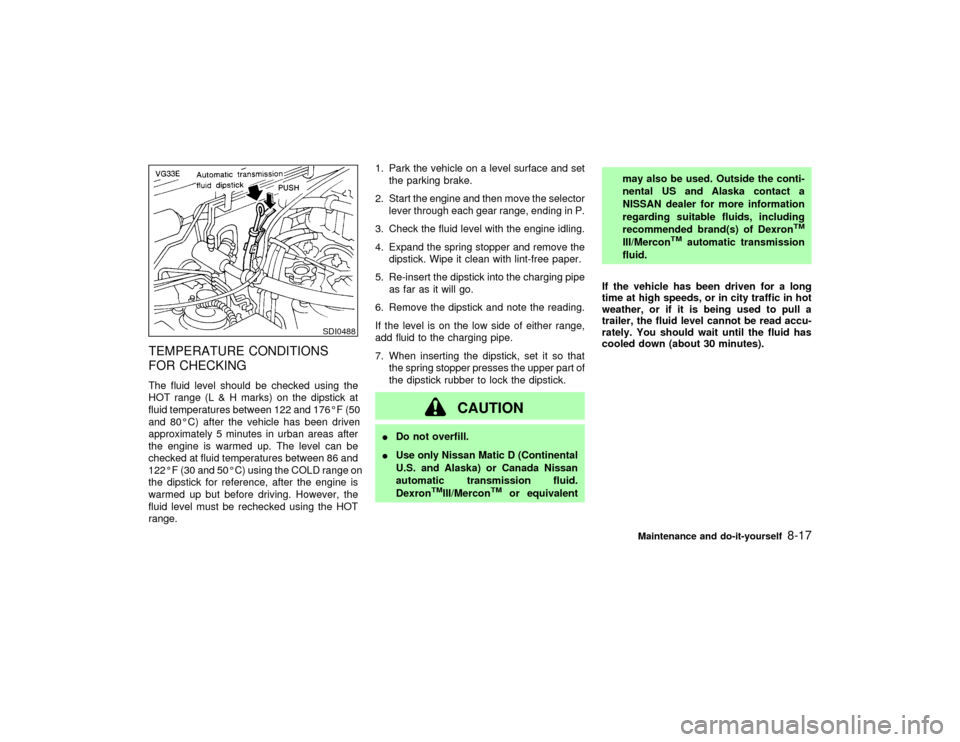
TEMPERATURE CONDITIONS
FOR CHECKINGThe fluid level should be checked using the
HOT range (L & H marks) on the dipstick at
fluid temperatures between 122 and 176ÉF (50
and 80ÉC) after the vehicle has been driven
approximately 5 minutes in urban areas after
the engine is warmed up. The level can be
checked at fluid temperatures between 86 and
122ÉF (30 and 50ÉC) using the COLD range on
the dipstick for reference, after the engine is
warmed up but before driving. However, the
fluid level must be rechecked using the HOT
range.1. Park the vehicle on a level surface and set
the parking brake.
2. Start the engine and then move the selector
lever through each gear range, ending in P.
3. Check the fluid level with the engine idling.
4. Expand the spring stopper and remove the
dipstick. Wipe it clean with lint-free paper.
5. Re-insert the dipstick into the charging pipe
as far as it will go.
6. Remove the dipstick and note the reading.
If the level is on the low side of either range,
add fluid to the charging pipe.
7. When inserting the dipstick, set it so that
the spring stopper presses the upper part of
the dipstick rubber to lock the dipstick.
CAUTION
IDo not overfill.
IUse only Nissan Matic D (Continental
U.S. and Alaska) or Canada Nissan
automatic transmission fluid.
Dexron
TMIII/Mercon
TM
or equivalentmay also be used. Outside the conti-
nental US and Alaska contact a
NISSAN dealer for more information
regarding suitable fluids, including
recommended brand(s) of Dexron
TM
III/Mercon
TM
automatic transmission
fluid.
If the vehicle has been driven for a long
time at high speeds, or in city traffic in hot
weather, or if it is being used to pull a
trailer, the fluid level cannot be read accu-
rately. You should wait until the fluid has
cooled down (about 30 minutes).
SDI0488
Maintenance and do-it-yourself
8-17
Z
01.9.21/R50-D/V5
X
Page 231 of 288
under severe conditions require frequent
checks of the battery fluid level.
WARNING
Be sure the ignition key is in the OFF or
LOCK position. The engine could rotate
unexpectedly.
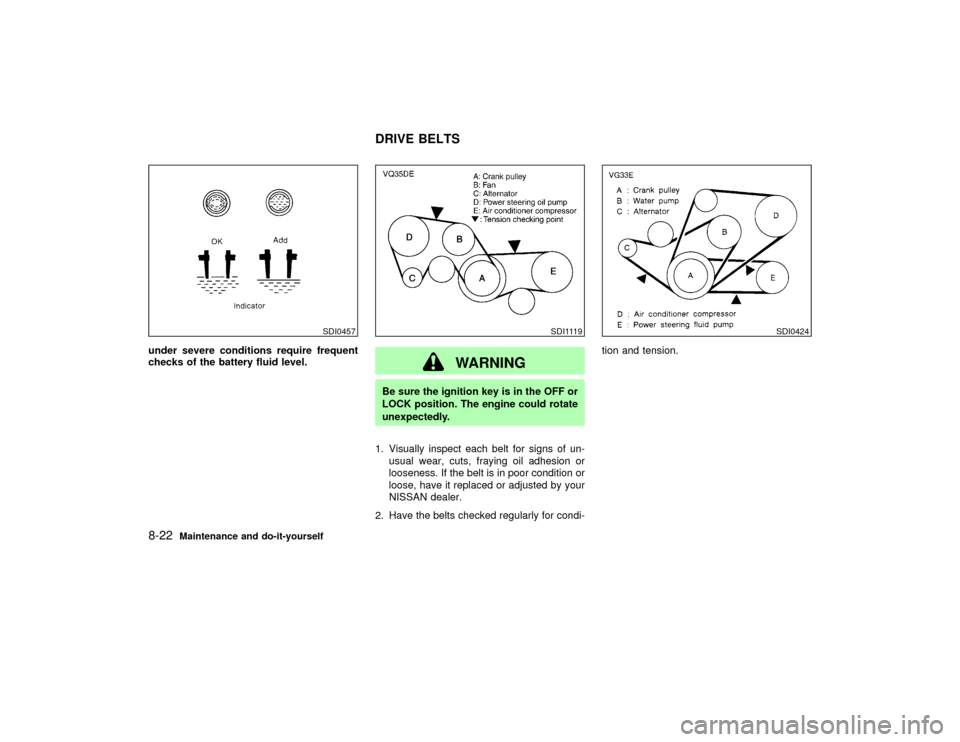
1. Visually inspect each belt for signs of un-
usual wear, cuts, fraying oil adhesion or
looseness. If the belt is in poor condition or
loose, have it replaced or adjusted by your
NISSAN dealer.
2. Have the belts checked regularly for condi-tion and tension.
SDI0457
SDI1119
SDI0424
DRIVE BELTS
8-22
Maintenance and do-it-yourself
Z
01.9.21/R50-D/V5
X
Page 233 of 288
cleaner removed can cause you or
others to be burned. The air cleaner
not only cleans the air, it stops flame
if the engine backfires. If it is not
there, and the engine backfires, you
could be burned. Do not drive with
the air cleaner removed and be care-
ful working on the engine with the air
cleaner removed.
INever pour fuel into the throttle body
or attempt to start the engine with the
air cleaner removed. Doing so could
result in serious injury.
CLEANINGIf your windshield is not clear after using the
windshield washer of if a wiper blade chatters
when running, wax or other material may be on
the blade or windshield.
Clean the outside of the windshield with a
washer solution or a mild detergent. Your
windshield is clean if beads do not form when
rinsing with clear water.
Clean the blade by wiping it with a cloth
soaked in a washer solution or a mild deter-
gent. Then rinse the blade with clear water. If
your windshield is still not clear after cleaningthe blades and using the wiper, replace the
blades.
REPLACINGReplace the wiper blades if they are worn.
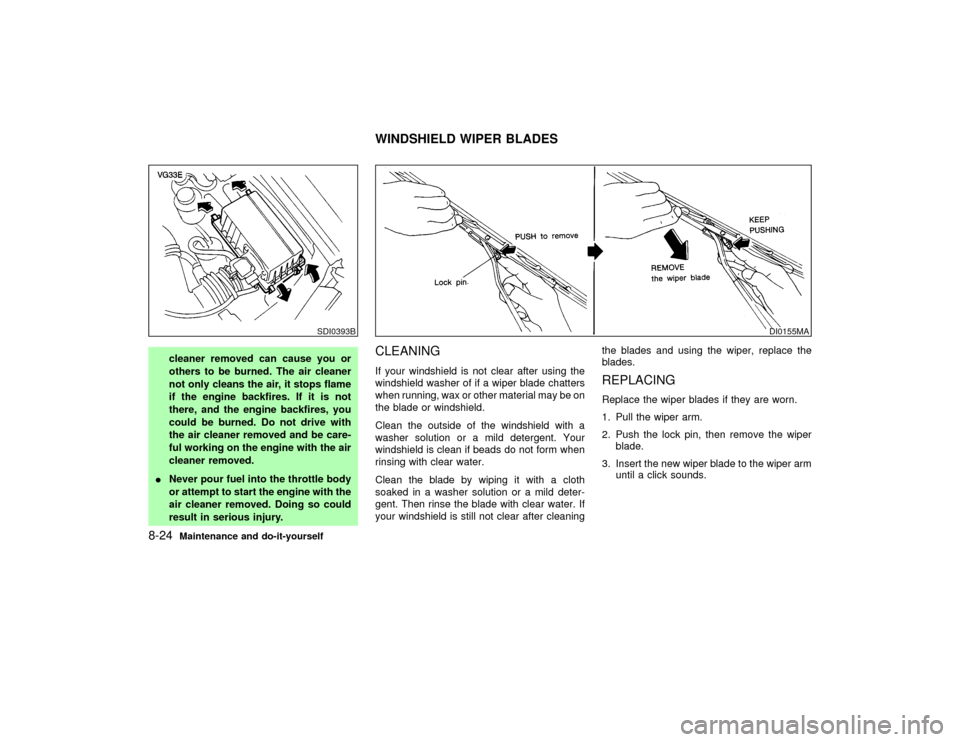
1. Pull the wiper arm.
2. Push the lock pin, then remove the wiper
blade.
3. Insert the new wiper blade to the wiper arm
until a click sounds.
SDI0393B
DI0155MA
WINDSHIELD WIPER BLADES
8-24
Maintenance and do-it-yourself
Z
01.9.21/R50-D/V5
X
Page 262 of 288

Grade Road wheel/
offset in (mm)Tire Spare tire size
4x2 PATH-
FINDERXE 16x7JJ Aluminum/
1.97 (50)*1P245/70R16
106SP245/70R16 106S
215/80R16 103M*2
SE
WIDE16x7JJ Aluminum/
0.79 (20)P255/65R16
106SP255/65R16 106S
215/80R16 103M*2
LE
WIDE17x8JJ Aluminum/
0.79 (20)P245/65R17
105SP245/65R17 105S
215/80R16 103M*2
4x4 PATH-
FINDERXE 16x7JJ Aluminum/
1.97 (50)*1P245/70R16
106SP245/70R16 106S
SE
WIDE16x7JJ Aluminum/
0.79 (20)P255/65R16
106SP255/65R16 106S
LE
WIDE17x8JJ Aluminum/
0.79 (20)P245/65R17
105SP245/65R17 105S
*1: Option
*2: If so equipped (for US)
DIMENSIONS AND WEIGHTSPATHFINDER
Overall length*1 in (mm) 182.7 (4,640)
Overall width in (mm) 69.7 (1,770)
71.7 (1,820)*2
Overall height in (mm) 68.1 (1,730)
67.9 (1,725)*2
Front tread in (mm) 58.3 (1,480)
60.6 (1,540)*2
Rear tread in (mm) 58.5 (1,485)
60.8 (1,545)*2
Wheelbase in (mm) 106.3 (2,700)
Gross vehicle weight rating
lb (kg)See the ªF.M.V.S.S. certification
labelº on the driver's side lock
pillar.
Gross axle weight rating
Front lb (kg)
Rear lb (kg)
*1: On spare tire carrier equipped models, the spare tire carrier adds 9.45 in (240
mm) to the overall length.
*2: SE and LE wide models
WHEELS AND TIRES
Technical and consumer information
9-11
Z
01.9.21/R50-D/V5
X
Page 268 of 288
This could result in loss of control
and cause personal injury.
PAYLOAD WEIGHT CAPACITYThe payload weight capacity is the maximum
total weight of passengers, optional equipment
(air conditioning, trailer hitch, etc.) and cargo
that your vehicle is designed to carry.
Before driving a loaded vehicle, confirm that
you do not exceed the Gross Vehicle Weight
Rating (GVWR) or the Gross Axle Weight
Rating (GAWR) for your vehicle. See ªVehicle
loading informationº earlier in this section for
details.
Also check tires for proper inflation pressures.
See the tire placard affixed to the glove box lid.
Payload Weight Capacity Unit: lb (kg)
VQ35DE
2WD 4WD
Automatic and
Manual Trans-
missionAutomatic and
Manual Trans-
mission
XE, SE, LE
US 980 (445) 970 (440)
Canada Ð 945 (430)
MEASUREMENT OF WEIGHTSSecure loose items to prevent weight shifts
that could affect the balance of your vehicle.
When the vehicle is loaded, drive to a scale
and weight the front and the rear wheels
separately to determine axle loads. Individual
axle loads should not exceed either of the
gross axle weight ratings (GAWR). The total of
the axle loads should not exceed the gross
vehicle weight rating (GVWR). These ratings
are given on the vehicle certification label that
is located on the driver's door lock pillar. If
weight ratings are exceeded, move or remove
items to bring all weights below the ratings.
CAUTION
Overloading can shorten the life of your
vehicle. Failures caused by overloading
are not covered by your warranty.Your new vehicle was designed to be used
primarily to carry passengers and cargo. Re-
member that towing a trailer will place addi-
tional loads on your vehicle's engine, drive
train, steering, braking and other systems.
ANissan Trailer Towing Guide (US only)is
available from an authorized NISSAN dealer.
This guide includes information on trailer tow-
ing ability and the special equipment required
for proper towing.
MAXIMUM LOAD LIMITS
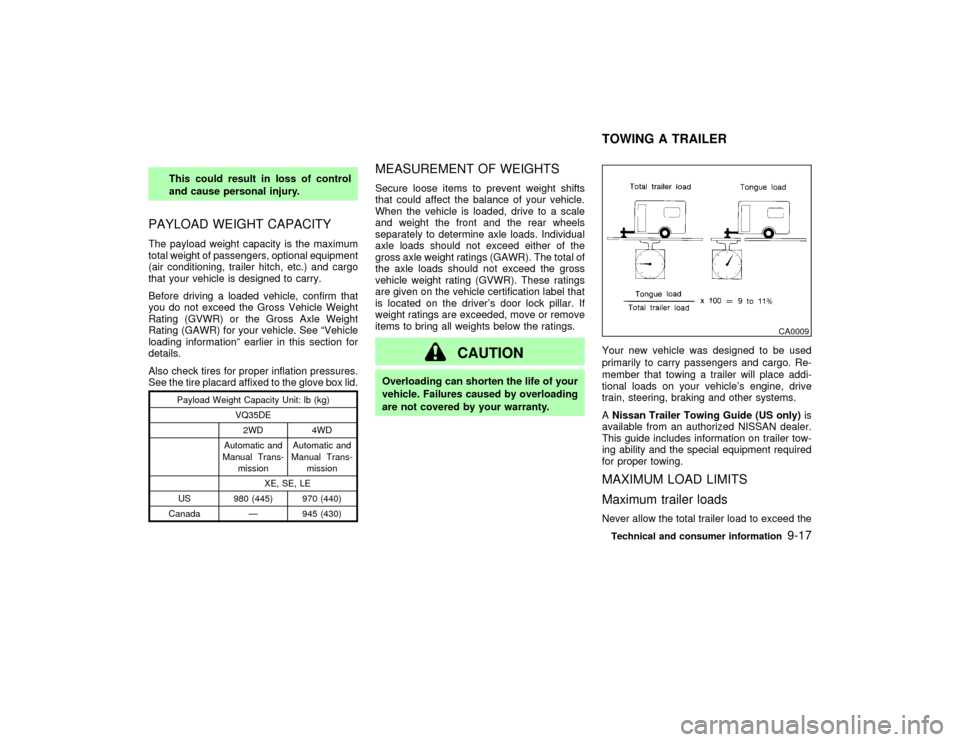
Maximum trailer loadsNever allow the total trailer load to exceed the
CA0009
TOWING A TRAILERTechnical and consumer information
9-17
Z
01.9.21/R50-D/V5
X
Page 271 of 288
IAfter the hitch is removed, seal the
bolt holes to prevent exhaust fumes,
water or dust from entering the pas-
senger compartment.
IRegularly check all hitch mounting
bolts are securely mounted.
ITo reduce the possibility of additional
damage if your vehicle is struck from
the rear, where practical, remove the
hitch and/or receiver when not in use.
INever connect a trailer brake system
directly to the vehicle brake system.Tire pressuresIWhen towing a trailer, inflate the vehicle
tires to the recommended cold tire pressure
indicated on the tire placard (affixed to the
glove box lid).
ITrailer tire condition, size, load rating and
proper inflation pressure should be in ac-
cordance with the trailer and tire manufac-
turers' specifications.Safety chainsAlways use a suitable chain between yourvehicle and the trailer. The chain should be
crossed and should be attached to the hitch,
not to the vehicle bumper or axle. Be sure to
leave enough slack in the chain to permit
turning corners.
Trailer lightsTrailer lights should comply with Federal
and/or local regulations.
When wiring vehicle for towing connection,
connect stop and tail light pickup into the
vehicle electrical circuit at point between
the sensor and stop light switch or light
switch.Trailer brakesIf your trailer is equipped with a braking sys-
tem, make sure it conforms to Federal and/or
local regulations and that it is properly in-
stalled.
WARNING
Never connect a trailer brake system
directly to the vehicle brake system.Trailer towing tipsIn order to gain skill and an understanding ofthe vehicle's behavior, you should practice
turning, stopping and backing up in an area
which is free from traffic. Steering stability and
braking performance will be somewhat differ-
ent than under normal driving conditions.
IAlways secure items in the trailer to prevent
load shift while driving.
IAvoid abrupt starts, acceleration or stops.
IAvoid sharp turns or lane changes.
IAlways drive your vehicle at a moderate
speed.
IAlways block the wheels on both vehicle
and trailer when parking. Parking on a
slope is not recommended; however, if you
must do so, and if your vehicle is equipped
with automatic transmission, first block the
wheels and apply the parking brake, and
then move the transmission selector lever
into the P position. If you move the selector
lever to the P position before blocking the
wheels and applying the parking brake,
transmission damage could occur.
IWhen going down a hill, shift into a lower
gear and use the engine braking effect.
When ascending a long grade, downshift
the transmission to a lower gear and reduce
speed to reduce chances of engine over-
loading and/or overheating.
9-20
Technical and consumer information
Z
01.9.21/R50-D/V5
X
Page 280 of 288

10 Index
A
ABS (Anti-lock brake system) ......................... 5-32
Air bag system
Front (See supplemental front airbag
system) ...................................................... 1-16
Side (See supplemental side air bag
system) ...................................................... 1-18
Air bag warning labels .................................... 1-20
Air bag warning light.............................. 1-21, 2-12
Air cleaner housing filter ................................. 8-23
Air conditioner
Air conditioner operation ...................... 4-2, 4-8
Air conditioner service ................ 4-2, 4-8, 4-10
Air conditioner specification label.............. 9-14
Air conditioning system refrigerant and
lubricant recommendations ................ 4-10, 9-8
Heater and air conditioner (automatic) ....... 4-8
Heater and air conditioner controls ............. 4-2
Servicing air conditioner .............................. 4-2
Air conditioner operation, Semiautomatic ......... 4-5
Air flow charts ................................................... 4-5
Alcohol, drugs and driving ................................ 5-4
Anchor point locations
Top tether strap ......................................... 1-41
Antenna........................................................... 4-31
Anti-lock Brake System (ABS) ........................ 5-32
Anti-lock brake warning light............................. 2-9Appearance care
Exterior appearance care ............................ 7-2
Interior appearance care ............................. 7-3
Armrest ............................................................. 1-9
Ashtray (See cigarette lighter and ashtray) .... 2-26
ATP warning light ........................................... 2-10
Audible reminders ........................................... 2-15
Audio operation precautions ........................... 4-12
Audio system .................................................. 4-11
Steering wheel audio controls ................... 4-30
Automatic
Automatic transmission fluid (ATF) ........... 8-16
Drive positioner ......................................... 3-16
Driving with automatic
transmission ....................................... 5-6, 5-10
Seat positioner, seat ................................. 3-16
Transmission park warning light ............... 2-10
Transmission selector lever lock release .. 5-13
Avoiding collision and rollover .......................... 5-4
B
Battery............................................................. 8-21
Battery saver system................................. 2-20
Battery replacement, (See remote keyless entry
system) ............................................................. 3-8
Before starting the engine ................................ 5-9
Belts (See drive belts) .................................... 8-22Brake
Anti-lock brake system (ABS) ................... 5-32
Brake and clutch fluid................................ 8-18
Brake booster ............................................ 8-26
Brake fluid ................................................. 8-18
Brake pedal ............................................... 8-25
Brake pedal check..................................... 8-26
Brake system............................................. 5-32
Parking brake check ........................ 5-16, 8-25
Parking brake operation ............................ 5-16
Warning light ............................................. 2-10
Break-in schedule ........................................... 5-19
Bulb check/instrument panel ............................ 2-9
Bulb replacement ............................................ 8-30
C
Capacities and recommended fuel/lubricants... 9-2
Car phone or CB radio ................................... 4-32
Cargo (See vehicle loading information) ........ 2-33
Cargo net ........................................................ 2-33
Cassette player (See audio system) .... 4-16, 4-23,
4-28
Catalytic converter, Three way catalyst............ 5-3
CD care and cleaning ..................................... 4-26
Child restraints ................................................ 1-31
Installation on front passenger seat .......... 1-42
Installation on rear seat outboard
positions .................................................... 1-35
Z
01.9.21/R50-D/V5
X
Page 281 of 288

Installation on rear seat center position .... 1-33
Precautions on child restraints .................. 1-31
Top tether strap anchor point locations .... 1-41
With top tether strap.................................. 1-40
Child safety ..................................................... 1-24
Child safety rear door lock................................ 3-4
Chimes, Audible reminders............................. 2-15
Cigarette lighter and ashtray .......................... 2-26
Circuit breaker, Fusible link ............................ 8-28
Cleaning exterior and interior .................... 7-2, 7-3
Clock ............................................................... 2-25
Clutch
Clutch pedal .............................................. 8-27
Fluid ........................................................... 8-18
Clutch housing drain (4x4 only) ...................... 8-40
Cold weather driving ....................................... 5-34
Compact Disc (CD) player (See audio
system) ........................................................... 4-17
Compact spare tire ......................................... 8-39
Compass display .............................................. 2-7
Console box .................................................... 2-30
Controls
Heater and air conditioner controls ............. 4-2
Heater and air conditioner controls
(automatic)................................................... 4-8
Heater and semiautomatic air conditioner .. 4-3
Steering wheel audio controls ................... 4-30
Coolant
Capacities and recommended fuel/
lubricants ..................................................... 9-2
Changing engine coolant .......................... 8-10
Checking engine coolant level .................... 8-9
Corrosion protection ......................................... 7-4
Cover, Tonneau cover .................................... 2-33Cruise control.................................................. 5-17
Cup holders .................................................... 2-28
D
Daytime running light system ......................... 2-21
Defogger switch, Glass hatch and outside mirror
defogger switch............................................... 2-19
Dimensions and weights ................................. 9-11
Door open warning light ................................. 2-11
Drive belts ....................................................... 8-22
Drive positioner, Automatic ............................. 3-16
Driving
Cold weather driving ................................. 5-34
Driving with automatic transmission .. 5-6, 5-10
Driving with manual transmission ...... 5-7, 5-14
On-pavement and offroad driving ............... 5-3
Precautions when starting and driving ........ 5-2
Safety precautions....................................... 5-4
E
Economy, Fuel ................................................ 5-19
Electric sunroof ............................................... 2-36
Emission control information label .................. 9-14
Emission control system warranty .................. 9-22
Engine
Before starting the engine ........................... 5-9
Block heater .............................................. 5-35
Capacities and recommended fuel/
lubricants ..................................................... 9-2
Changing engine coolant .......................... 8-10
Changing engine oil .................................. 8-14Changing engine oil filter .......................... 8-15
Checking engine coolant level .................... 8-9
Checking engine oil level .......................... 8-13
Coolant temperature gauge ........................ 2-4
Engine compartment check locations ......... 8-7
Engine cooling system ................................ 8-9
Engine oil................................................... 8-13
Engine oil and oil filter recommendation..... 9-6
Engine oil viscosity ...................................... 9-6
Engine serial number ................................ 9-13
Engine specifications................................... 9-9
If your vehicle overheats ........................... 6-11
Starting the engine ...................................... 5-9
Exhaust gas (Carbon monoxide) ...................... 5-2
F
F.M.V.S.S. certification label........................... 9-13
Filter, Air cleaner housing filter ....................... 8-23
Flashers (See hazard warning flasher
switch) ............................................................. 2-23
Flat tire .............................................................. 6-2
Floor mat cleaning ............................................ 7-4
Fluid
Automatic transmission fluid (ATF) ........... 8-16
Brake and clutch fluid................................ 8-18
Brake fluid ................................................. 8-18
Capacities and recommended fuel/
lubricants ..................................................... 9-2
Engine coolant............................................. 8-9
Engine oil................................................... 8-13
Power steering fluid................................... 8-18
Window washer fluid ................................. 8-20
Z
01.9.21/R50-D/V5
X
10-2