2002 NISSAN MAXIMA maintenance
[x] Cancel search: maintenancePage 212 of 247
to maintain their appearance.
IClean the inner side of the wheels when the
wheel is changed or the underside of the
vehicle is washed.
IDo not use abrasive cleaners when wash-
ing the wheels.
IInspect wheel rims regularly for dents or
corrosion. Such damage may cause loss of
pressure or poor seal at the tire bead.
INISSAN recommends that the road wheels
be waxed to protect against road salt in
areas where it is used during winter.
Spare tire (T-type spare tire)Observe the following precautions if the T-type
spare tire must be used, otherwise your ve-
hicle could be damaged or involved in an
accident.
CAUTION
IThe T-type spare tire should be used
only for emergency. It should be re-
placed by the standard tire at the first
opportunity.IDrive carefully while the T-type spare
tire is installed.
Avoid sharp turns and abrupt braking
while driving.
IPeriodically check the T-type spare
tire inflation pressure, and always
keep it at 60 psi (420 kPa, 4.2 bar).
IAlways keep the pressure of the full
size spare tire (if so equipped) at the
recommended pressure for standard
tires, as indicated on the tire placard.
For tire placard location, see ªTire
placardº in the ª9. Technical and con-
sumer informationº.
IDo not drive your vehicle at speeds
faster than 50 MPH (80 km/h).
IDo not use tire chains on a T-type
spare tire. Tire chains will not fit prop-
erly on the T-type spare tire and may
cause damage to the vehicle.
IWhen driving on roads covered with
snow or ice, the T-type spare tire
should be used on the rear wheel andthe original tire used on the front
wheels (drive wheels). Use tire chains
only on the front two original tires.
ITire tread of the T-type spare tire will
wear at a faster rate than the original
tire. Replace the T-type spare tire as
soon as the tread wear indicators
appear.
IBecause the T-type spare tire is
smaller than the original tire, ground
clearance is reduced. To avoid dam-
age to the vehicle do not drive over
obstacles. Also do not drive the ve-
hicle through an automatic car wash
since it may get caught.
IDo not use the T-type spare tire on
other vehicles.
IDo not use more than one T-type
spare tire at the same time.
IDo not tow a trailer while the T-type
spare tire is installed.
Maintenance and do-it-yourself
8-37
Z
01.9.21/A33-D/V5.0
X
Page 213 of 247

MEMO8-38
Maintenance and do-it-yourself
Z
01.9.21/A33-D/V5.0
X
Page 214 of 247

MEMO
Maintenance and do-it-yourself
8-39
Z
01.9.21/A33-D/V5.0
X
Page 215 of 247

MEMO8-40
Maintenance and do-it-yourself
Z
01.9.21/A33-D/V5.0
X
Page 216 of 247

9 Technical and consumer informationCapacities and recommended fuel/lubricants ........... 9-2
Fuel recommendation........................................... 9-3
Engine oil and oil filter recommendation .............. 9-5
Recommended SAE viscosity number ................. 9-6
Air conditioning system refrigerant and lubricant
recommendations ................................................. 9-6
Specifications ............................................................ 9-7
Engine .................................................................. 9-7
Wheels and tires .................................................. 9-9
Dimensions and weights ...................................... 9-9
When traveling or registering your vehicle in
another country ....................................................... 9-10
Vehicle identification ............................................... 9-10
Vehicle identification number (VIN) plate ........... 9-10
Vehicle identification number
(Chassis number) ............................................... 9-10
Engine serial number ......................................... 9-11
F.M.V.S.S. certification label .............................. 9-11
Emission control information label ..................... 9-11Tire placard ........................................................ 9-12
Air conditioner specification label ....................... 9-12
Installing front license plate..................................... 9-13
Vehicle loading information ..................................... 9-14
Terms ................................................................. 9-14
Determining vehicle load capacity...................... 9-14
Loading tips ........................................................ 9-15
Towing a trailer ....................................................... 9-15
Maximum load limits ........................................... 9-16
Towing safety ..................................................... 9-17
Uniform tire quality grading ..................................... 9-19
Emission control system warranty .......................... 9-20
Reporting safety defects (US only) ......................... 9-20
Readiness for inspection/maintenance (I/M) test
(US only) ................................................................. 9-21
Owner's Manual/Service Manual order
information............................................................... 9-22
In the event of a collision ........................................ 9-22
Z
01.9.21/A33-D/V5.0
X
Page 217 of 247

The following are approximate capacities. The actual refill capacities may be a little different. When refilling, follow the procedure
instructed in the ª8. Maintenance and do-it-yourselfº section to determine the proper refill capacity.
Capacity (Approximate)
Recommended
specifications US
measureImp
measureLiter
Fuel 18-1/2 gal 15-3/8 gal 70 Unleaded gasoline with an octane rating of at least 91 AKI (RON 96)*1
Engine oil*6
Drain and refill
With oil filter change 4-1/4 qt 3-1/2 qt 4.0IAPI Certification Mark*2, *3
IAPI grade SG/SH, Energy ConservingI&IIorAPIgrade SJ, Energy
Conserving*2, *3
IILSAC grade GF-I & GF-II*2, *3 Without oil filter change 3-7/8 qt 3-1/4 qt 3.7
Cooling system
With reservoir 8-1/8 qt 6-3/4 qt 7.7
Genuine NISSAN anti-freeze coolant or equivalent
Reservoir 7/8 qt 3/5 qt 0.8
Manual transmission gear oil Ð Ð Ð API GL-4, Viscosity SAE 75W-90 only
Automatic transmission fluid
Refill to the proper oil level according to the instructions
in the ª8. Maintenance and do-it-yourselfº section.Nissan Matic ªDº (Continental U.S. and Alaska) or Canada NISSAN Auto-
matic Transmission Fluid*4
Power steering fluidGenuine Nissan PSFII or equivalent*8
Brake and clutch fluidGenuine Nissan Brake Fluid*5 or equivalent DOT 3 (US FMVSS No. 116)
Multi-purpose grease Ð Ð Ð NLGI No. 2 (Lithium soap base)
Air conditioning system refrigerant Ð Ð Ð HFC-134a (R-134a)*7
Air conditioning system lubricants Ð Ð ÐNissan A/C System Oil
Type S or exact equivalent
*1: For additional information, see later in this paragraph for fuel recommendation.
*2: For additional information, see later in this paragraph for engine oil and oil filter recommendation.
*3: For additional information, see later in this paragraph for recommended SAE viscosity number.
*4: Dexron
TMIII/Mercon
TM
or equivalent may also be used. Outside the continental United States and Alaska contact a NISSAN dealer for more information regarding
suitable fluids, including recommended brand(s) of Dexron
TMIII/Mercon
TM
automatic transmission fluid.
*5: Available in mainland US through your NISSAN dealer.
*6: For additional information, see ªEngine oilº in the ª8. Maintenance and do-it-yourselfº section for changing engine oil.
*7: For additional information, see ªVehicle identificationº in this section for air conditioner specification label.
*8: Genuine Nissan PSFII, Canada Nissan Automatic Transmission fluid, Dexron
TMIII/Mercon
TM
or equivalent ATF may also be used.
CAPACITIES AND
RECOMMENDED
FUEL/LUBRICANTS9-2
Technical and consumer information
Z
01.9.21/A33-D/V5.0
X
Page 220 of 247

ENGINE OIL AND OIL FILTER
RECOMMENDATION
Selecting the correct oilIt is essential to choose the correct quality, and
viscosity oil to ensure satisfactory engine life
and performance. NISSAN recommends the
use of a low friction oil (energy conserving oil)
in order to improve fuel economy and con-
serve energy. Oils which do not have the
specified quality label should not be used as
they could cause engine damage.
Only those engine oils with the American Pe-
troleum Institute (API) certification mark on thefront of the container should be used. This type
of oil supersedes the existing API SG, SH, or
SJ and Energy ConservingI&IIcategories.
If you cannot find engine oil with the API
certification mark, use an API grade SG/SH,
Energy ConservingI&IIorAPIgrade SJ,
Energy conserving oil. An oil with a single
designation SG or SH, or in combination with
other categories (for example, SG/CC or
SG/CD) may also be used if one with the API
certification mark cannot be found. An ILSAC
grade GF-I & GF-II oil can also be used.
Mineral based or synthetic type oils may be
used in your NISSAN vehicle. These oils musthowever, meet the API quality and SAE vis-
cosity ratings specified for your vehicle. Do not
mix mineral based and synthetic type oils in
the engine at the same time.
Oil additivesNISSAN does not recommend the use of oil
additives. The use of an oil additive is not
necessary when the proper oil type is used
and maintenance intervals are followed.
Oil which may contain foreign matter or has
been previously used should not be used.Oil viscosityThe engine oil viscosity or thickness changes
with temperature. Because of this, it is impor-
tant that the engine oil viscosity be selected
based on the temperatures at which the ve-
hicle will be operated before the next oil
change. The recommended SAE viscosity
number chart shows the recommended oil
viscosities for the expected ambient tempera-
tures. Choosing an oil viscosity other than that
recommended could cause serious engine
damage.Selecting the correct oil filterYour new vehicle is equipped with a high-
quality genuine NISSAN oil filter. When replac-
ing, use the genuine oil filter or its equivalent
STI0293
Technical and consumer information
9-5
Z
01.9.21/A33-D/V5.0
X
Page 221 of 247
for the reason described in change intervals.Change intervalsThe oil and oil filter change intervals for your
engine are based on the use of the specified
quality oils and filters. Oil and filter other than
the specified quality, or oil and filter change
intervals longer than recommended could re-
duce engine life. Damage to engines caused
by improper maintenance or use of incorrect
oil and filter quality and/or viscosity is not
covered by the new NISSAN vehicle warran-
ties.
Your engine was filled with a high quality
engine oil when it was built. You do not have to
change the oil before the first recommended
change interval. Oil and filter change intervals
depend upon how you use your vehicle. Op-
eration under the following conditions may
require more frequent oil and filter changes.
Irepeated short distance driving at cold out-
side temperatures,
Idriving in dusty conditions,
Iextensive idling,
Itowing a trailer.
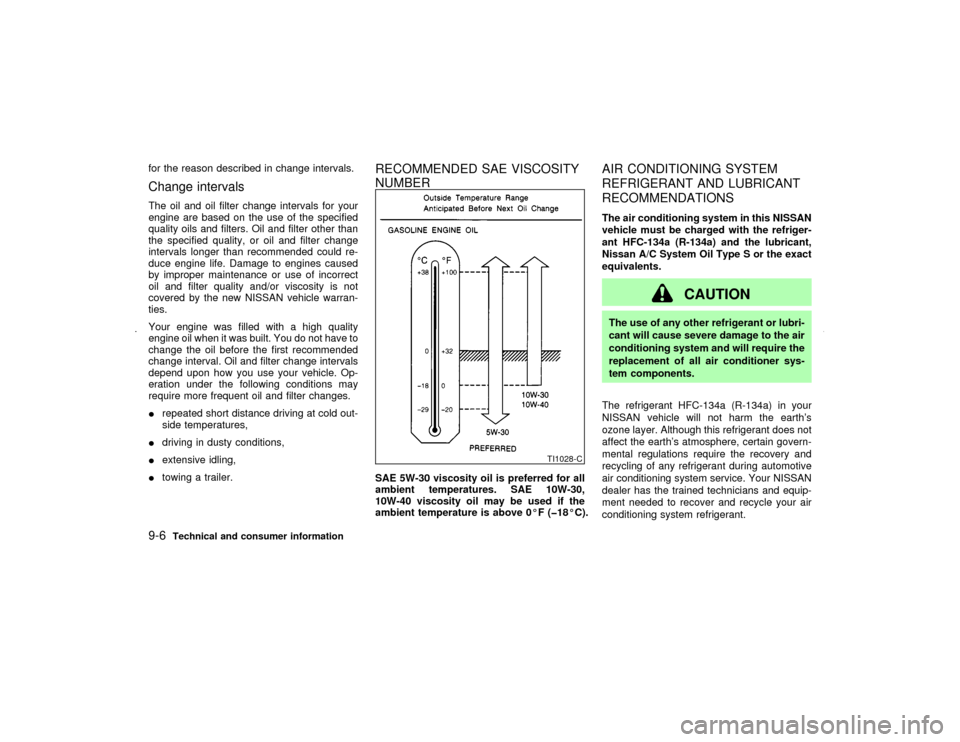
RECOMMENDED SAE VISCOSITY
NUMBERSAE 5W-30 viscosity oil is preferred for all
ambient temperatures. SAE 10W-30,
10W-40 viscosity oil may be used if the
ambient temperature is above 0ÉF (þ18ÉC).
AIR CONDITIONING SYSTEM
REFRIGERANT AND LUBRICANT
RECOMMENDATIONSThe air conditioning system in this NISSAN
vehicle must be charged with the refriger-
ant HFC-134a (R-134a) and the lubricant,
Nissan A/C System Oil Type S or the exact
equivalents.
CAUTION
The use of any other refrigerant or lubri-
cant will cause severe damage to the air
conditioning system and will require the
replacement of all air conditioner sys-
tem components.
The refrigerant HFC-134a (R-134a) in your
NISSAN vehicle will not harm the earth's
ozone layer. Although this refrigerant does not
affect the earth's atmosphere, certain govern-
mental regulations require the recovery and
recycling of any refrigerant during automotive
air conditioning system service. Your NISSAN
dealer has the trained technicians and equip-
ment needed to recover and recycle your air
conditioning system refrigerant.
TI1028-C
9-6
Technical and consumer information
Z
01.9.21/A33-D/V5.0
X