2002 NISSAN MAXIMA ECO mode
[x] Cancel search: ECO modePage 147 of 247
IWhen the vehicle is stopped for a
period of time, for example at a stop
light, shift to N (Neutral) and release
the clutch pedal with the foot brake
applied.Suggested up-shift speedsShown below are suggested vehicle speeds
for shifting into a higher gear. These sugges-
tions relate to fuel economy and vehicle per-
formance. Actual up-shift speeds will vary ac-
cording to road conditions, the weather and
individual driving habits.
For normal acceleration in low altitude areas
[less than 4,000 ft (1,219 m)]:
Gear changeACCEL shift
point
MPH (km/h)CRUISE shift
point
MPH (km/h)
1st to 2nd 13 (21) 13 (21)
2nd to 3rd 23 (37) 16 (26)
3rd to 4th 33 (53) 27 (43)
4th to 5th 39 (63) 36 (58)
5th to 6th 50 (80) 50 (80)
For quick acceleration when the engine is cold
or in high altitude areas [over 4,000 ft (1,219
m)]:Gear change MPH (km/h)
1st to 2nd 15 (24)
2nd to 3rd 25 (40)
3rd to 4th 40 (64)
4th to 5th 45 (72)
5th to 6th 50 (80)
Suggested maximum speed in each
gearDownshift to a lower gear if the engine is not
running smoothly, or if you need to accelerate.
Do not exceed the maximum suggested speed
(shown below) in any gear. For level road
driving, use the highest gear suggested for
that speed. Always observe posted speed
limits, and drive according to the road condi-
tions, which will ensure safe operation. Do not
over-rev the engine when shifting to a lower
gear as it may cause engine damage or loss of
vehicle control.
Gear MPH (km/h)
1st 30 (48)
2nd 55 (88)
3rd 80 (128)
4th Ð
5th Ð
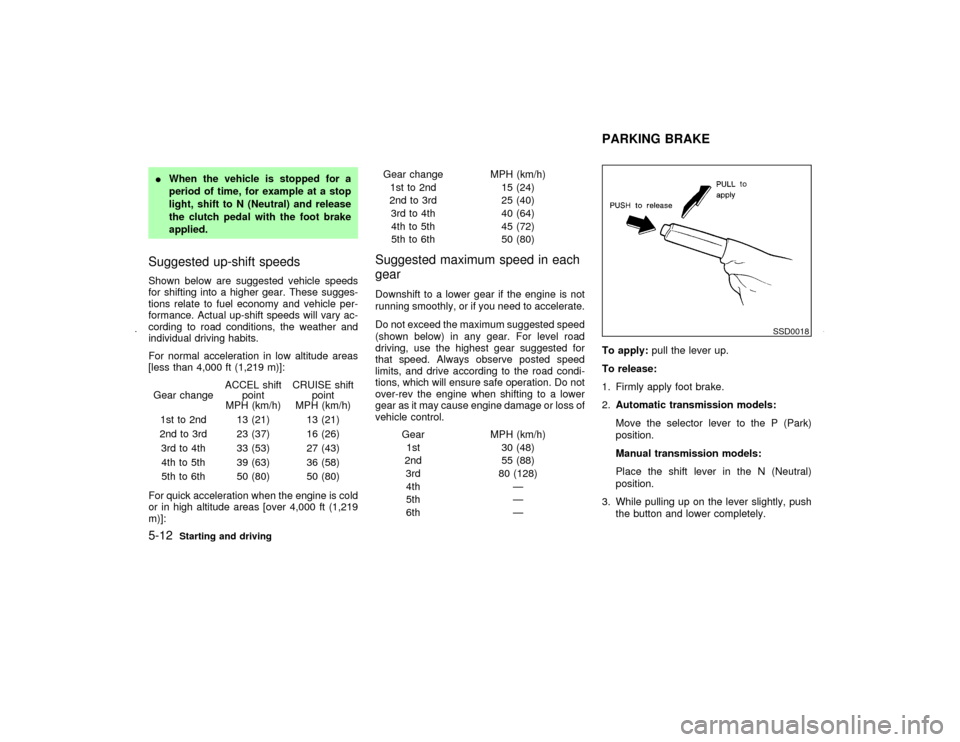
6th ÐTo apply:pull the lever up.
To release:
1. Firmly apply foot brake.
2.Automatic transmission models:
Move the selector lever to the P (Park)
position.
Manual transmission models:
Place the shift lever in the N (Neutral)
position.
3. While pulling up on the lever slightly, push
the button and lower completely.
SSD0018
PARKING BRAKE
5-12
Starting and driving
Z
01.9.21/A33-D/V5.0
X
Page 150 of 247

the vehicle speed is over 25 MPH (40 km/h). During the first 1,000 miles (1,600 km), follow
these recommendations for the future reliabil-
ity and economy of your new vehicle.
IAvoid driving for long periods at constant
speed, either fast or slow.
IDo not accelerate at full throttle in any gear.
IAvoid quick starts.
IAvoid hard braking as much as possible.
IDo not tow a trailer for the first 500 miles
(800 km).
IAccelerate slowly and smoothly. Maintain
cruising speeds with a constant accelerator
position.
IDrive at moderate speeds on the highway.
Driving at high speed will lower fuel
economy.
IAvoid unnecessary stopping and braking.
Maintain a safe distance behind other ve-
hicles.
IUse a proper gear range which suits road
conditions. On level roads, shift into high
gear as soon as possible.
IAvoid unnecessary engine idling.
SD1001M
BREAK-IN SCHEDULE INCREASING FUEL ECONOMY
Starting and driving
5-15
Z
01.9.21/A33-D/V5.0
X
Page 151 of 247
IKeep your engine tuned up.
IFollow the recommended periodic mainte-
nance schedule.
IKeep the tires inflated at the correct pres-
sure. Low pressure will increase tire wear
and waste fuel.
IKeep the front wheels in correct alignment.
Improper alignment will cause not only tire
wear but also lower fuel economy.
IAir conditioner operation lowers fuel
economy. Use the air conditioner only when
necessary.
IWhen cruising at highway speeds, it is
more economical to use the air conditioner
and leave the windows closed to reduce
drag.
WARNING
IDo not stop or park the vehicle over
flammable materials such as dry
grass, waste paper or rags. They may
ignite and cause a fire.
INever leave the engine running while
the vehicle is unattended.
INever leave children unattended in
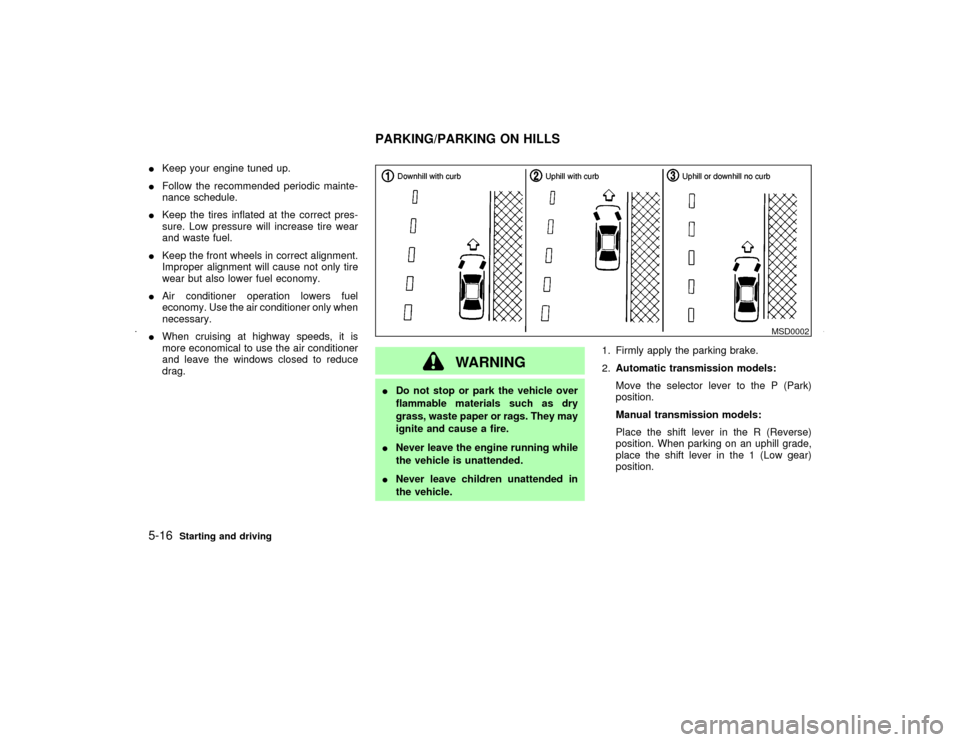
the vehicle.1. Firmly apply the parking brake.
2.Automatic transmission models:
Move the selector lever to the P (Park)
position.
Manual transmission models:
Place the shift lever in the R (Reverse)
position. When parking on an uphill grade,
place the shift lever in the 1 (Low gear)
position.
MSD0002
PARKING/PARKING ON HILLS
5-16
Starting and driving
Z
01.9.21/A33-D/V5.0
X
Page 165 of 247
CAUTION
IAlways connect positive (+) to posi-
tive (+) and negative (þ) to body
ground (for example, strut mounting
bolt, etc. Ð not to the battery).
IMake sure that cables do not touch
moving parts in the engine compart-
ment and that clamps do not contact
any other metal.
5. Start the engine of the other vehicle and let
it run for a few minutes.
6. Keep the engine speed of the other vehicle
at about 2,000 rpm, and start your engine in
the normal manner.
CAUTION
Do not keep starter motor engaged for
more than 10 seconds. If the engine
does not start right away, turn the key
off and wait 3 to 4 seconds before trying
again.7. After starting your engine, carefully discon-
nect the negative cable and then the posi-
tive cable.
8. Replace the vent caps (if so equipped). Be
sure to dispose of the cloth used to cover
the vent holes as it may be contaminated
with corrosive acid.Do not start the engine by pushing.
CAUTION
IAutomatic transmission models can-
not be push started. This may cause
transmission damage.
IThree way catalyst equipped models
should not be started by pushing
since the three way catalyst may be
damaged.
INever try to start the vehicle by tow-
ing it; when the engine starts, the
forward surge could cause the ve-
hicle to collide with the tow vehicle.PUSH STARTING
6-8
In case of emergency
Z
01.9.21/A33-D/V5.0
X
Page 168 of 247
CAUTION
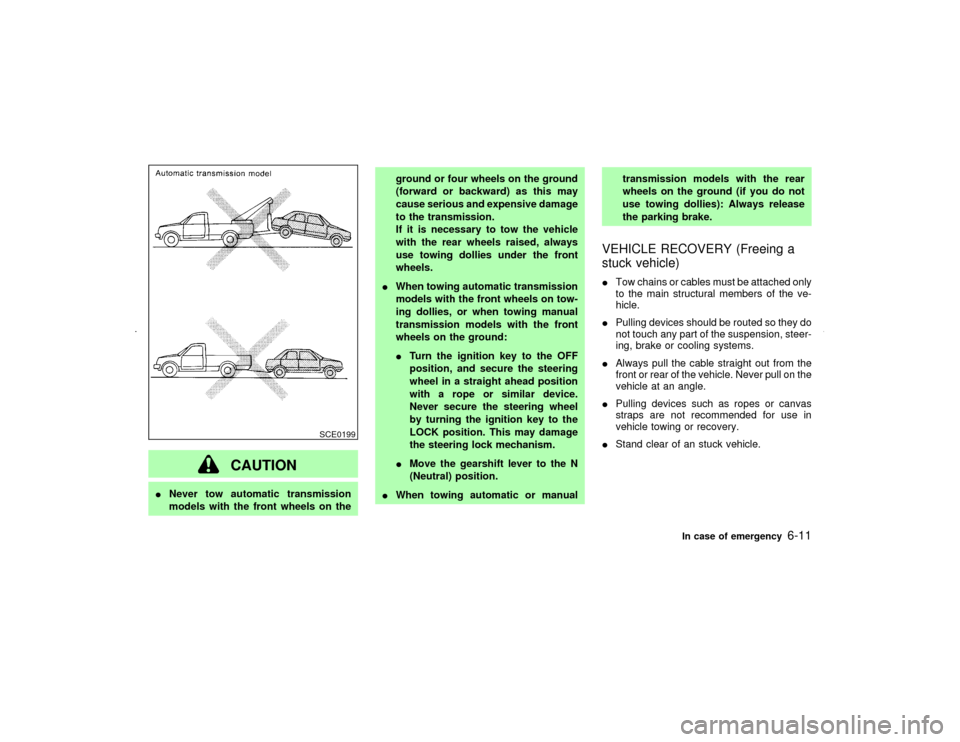
INever tow automatic transmission
models with the front wheels on theground or four wheels on the ground
(forward or backward) as this may
cause serious and expensive damage
to the transmission.
If it is necessary to tow the vehicle
with the rear wheels raised, always
use towing dollies under the front
wheels.
IWhen towing automatic transmission
models with the front wheels on tow-
ing dollies, or when towing manual
transmission models with the front
wheels on the ground:
ITurn the ignition key to the OFF
position, and secure the steering
wheel in a straight ahead position
with a rope or similar device.
Never secure the steering wheel
by turning the ignition key to the
LOCK position. This may damage
the steering lock mechanism.
IMove the gearshift lever to the N
(Neutral) position.
IWhen towing automatic or manualtransmission models with the rear
wheels on the ground (if you do not
use towing dollies): Always release
the parking brake.
VEHICLE RECOVERY (Freeing a
stuck vehicle)ITow chains or cables must be attached only
to the main structural members of the ve-
hicle.
IPulling devices should be routed so they do
not touch any part of the suspension, steer-
ing, brake or cooling systems.
IAlways pull the cable straight out from the
front or rear of the vehicle. Never pull on the
vehicle at an angle.
IPulling devices such as ropes or canvas
straps are not recommended for use in
vehicle towing or recovery.
IStand clear of an stuck vehicle.
SCE0199
In case of emergency
6-11
Z
01.9.21/A33-D/V5.0
X
Page 209 of 247
potential maximum vehicle speed. Never
exceed the maximum speed rating of the
tire.
For additional information regarding
tires, refer to ªImportant Tire Safety In-
formationº in the Warranty Information
Booklet (US) or ªTire Safety Informa-
tionº in the Warranty Information book-
let (Canada).All season tiresNISSAN specifies all season tires on some
models to provide good performance for use
all year around, including snowy and icy road
conditions. All season tires are identified by
ALL SEASON and/or M&S on the tire sidewall.
Snow tires have better snow traction than all
season tires and may be more appropriate in
some areas.Summer tiresNISSAN specifies summer tires on some mod-
els to provide superior performance on dry
roads. Summer tire performance in snow and
ice will be substantially reduced. Summer tires
do not have the tire traction rating M&S on the
tire sidewall.If you operate your vehicle in snowy or icy
conditions, NISSAN recommends the use of
snow or all season tires on all four wheels.
Snow tiresIf snow tires are needed, it is necessary to
select tires equivalent in size and load rating to
the original equipment tires. If you do not, it
can adversely affect the safety and handling of
your vehicle.
Generally, snow tires will have lower speed
ratings than factory equipped tires and may
not match the potential maximum vehicle
speed. Never exceed the maximum speed
rating of the tire.
If you operate your vehicle in snowy or icy
conditions, NISSAN recommends the use of
snow or all season tires on all four wheels.
For additional traction on icy roads, studded
tires may be used. However, some provinces
and states prohibit their use. Check local, state
and provincial laws before installing studded
tires. Skid and traction capabilities of studded
snow tires, on wet or dry surfaces, may be
poorer than that of non-studded snow tires.TIRE CHAINSUse of tire chains may be prohibited according
to location. Check the local laws before install-ing tire chains. When installing tire chains,
make sure they are of proper size for the tires
on your vehicle and are installed according to
the chain manufacturer's suggestions.Use
only SAE class S chains.Other types may
damage your vehicle. Use chain tensioners
when recommended by the tire chain manu-
facturer to ensure a tight fit. Loose end links of
the tire chain must be secured or removed to
prevent the possibility of whipping action dam-
age to the fenders or undercarriage. If pos-
sible, avoid fully loading your vehicle when
using tire chains. In addition, drive at a re-
duced speed. Otherwise, your vehicle may be
damaged and/or vehicle handling and perfor-
mance may be adversely affected.
Never install tire chains on a T-type spare tire.
Do not use the chains on dry roads.
8-34
Maintenance and do-it-yourself
Z
01.9.21/A33-D/V5.0
X
Page 224 of 247

WHEELS AND TIRESRoad wheelType Size Offset in (mm)
Aluminum16 x 6-1/2JJ
17 x 7JJ
17 x 7JJ (option)1.57 (40)
1.57 (40)*2
1.75 (45)*3
TireConventionalP215/55R16 91H
P215/55R17 93H
P225/50R17 93V
SpareConventional*1
T125/70D16
T125/90D16
T135/70D16
T135/90D16
*1: For option
*2: For P215/55R17 91H
*3: For P225/50R17 93V
DIMENSIONS AND WEIGHTS
Sedan
Overall length in (mm) 191.5 (4,863)
Overall width in (mm) 70.3 (1,785)
Overall height in (mm)56.3 (1,430)*3
56.7 (1,440)*4
57.1 (1,450)*5
Front tread in (mm)60.2 (1,530)*1
59.8 (1,520)*2
Rear tread in (mm)59.4 (1,510)*1
59.1 (1,500)*2
Wheelbase in (mm) 108.3 (2,750)
Gross vehicle weight rating lb (kg)
See the F.M.V.S.S. certifica-
tion label on the driver's side
lock pillar. Gross axle weight rating
Front lb (kg)
Rear lb (kg)
*1: For models with road wheel size - 16 x 6.5JJ, 17 x 7JJ (offset 1.57 in (40 mm))
*2: For models with aluminum wheel size - 17 x 7JJ (offset 1.75 in (45 mm))
*3: For models with the tire size P215/55R16 91H
*4: For models with the tire size P225/50R17 93V
*5: For models with the tire size P215/55R17 93H
Technical and consumer information
9-9
Z
01.9.21/A33-D/V5.0
X
Page 233 of 247

trailer is hitched. Do not drive the vehicle if
it has an abnormal nose-up or nose-down
condition; check for improper tongue load,
overload, worn suspension or other pos-
sible causes of either condition.
IAlways secure items in the trailer to prevent
load shifts while driving.
IBe certain your rear view mirrors conform to
all federal, state or local regulations. If not,
install any mirrors required for towing be-
fore driving the vehicle.
Trailer towing tipsIn order to gain skill and an understanding of
the vehicle's behavior, you should practice
turning, stopping and backing up in an area
which is free from traffic. Steering stability, and
braking performance will be somewhat differ-
ent than under normal driving conditions.
IAlways secure items in the trailer to prevent
load shift while driving.
IAvoid abrupt starts, acceleration or stops.
IAvoid sharp turns or lane changes.
IAlways drive your vehicle at a moderate
speed.
IAlways block the wheels on both vehicle
and trailer when parking. Parking on aslope is not recommended; however, if you
must do so, and if your vehicle is equipped
with automatic transmission, first block the
wheels and apply the parking brake, and
then move the transmission selector lever
into the P (Park) position. If you move the
selector lever to the P (Park) position be-
fore blocking the wheels and applying the
parking brake, transmission damage could
occur.
IWhen going down a hill, shift into a lower
gear and use the engine braking effect.
When ascending a long grade, downshift
the transmission to a lower gear and reduce
speed to reduce chances of engine over-
loading and/or overheating.
IIf the engine coolant rises to an extremely
high temperature when the air conditioning
system is on, turn off the air conditioner.
Coolant heat can be additionally vented by
opening the windows, switching the fan
control to high and setting the temperature
control to the HOT position.
ITrailer towing requires more fuel than nor-
mal circumstances.
IAvoid towing a trailer for the first 500 miles
(800 km).
IHave your vehicle serviced more often thanat intervals specified in the recommended
maintenance schedule.
IWhen making a turn, your trailer wheels will
be closer to the inside of the turn than your
vehicle wheels. To compensate for this,
make a larger than normal turning radius
during the turn.
ICrosswinds and rough roads will adversely
affect vehicle/trailer handling, possibly
causing vehicle sway. When being passed
by larger vehicles, be prepared for possible
changes in crosswinds that could affect
vehicle handling. If swaying does occur,
firmly grip the steering wheel, steer straight
ahead, and immediately (but gradually) re-
duce vehicle speed. This combination will
help stabilize the vehicle. Never increase
speed.
IBe careful when passing other vehicles.
Passing while towing a trailer requires con-
siderably more distance than normal pass-
ing. Remember the length of the trailer
must also pass the other vehicle before you
can safely change lanes.
ITo maintain engine braking efficiency and
electrical charging performance, do not use
fifth gear (manual transmission) or over-
drive (automatic transmission).9-18
Technical and consumer information
Z
01.9.21/A33-D/V5.0
X