2002 NISSAN FRONTIER 4WD
[x] Cancel search: 4WDPage 142 of 273
(manual transmission vehicles), us-
ing only the brake, as this could
cause loss of control.
cHeavy braking going down a hill
could cause your brakes to overheat
and fade, resulting in loss of control
and an accident. Apply brakes lightly
and use a low gear to control your
speed.
cUnsecured cargo can be thrown
around when driving over rough ter-
rain. Properly secure all cargo so it
will not be thrown forward and cause
injury to you or your passengers.
cTo avoid raising the center of gravity
excessively, do not exceed the rated
capacity of the roof rack (if so
equipped) and evenly distribute the
load. Secure heavy loads in the
cargo area as far forward and as low
as possible. Do not equip the vehicle
with tires larger than specified in this
manual. This could cause your ve-
hicle to roll over.
cDo not grip the inside or spokes of
the steering wheel when driving off-
road. The steering wheel could movesuddenly and injure your hands. In-
stead drive with your fingers and
thumbs on the outside of the rim.
cBefore operating the vehicle, ensure
that the driver and all passengers
have their seat belts fastened.
cAlways drive with the floor mats in
place as the floor may become hot.
cLower your speed when encounter-
ing strong crosswinds. With a higher
center of gravity, your NISSAN is
more affected by strong side winds.
Slower speeds ensure better vehicle
control.
cDo not drive beyond the perfor-
mance of the tires, even with 4WD
engaged.
cAccelerating quickly, sharp steering
maneuvers or sudden braking may
cause loss of control.
cIf at all possible, avoid sharp turning
maneuvers, particularly at high
speeds. Your NISSAN four-wheel
drive vehicle has a higher center of
gravity than a two-wheel drive veh-icle. The vehicle is not designed for
cornering at the same speeds as
conventional two-wheel drive ve-
hicles. Failure to operate this vehicle
correctly could result in loss of con-
trol and/or a roll over accident.
cAlways use tires of the same type,
size, brand, construction (bias, bias-
belted, or radial), and tread pattern
on all four wheels. Install tire chains
on the rear wheels when driving on
slippery roads and drive carefully.
cBe sure to check the brakes immedi-
ately after driving in mud or water.
See(Brake system(later in this sec-
tion for(Wet brakes(.
cAvoid parking your vehicle on steep
hills. If you get out of the vehicle and
it rolls forward, backward or side-
ways, you could be injured.
cWhenever you drive off-road
through sand, mud or water as deep
as the wheel hub, more frequent-
maintenance may be required. See
(Periodic maintenance(in the(Main-
tenance and do-it-yourself(section
of this manual.
Starting and driving
5-5
ZX
Page 158 of 273
resulting in serious personal injury
or property damage.
2HÐ (2WD, high range) Only the rear
wheels are driven. Use for driving under the
same conditions as standard 2WD vehicles
or state dynamometer I/M testing.
4HÐ (4WD, high range) Four wheels are
driven. Use when driving on roads where it
is difficult to drive in the 2H position (i.e.,
driving at normal speeds on snow covered,
icy, wet, muddy or sandy roads).
4LÐ (4WD, low range) Four wheels are
driven. Use when climbing or descending
steep hills, or during hard driving in sand,
mud or deep snow. The 4L position pro-
vides maximum power and traction. Avoid
raising vehicle speed excessively, as the
maximum speed is approximately 30 MPH
(48 km/h).
NÐ No wheels are driven. Always keep the
transfer lever out of the N (Neutral) position.
Shift the lever quickly and smoothly when
moving across the N (Neutral) position with
the vehicle stopped.
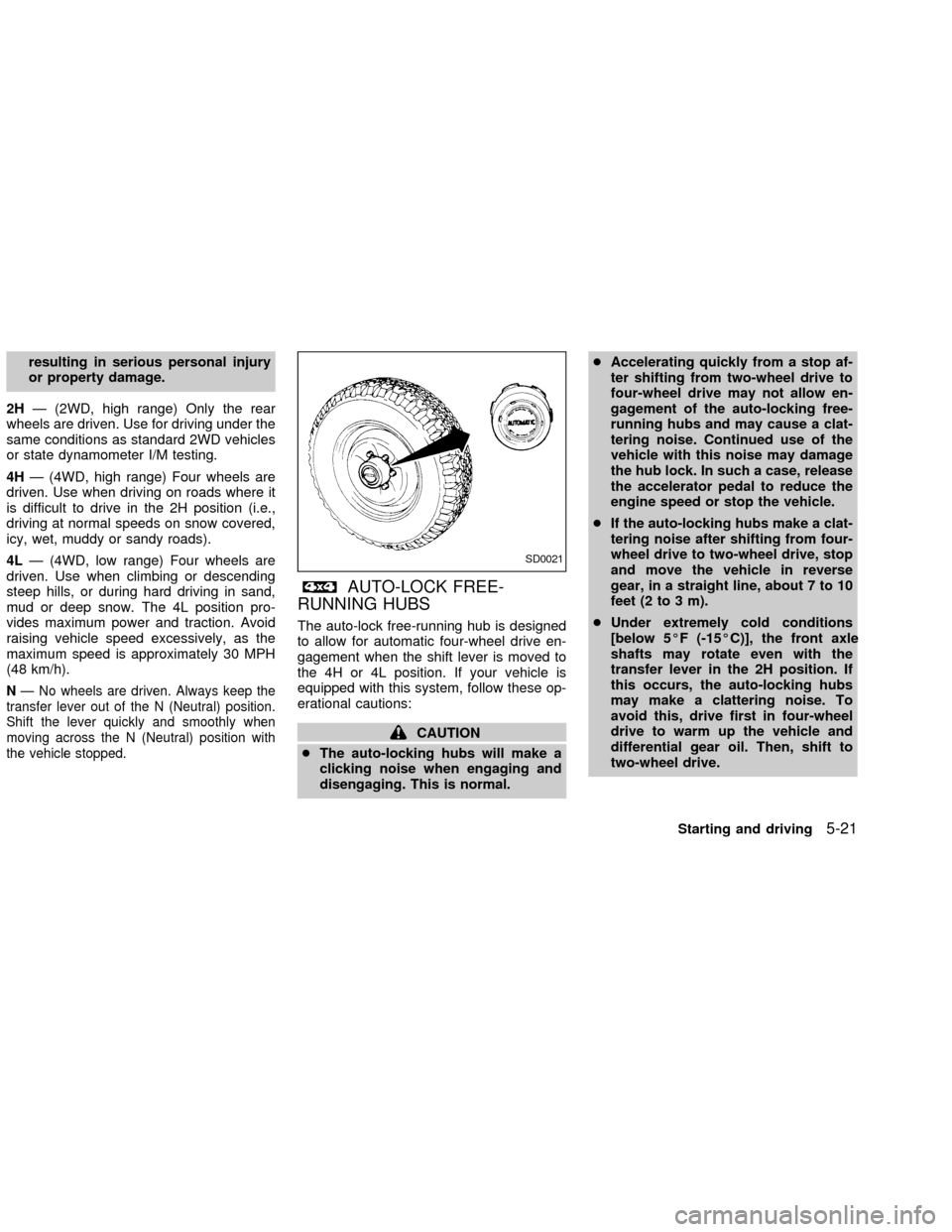
AUTO-LOCK FREE-
RUNNING HUBS
The auto-lock free-running hub is designed
to allow for automatic four-wheel drive en-
gagement when the shift lever is moved to
the 4H or 4L position. If your vehicle is
equipped with this system, follow these op-
erational cautions:
CAUTION
cThe auto-locking hubs will make a
clicking noise when engaging and
disengaging. This is normal.cAccelerating quickly from a stop af-
ter shifting from two-wheel drive to
four-wheel drive may not allow en-
gagement of the auto-locking free-
running hubs and may cause a clat-
tering noise. Continued use of the
vehicle with this noise may damage
the hub lock. In such a case, release
the accelerator pedal to reduce the
engine speed or stop the vehicle.
cIf the auto-locking hubs make a clat-
tering noise after shifting from four-
wheel drive to two-wheel drive, stop
and move the vehicle in reverse
gear, in a straight line, about 7 to 10
feet (2 to 3 m).
cUnder extremely cold conditions
[below 5ÉF (-15ÉC)], the front axle
shafts may rotate even with the
transfer lever in the 2H position. If
this occurs, the auto-locking hubs
may make a clattering noise. To
avoid this, drive first in four-wheel
drive to warm up the vehicle and
differential gear oil. Then, shift to
two-wheel drive.
SD0021
Starting and driving5-21
ZX
Page 160 of 273

TO SHIFT
TRANSFER CASE:SHIFT PROCEDURE FOR AUTO-LOCK FREE-RUNNING HUBS
From 2H to 4HMove the transfer case shift lever to 4H at speeds below 25 MPH (40 km/h). It is not necessary to depress the clutch pedal. Per-
form this operation when driving straight, not while cornering.
From 4H to 2H1. Move the transfer case shift lever to 2H. This can be done at any speed, and it is not necessary to depress the clutch pedal.
Perform this operation when driving straight, not while cornering.
2. Disengage the AUTO-LOCK hubs following the procedure outlined below.
NOTE:
The 4WD indicator light may not turn off immediately under certain driving conditions, such as when the vehicle is driven
uphill. This is normal and it will shut off as the vehicle is driven further.
AUTO-LOCK HUB DISENGAGEMENT (FREE MODE)
The AUTO-LOCK hubs will not disengage until the vehicle is completely stopped and is then moved in a straight line, approxi-
mately 7-10 feet (2-3 m), in the opposite direction of travel. For example:
If you were driving the vehicle forward, stop and move the vehicle 7-10 feet (2-3 m) backward.
If you were driving the vehicle in reverse, stop and move the vehicle 7-10 feet (2-3 m) forward.
It is not necessary to immediately return the AUTO-LOCK hubs to FREE MODE when shifting from 4H to 2H. The vehicle may be
operated under normal 2H conditions with the AUTO-LOCK hubs engaged. However, disengaging the AUTO-LOCK hubs will al-
low for better fuel economy, quieter ride and less component wear. Leaving the hubs locked while driving in 2H may be desir-
able so that you can easily shift to 4H at speeds greater than 25 MPH (40 km/h).
From 4H to 4L or 4L to
4H1. Stop the vehicle.
2. Depress the clutch pedal, or place the transmission selector lever in the N (Neutral) position.
3. Depress the transfer case shift lever and move it to the 4L or 4H position. Change gears quickly and smoothly.
From 2H to 4L1. Stop the vehicle.
2. Depress the clutch pedal, or place the transmission selector lever in the N (Neutral) position.
3. Depress the transfer case shift lever and move it to the 4L position. Change gears quickly and smoothly.
From 4L to 2H1. Stop the vehicle.
2. Depress the clutch pedal, or place the transmission selector lever in the N (Neutral) position.
3. Depress the transfer case shift lever and move it to the 2H position. Change gears quickly and smoothly.
4. Disengage the AUTO-LOCK hubs following the procedure outlined above.
Starting and driving5-23
ZX
Page 244 of 273

DIMENSIONS AND WEIGHTS
Unit: (mm) (in)
Drive Type2WD 4WD
Body King Cab Crew Cab Crew Cab King Cab Crew Cab Crew Cab
Wheelbase Long Short Long Long Short Long
Overall length*1 5153 (202.9) 5077 (199.9) 5532 (217.8) 5153 (202.9) 5077 (199.9) 5532 (217.8)
Overall width 1808 (71.2)*4 1808 (71.2)*4 1808 (71.2)**4 1808 (71.2)*4 1808 (71.2)*4 1808 (71.2)*4
Overall height1605 (63.2)*2
1694 (66.7)*3
1687 (66.4)*51694 (66.7)*3
1687 (66.4)*51694 (66.7)*3
1687 (66.4)*51694 (66.7)*3
1687 (66.4)*51687 (66.4) 1687 (66.4)
Front tread1395 (54.9)*2
1525 (60)1525 (60) 1525 (60) 1525 (60) 1525 (60) 1525 (60)
Rear tread1390 (54.7)*2
1507 (59.3)1507 (59.3) 1507 (59.3) 1507 (59.3) 1507 (59.3) 1507 (59.3)
Wheelbase 2950 (116.1) 2950 (116.1) 3329.9 (131.1) 2950 (116.1) 2950 (116.1) 3329.9 (131.1)
Gross vehicle weight rating
lb (kg)
Gross axle weight rating See the ``F.M.V.S.S. certification label'' on the driver side door jamb pillar.
Front lb (kg)
Rear lb (kg)
*1: Includes rear step bumper.
*2: XE with KA24DE engine.
*3: XE with VG33E engine and SE models.
*4: With over-fender.
*5: SC with VG33ER engine.
Technical and consumer information9-11
ZX
Page 253 of 273
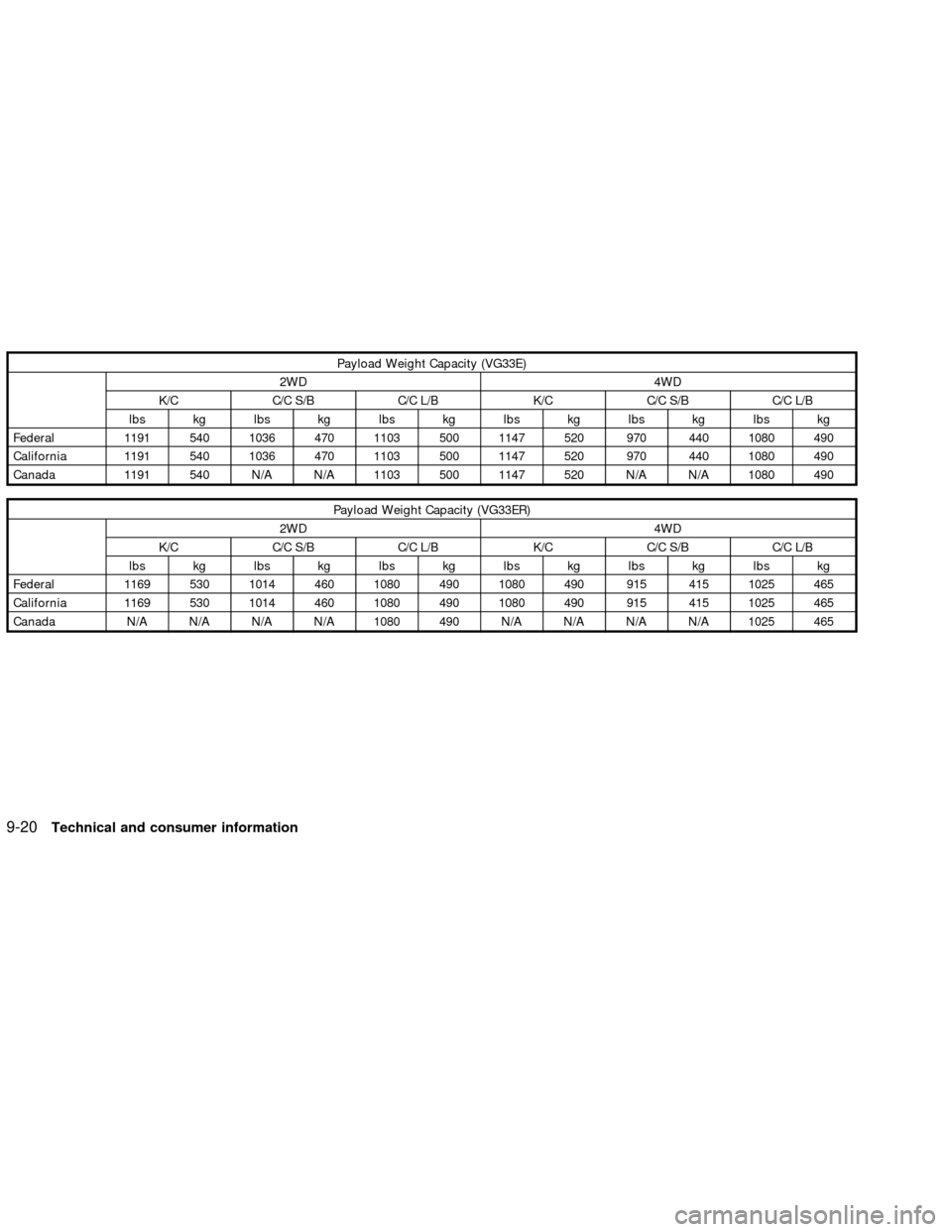
Payload Weight Capacity (VG33E)
2WD 4WD
K/C C/C S/B C/C L/B K/C C/C S/B C/C L/B
lbs kg lbs kg lbs kg lbs kg lbs kg lbs kg
Federal 1191 540 1036 470 1103 500 1147 520 970 440 1080 490
California 1191 540 1036 470 1103 500 1147 520 970 440 1080 490
Canada 1191 540 N/A N/A 1103 500 1147 520 N/A N/A 1080 490
Payload Weight Capacity (VG33ER)
2WD 4WD
K/C C/C S/B C/C L/B K/C C/C S/B C/C L/B
lbs kg lbs kg lbs kg lbs kg lbs kg lbs kg
Federal 1169 530 1014 460 1080 490 1080 490 915 415 1025 465
California 1169 530 1014 460 1080 490 1080 490 915 415 1025 465
Canada N/A N/A N/A N/A 1080 490 N/A N/A N/A N/A 1025 465
9-20Technical and consumer information
ZX
Page 256 of 273

TOWING LOAD/SPECIFICATION CHART
Unit: lbs (kg)
MODEL
WEIGHT2WD 4WD
M/T (4cyl) A/T (4cyl) M/T (V6) A/T (V6) M/T (V6) A/T (V6)
MAXIMUM
TRAILER
WEIGHT*13,001 (1,361) 2,000 (907)Except Supercharger
3,500 (1,588)Except Supercharger
5,000 (2,268)Except S/C C/C L/B
3,500 (1,588)Except S/C C/C L/B
5,000 (2,268)
Supercharger
3,400 (1,542)Supercharger
4,902 (2,223)S/C C/C L/B
3,400 (1,542)S/C C/C L/B
4,902 (2,223)
MAXIMUM
TONGUE
LOAD300 (136) 200 (91)Except Supercharger
350 (159)Except Supercharger
500 (227)350 (159)Except S/C C/C L/B
500 (227)
Supercharger
340 (154)Supercharger
490 (222)S/C C/C L/B
340 (154)S/C C/C L/B
490 (222)
GROSS
COMBINED
WEIGHT
RATING7,000 (3,175) 6,000 (2,721) 8,002 (3,629) 9,500 (4,309) 8,002 (3,629) 9,500 (4,309)
RECOMMENDED
EQUIPMENT*2Sway Control
DeviceÐSway Control
DeviceSway Control
DeviceSway Control
DeviceSway Control
Device
*1: ll towing above 1,000 lb (454 kg) requires the use of trailer brakes. NISSAN recommends the use of a tandem axle trailer whenever towing above 3,000
lb (1,361 kg).
*2: A sway control device is recommended for all towing above 2,000 lb (907 kg). Sway control devices are not offered by NISSAN. See a professional
trailer/hitch outlet for a properly designed sway control device for your trailer.
M/T = Manual Transmission
A/T = Automatic Transmission
2WD = 2-wheel drive
4WD = 4-wheel drive
C/C = Crew Cab
L/B = Long Bed
S/C = Supercharger
Technical and consumer information9-23
ZX
Page 262 of 273
perform the driving pattern, an authorized
NISSAN dealer can conduct it for you.
Dynamometer testing for Inspection/
Maintenance (I/M) test (US only)
Due to legal requirements in some
states/areas, your vehicle may be tested for
emissions on a dynamometer. The transfer
control lever (if so equipped) MUST be in
the 2H position for I/M testing on a two
wheel dynamometer.
WARNING
cIf the transfer control lever is not in
the 2H position during the dyna-
mometer I/M testing, the vehicle
could come off the dynamometer
and cause serious personal injury
and/or body damage to the vehicle.
cSerious damage will occur to the
4WD system if the transfer control
lever is not in the 2H position
Technical and consumer information
9-29
ZX