2002 NISSAN FRONTIER fuel
[x] Cancel search: fuelPage 194 of 273
Automatic transmission fluid level*
Check the level after putting the selector
lever in P with the engine idling at operating
temperature.
Engine coolant level*Check the coolant
level when the engine is cold.
Radiator and hosesCheck the front of the
radiator and clean off any dirt, insects,
leaves, etc., that may have accumulated.
Make sure the hoses have no cracks, de-
formation, rot or loose connections.
Engine drive belts*Make sure the drive
belts are not frayed, worn, cracked or oily.
Battery*Check the fluid level in each cell. It
should be between the MAX and MIN lines.
Vehicles operated in high temperatures or
under severe conditions require frequent
checks of the battery fluid level.
Exhaust systemMake sure there are no
loose supports, cracks or holes. If the sound
of the exhaust seems unusual or there is a
smell of exhaust fumes, immediately have
the exhaust system inspected by an autho-
rized NISSAN dealer. See the carbon mon-
oxide warning in the ``Starting and driving''
section of this manual.UnderbodyThe underbody is frequently
exposed to corrosive substances such as
those used on icy roads or to control dust. It
is very important to remove these sub-
stances from the underbody, otherwise rust
may form on the floor pan, frame, fuel lines
and exhaust system. At the end of winter,
the underbody should be thoroughly flushed
with plain water, in those areas where mud
and dirt may have accumulated. See the
``Appearance and care'' section of this
manual.
Fluid leaksCheck under the vehicle for
fuel, oil, water or other fluid leaks after the
vehicle has been parked for a while. Water
dripping from the air conditioner after use is
normal. If you should notice any leaks or if
gasoline fumes are evident, check for the
cause and have it corrected immediately.When performing any inspection or mainte-
nance work on your vehicle, always take
care to prevent serious accidental injury to
yourself or damage to the vehicle. The
following are general precautions which
should be closely observed.
WARNING
cPark the vehicle on a level surface,
apply the parking brake securely and
block the wheels to prevent the ve-
hicle from moving. For manual trans-
mission models, move the shift lever
to N (Neutral). For automatic trans-
mission models, move the selector
lever to P (Park).
cBe sure the ignition key is in the OFF
or LOCK position when performing
any parts replacement or repairs.
cNever leave the engine or automatic
transmission related component
harnesses disconnected while the
ignition switch is in the ON position.
cNever connect or disconnect the bat-
tery or any transistorized compo-
nent while the ignition switch is in
the ON position.
MAINTENANCE
PRECAUTIONS
Maintenance and do-it-yourself8-5
ZX
Page 195 of 273
cIf you must work with the engine run-
ning, keep your hands, clothing, hair
and tools away from moving fans,
belts, and any other moving parts.
cIt is advisable to secure or remove
any loose clothing and remove any
jewelry, such as rings, watches, etc.,
before working on your vehicle.
cAlways wear eye protection when-
ever you work on your vehicle.
cIf you must run the engine in an
enclosed space such as a garage, be
sure there is proper ventilation for
exhaust gases to escape.
cNever get under the vehicle while it
is supported only by a jack. If it is
necessary to work under the vehicle,
support it with safety stands.
c
Keep smoking materials, flame and
sparks away from fuel tank and battery.
cOn gasoline engine models with the
multiport fuel injection (MFI) system,
the fuel filter or fuel lines should be
serviced by an authorized NISSAN
dealer because the fuellines are un-der high pressure even when the
engine is off.
CAUTION
cDo not work under the hood while
the engine is hot. Turn the engine off
and wait until it cools down.
cNever connect or disconnect either
the battery or any transistorized
component connector while the igni-
tion is on.
cNever leave the engine or automatic
transmission related component
harnesses disconnected while the
ignition switch is in the ON position.
cAvoid contact with used engine oil
and coolant. Improperly disposed
engine oil, engine coolant and/or
other vehicle fluids can damage the
environment. Always conform to lo-
cal regulations for disposal of ve-
hicle fluid.
This ``Maintenance and do-it-yourself'' sec-
tion gives instructions regarding only those
items which are relatively easy for an owner
to perform.A genuine NISSAN service manual is also
available. See `Owner's Manual/Service
Manual order information'' in the ``Technical
and consumer information'' section.
You should be aware that incomplete or
improper servicing may result in operating
difficulties or excessive emissions, and
could affect your warranty coverage.If in
doubt about any servicing, have it done
by an authorized NISSAN dealer.
8-6Maintenance and do-it-yourself
ZX
Page 203 of 273
7. Refill engine with a recommended oil
through the oil filler opening then install
the oil filler cap securely.
See ``Capacities and recommended
fuel/lubricants'' in the ``Technical and
consumer information'' section for drain
and refill capacity.
The drain and refill capacity depends on
the oil temperature and drain time. Use
these specifications for reference only.
Always use the dipstick to determine
when the proper amount of oil is in the
engine.
8. Start the engine. Check for leakage
around the drain plug and oil filter. Cor-
rect as required.
9. Turn the engine off and wait several
minutes. Check the oil level with the
dipstick. Add engine oil if necessary.
CHANGING ENGINE OIL FILTER
1. Park the vehicle on a level surface and
apply the parking brake.
2. Turn the engine off.
3. Remove the splash shield.
cRemove the six push pins.
cRemove the six bolts and the splash
shield.
4.
Place a large drain pan under the oil filter.
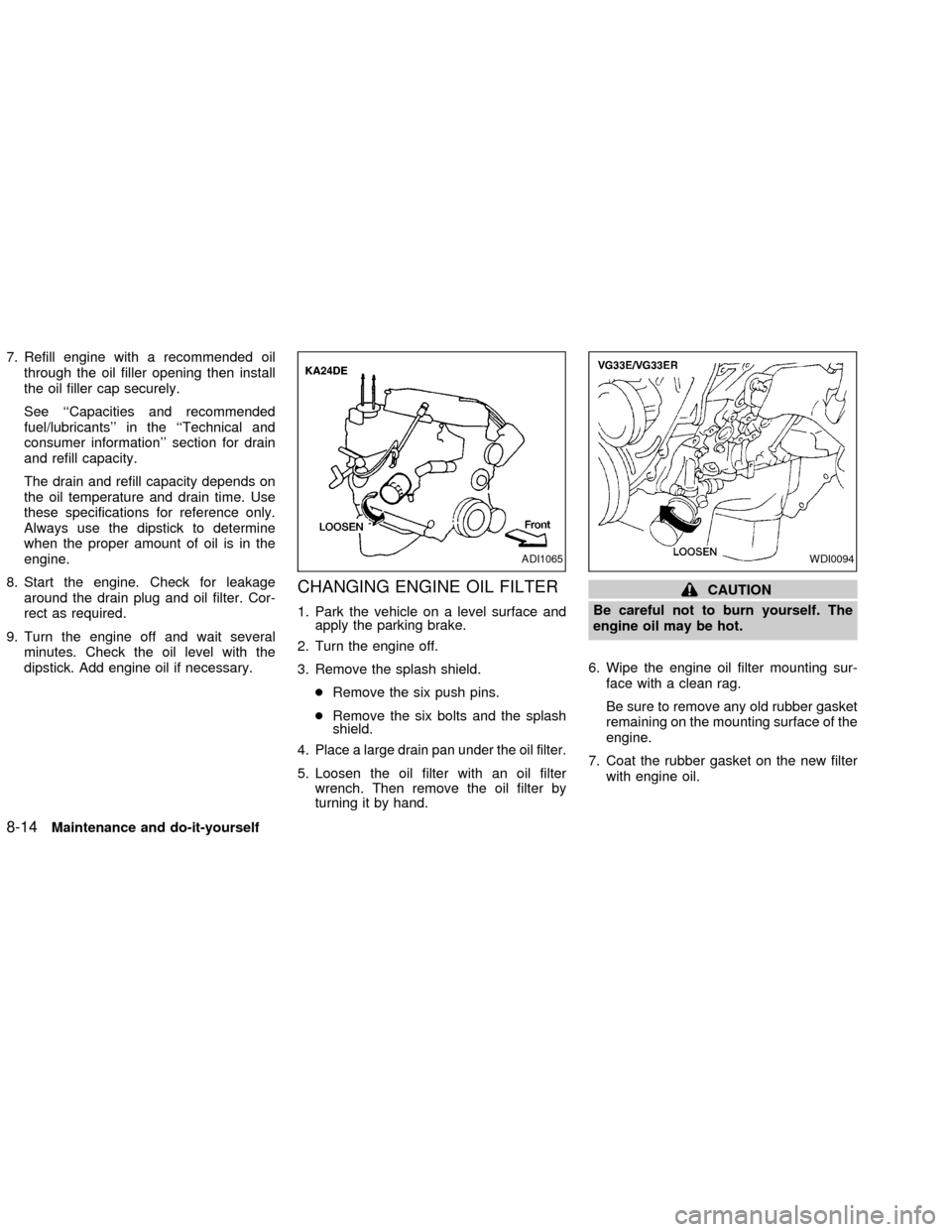
5. Loosen the oil filter with an oil filter
wrench. Then remove the oil filter by
turning it by hand.
CAUTION
Be careful not to burn yourself. The
engine oil may be hot.
6. Wipe the engine oil filter mounting sur-
face with a clean rag.
Be sure to remove any old rubber gasket
remaining on the mounting surface of the
engine.
7. Coat the rubber gasket on the new filter
with engine oil.
ADI1065WDI0094
8-14Maintenance and do-it-yourself
ZX
Page 206 of 273
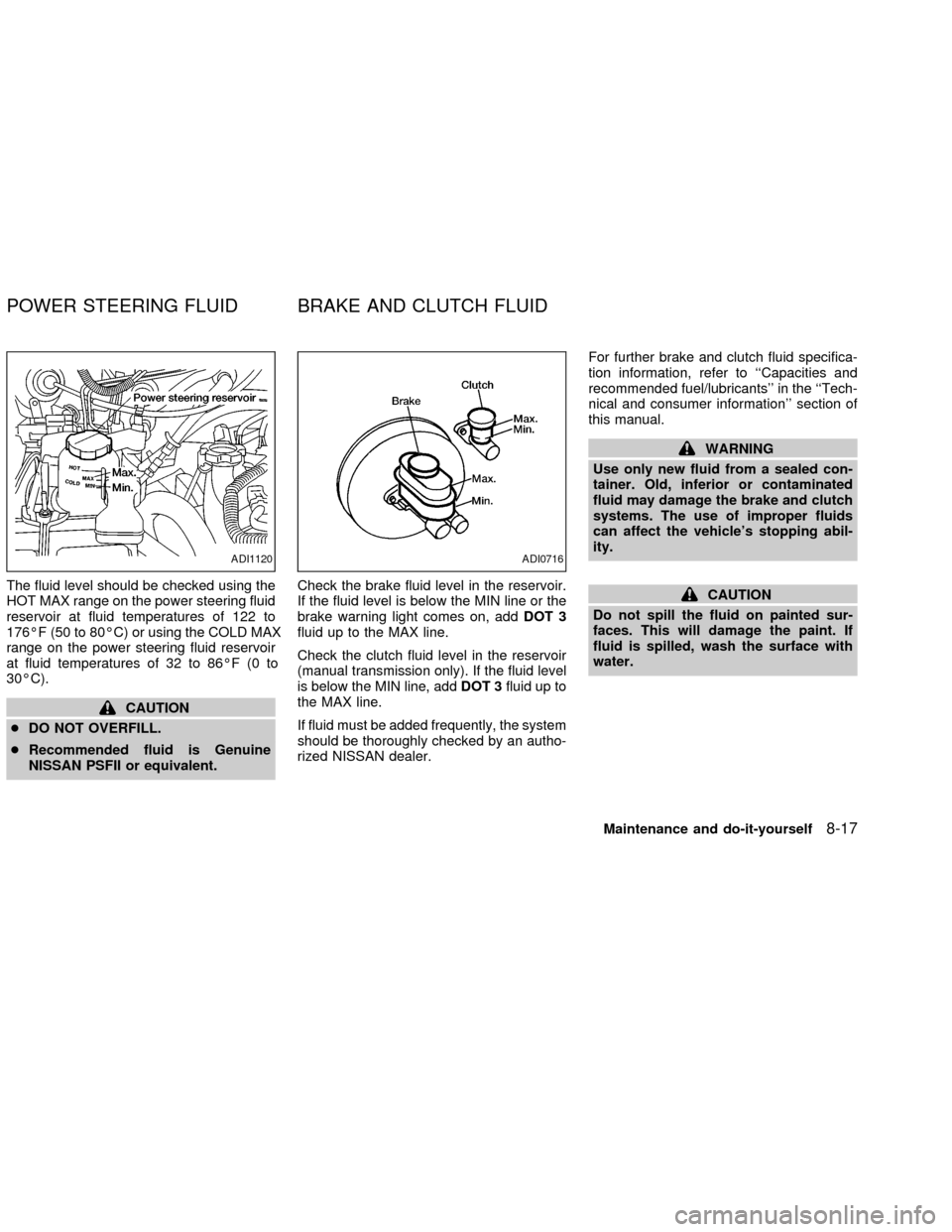
The fluid level should be checked using the
HOT MAX range on the power steering fluid
reservoir at fluid temperatures of 122 to
176ÉF (50 to 80ÉC) or using the COLD MAX
range on the power steering fluid reservoir
at fluid temperatures of 32 to 86ÉF (0 to
30ÉC).
CAUTION
cDO NOT OVERFILL.
cRecommended fluid is Genuine
NISSAN PSFII or equivalent.Check the brake fluid level in the reservoir.
If the fluid level is below the MIN line or the
brake warning light comes on, addDOT 3
fluid up to the MAX line.
Check the clutch fluid level in the reservoir
(manual transmission only). If the fluid level
is below the MIN line, addDOT 3fluid up to
the MAX line.
If fluid must be added frequently, the system
should be thoroughly checked by an autho-
rized NISSAN dealer.For further brake and clutch fluid specifica-
tion information, refer to ``Capacities and
recommended fuel/lubricants'' in the ``Tech-
nical and consumer information'' section of
this manual.
WARNING
Use only new fluid from a sealed con-
tainer. Old, inferior or contaminated
fluid may damage the brake and clutch
systems. The use of improper fluids
can affect the vehicle's stopping abil-
ity.
CAUTION
Do not spill the fluid on painted sur-
faces. This will damage the paint. If
fluid is spilled, wash the surface with
water.
ADI1120ADI0716
POWER STEERING FLUID BRAKE AND CLUTCH FLUID
Maintenance and do-it-yourself8-17
ZX
Page 213 of 273
cNever pour fuel into the throttle body
or attempt to start the engine with
the air cleaner removed. Doing so
could result in serious injury.
8-24Maintenance and do-it-yourself
ZX
Page 221 of 273
cAiming is not necessary after replac-
ing the bulb. When aiming adjust-
ment is necessary, contact an autho-
rized NISSAN dealer.
cDo not leave the bulb out of the
headlight reflector for a long period
of time as dust, moisture, and smoke
may enter the headlight body and
affect the performance of the head-
light.
Replacing the headlight bulb
1. Open the hood.
2. Disconnect the negative (2) battery
cable.
3 Disconnect the electrical connector from
the rear end of the bulb.
4. Turn the bulb retaining ring counterclock-
wise until it is free from the headlamp
reflector and then remove it.
5. Carefully remove the headlight bulb. Do
not shake or rotate the bulb when remov-
ing it.
DO NOT TOUCH THE BULB.6. Install the new bulb in the reverse order
of removal.
cBe sure the lip of the bulb socket
contacts the headlight body.
Adjusting the headlight aim
Before performing aiming adjustment, make
sure of the following:
a. Use an aiming wall screen.
b. Keep all of the tires inflated to the correct
pressure.
c. Place the vehicle and screen on level
ground.
d. See that the vehicle is unloaded (except
for full levels of coolant, engine oil and
fuel, and that the spare tire, jack, and
tools are stored). Have the driver or an
equivalent weight placed in the driver's
seat.
1. Open the hood. Turn headlight low beam
on.
2. Adjust the vertical aim by turning the
adjustment screw.cCover the opposite headlight and ensure
the fog lights (if so equipped) are turned
off.
cAdjust beam pattern until cutoff line is
positioned at the same height off ground
as bulb center (on H-line).
8-32Maintenance and do-it-yourself
ZX
Page 234 of 273

9 Technical and consumer information
Capacities and recommended fuel/lubricants ........9-2
Fuel recommendation ........................................9-4
Engine oil and oil filter recommendation ...........9-6
Recommended SAE viscosity number ..............9-7
Air conditioner system refrigerant and
lubricant recommendations ...............................9-8
Specifications .........................................................9-9
Engine ...............................................................9-9
Wheels and tires..............................................9-10
Dimensions and weights .................................9-11
When traveling or registering your vehicle in
another country ....................................................9-12
Vehicle identification ............................................9-12
Vehicle identification number (VIN)
plate .................................................................9-12
Vehicle identification number
(chassis number) .............................................9-12
Engine serial number ......................................9-13
F.M.V.S.S. certification label ...........................9-13
Emission control information label ..................9-14
Tire placard......................................................9-14
Air conditioner specification label ....................9-14Installing front license plate..................................9-15
Vehicle loading information ..................................9-15
Terms...............................................................9-15
Determining vehicle payload capacity .............9-16
Securing the load ............................................9-16
Loading tips .....................................................9-17
Truck-camper loading information........................9-17
Payload weight capacity ..................................9-19
Measurement of weights .................................9-21
Towing a trailer.....................................................9-21
Maximum load limits ........................................9-21
Towing load/specification chart .......................9-23
Towing safety ..................................................9-24
Uniform tire quality grading ..................................9-26
Emission control system warranty .......................9-27
Reporting safety defects (US only) ......................9-28
Readiness for inspection/maintenance (I/M)
test (US only) .......................................................9-28
Owner's manual/service manual order
information ............................................................9-30
In the event of a collision ................................9-31
ZX
Page 235 of 273
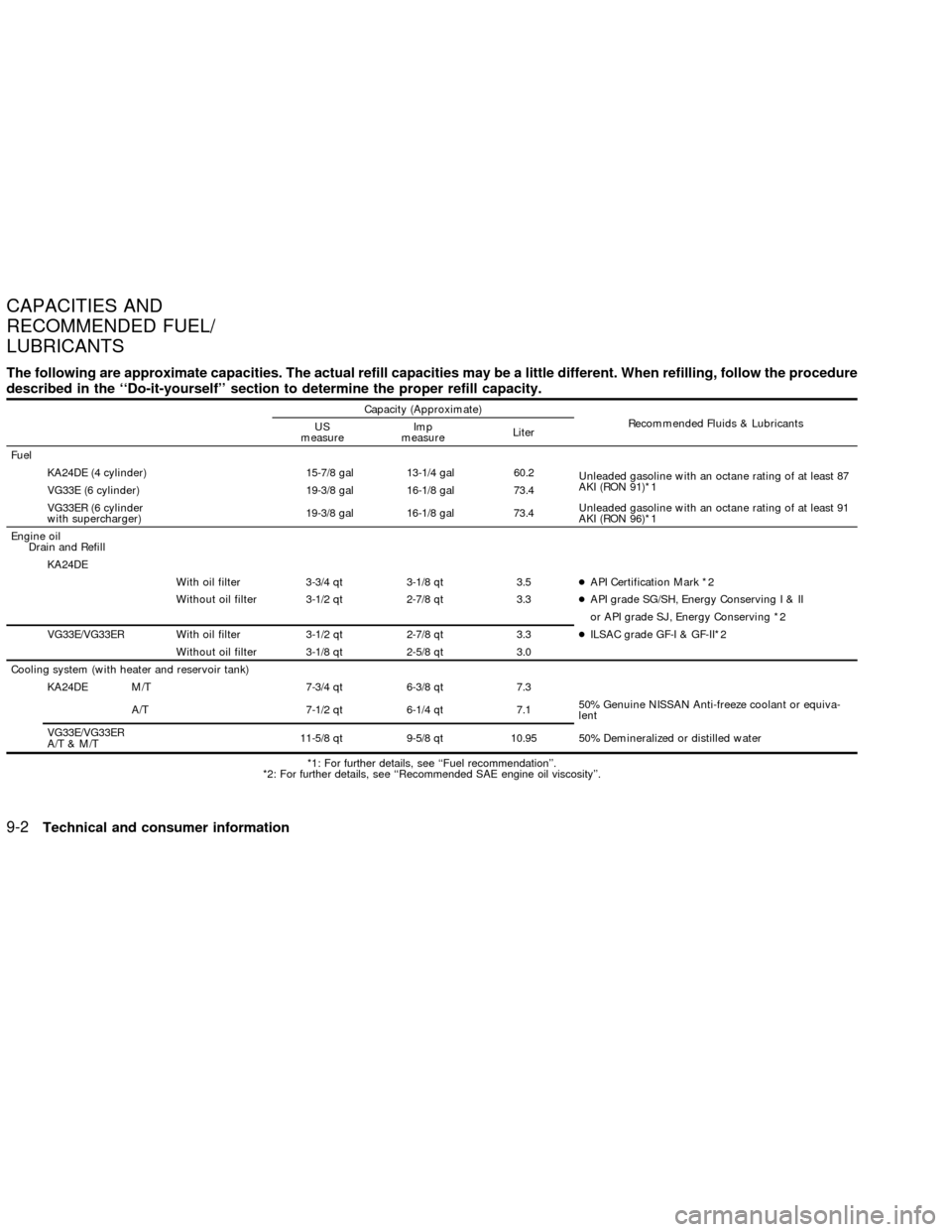
The following are approximate capacities. The actual refill capacities may be a little different. When refilling, follow the procedure
described in the ``Do-it-yourself'' section to determine the proper refill capacity.
Capacity (Approximate)
Recommended Fluids & Lubricants
US
measureImp
measureLiter
Fuel
KA24DE (4 cylinder) 15-7/8 gal 13-1/4 gal 60.2
Unleaded gasoline with an octane rating of at least 87
AKI (RON 91)*1
VG33E (6 cylinder) 19-3/8 gal 16-1/8 gal 73.4
VG33ER (6 cylinder
with supercharger)19-3/8 gal 16-1/8 gal 73.4Unleaded gasoline with an octane rating of at least 91
AKI (RON 96)*1
Engine oil
Drain and Refill
KA24DE
With oil filter 3-3/4 qt 3-1/8 qt 3.5cAPI Certification Mark *2
Without oil filter 3-1/2 qt 2-7/8 qt 3.3cAPI grade SG/SH, Energy ConservingI&II
or API grade SJ, Energy Conserving *2
VG33E/VG33ER With oil filter 3-1/2 qt 2-7/8 qt 3.3cILSAC grade GF-I & GF-II*2
Without oil filter 3-1/8 qt 2-5/8 qt 3.0
Cooling system (with heater and reservoir tank)
KA24DE M/T 7-3/4 qt 6-3/8 qt 7.3
A/T 7-1/2 qt 6-1/4 qt 7.150% Genuine NISSAN Anti-freeze coolant or equiva-
lent
VG33E/VG33ER
A/T & M/T11-5/8 qt 9-5/8 qt 10.95 50% Demineralized or distilled water
*1: For further details, see ``Fuel recommendation''.
*2: For further details, see ``Recommended SAE engine oil viscosity''.
CAPACITIES AND
RECOMMENDED FUEL/
LUBRICANTS
9-2Technical and consumer information
ZX