2002 NISSAN FRONTIER oil
[x] Cancel search: oilPage 202 of 273
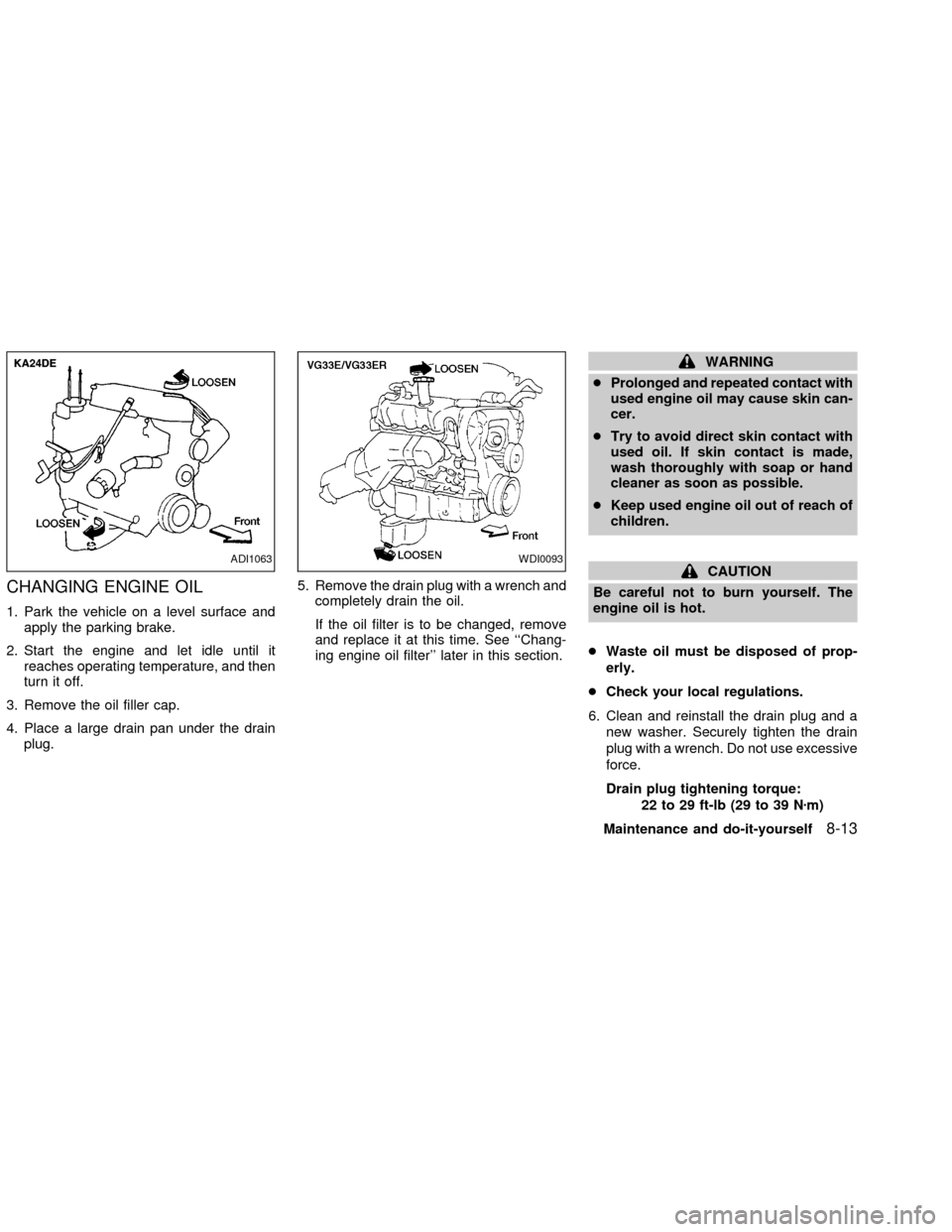
CHANGING ENGINE OIL
1. Park the vehicle on a level surface and
apply the parking brake.
2. Start the engine and let idle until it
reaches operating temperature, and then
turn it off.
3. Remove the oil filler cap.
4. Place a large drain pan under the drain
plug.5. Remove the drain plug with a wrench and
completely drain the oil.
If the oil filter is to be changed, remove
and replace it at this time. See ``Chang-
ing engine oil filter'' later in this section.
WARNING
cProlonged and repeated contact with
used engine oil may cause skin can-
cer.
cTry to avoid direct skin contact with
used oil. If skin contact is made,
wash thoroughly with soap or hand
cleaner as soon as possible.
cKeep used engine oil out of reach of
children.
CAUTION
Be careful not to burn yourself. The
engine oil is hot.
cWaste oil must be disposed of prop-
erly.
cCheck your local regulations.
6. Clean and reinstall the drain plug and a
new washer. Securely tighten the drain
plug with a wrench. Do not use excessive
force.
Drain plug tightening torque:
22 to 29 ft-lb (29 to 39 Nzm)ADI1063WDI0093
Maintenance and do-it-yourself8-13
ZX
Page 203 of 273
7. Refill engine with a recommended oil
through the oil filler opening then install
the oil filler cap securely.
See ``Capacities and recommended
fuel/lubricants'' in the ``Technical and
consumer information'' section for drain
and refill capacity.
The drain and refill capacity depends on
the oil temperature and drain time. Use
these specifications for reference only.
Always use the dipstick to determine
when the proper amount of oil is in the
engine.
8. Start the engine. Check for leakage
around the drain plug and oil filter. Cor-
rect as required.
9. Turn the engine off and wait several
minutes. Check the oil level with the
dipstick. Add engine oil if necessary.
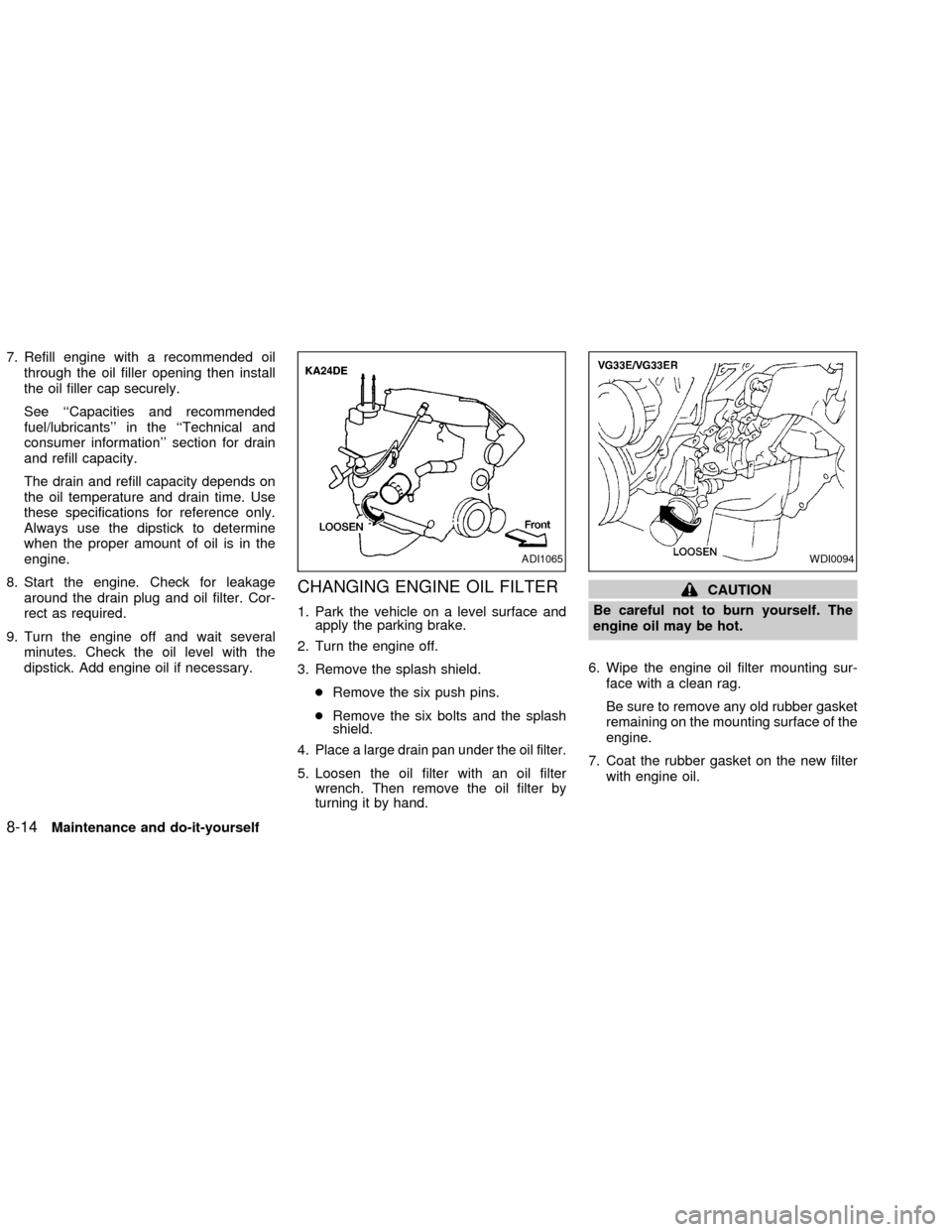
CHANGING ENGINE OIL FILTER
1. Park the vehicle on a level surface and
apply the parking brake.
2. Turn the engine off.
3. Remove the splash shield.
cRemove the six push pins.
cRemove the six bolts and the splash
shield.
4.
Place a large drain pan under the oil filter.
5. Loosen the oil filter with an oil filter
wrench. Then remove the oil filter by
turning it by hand.
CAUTION
Be careful not to burn yourself. The
engine oil may be hot.
6. Wipe the engine oil filter mounting sur-
face with a clean rag.
Be sure to remove any old rubber gasket
remaining on the mounting surface of the
engine.
7. Coat the rubber gasket on the new filter
with engine oil.
ADI1065WDI0094
8-14Maintenance and do-it-yourself
ZX
Page 204 of 273
8. Screw in the oil filter until a slight resis-
tance is felt, then tighten an additional
2/3 turn.
9. Start the engine and check for leakage
around the oil filter. Correct as required.
10.Turn the engine off and wait several
minutes. Check the oil level. Add engine
oil if necessary.WARNING
cWhen the engine is running, keep
hands, jewelry and clothing away
from any moving parts such as the
cooling fan and drive belts.
cAutomatic transmission fluid is poi-
sonous and should be stored care-
fully in marked containers out of the
reach of children.
TEMPERATURE CONDITIONS
FOR CHECKING
cThe fluid level should be checked using
the HOT range on the dipstick after the
following conditions have been met:
Ð The engine should be warmed up to
operating temperature.
Ð The vehicle should be driven at least 5
minutes.
Ð The ATF should be warmed to between
122 and 176ÉF (50 and 80ÉC).
cThe ATF can be checked at fluid tem-
peratures of 86 to 122ÉF (30 to 50ÉC)
using the COLD range on the dipstickafter the engine is warmed up and before
driving. However, the fluid should be re-
checked using the HOT range.
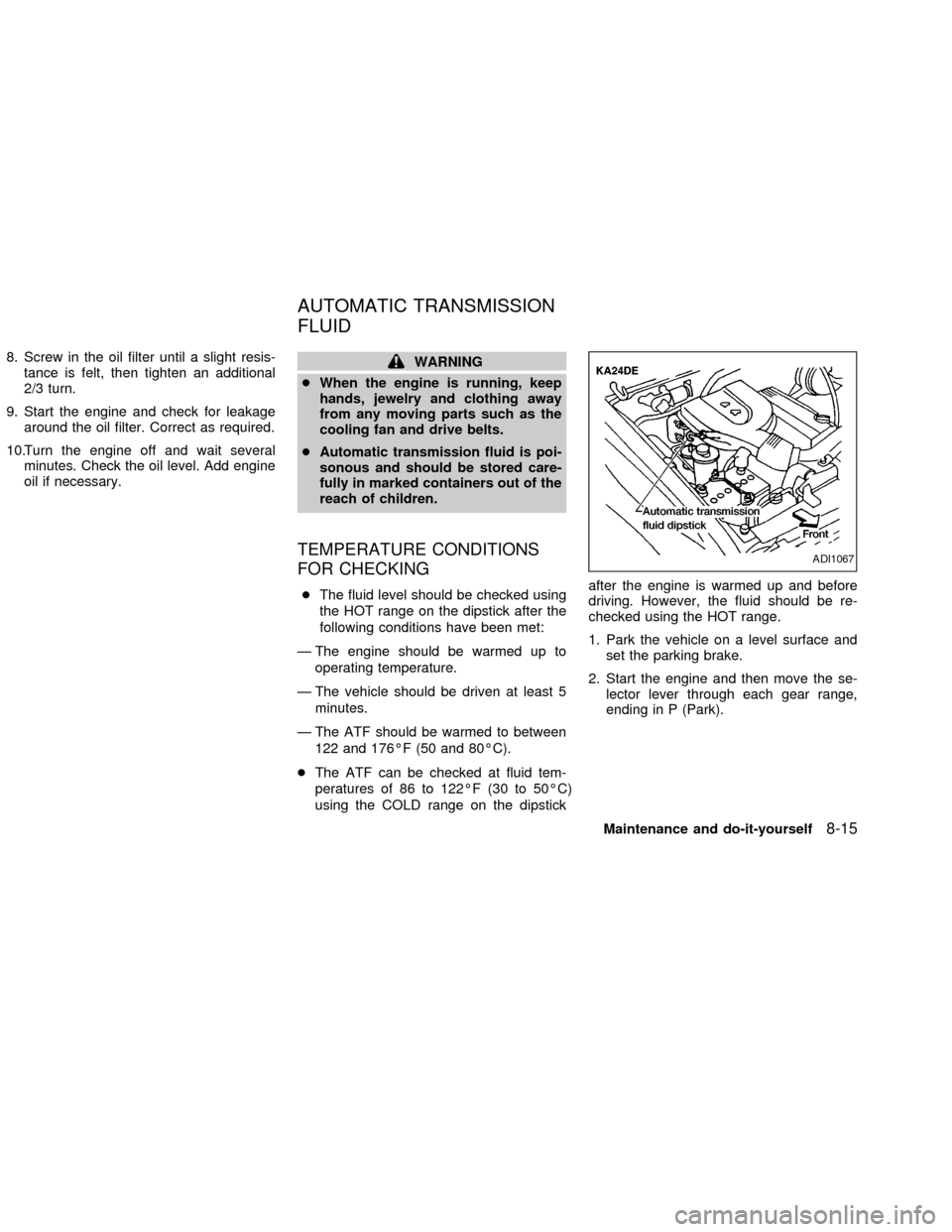
1. Park the vehicle on a level surface and
set the parking brake.
2. Start the engine and then move the se-
lector lever through each gear range,
ending in P (Park).
ADI1067
AUTOMATIC TRANSMISSION
FLUID
Maintenance and do-it-yourself8-15
ZX
Page 221 of 273
cAiming is not necessary after replac-
ing the bulb. When aiming adjust-
ment is necessary, contact an autho-
rized NISSAN dealer.
cDo not leave the bulb out of the
headlight reflector for a long period
of time as dust, moisture, and smoke
may enter the headlight body and
affect the performance of the head-
light.
Replacing the headlight bulb
1. Open the hood.
2. Disconnect the negative (2) battery
cable.
3 Disconnect the electrical connector from
the rear end of the bulb.
4. Turn the bulb retaining ring counterclock-
wise until it is free from the headlamp
reflector and then remove it.
5. Carefully remove the headlight bulb. Do
not shake or rotate the bulb when remov-
ing it.
DO NOT TOUCH THE BULB.6. Install the new bulb in the reverse order
of removal.
cBe sure the lip of the bulb socket
contacts the headlight body.
Adjusting the headlight aim
Before performing aiming adjustment, make
sure of the following:
a. Use an aiming wall screen.
b. Keep all of the tires inflated to the correct
pressure.
c. Place the vehicle and screen on level
ground.
d. See that the vehicle is unloaded (except
for full levels of coolant, engine oil and
fuel, and that the spare tire, jack, and
tools are stored). Have the driver or an
equivalent weight placed in the driver's
seat.
1. Open the hood. Turn headlight low beam
on.
2. Adjust the vertical aim by turning the
adjustment screw.cCover the opposite headlight and ensure
the fog lights (if so equipped) are turned
off.
cAdjust beam pattern until cutoff line is
positioned at the same height off ground
as bulb center (on H-line).
8-32Maintenance and do-it-yourself
ZX
Page 234 of 273

9 Technical and consumer information
Capacities and recommended fuel/lubricants ........9-2
Fuel recommendation ........................................9-4
Engine oil and oil filter recommendation ...........9-6
Recommended SAE viscosity number ..............9-7
Air conditioner system refrigerant and
lubricant recommendations ...............................9-8
Specifications .........................................................9-9
Engine ...............................................................9-9
Wheels and tires..............................................9-10
Dimensions and weights .................................9-11
When traveling or registering your vehicle in
another country ....................................................9-12
Vehicle identification ............................................9-12
Vehicle identification number (VIN)
plate .................................................................9-12
Vehicle identification number
(chassis number) .............................................9-12
Engine serial number ......................................9-13
F.M.V.S.S. certification label ...........................9-13
Emission control information label ..................9-14
Tire placard......................................................9-14
Air conditioner specification label ....................9-14Installing front license plate..................................9-15
Vehicle loading information ..................................9-15
Terms...............................................................9-15
Determining vehicle payload capacity .............9-16
Securing the load ............................................9-16
Loading tips .....................................................9-17
Truck-camper loading information........................9-17
Payload weight capacity ..................................9-19
Measurement of weights .................................9-21
Towing a trailer.....................................................9-21
Maximum load limits ........................................9-21
Towing load/specification chart .......................9-23
Towing safety ..................................................9-24
Uniform tire quality grading ..................................9-26
Emission control system warranty .......................9-27
Reporting safety defects (US only) ......................9-28
Readiness for inspection/maintenance (I/M)
test (US only) .......................................................9-28
Owner's manual/service manual order
information ............................................................9-30
In the event of a collision ................................9-31
ZX
Page 235 of 273

The following are approximate capacities. The actual refill capacities may be a little different. When refilling, follow the procedure
described in the ``Do-it-yourself'' section to determine the proper refill capacity.
Capacity (Approximate)
Recommended Fluids & Lubricants
US
measureImp
measureLiter
Fuel
KA24DE (4 cylinder) 15-7/8 gal 13-1/4 gal 60.2
Unleaded gasoline with an octane rating of at least 87
AKI (RON 91)*1
VG33E (6 cylinder) 19-3/8 gal 16-1/8 gal 73.4
VG33ER (6 cylinder
with supercharger)19-3/8 gal 16-1/8 gal 73.4Unleaded gasoline with an octane rating of at least 91
AKI (RON 96)*1
Engine oil
Drain and Refill
KA24DE
With oil filter 3-3/4 qt 3-1/8 qt 3.5cAPI Certification Mark *2
Without oil filter 3-1/2 qt 2-7/8 qt 3.3cAPI grade SG/SH, Energy ConservingI&II
or API grade SJ, Energy Conserving *2
VG33E/VG33ER With oil filter 3-1/2 qt 2-7/8 qt 3.3cILSAC grade GF-I & GF-II*2
Without oil filter 3-1/8 qt 2-5/8 qt 3.0
Cooling system (with heater and reservoir tank)
KA24DE M/T 7-3/4 qt 6-3/8 qt 7.3
A/T 7-1/2 qt 6-1/4 qt 7.150% Genuine NISSAN Anti-freeze coolant or equiva-
lent
VG33E/VG33ER
A/T & M/T11-5/8 qt 9-5/8 qt 10.95 50% Demineralized or distilled water
*1: For further details, see ``Fuel recommendation''.
*2: For further details, see ``Recommended SAE engine oil viscosity''.
CAPACITIES AND
RECOMMENDED FUEL/
LUBRICANTS
9-2Technical and consumer information
ZX
Page 236 of 273

Capacity (Approximate)
Recommended Fluids & Lubricants
US
measureImp
measureLiter
Manual transmission gear oil KA24DE 4x2 4-1/4 pt 3-1/2 pt 2.0 API GL-4*1 Viscosity SAE 75W-90 only
VG33E/
VG33ER4x2 5-7/8 pt 4-7/8 pt 2.8
4x4 10-3/4 pt 9 pt 5.1
Final drive gear oil KA24DE 2-3/4 pt 2-1/4 pt 1.3 API GL-5*1
VG33E/
VG33ER4x4 Front 3-1/8 pt 2-5/8 pt 1.5
Rear 5-7/8 pt 4-7/8 pt 2.8
Transfer fluid 2-3/8 qt 2 qt 2.2Nissan Matic `D' (Continental U.S. and Alaska) or Canada
NISSAN Automatic Transmission Fluid or API GL-4. *4
Automatic transmission fluid
Refill to the proper oil level according
to the instructions in the ``Do-it-
yourself'' section.Nissan Matic `D' (Continental U.S. and Alaska) or Canada
NISSAN Automatic Transmission Fluid. *4
Power steering fluidGenuine NISSAN PSF II or equivalent *7
Brake and clutch fluidGenuine Nissan Brake Fluid*5 or equivalent
DOT 3 (US FMVSS No. 116)
Multi-purpose grease Ð Ð Ð NLGI No. 2 (Lithium Complex)
Air conditioning system refrigerant lb (kg) 1.32 - 1.54 (0.60 - 0.70) HFC-134a (R-134a)*6
Air conditioning system lubricant 6.8 oz 7.0 oz 200 ml Nissan A/C System Lubricant PAG Type R or equivalent*6
*1: For further details, see ``Recommended SAE gear oil viscosity''.
*2: SAE 90 is acceptable in temperatures above 0ÉF (þ18ÉC).
*3: Contact your NISSAN dealer for a list of approved oils.
*4: Dexron
TMIII/MerconTMor equivalent may also be used. Outside the Continental United States and Alaska contact an authorized Nissan dealership for more information regarding suitable
fluids, including recommended brand(s) of DexronTMIII/MerconTMAutomatic Transmission Fluid.
*5: Available in mainland U.S.A. through an authorized NISSAN dealer.
*6: For further details, see ``Air conditioner specification label''.
*7: Genuine NISSAN PSF, Canada NISSAN Automatic Transmmission Fluid, Dexron
TMIII/MerconTM, or equivalent ATF may also be used.
Technical and consumer information9-3
ZX
Page 239 of 273

ENGINE OIL AND OIL FILTER
RECOMMENDATION
Selecting the correct oil
It is essential to choose engine oil with the
correct quality and viscosity to ensure sat-
isfactory engine life and performance.
NISSAN recommends the use of a low
friction oil (energy conserving oil) in order to
improve fuel economy and conserve en-
ergy. Oils which do not have the specified
quality label should not be used as they
could cause engine damage.Only those engine oils with the American
Petroleum Institute (API) CERTIFICATION
MARK on the front of the container should
be used. This type of oil supersedes the
existing API SG, SH or SJ and Energy
ConservingI&IIcategories.
If you cannot find engine oil with the API
CERTIFICATION MARK, use an API grade
SG/SH, Energy ConservingI&IIorAPI
grade SJ, Energy Conserving oil. An oil with
a single designation SG or SH, or in combi-
nation with other categories (for example,
SG/CC or SG/CD) may also be used if one
with the API CERTIFICATION MARK cannotbe found. An ISLAC grade GF-I & GF-II oil
can also be used.
Mineral based or synthetic type oils may be
used in your NISSAN vehicle. These oils
must however, meet the API quality and
SAE viscosity ratings specified for your ve-
hicle. Do not mix mineral based and syn-
thetic type oils in the engine.
Oil additives
NISSAN does not recommend the use of oil
additives. The use of an oil additive is not
necessary when the proper oil type is used
and maintenance intervals are followed.
Oil which may contain foreign matter or has
been previously used should not be used.
Oil viscosity
The engine oil viscosity or thickness
changes with temperature. Because of this,
it is important that the engine oil viscosity be
selected based on the temperatures at
which the vehicle will be operated before
the next oil change. The chart ``Recom-
mended SAE viscosity number'' shows the
recommended oil viscosities for the ex-
pected ambient temperatures. Choosing an
oil viscosity other than that recommended
WTI0033
9-6Technical and consumer information
ZX