2002 MERCEDES-BENZ SLK 230 KOMPRESSOR capacity
[x] Cancel search: capacityPage 94 of 290

91 Climate control
Te ch n i c a l
data Instruments
and controlsOperationDrivingInstrument
cluster displayPractical hints Car care Index Air recirculation
This mode can be selected to temporarily reduce the
entry of annoying odors or dust into the vehicle’s
interior.
Outside air is not supplied to the vehicle’s interior.
To s el ect , p res s O button.
To cancel, press O button again.
The system will automatically switch from recirculated
air to fresh air
•after approximately 5 minutes at outside
temperatures below approximately 40°F (5°C),
•after approximately 30 minutes, at outside
temperatures above approximately 40°F (5°C),
•after approximately 5 minutes, if button S is
pressed.
At high outside temperatures, the system automatically
engages the recirculated air mode for approximately
30 minutes, thereby increasing the cooling capacity
performance. Press O button again to extend the
recirculated air mode.Residual engine heat utilization (REST)
With the engine switched off, it is possible to continue
heating the interior for a short while.
Air volume is controlled automatically. Select
temperature for each side of the passenger
compartment. Set air distribution control switch to the
desired position.
To s e l e c t :
Turn key in steering lock to position 1 or 0 or remove.
Press O button. Indicator lamp in the button lights
up.
This function selection will not activate if the battery
charge level is insufficient.
To c a n c e l :
Press O button. Indicator lamp in the button goes
out.
The system will automatically shut off
•if you turn key in steering lock to position 2,
•after approximately 30 minutes,
•if the battery voltage drops.
Page 167 of 290
164 Driving instructions
Te ch n i c a l
data Instruments
and controlsOperationDrivingInstrument
cluster displayPractical hints Car care Index
Winter driving
Have your vehicle winterized at your authorized
Mercedes-Benz Center before the onset of winter.
•Change the engine oil if the engine contains an oil
which is not approved for winter operation. For
viscosity (SAE / CCMC class) and filling quantity,
see page 266.
•Check engine coolant anticorrosion / antifreeze
concentration.•Additive for the windshield washer and headlamp
cleaning system: Add MB Concentrate “S” to a
premixed windshield washer solvent / antifreeze
which is formulated for below freezing
temperatures, see page 199.
•Test battery: Battery capacity drops with decreasing
ambient temperature. A well charged battery helps
to ensure that the engine can be started, even at low
ambient temperatures.
•Tires: We recommend M+S rated radial-ply tires on
all four wheels for the winter season. Observe
permissible maximum speed for M+S rated radial-
ply tires and the legal speed limit.
Note:
In winter operation, the maximum effectiveness of the
antilock brake system (ABS) or electronic stability
program (ESP) can only be achieved with M+S rated
radial-ply tires and / or snow chains recommended by
Mercedes-Benz. Snow chains maximize performance.
Wa r n i n g !
If the vehicle becomes stuck in snow, make sure
that snow is kept clear of the exhaust pipe and
from around the vehicle with engine running.
O t h e rw i s e , d e a d ly c a r b o n m on ox i d e ( CO ) ga s e s m ay
enter vehicle interior resulting in unconsciousness
and death.To assure sufficient fresh air ventilation, open a
window slightly on the side of the vehicle not
facing the wind.
Page 180 of 290

177 What you should know at the gas station
Te ch n i c a l
data Instruments
and controlsOperationDrivingInstrument
cluster displayPractical hints Car care Index What you should know at the gas station
Fuel supply
Open flap by pushing near front (arrow). Turn fuel cap
to the left and hold on to it until possible pressure in
tank has been released, then remove cap. Failure to
remove slowly could result in personal injury.See page 244 for notes on fuel filler flap, manual
release.
Fuel
To prevent fuel vapors from escaping into open air, fully
insert filler nozzle unit.
Only fill fuel tank until the filler nozzle unit cuts out —
do not top up or overfill.
Leaving the engine running and the fuel cap open can
cause the “CHECK ENGINE” lamp to illuminate.
Fuel tank capacity approximately 15.8 US gal (60.0 l).
This includes approximately 2.1 US gal (8.0 l) reserve.
Use premium unleaded gasoline: Posted Octane
Index 91 (Average of 96 RON / 86 MON).
Wa r n i n g !
Gasoline is highly flammable and poisonous. It
burns violently and can cause serious injury.
Whenever you are around gasoline, avoid inhaling
fumes and skin contact, extinguish all smoking
materials. Never allow sparks, flame or smoking
materials near gasoline!
P88.60-2028-21
Wa r n i n g !
Overfilling of fuel tank may result in creating
pressure in the system which could cause a gas
discharge such as the gas spraying back out upon
removing the filler nozzle which could cause
personal injury.
Page 202 of 290
199 Windshield and headlamp washer system
Te ch n i c a l
data Instruments
and controlsOperation DrivingInstrument
cluster displayPractical hintsCar care Index Windshield and headlamp washer system
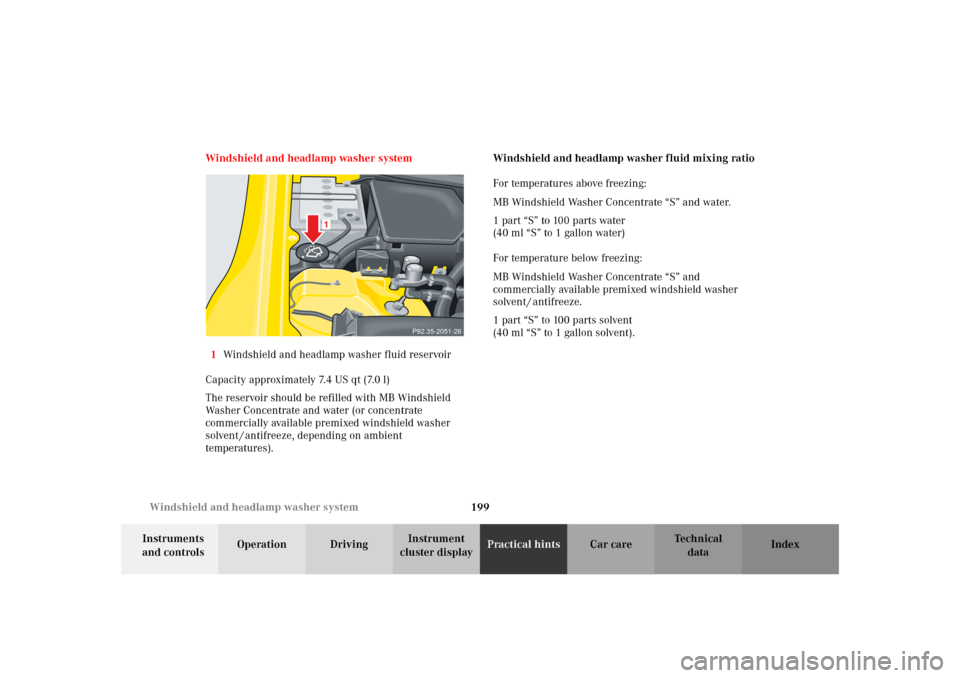
1Windshield and headlamp washer fluid reservoir
Capacity approximately 7.4 US qt (7.0 l)
The reservoir should be refilled with MB Windshield
Washer Concentrate and water (or concentrate
commercially available premixed windshield washer
solvent / antifreeze, depending on ambient
temperatures).Windshield and headlamp washer fluid mixing ratio
For temperatures above freezing:
MB Windshield Washer Concentrate “S” and water.
1 part “S” to 100 parts water
(40 ml “S” to 1 gallon water)
For temperature below freezing:
MB Windshield Washer Concentrate “S” and
commercially available premixed windshield washer
solvent / antifreeze.
1 part “S” to 100 parts solvent
(40 ml “S” to 1 gallon solvent).
1
P82.35-2051-26
Page 204 of 290
201 Vehicle jack
Te ch n i c a l
data Instruments
and controlsOperation DrivingInstrument
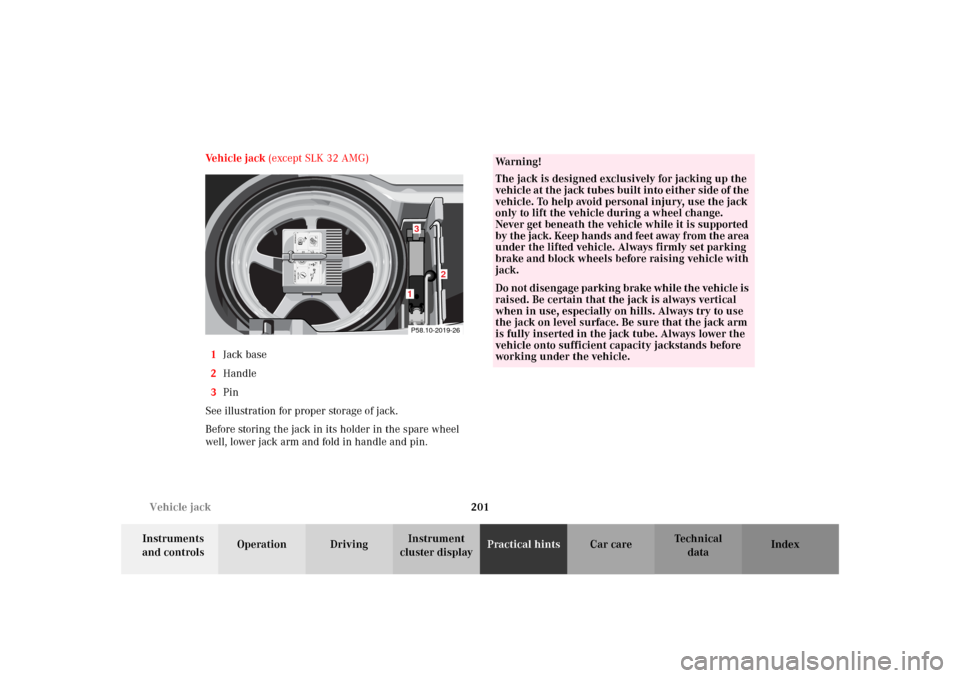
cluster displayPractical hintsCar care Index Ve h i c l e j a c k (except SLK 32 AMG)
1Jack base
2Handle
3Pin
See illustration for proper storage of jack.
Before storing the jack in its holder in the spare wheel
well, lower jack arm and fold in handle and pin.
1
0
456max. 6 min
A 170 584 01 38 AIR COMPRESSOR 23
Mercedes-Benz2
3
2 1
12,5 bar
36 psi1
0 23
4
5
620PSI
BAR40
60
80LUFTPRESSER 1
2
P58.10-2019-261
2
3
Wa r n i n g !
The jack is designed exclusively for jacking up the
vehicle at the jack tubes built into either side of the
vehicle. To help avoid personal injury, use the jack
only to lift the vehicle during a wheel change.
Never get beneath the vehicle while it is supported
by the jack. Keep hands and feet away from the area
under the lifted vehicle. Always firmly set parking
brake and block wheels before raising vehicle with
jack.Do not disengage parking brake while the vehicle is
raised. Be certain that the jack is always vertical
when in use, especially on hills. Always try to use
the jack on level surface. Be sure that the jack arm
is fully inserted in the jack tube. Always lower the
vehicle onto sufficient capacity jackstands before
working under the vehicle.
Page 210 of 290
207 Tires, wheels
Te ch n i c a l
data Instruments
and controlsOperation DrivingInstrument
cluster displayPractical hintsCar care Index Changing wheelsMove vehicle to a level area which is a safe distance
from the roadway.
1. Set parking brake and turn on hazard warning
flasher.
2. Move selector lever to position “P” and turn off
engine (manual transmission to 1st or reverse gear).
3. Prevent vehicle from rolling away by blocking
wheels with wheel chocks (not supplied with
vehicle) or sizable wood block or stone. When
changing a wheel on a hill, place chocks on the
downhill side blocking both wheels of the other
axle. On a level road, place one chock in front of and
one behind the wheel that is diagonally opposite to
the wheel being changed.
The jack is designed exclusively for jacking up the
vehicle at the jack tubes built into either side of the
vehicle. To help avoid personal injury, use the jack
only to lift the vehicle during a wheel change.
Never get beneath the vehicle while it is supported
by the jack. Keep hands and feet away from the area
under the lifted vehicle. Always firmly set parking
brake and block wheels before raising vehicle with
jack.Do not disengage parking brake while the vehicle is
raised. Be certain that the jack is always vertical
when in use, especially on hills. Always try to use
the jack on level surface. Be sure that the jack arm
is fully inserted in the jack tube. Always lower the
vehicle onto sufficient capacity jackstands before
working under the vehicle.
Page 223 of 290
220 Battery
Te ch n i c a l
data Instruments
and controlsOperation DrivingInstrument
cluster displayPractical hintsCar care Index
If a tire constantly loses air, it should be inspected for
damage.
The spare tire should be checked periodically for
condition. Spare tire will age and become worn over
time even if never used, and thus should be inspected
and replaced when necessary.Battery
Important!
Battery replacement information:
The maintenance-free battery is located in the engine
compartment.
The service life of the battery is dependent on its
condition of charge. The battery should always be kept
sufficiently charged, in order to last an optimum length
of time.
Wa r n i n g !
Do not overinflate tires. Overinflating tires can
result in sudden deflation (blowout) because they
are more likely to become punctured or damaged
by road debris, potholes etc.. Follow recommended
inflation pressures.Do not overload the tires by exceeding the specified
vehicle capacity weight (as indicated by the label
on the driver’s door latch post). Overloading the
tires can overheat them, possibly causing a
blowout.
Wa r n i n g !
Failure to follow these instructions can result in
severe injury or death.Never lean over batteries while connecting, you
might get injured.Battery fluid contains sulfuric acid. Do not allow
this fluid to come in contact with eyes, skin or
clothing. In case it does, immediately flush affected
area with water and seek medical help.A battery will also produce hydrogen gas, which is
flammable and explosive. Keep flames or sparks
away from battery, avoid improper connection of
jumper cables, smoking etc..
Page 269 of 290

266 Fuels, coolants, lubricants etc. - capacities
Te ch n i c a l
data Instruments
and controlsOperation DrivingInstrument
cluster displayPractical hints Car care Index
Fuels, coolants, lubricants etc. – capacities
Vehicle components and their respective lubricants must match. Therefore use only brands tested and recommended
by us. Please refer to the Factory Approved Service Products pamphlet, or inquire at your authorized Mercedes-Benz
Center.
Model Capacity Fuels, coolants, lubricants etc.
Engine with oil filter SLK 230
SLK 320
SLK 32 AMG6.1 US qt (5.5 l)
8.5 US qt (8.0 l)Recommended engine oils
Automatic transmission 8.5 US qt (8.0 l) Automatic transmission fluid
Manual transmission SLK 230
SLK 3201. 6 U S q t ( 1. 5 l )
1. 9 U S q t ( 1. 8 l )Transmission oil
Rear axle 1.4 US qt (1.3 l) Hypoid gear oil SAE 90, 85 W 90
Power steering approx. 1.1 US qt (1.0 l) MB Power steering fluid
Front wheel hubs approx. 1.5 oz (43 g) each High temperature roller bearing grease
Brake system approx. 0.5 US qt (0.5 l) MB Brake fluid (DOT 4)
Cooling system SLK 230
SLK 320
SLK 32 AMGapprox. 9.8 US qt (9.3 l)
approx. 11.8 US qt (11.2 l)
approx. 15.3 US qt (14.5 l)MB Anticorrosion / antifreeze