2002 MERCEDES-BENZ SL500 vent
[x] Cancel search: ventPage 13 of 302

10 Introduction
Roadside assistance
The Mercedes-Benz Roadside Assistance Program provides factory trained technical help in the event of a breakdown.
Calls to the toll-free Roadside Assistance number:
1-800-FOR-MERCedes (in the USA)
1-800-387-0100 (in Canada)
will be answered by Mercedes-Benz Client Assistance Representatives 24 hours a day, 365 days a year.
For additional information refer to the Mercedes-Benz Roadside Assistance Program brochure in your glove box.
Change of address or ownership
If you change your address, be sure to send in the “Change of Address Notice” found in the Service and Warranty
Information Booklet, or simply call the Mercedes-Benz Client Assistance Center (in the USA) at
1-800-FOR-MERCedes, or Customer Service (in Canada) at 1-800-387-0100. It is in your own interest that we can
contact you should the need arise.
If you sell your Mercedes, please leave all literature with the vehicle to make it available to the next operator.
If you bought this vehicle used, be sure to send in the “Notice of Purchase of Used Car” found in the Service and
Warranty Information Booklet, or call the Mercedes-Benz Client Assistance Center (in the USA) at
1-800-FOR-MERCedes, or Customer Service (in Canada) at 1-800-387-0100.
Page 16 of 302
13 IntroductionWhere to find it
The Operator’s Manual is divided into eight sections:
•Instruments and controls: An overview of all the controls that can be operated from the driver’s seat.
•Operation: Information on the vehicle’s equipment and its operation.
•Driving: Important information on driving.
•Instrument cluster display: Displays and indicator lamps on the instrument cluster with brief instructions.
•Practical hints: Assistance and instructions in the event of an emergency.
•Car care: Instructions on caring for your vehicle.
•Technical data: All the important technical data for your vehicle as well as consumer information such as fuels,
coolants, lubricants etc. is contained here.
•Index: Key terms to help you find a topic quickly.
Other documents may also be supplied, depending on your vehicle’s equipment.
Explanation of color used:
Warning notices for the protection of yourself and
others appear on red background.
Page 41 of 302
37 Central locking system
Te ch n ica l
data Instruments
and controlsOperationDrivingInstrument
cluster displayPractical hints Car care Index Automatic central locking
The central locking switch also operates the automatic
central locking.
With the automatic central locking system activated, the
doors and trunk are locked at vehicle speeds of approx.
9 mph (15 km/h) or more. The fuel filler flap remains
unlocked.
To a ctiva te:
With key in steering lock position 2 hold upper portion
of switch (1) for a minimum of 5 seconds.
To deactivate:
With key in steering lock position 2 hold lower portion
of switch (2) for a minimum of 5 seconds.
Notes:
If doors are unlocked with the central locking switch
after activating the automatic central locking, and
neither door is opened, then the doors remain unlocked
even at vehicle speeds of approx. 9 mph (15 km/h) or
more.If a door is opened from the inside at speeds of approx.
9 mph (15 km/h) or less with the automatic central
locking activated, the door will again be automatically
locked at speeds of approx. 9 mph (15 km/h) or more.
Important!
When towing the vehicle, or with the vehicle on a
dynamometer test stand, please, note the following:
With the automatic central locking activated and the
key in steering lock position 2, the vehicle doors will
lock if the left front wheel as well as the right rear
wheel spin are turning at vehicle speeds of approx.
9mph (15km/h) or more.
To prevent the vehicle door locks from locking,
deactivate the automatic central locking.
Emergency unlocking in case of accident
The doors unlock automatically a short time after a
strong deceleration is detected, such as in a collision
(this is intended to aid rescue and exit). Driving on
rough roads may cause the vehicle to unlock. If
necessary, the vehicle can be locked again with the
interior central locking switch.
Page 47 of 302
43 Tow-away protection
Te ch n ica l
data Instruments
and controlsOperationDrivingInstrument
cluster displayPractical hints Car care Index Tow - aw ay al a rm
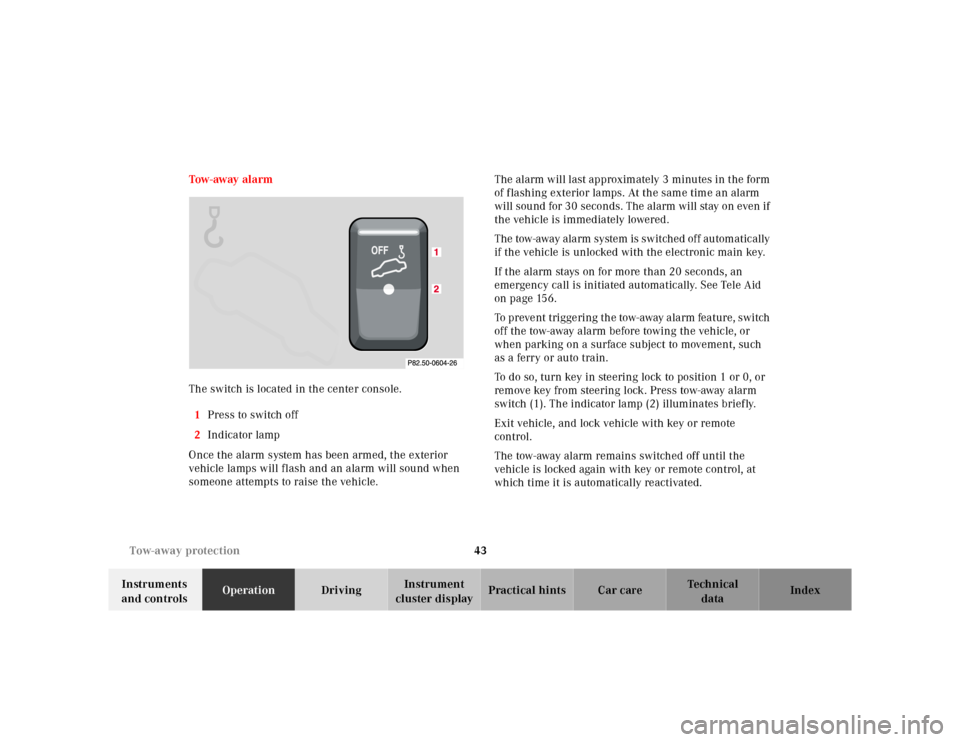
The switch is located in the center console.
1Press to switch off
2Indicator lamp
Once the alarm system has been armed, the exterior
vehicle lamps will flash and an alarm will sound when
someone attempts to raise the vehicle.The alarm will last approximately 3 minutes in the form
of f lashing exterior lamps. At the same time an alarm
will sound for 30 seconds. The alarm will stay on even if
the vehicle is immediately lowered.
The tow-away alarm system is switched off automatically
if the vehicle is unlocked with the electronic main key.
If the alarm stays on for more than 20 seconds, an
emergency call is initiated automatically. See Tele Aid
on page 156.
To prevent triggering the tow-away alarm feature, switch
off the tow-away alarm before towing the vehicle, or
when parking on a surface subject to movement, such
as a ferry or auto train.
To do so, turn key in steering lock to position 1 or 0, or
remove key from steering lock. Press tow-away alarm
switch (1). The indicator lamp (2) illuminates briefly.
Exit vehicle, and lock vehicle with key or remote
control.
The tow-away alarm remains switched off until the
vehicle is locked again with key or remote control, at
which time it is automatically reactivated.
Page 49 of 302
45 Seats
Te ch n ica l
data Instruments
and controlsOperationDrivingInstrument
cluster displayPractical hints Car care Index 5Head restraint
(with shoulder belt height adjustment)
Adjust the head restraint so that the upper portion
of the shoulder belt is located as close as possible to
the middle of the shoulder. The head restraint can
be tilted forward by hand.
Note:
To prevent the backrest from touching the soft top
storage compartment cover when the seat is moved
back, the backrest will automatically move to a more
upright position.
When reclining the backrest, the seat will automatically
move forward to prevent the backrest from touching the
soft top storage compartment cover.
Wa r n i n g !
When leaving the vehicle always remove the key
from the steering lock, and lock the vehicle.The power seats can also be operated with a door
open. Do not leave children unattended in the
vehicle, or with access to an unlocked vehicle.
Unsupervised use of vehicle equipment may cause
serious personal injury.
Do not adjust the driver’s seat while driving.
Adjusting the seat while driving could cause the
driver to lose control of the vehicle.Never ride in a moving vehicle with the backrest
reclined.
Sitting in an excessively reclined position can be
dangerous. You could slide under the seat belt in a
collision. If you slide under it, the belt would apply
force at the abdomen or neck. That could cause
serious or even fatal injuries. The backrest and seat
belt provide the best restraint when the wearer is
in an upright position and the belt is properly
positioned on the body.The rear storage area should never be occupied by
passengers since the vehicle is a 2 seater.
Furthermore, there is a risk of injury in the rear by
adjusting the power assisted front seats.Never place hands under seat or near any moving
parts while a seat is being adjusted.
Page 65 of 302

61 Restraint systems
Te ch n ica l
data Instruments
and controlsOperationDrivingInstrument
cluster displayPractical hints Car care Index come on at all or if it fails to extinguish after
approximately 4 seconds or if it comes on thereafter, a
malfunction in the system has been detected.
The following system components are monitored or
undergo a selfcheck: crash-sensor(s), airbag ignition
circuits, seat belt buckles, emergency tensioning
retractors, seat sensor.
Initially, when the key is turned from steering lock
position 0 to positions 1 or 2, malfunctions in the crash-
sensor are detected and indicated (the “SRS” indicator
lamp stays on longer than 4 seconds or does not come
on). In the operational mode, after the indicator lamp
has gone out following the initial check, interruptions or
short circuits in the airbag ignition circuit and in the
driver and passenger seat belt buckle harnesses, and
low voltage in the entire system are detected and
indicated.Have the system checked at your authorized
Mercedes-Benz Center immediately.
Wa r n i n g !
In the event a malfunction of the “SRS” is indicated
as outlined above, the “SRS” may not be
operational. For your safety, we strongly
recommend that you visit an authorized
Mercedes-Benz Center immediately to have the
system checked; otherwise the “SRS” may not be
activated when needed in an accident, which could
result in serious or fatal injury, or it might deploy
unexpectedly and unnecessary which could also
result in injury.
Page 68 of 302
64 Restraint systems
Te ch n ica l
data Instruments
and controlsOperationDrivingInstrument
cluster displayPractical hints Car care Index
To reduce the risk of injury when the front airbags
inflate, it is very important for the driver and front
passenger to always be in a properly seated
position and to wear their seat belts.
For maximum protection in the event of a collision
always be in normal seated position w ith your back
against the backrest. Fasten your seat belt and
ensure that it is properly positioned on your body.For unobstructive inflation of door side impact
airbags, keep door pocket lids closed.Since the airbag inflates with considerable speed
and force, a proper seating and hands on steering
wheel position will help to keep you at a safe
distance from the airbag.
Occupants who are unbelted, out of position or too
close to the airbag can be seriously injured by an
airbag as it inflates with great force in the blink of
an eye:• Sit properly belted in an upright position with
your back against the backrest.
• Adjust the driver’s seat as far as possible
rearward, still permitting proper operation of
vehicle controls. Adjust the driver’s seat as far
as possible rearward, still permitting proper
operation of vehicle controls. The distance
from the center of the driver’s breastbone to
the center of the airbag cover on the steering
wheel must be at least ten inches (25 cm) or
more. You should be able to accomplish this by
a combination of adjustments to the seat and
steering wheel. If you have any problems,
please see your authorized Mercedes-Benz
Center.• Do not lean with your head or chest close to the
steering wheel or dashboard.• Keep hands on the outside of steering wheel
rim. Placing hands and arms inside the rim
can increase the risk and potential severity of
hand/arm injury when the driver front airbag
inflates.• Do not lean against doors.
Page 73 of 302
69 Restraint systems
Te ch n ica l
data Instruments
and controlsOperationDrivingInstrument
cluster displayPractical hints Car care Index Important!
The use of infant or child restraints is required by law in
all 50 states and all Canadian provinces.
Infants and small children should be seated in an
appropriate infant or child restraint system properly
secured by a lap-shoulder belt, and that complies with
U.S. Federal Motor Vehicle Safety Standard 213 and
Canadian Motor Vehicle Safety Standard 213.
A statement by the child restraint manufacturer of
compliance with this standard can be found on the
instruction label on the restraint and in the instruction
manual provided with the restraint.
When using any infant or child restraint system, be sure
to carefully read and follow all manufacturer’s
instructions for installation and use.
Please read and observe warning labels affixed to inside
of vehicle and to infant or child restraints.
U.S.A. Mod els only:
Since 1986 all U.S. child restraints comply with
U.S. regulations without the use of a tether strap.
Wa r n i n g !
Children 12 years old and under must never ride in
this vehicle, except in a Mercedes-Benz authorized
BabySmart
TM compatible child seat, which operates
with the BabySmart
TM system installed in the
vehicle to deactivate the passenger front airbag
when it is properly installed. Otherwise they will
be struck by the airbag when it inflates in a crash.
If this happens, serious or fatal injury can result.
Infants and small children must be seated in an
appropriate infant or child restraint system, which
is properly secured with the vehicle’s seat belt,
fully in accordance with the child seat
manufacturer’s instructions.Infants and small children should never share a
seat belt with another occupant. During an
accident, they could be crushed between the
occupant and seat belt.When the child restraint is not in use, remove it
from the vehicle or secure it with the seat belt to
prevent the child restraint from becoming a
projectile in the event of an accident.