Page 320 of 430
317 Malfunction and warning messages
Te ch n i c a l
data Instruments
and controlsOperation DrivingInstrument
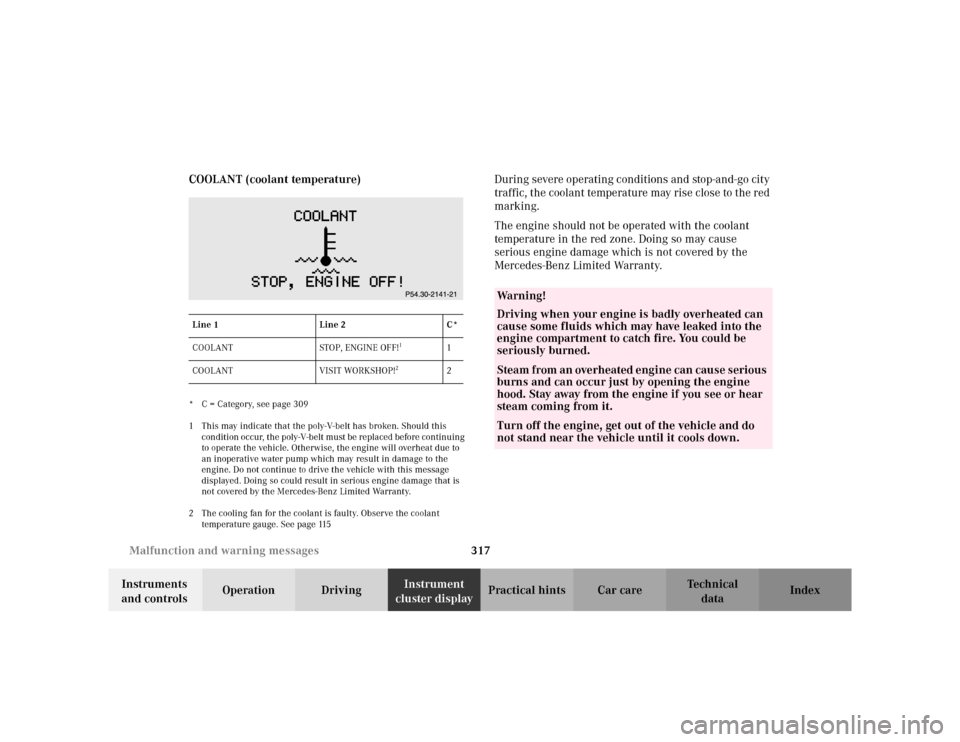
cluster displayPractical hints Car care Index COOLANT (coolant temperature)
* C = Category, see page 309
1 This may indicate that the poly-V-belt has broken. Should this
condition occur, the poly-V-belt must be replaced before continuing
to operate the vehicle. Otherwise, the engine will overheat due to
an inoperative water pump which may result in damage to the
engine. Do not continue to drive the vehicle with this message
displayed. Doing so could result in serious engine damage that is
not covered by the Mercedes-Benz Limited Warranty.
2 The cooling fan for the coolant is faulty. Observe the coolant
temperature gauge. See page 115
During severe operating conditions and stop-and-go city
traffic, the coolant temperature may rise close to the red
marking.
The engine should not be operated with the coolant
temperature in the red zone. Doing so may cause
serious engine damage which is not covered by the
Mercedes-Benz Limited Warranty.
Line 1 Line 2 C*
COOLANT STOP, ENGINE OFF!
1
1
COOLANT VISIT WORKSHOP!
2
2
Wa r n i n g !
Driving when your engine is badly overheated can
cause some fluids which may have leaked into the
engine compartment to catch fire. You could be
seriously burned.Steam from an overheated engine can cause serious
burns and can occur just by opening the engine
hood. Stay away from the engine if you see or hear
steam coming from it.Turn off the engine, get out of the vehicle and do
not stand near the vehicle until it cools down.
Page 342 of 430
339 Engine compartment
Te ch n i c a l
data Instruments
and controlsOperation DrivingInstrument
cluster displayPractical hintsCar care Index Auxiliary fuse box below rear seat
4Auxiliary fuse box below right rear seat
To o pen :
Remove the cover.
To c lo se:
Press the cover on.Hood
4
P82.10-0911-26
Wa r n i n g !
To help prevent personal injury, stay clear of
moving parts when the hood is open and the engine
is running. Be sure the hood is properly closed
before driving. When closing hood, use extreme
caution not to catch hands or fingers.The radiator fan may continue to run for
approximately 30 seconds or even restart after the
engine has been turned off. Stay clear from fan
blades.If you see flames or smoke coming from the engine
compartment, or if the coolant temperature gauge
indicates that the engine is overheated, do not open
the hood. Move away from vehicle and do not open
the hood until the engine has cooled. If necessary,
call a fire department.
Page 347 of 430
344 Engine compartment
Te ch n i c a l
data Instruments
and controlsOperation DrivingInstrument
cluster displayPractical hintsCar care Index
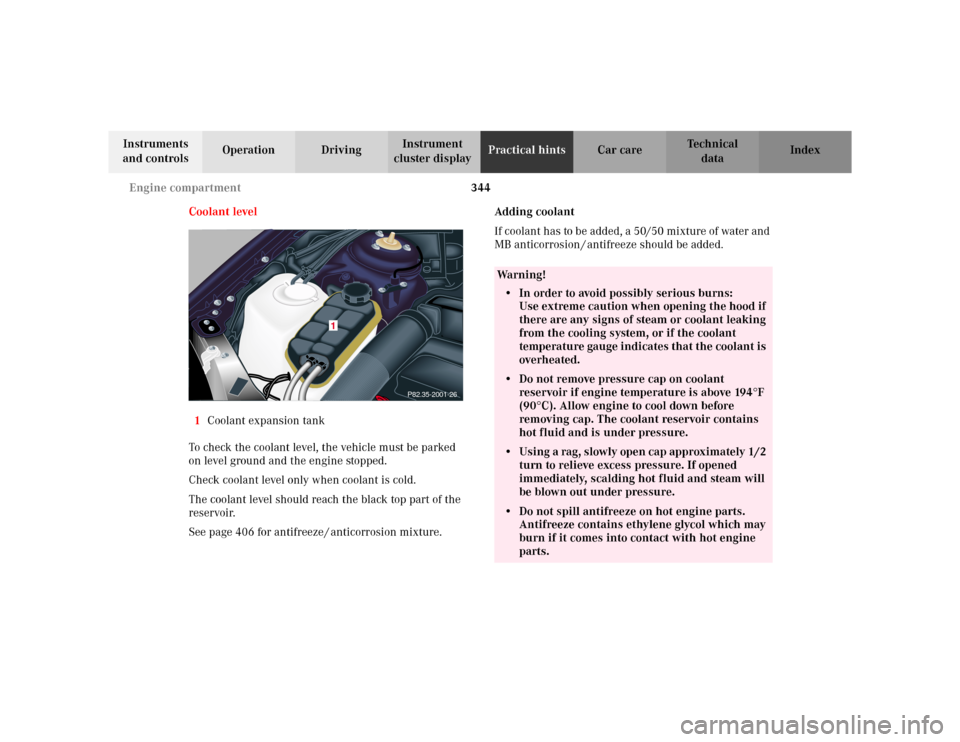
Coolant level
1Coolant expansion tank
To check the coolant level, the vehicle must be parked
on level ground and the engine stopped.
Check coolant level only when coolant is cold.
The coolant level should reach the black top part of the
reservoir.
See page 406 for antifreeze / anticorrosion mixture.Adding coolant
If coolant has to be added, a 50/50 mixture of water and
MB anticorrosion / antifreeze should be added.
P82.35-2001-26
1
Wa r n i n g !
• In order to avoid possibly serious burns:
Use extreme caution when opening the hood if
there are any signs of steam or coolant leaking
from the cooling system, or if the coolant
temperature gauge indicates that the coolant is
overheated.• Do not remove pressure cap on coolant
reservoir if engine temperature is above 194
°F
(90
°C). Allow engine to cool down before
removing cap. The coolant reservoir contains
hot fluid and is under pressure.
• Using a rag, slowly open cap approximately 1/2
turn to relieve excess pressure. If opened
immediately, scalding hot fluid and steam will
be blown out under pressure.• Do not spill antifreeze on hot engine parts.
Antifreeze contains ethylene glycol which may
burn if it comes into contact with hot engine
parts.
Page 419 of 430
416 Index
Te ch n i c a l
data Instruments
and controlsOperation DrivingInstrument
cluster displayPractical hints Car careIndex
Heated seats ..................................................................... 71
High beams
See Combination switch .......................................... 162
Hood ................................................................................. 339
HOOD - malfunction and warning messages ............ 326
IIdentification labels ....................................................... 393
Illuminated vanity mirrors ........................................... 195
Indicator lamps in the instrument cluster ................. 302
Individual settings ......................................................... 138
INST. CLUSTER (Instrument cluster) ..................... 140
LIGHTING ................................................................... 142
VEHICLE .................................................................... 146
Infant and child restraint systems ................................ 99
Installation ................................................................. 101
Information call
See Tele Aid ............................................................... 223
Infrared reflecting windshield .................................... 214
Inside rear view mirror ................................................. 103
Instrument cluster ..........................................................112
Activating ....................................................................114
Illumination ................................................................114
Indicator lamps .................................................112, 302Instruments and controls ............................................... 18
Interior
General notes ............................................................. 196
Interior lighting .............................................................. 190
Rear reading lamp ..................................................... 191
JJack .................................................................................. 347
Jump starting ................................................................. 359KKEY - malfunction and warning messages ............... 325
Key dependent memory settings ..................................111
KEYLESS-GO .....................................................................36
Changing batteries ................................................... 374
Checking last KEYLESS-GO-card locking mode ..... 41
Choosing global or selective mode ........................... 41
Starting the engine .................................................. 236
Turning off the engine ............................................ 236
KEYLESS-GO-card ..................................................... 28, 30
Keys, changing battery .................................................. 371
Keys, vehicle .....................................................................28
