2002 MERCEDES-BENZ S430 EGR
[x] Cancel search: EGRPage 4 of 430

1 Contents
IntroductionProduct information .......................... 7
Operator’s manual ............................. 8
Where to find it ................................ 13
Reporting Safety Defects ................ 15Instruments and controlsInstruments and controls ............... 18
Door control panel ....................... 20
Overhead control panel ............... 21
Dashboard ..................................... 22
Center console .............................. 24OperationVehicle keys ...................................... 28
Start lock-out .................................... 31
General notes on the
central locking system ............... 32
Central locking system ................... 33
Radio frequency and
infrared remote control ............... 33
KEYLESS-GO ................................. 36Opening and closing windows
and sliding / pop-up roof
from outside ................................. 43
Panic button ................................. 45
Mechanical keys .......................... 45
Doors ................................................. 46
Power closing assist for
doors and trunk lid .................... 48
Central locking switch .................... 48
Automatic central locking .............. 50
Emergency unlocking in
case of accident .......................... 50
Trunk ..................................................51
Trunk lamp ....................................... 54
Trunk lid release switch ................ 55
Trunk lid release/close switch ...... 56
Trunk lid emergency release ........ 59
Antitheft alarm system ................... 60
Tow-away alarm ................................ 61
Easy-entry/exit feature .................. 63
Front seat adjustment ..................... 64
Removal and installation of
front seat head restraints .......... 68
Lumbar support ............................... 69Multicontour backrest ..................... 69
Seat heater ........................................ 71
Seat ventilation system ................... 74
Rear seat head restraints ................ 76
Power head restraints, rear ............ 77
Power seats, rear .............................. 78
Power seats, setting passenger
seat position from rear ............... 80
Seat belts and integrated
restraint system .......................... 81
Seat belts ........................................... 81
Seat belt nonusage
warning system ........................... 82
BabySmart
TM airbag
deactivation system .................... 88
Self-test BabySmart
TM without
special child seat installed ......... 88
Supplemental Restraint
System (SRS) ............................... 89
Emergency tensioning
retractor (ETR) ............................. 90
Airbags .............................................. 91
Page 29 of 430

26 Contents – Operation
Te ch n i c a l
data Instruments
and controlsOperationDrivingInstrument
cluster displayPractical hints Car care Index
OperationVehicle keys ...................................... 28
Start lock-out .................................... 31
General notes on the
central locking system ............... 32
Central locking system ................... 33
Radio frequency and
infrared remote control ............... 33
KEYLESS-GO ................................. 36
Opening and closing windows
and sliding / pop-up roof
from outside .................................. 43
Panic button .................................. 45
Mechanical keys ........................... 45
Doors .................................................. 46
Power closing assist for
doors and trunk lid ..................... 48
Central locking switch .................... 48
Automatic central locking .............. 50
Emergency unlocking in
case of accident ........................... 50
Trunk ................................................. 51
Trunk lamp ....................................... 54Trunk lid release switch ................ 55
Trunk lid release/close switch ...... 56
Trunk lid emergency release ........ 59
Antitheft alarm system ................... 60
Tow-away alarm ................................ 61
Easy-entry/exit feature .................. 63
Front seat adjustment ..................... 64
Removal and installation of
front seat head restraints .......... 68
Lumbar support ............................... 69
Multicontour backrest .................... 69
Seat heater ......................................... 71
Seat ventilation system ................... 74
Rear seat head restraints ................ 76
Power head restraints, rear ........... 77
Power seats, rear ............................. 78
Power seats, setting passenger
seat position from rear .............. 80
Seat belts and integrated
restraint system ...........................81
Seat belts ...........................................81
Seat belt nonusage
warning system .......................... 82BabySmart
TM airbag
deactivation system .................... 88
Self-test BabySmart
TM without
special child seat installed ......... 88
Supplemental Restraint
System (SRS) ............................... 89
Emergency tensioning
retractor (ETR) ............................. 90
Airbags .............................................. 91
Safety guidelines for the
seat belt, emergency
tensioning retractor
and airbag .................................... 97
Infant and child
restraint systems ......................... 99
Steering wheel adjustment .......... 102
Rear view mirrors .......................... 103
Memory function ........................... 108
Key dependent
memory settings ........................ 111
Instrument cluster ..........................112
Multifunction steering wheel,
multifunction display ................118
Page 31 of 430
28 Central locking system
Te ch n i c a l
data Instruments
and controlsOperationDrivingInstrument
cluster displayPractical hints Car care Index
Vehicle keys and KEYLESS-GO-cards (optional)
Included with your vehicle are:
•2 electronic keys with integrated radio frequency
and infrared remote controls plus removable
mechanical key.
The locking tabs for the mechanical key portion of
the two electronic keys are a different color to help
distinguish each individual key.
•Vehicles with KEYLESS-GO:
2 KEYLESS-GO-cards without removable mechanical
key.Vehicles with KEYLESS-GO:
See page 42 on how to use the electronic key together
with the KEYLESS-GO-card.
Important!
In the case of the loss of a KEYLESS-GO-card, electronic
keys or mechanical keys, please, contact an authorized
Mercedes-Benz Center or call 1-800-FOR-MERCedes (in
the USA), or 1-800-387-0100 (in Canada) as soon as
possible to have the keys or KEYLESS-GO-card
deactivated.
Wa r n i n g !
When leaving the vehicle always remove the
electronic key from the starter switch, and lock
your vehicle. Do not leave children unattended in
the vehicle, or with access to an unlocked vehicle.
Unsupervised use of vehicle equipment may cause
serious personal injury.
Page 32 of 430
29 Central locking system
Te ch n i c a l
data Instruments
and controlsOperationDrivingInstrument
cluster displayPractical hints Car care Index Electronic key
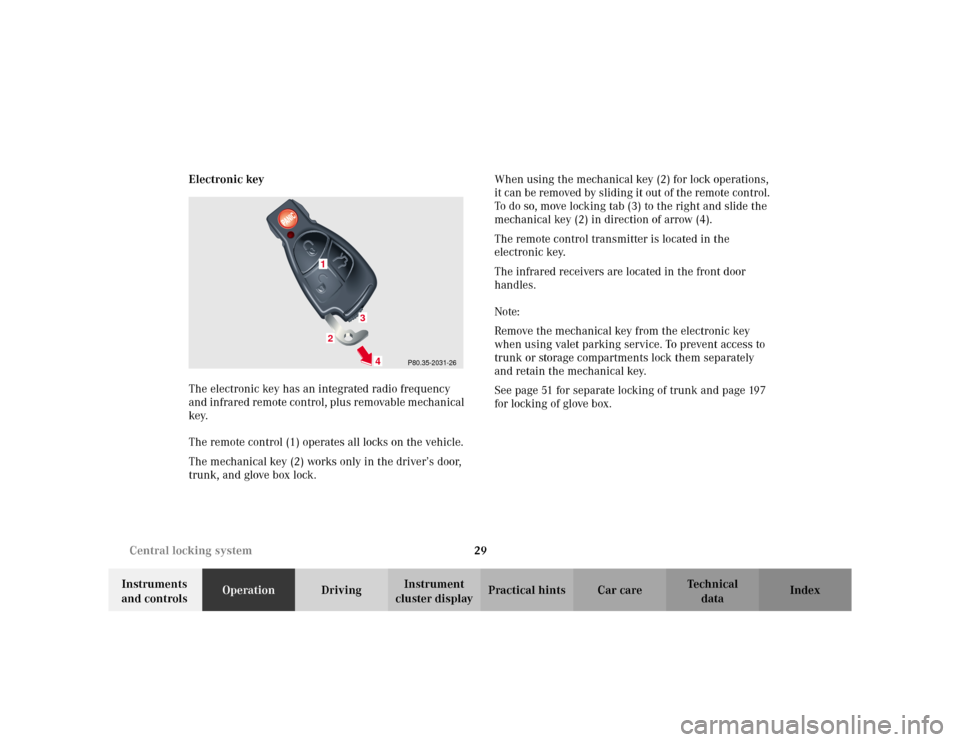
The electronic key has an integrated radio frequency
and infrared remote control, plus removable mechanical
key.
The remote control (1) operates all locks on the vehicle.
The mechanical key (2) works only in the driver’s door,
trunk, and glove box lock.When using the mechanical key (2) for lock operations,
it can be removed by sliding it out of the remote control.
To do so, move locking tab (3) to the right and slide the
mechanical key (2) in direction of arrow (4).
The remote control transmitter is located in the
electronic key.
The infrared receivers are located in the front door
handles.
Note:
Remove the mechanical key from the electronic key
when using valet parking service. To prevent access to
trunk or storage compartments lock them separately
and retain the mechanical key.
See page 51 for separate locking of trunk and page 197
for locking of glove box.
P80.35-2031-26
1
3
4
2
Page 36 of 430

33 Central locking system
Te ch n i c a l
data Instruments
and controlsOperationDrivingInstrument
cluster displayPractical hints Car care Index Central locking system
Radio frequency and infrared remote control
The electronic key has an integrated radio frequency
and infrared remote control.
Due to the extended operational range of the remote
control, it could be possible to unintentionally lock or
unlock the vehicle by pressing the transmit button. If
one of the transmit buttons is pressed, the battery check
lamp lights up briefly – indicating that the batteries are
in order. See page 371 for checking batteries.
The vehicle doors, trunk and fuel filler flap can be
centrally locked and unlocked via remote control.
Opening and closing the windows and sliding/pop-up
roof and switching on the driver’s seat ventilation can
only be done with the infrared portion of the remote
control. Aim transmitter eye at a receiver (6 or 7), press
and hold transmit button Œor ‹, seepage43.
With vehicle centrally locked, the trunk can also be
opened by using the remote control.
If the electronic key is inserted in starter switch, the
vehicle cannot be locked or unlocked, and the trunk lid
cannot be opened with the remote control.1Transmit button
‹ Locking
ΠUnlocking
Š Opening trunk (if not separately locked)
2Lamp for battery check (see page 371 for changing
batteries if it does not light up briefly)
3PANIC button
4Transmitter eye
5Locking tab for mechanical key
P80.35-2032-26
24
3
5
1
Page 84 of 430
81 Restraint systems
Te ch n i c a l
data Instruments
and controlsOperationDrivingInstrument
cluster displayPractical hints Car care Index Seat belts and integrated restraint system
Your vehicle is equipped with seat belts for all seats,
emergency tensioning retractors for all outboard seat
belts, dual front airbags, side impact airbags for driver,
front and outer rear passengers, and head protective
window curtain airbags. Their protective functions are
designed to complement one another.
Seat belts
Important!
Laws in most states and all Canadian provinces require
seat belt use.
All states and provinces require use of child restraints
that comply with U.S. Federal Motor Vehicle Safety
Standard 213 and Canadian Motor Vehicle Safety
Standard 213.
All child restraints systems are designed to be secured
in vehicle seats by lap belts or the lap belt portion of a
lap-shoulder belt.
For your safety and that of your passengers we strongly
recommend their use.
Wa r n i n g !
Children 12 years old and under must never ride in
the front seat, except in a Mercedes-Benz
authorized BabySmart
TM compatible child seat,
which operates with the BabySmart
TM system
installed in the vehicle to deactivate the passenger-
side front airbag when it is properly installed.
Otherwise they will be struck by the airbag when it
inflates in a crash. If this happens, serious or fatal
injury will result.
According to accident statistics, children are safer
when properly restrained in the rear seating
positions than in the front seating positions.
Infants and small children must ride in back seats
and be seated in an appropriate infant or child
restraint system, which is properly secured with
the vehicle’s seat belt, fully in accordance with the
child seat manufacturer’s instructions.A child’s risk of serious or fatal injuries is
significantly increased if the child restraints are
not properly secured in the vehicle and the child is
not properly secured in the child restraint.
Page 89 of 430
86 Restraint systems
Te ch n i c a l
data Instruments
and controlsOperationDrivingInstrument
cluster displayPractical hints Car care Index
Wa r n i n g !
USE SEAT BELTS PROPERLY.• Seat belts can only work when used properly.
Never wear seat belts in any other way than as
described in this section, as that could result
in serious injuries in case of an accident.• E ach oc c upan t s houl d wear t hei r s ea t bel t a t al l
times, because seat belts help reduce the
likelihood of and potential severity of injuries
in accidents, including rollovers. The
integrated restraint system includes “SRS”
(driver airbag, front passenger airbag, side
impact airbags, head protection window
curtain airbags for side windows), “ETR” (seat
belt emergency tensioning retractors), and
front knee bolsters. The system is designed to
enhance the protection offered to properly
belted occupants in certain frontal (front
airbags) and side (side impact and window
curtain airbags) impacts which exceed preset
deployment thresholds.
• Never wear the shoulder belt under your arm,
against your neck or off your shoulder. In a
crash, your body would move too far forward.
That would increase the chance of head and
neck injuries. The belt would also apply too
much force to the ribs or abdomen, which
could severely injure internal organs such as
your liver or spleen.• Never wear belts over rigid or breakable
objects in or on your clothing, such as
eyeglasses, pens, keys etc., as these might
cause injuries.• Position the lap belt as low as possible on your
hips and not across the abdomen. If the belt is
positioned across your abdomen, it could cause
serious injuries in a crash.• Each seat belt should never be used for more
than one person at a time. Do not fasten a seat
belt around a person and another person or
other objects.• Belts should not be worn twisted. In a crash,
you wouldn’t have the full width of the belt to
manage impact forces. The twisted belt against
your body could cause injuries.
Page 165 of 430
162 Combination switch
Te ch n i c a l
data Instruments
and controlsOperationDrivingInstrument
cluster displayPractical hints Car care Index
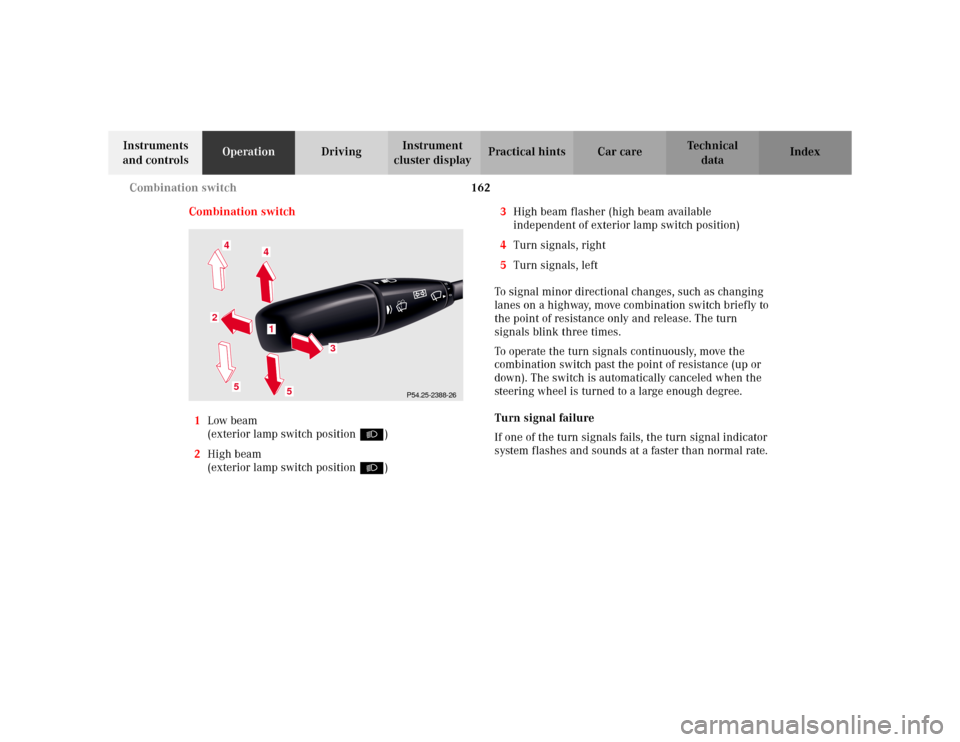
Combination switch
1Low beam
(exterior lamp switch position B)
2High beam
(exterior lamp switch position B)3High beam flasher (high beam available
independent of exterior lamp switch position)
4Turn signals, right
5Turn signals, left
To signal minor directional changes, such as changing
lanes on a highway, move combination switch briefly to
the point of resistance only and release. The turn
signals blink three times.
To operate the turn signals continuously, move the
combination switch past the point of resistance (up or
down). The switch is automatically canceled when the
steering wheel is turned to a large enough degree.
Turn signal failure
If one of the turn signals fails, the turn signal indicator
system flashes and sounds at a faster than normal rate.
P54.25-2388-26
5
2
1
4
3
4
5