Page 300 of 350
297 Rear seat cushion
Technical
data Instruments
and controlsOperation DrivingInstrument
cluster displayPractical hintsCar care Index Rear seat cushionRemoval:
Pull locking tabs up (on left and right side of seat) and
lift seat at the front.
Installation:
Guide seat belt buckles through openings in seat
cushion. Slide rear edge of cushion under the backrest
as far as it will go, and push front of cushion down until
it locks in place.
Caution!
Watch out for sharp edges when removing or installing
the rear seat cushion, and make sure that it is securely
locked in place again, to prevent personal injury.
P91.12-2193-26
W210.book Seite 297 Mittwoch, 30. Mai 2001 11:45 11
Page 301 of 350
298 Emergency operation of sliding / pop-up roof
Technical
data Instruments
and controlsOperation DrivingInstrument
cluster displayPractical hintsCar care Index
Emergency operation of sliding / pop-up roof
The sliding / pop-up roof can be opened or closed
manually should an electrical malfunction occur.
The sliding/pop-up roof drive is located behind the lens
of the left interior lamp between the sun visors.
1. Pry off lens (1) by using a screw driver.
2. Remove cover (2).
3. Obtain crank (3) (supplied with vehicle) and insert
it through hole.To slide the roof closed or to raise the roof at the rear:
turn crank clockwise.
To slide the roof open or to lower the roof at the rear:
turn crank counterclockwise.
Note:
Push crank upward while turning it, to disengage the
electric motor.
1
P77.20-2037-26
W210.book Seite 298 Mittwoch, 30. Mai 2001 11:45 11
Page 302 of 350
299 Manual release for fuel filler flap
Technical
data Instruments
and controlsOperation DrivingInstrument
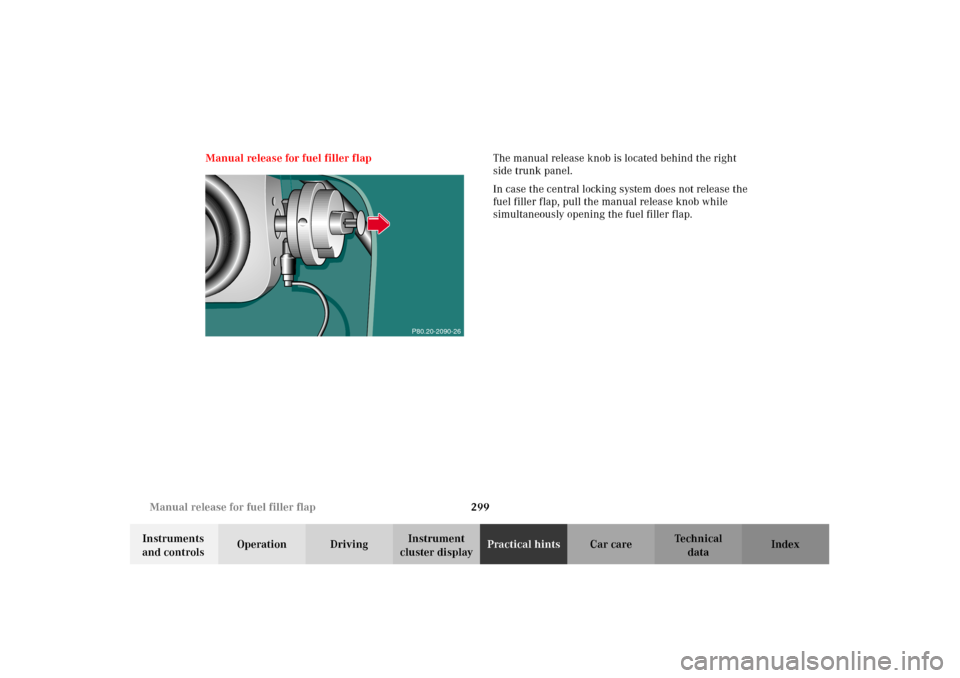
cluster displayPractical hintsCar care Index Manual release for fuel filler flapThe manual release knob is located behind the right
side trunk panel.
In case the central locking system does not release the
fuel filler flap, pull the manual release knob while
simultaneously opening the fuel filler flap.
P80.20-2090-26
W210.book Seite 299 Mittwoch, 30. Mai 2001 11:45 11
Page 303 of 350
300 Replacing wiper blade insert
Technical
data Instruments
and controlsOperation DrivingInstrument
cluster displayPractical hintsCar care Index
Replacing wiper blade insert
For safety reasons, remove electronic key from steering
lock before replacing the wiper blade, otherwise the
motor can suddenly turn on and cause injury.
Notes:
Do not open engine hood with wiper arm folded forward.
Do not allow the wiper arm to contact the windshield
glass without a wiper blade inserted. The glass may be
scratched or broken.
Make certain that the wiper blade is properly installed.
An improperly installed wiper blade may cause
windshield damage.
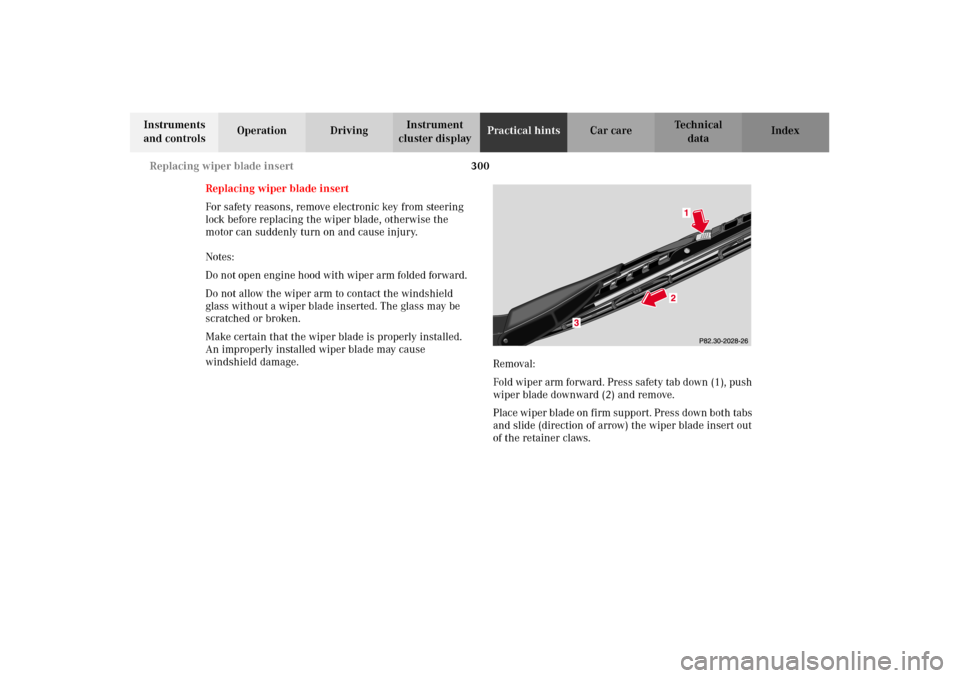
Removal:
Fold wiper arm forward. Press safety tab down (1), push
wiper blade downward (2) and remove.
Place wiper blade on firm support. Press down both tabs
and slide (direction of arrow) the wiper blade insert out
of the retainer claws.
W210.book Seite 300 Mittwoch, 30. Mai 2001 11:45 11
Page 304 of 350
301 Replacing wiper blade insert
Technical
data Instruments
and controlsOperation DrivingInstrument
cluster displayPractical hintsCar care Index Installation:
Slide (direction of arrow) wiper blade insert into
retainer claws until tabs are engaged.
Insert wiper blade between tabs (3) on the wiper arm,
and slide into end of wiper arm. Press safety tab upward
until it locks in place.
W210.book Seite 301 Mittwoch, 30. Mai 2001 11:45 11
Page 305 of 350
302 Roof rack
Technical
data Instruments
and controlsOperation DrivingInstrument
cluster displayPractical hintsCar care Index
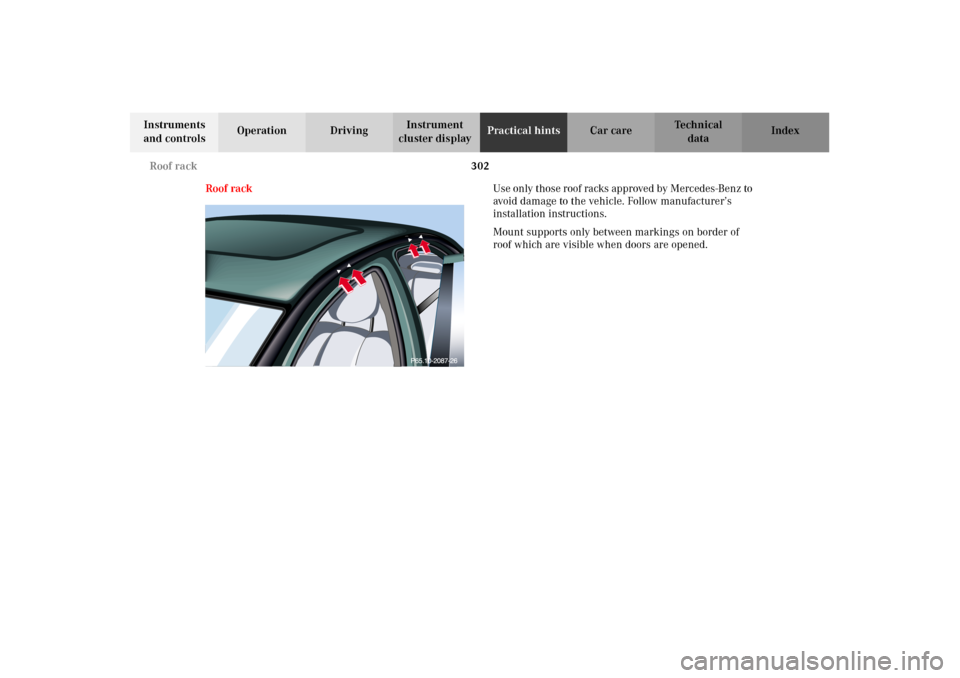
Roof rackUse only those roof racks approved by Mercedes-Benz to
avoid damage to the vehicle. Follow manufacturer’s
installation instructions.
Mount supports only between markings on border of
roof which are visible when doors are opened.
W210.book Seite 302 Mittwoch, 30. Mai 2001 11:45 11
Page 306 of 350

303 Contents – Vehicle care
Technical
data Instruments
and controlsOperation DrivingInstrument
cluster displayPractical hintsCar careIndex
Vehicle careCleaning and care
of the vehicle .............................304
Power washer ..............................305
Tar stains .....................................305
Paintwork, painted body
components .................................305
Engine cleaning ..........................306
Vehicle washing .........................306
Ornamental moldings ................306
Headlamps, taillamps,
turn signal lenses ......................306
Cleaning the parktronic
system sensors ...........................307Window cleaning /
glass sunroof .............................. 307
Wiper blades .............................. 307
Light alloy wheels ..................... 308
Instrument cluster ..................... 308
Steering wheel and
gear selector lever ..................... 308
Cup holder .................................. 308
Seat belts ..................................... 308
Headliner and shelf
below rear window .................... 308
Upholstery .................................. 309
Hard plastic trim items ............. 309
Plastic and rubber parts ........... 309
W210.book Seite 303 Mittwoch, 30. Mai 2001 11:45 11
Page 307 of 350
304 Cleaning and care of the vehicle
Technical
data Instruments
and controlsOperation DrivingInstrument
cluster displayPractical hintsCar careIndex
Cleaning and care of the vehicle
In operation, your vehicle is subjected to varying
external influences which, if gone unchecked, can
attack the paintwork as well as the underbody and
cause lasting damage.
Such damage is caused not only by extreme and varying
climatic conditions, but also by air polution, road salt,
tar, gravel and stone chipping. Grease and oil, fuel,
coolant, brake fluid, bird droppings, insects, tree resins
etc. should be removed immediately to avoid paint
damage. Frequent washing reduces and/or eliminates
the aggressiveness and potency of the above adverse
influences.More frequent washings are necessary to deal with
unfavorable conditions; for example, near the ocean, in
industrial areas (smoke, exhaust emissions), or during
winter operation.
You should check your vehicle from time to time for
stone chipping or other damage. Any damage should be
repaired as soon as possible to prevent the start of
corrosion.
In doing so, do not neglect the underside of the vehicle.
A prerequisite for a thorough check is a washing of the
underbody followed by a thorough inspection. Damaged
areas need to be reundercoated.
Your vehicle has been treated at the factory with a wax-
base rustproofing in the body cavities which will last for
the lifetime of the vehicle. Post-production treatment is
neither necessary nor recommended by Mercedes-Benz
because of the possibility of incompatibility between
materials used in the production process and others
applied later.
We have selected car-care products and compiled
recommendations which are specially matched to our
vehicles and which always reflect the latest technology.
You can obtain Mercedes-Benz approved car-care
products at your authorized Mercedes-Benz Center.
Wa r n i n g !
Many cleaning products can be hazardous. Some
are poisonous, others are flammable. Always follow
the instructions on the particular container.
Always open your vehicle’s doors or windows when
cleaning the inside.Never use fluids or solvents that are not designed
for cleaning your vehicle.
W210.book Seite 304 Mittwoch, 30. Mai 2001 11:45 11